
A DWI arrest can be overwhelming—but you don’t have to face it alone. Deciding whether to refuse a breathalyzer is one of the most high-stakes choices you can make during a traffic stop, and it has immediate, significant consequences. On one hand, refusing denies the prosecution a key piece of scientific evidence against you—your exact Blood Alcohol Concentration (BAC). On the other, it triggers an automatic driver's license suspension under Texas law. This is where a tough situation gets complicated, fast.
The Critical Decision Every Texas Driver Faces
Getting pulled over for a suspected DWI is an incredibly stressful experience. The flashing lights in your rearview mirror, the officer’s pointed questions, and the sudden demand to take a chemical test all create immense pressure. In that moment, you’re forced to make a snap judgment that will set the entire tone for what comes next.
Your choice isn’t just about the criminal charge. It also kicks off a separate, immediate civil process that puts your driving privileges on the line. Understanding that you’re suddenly fighting a battle on two fronts is the first step toward building a smart defense.
Two Cases, Not One: The Criminal Charge and the License Suspension
When you're arrested for DWI in Texas and refuse a breathalyzer, you don't just have one legal problem—you have two distinct challenges running on parallel tracks:
- The Criminal Case: This is where the State of Texas will try to prove you were intoxicated while operating a vehicle. The potential penalties here range from hefty fines and probation to jail time.
- The Administrative Case: This is a civil case handled by the Texas Department of Public Safety (DPS), and it has nothing to do with guilt or innocence. It’s all about your driver's license. Refusing the breath test automatically triggers this process, known as an Administrative License Revocation (ALR).
You only have 15 days from the date of your arrest to request an ALR hearing and fight the automatic suspension of your license. If you miss this deadline, you forfeit your right to challenge it, and your license will be suspended without a fight.
Texas DWI Laws Explained: Understanding Implied Consent
So, how can the state just take your license for saying "no" to a test? The answer lies in a legal principle called "implied consent." When you accepted your Texas driver's license, you implicitly agreed to provide a breath or blood sample if you are lawfully arrested for driving while intoxicated.
By refusing, you are breaking that agreement. This gives the state the right to administratively suspend your license, regardless of whether you are ever convicted of DWI. This is a crucial point—the license suspension is a civil penalty for the refusal itself, completely separate from any criminal punishment. An experienced Houston DWI lawyer can represent you in both criminal court and the ALR hearing, making sure your rights are protected on both fronts.
At a Glance: Refusing vs. Submitting to a Breathalyzer
Making a decision under pressure is tough. This table breaks down the immediate consequences of your choice during a Texas DWI stop to give you a clearer picture.
| Your Choice | Immediate Consequence (Administrative) | Potential Impact (Criminal Case) |
|---|---|---|
| Refuse the Test | Automatic license suspension process (ALR) begins. You have 15 days to request a hearing. | The prosecution has no scientific BAC evidence. However, the refusal can be used against you as evidence of "consciousness of guilt." |
| Submit to the Test | No automatic ALR suspension unless your BAC is 0.08 or higher. | The prosecution has a specific BAC number to use as evidence. If it's over the limit, it's a powerful piece of evidence for them. |
Ultimately, there's no single "right" answer for every situation. The best choice depends on the specific facts of your case, but understanding the two separate battles you'll face is absolutely essential for a strong defense.
How Implied Consent Law Works in Texas
When you get your Texas driver's license, you enter into an agreement with the state. A key part of that agreement is Implied Consent. By accepting the privilege of driving on Texas roads, you have already—in the eyes of the law—agreed to provide a breath or blood sample if a police officer lawfully arrests you for driving while intoxicated. This isn't a new decision you make on the side of the road; it's a condition you accepted when you got your license.
What Is a Lawful Arrest?
An officer can't just pull you over and demand a test out of the blue. The implied consent law only kicks in after a lawful arrest for DWI. For an arrest to be lawful, the officer must have probable cause—a solid, reasonable belief based on facts that you've been driving while intoxicated.
Probable cause isn't just a hunch. It's built from evidence gathered during the traffic stop, such as:
- The reason for the traffic stop (e.g., swerving or speeding).
- Your physical appearance, such as having bloodshot eyes or slurred speech.
- Anything you might have said about drinking.
- Your performance on any Standardized Field Sobriety Tests (SFSTs).
If the officer has enough evidence to establish probable cause and places you under arrest, their request for a breath or blood sample is now backed by the implied consent law.
The Consequences Are Administrative, Not Criminal
This is a critical point. The penalty for refusing a breathalyzer isn't a criminal charge. It’s an administrative penalty, handled entirely by the Texas Department of Public Safety (DPS). Because you broke your "agreement" to provide a sample, the DPS has the power to suspend your license through a process called an Administrative License Revocation (ALR).
This suspension can happen even if your criminal DWI case is eventually dismissed or you’re found not guilty. The ALR hearing and the criminal trial are two separate legal battles. The outcome of one doesn't dictate the outcome of the other.
Understanding this dual-track system is essential. For a deeper dive, you can learn more about how Texas' implied consent laws work and what it means for your case. By refusing the test, you create an immediate civil problem for your driver's license, but you also change the evidence in your criminal case, making the prosecutor's job more difficult.
Navigating Your Two Legal Battles After a DWI Arrest
Getting arrested for a DWI in Texas doesn't just start one legal problem—it kicks off two of them at the same time. One of the most important things you can do right away is understand the difference between these two battles, especially if you refused to take a breathalyzer.
The Criminal Case: Your Freedom at Stake
In your criminal DWI case, a prosecutor must prove you are guilty of DWI beyond a reasonable doubt. If you gave a breath or blood sample, that BAC number would be their star witness.
But if you refused the breathalyzer, their job gets harder. Without a concrete BAC number, they must build their case on more subjective evidence, like the officer’s testimony about your driving, your appearance, and your performance on field sobriety tests. While this weakens their position, prosecutors will argue your refusal shows “consciousness of guilt,” suggesting you said no because you knew you were intoxicated. A strategic Texas DUI attorney knows how to dismantle this argument and challenge the officer's subjective observations.
This flowchart shows how implied consent connects getting a license to the demand for a chemical test.
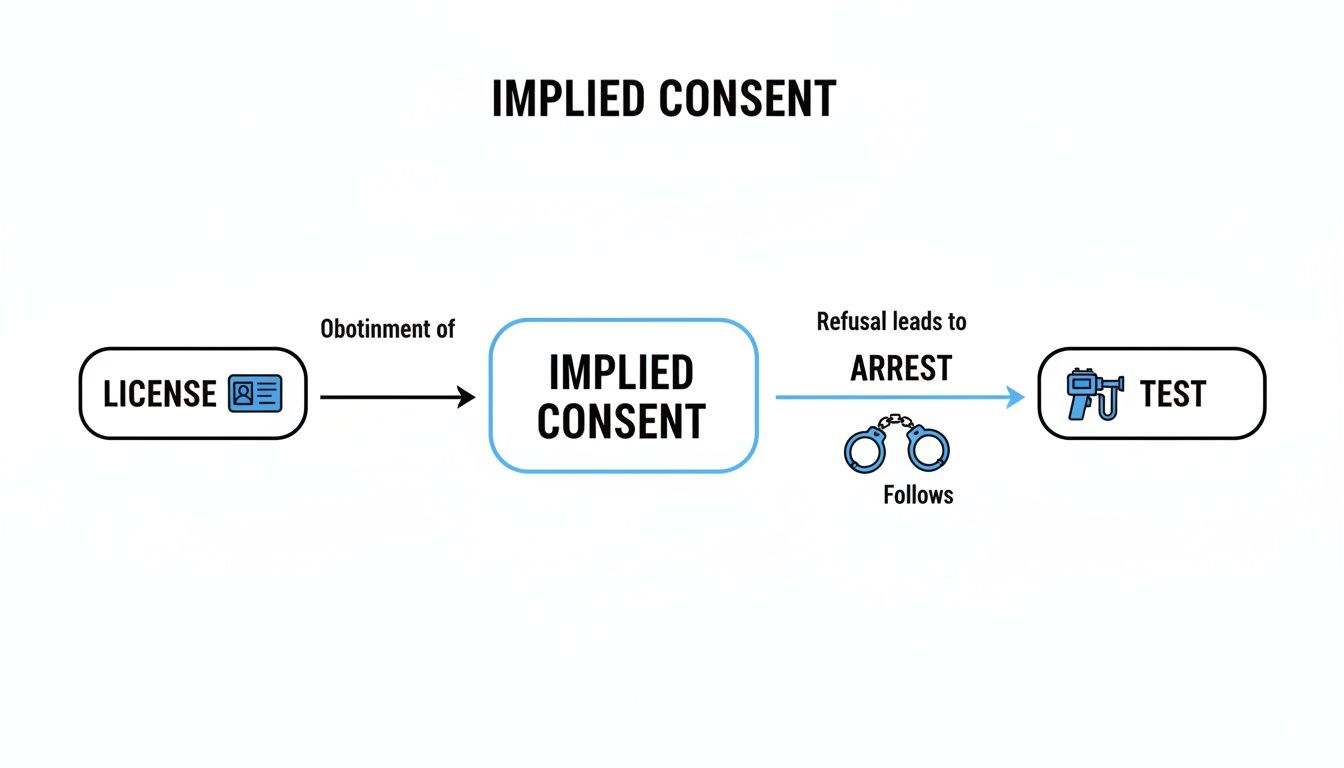
As you can see, the moment you start driving in Texas, you've legally agreed to comply with a chemical test if you're lawfully arrested for DWI.
The Administrative Case: Your License on the Line
When you refuse a breathalyzer, you automatically trigger the ALR process. This is the direct penalty for breaking Texas's implied consent law. The DPS immediately starts the process of suspending your driver's license.
Crucially, you have only 15 days from the date of your arrest to request an ALR hearing. If you miss this deadline, your license is suspended automatically. No second chances.
This is a trap many people fall into. For a first DWI in Texas, refusing the breathalyzer leads to an automatic 180-day license suspension if you don't fight it. If you have prior offenses, that suspension can stretch up to two years.
The ALR hearing is your one and only chance to stop that suspension. At the hearing, your lawyer can cross-examine the officer and challenge whether they had a valid reason to pull you over and probable cause to arrest you. To prepare, you need to understand the Administrative License Revocation process in Texas and see how an attorney can protect you. A skilled DWI lawyer is essential because they can fight for you in both arenas—working to protect your freedom in criminal court while simultaneously battling to save your driving privileges.
Weighing the Strategic Pros and Cons of Refusal
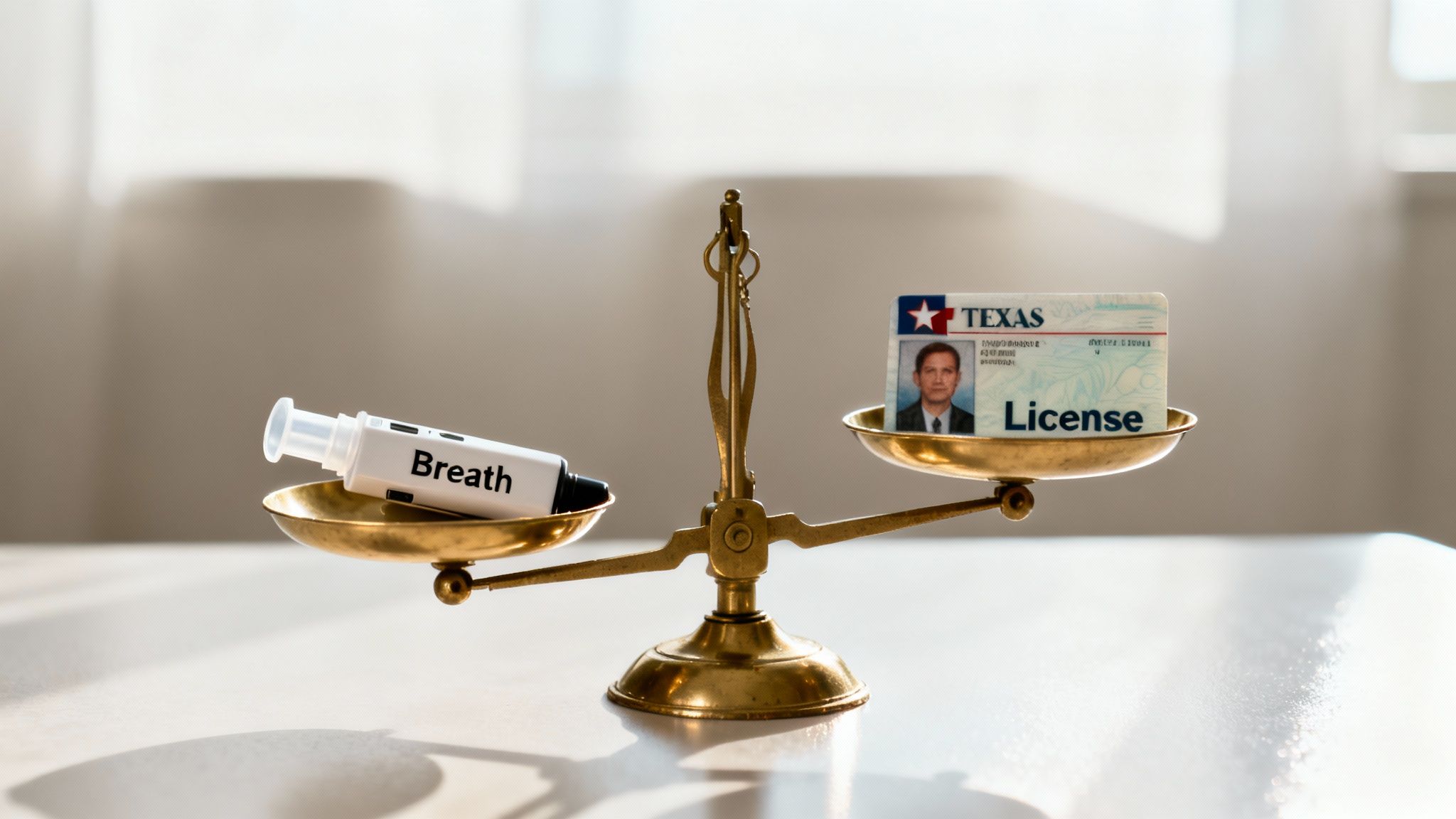
When an officer asks you to take a breathalyzer, you’re put on the spot to make a strategic choice with serious, long-term consequences. This isn't a simple question of "right" or "wrong"—it's a calculated risk with guaranteed trade-offs. The best path forward always depends on the unique facts of your situation.
The Big "Pro": Denying the State's Best Evidence
The primary advantage of refusing a breathalyzer is straightforward: You deny the prosecution its most powerful piece of evidence. A specific Blood Alcohol Concentration (BAC) number is like a smoking gun for the State. It’s scientific and tough to argue with in front of a jury.
Without that number, the prosecutor's case gets instantly weaker. They must build their entire argument on the officer’s subjective observations—your driving pattern, your physical appearance, and how you performed on the Standardized Field Sobriety Tests (SFSTs). This is where a skilled Houston DWI lawyer can make a huge difference by challenging this subjective evidence and offering jurors alternative, common-sense explanations.
The Guaranteed Downsides of Refusing
While the potential upside of refusal is significant, the consequences are immediate and automatic. These aren't possibilities; they are guaranteed outcomes.
Here are the main consequences:
- Automatic License Suspension: Your refusal immediately triggers the Administrative License Revocation (ALR) process. Your license will be suspended unless you act fast and successfully challenge it at an ALR hearing. You only have 15 days to request that hearing.
- Use of Refusal as Evidence: The prosecution will use your refusal against you in court, arguing that you refused because you knew you were guilty—what they call "consciousness of guilt."
- The Possibility of a Blood Warrant: Refusing a breathalyzer doesn't guarantee the police won't get your BAC. An officer can still get a search warrant from a judge and take you to a medical facility to have your blood drawn—by force, if necessary. If that happens, you end up with the worst of both worlds: a license suspension for the refusal and a BAC result for the criminal case.
A common misconception is that refusing the test means the state has no case. In reality, it just changes the type of evidence they will use against you. Your refusal becomes a central part of their narrative.
Texas DWI Penalties Explained: Administrative License Suspensions
This decision is about weighing a potential future benefit (a weaker criminal case) against an immediate, guaranteed penalty (license suspension).
The table below breaks down the specific administrative penalties for refusing a breathalyzer in Texas. Remember, these suspensions are completely separate from any criminal penalties you might face.
Texas License Suspension Penalties for Breathalyzer Refusal
| Offense History | License Suspension Period for Refusal |
|---|---|
| First DWI Offense | 180 days |
| One or More Prior DWI-Related Offenses | 2 years |
The administrative penalties are harsh. This is why it is so important to fight DWI Texas charges with a skilled attorney who understands both the criminal and administrative legal systems.
The Stakes Are Higher: Special Rules for CDL Holders and Young Drivers
While refusing a breathalyzer is a serious decision for anyone, the consequences skyrocket for two groups: professional drivers with a Commercial Driver's License (CDL) and anyone under the age of 21. For these individuals, a refusal isn't just about a potential criminal charge—it's about an immediate, career-altering administrative penalty.
A Career-Ending Move for CDL Holders?
For a professional truck driver, a DWI arrest can be a career death sentence. Texas holds CDL holders to a much higher standard. When you're behind the wheel of a commercial vehicle, the legal BAC limit is just .04%. But refusing a breathalyzer in any vehicle, even your personal car, triggers devastating penalties against your CDL.
- Automatic 1-Year Disqualification: On a first-time refusal, you face an automatic one-year disqualification of your commercial license.
- Lifetime Ban: If this is your second refusal or you have a prior offense, you could be facing a lifetime ban from ever holding a CDL again.
- No Occupational License: CDL holders cannot get an occupational license to keep driving their rig for work.
For professional drivers, the decision to refuse becomes incredibly complex.
Texas Has Zero Tolerance for Underage Drivers
For drivers under 21, Texas law is clear: there is a "Zero Tolerance" policy. It is illegal for a minor to drive with any detectable amount of alcohol in their system. This is a DUI (Driving Under the Influence), and the administrative penalties for refusing a breath test are just as strict. A minor who refuses to provide a sample for a first-time DUI offense faces an automatic 180-day license suspension.
You can learn more about the specific DUI penalties for minors in Texas to see the full picture of what you or your child might be facing.
For both CDL holders and underage drivers, a refusal creates an immediate administrative crisis. Protecting your license and your future requires an attorney who can fight on both fronts simultaneously.
Your Next Steps After a DWI Arrest and Refusal
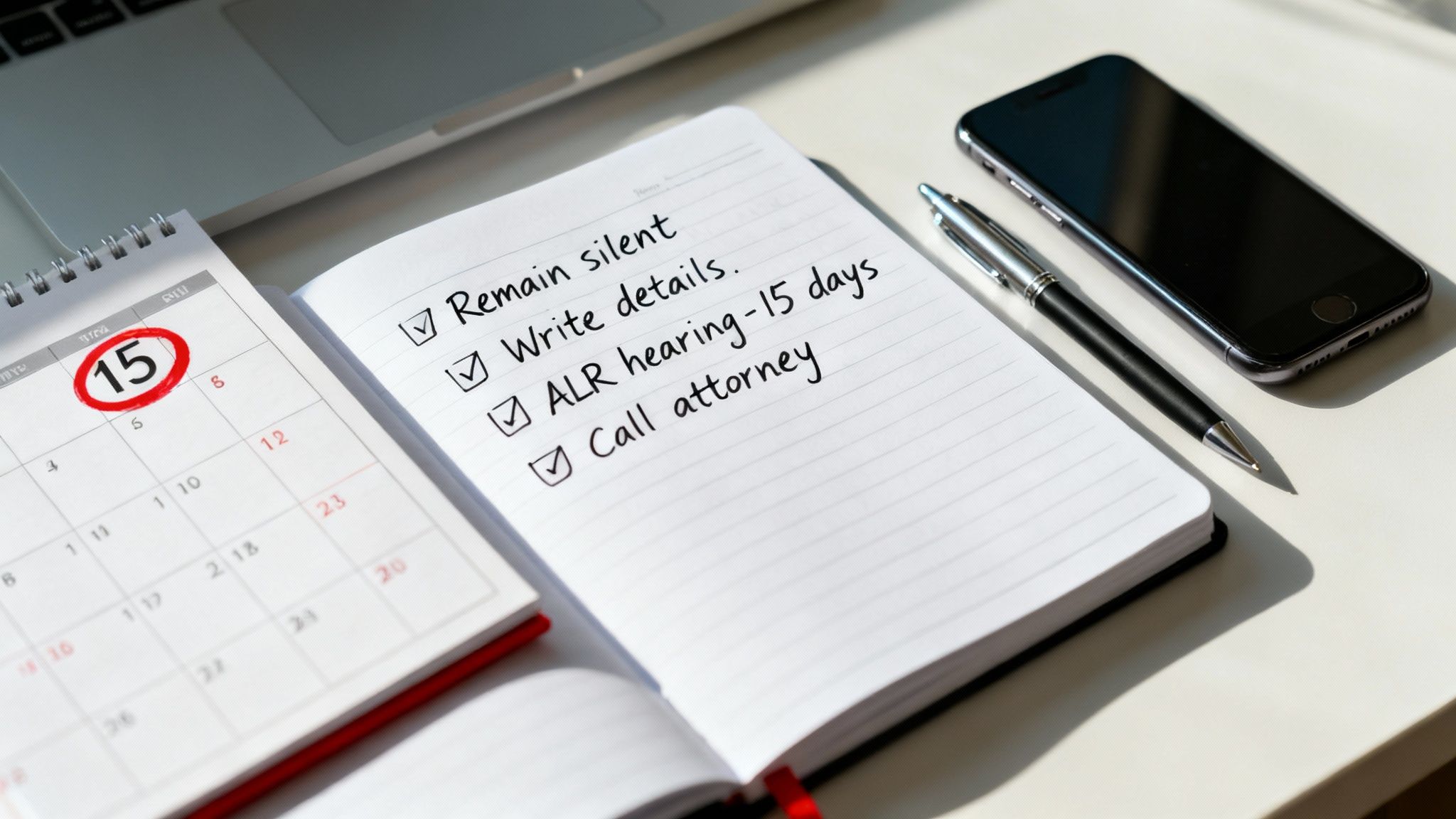
The moments after a DWI arrest are a blur of stress and confusion. It’s easy to feel powerless. But what you do in this critical window can make a massive difference. It’s time to take control, and that starts with knowing exactly what to do.
First, exercise your right to remain silent. You must provide basic identification, but that’s it. You do not have to answer questions about where you were, what you were drinking, or anything else. Simply and politely state that you wish to speak with an attorney and will not be answering any questions.
Document Everything You Can Remember
As soon as you can, write down everything you remember. Stressful memories fade fast, but the smallest details can become your biggest assets.
Make sure you include details like:
- The Initial Stop: Why did the officer pull you over? What reason did they give?
- Your Conversation: What did they ask? What did you say?
- The Environment: Note the weather conditions, lighting, and whether the ground was flat or sloped.
- Officer Conduct: Describe how the officer acted and what instructions they gave during any tests.
This account is a private record for you and your legal team. It’s often the key to spotting procedural mistakes that could be used to challenge the legality of the stop or the arrest itself.
A DWI arrest is overwhelming, but you don’t have to face it alone. Transforming anxiety into strategic action begins with these first steps, laying the groundwork for a strong legal defense.
The Most Important Deadline to Remember
Finally, there is one task that is more urgent than anything else: your driver's license. The moment you refused the breathalyzer, you kicked off a process to suspend your license. This administrative action moves fast.
You have only 15 days from the date of your arrest to formally request an Administrative License Revocation (ALR) hearing. If you miss this deadline, you automatically give up your right to fight the suspension.
The single best way to meet this deadline—and to protect your driving privileges—is to contact an experienced Houston DWI lawyer immediately. An attorney can file the ALR request for you, represent you at the hearing, and start building a comprehensive strategy to fight both the license suspension and the criminal DWI charge.
How a Houston DWI Attorney Can Defend Your Rights
Facing a DWI charge after refusing a breathalyzer can feel like an impossible battle. But it's a fight you don't have to take on alone. An experienced Houston DWI lawyer is your strategist, your advocate, and your guide. The moment you hire an attorney, the real work on your defense begins. We get started immediately, building a multi-faceted case designed to challenge the state at every turn and secure the best possible outcome.
Challenging the State's Case from the Start
A powerful defense starts by examining every detail of the traffic stop and arrest, searching for procedural mistakes and legal weaknesses.
Here’s how we fight for you:
- Contesting the Traffic Stop: Did the officer have a legally valid reason to pull you over? If they lacked reasonable suspicion, any evidence gathered afterward—including your refusal—could be thrown out of court.
- Questioning Probable Cause: We will scrutinize the officer’s report and any dashcam or bodycam footage to challenge whether they truly had enough probable cause to make an arrest.
- How to Fight a Breath Test Result (or Refusal): We analyze Field Sobriety Test performance. These tests are notoriously subjective and are frequently administered incorrectly. We know how to expose an officer's errors and highlight environmental factors that could have affected your performance.
By deconstructing the state's evidence piece by piece, we create the leverage needed to negotiate for a reduced charge or, in some cases, a complete dismissal.
A DWI arrest can be overwhelming—but you don’t have to face it alone. The right legal team provides the reassurance and expert guidance necessary to protect your rights, your freedom, and your future.
Fighting for Your License at the ALR Hearing
While building your criminal defense, we are simultaneously fighting to save your driver's license. You only have 15 days to request an Administrative License Revocation (ALR) hearing. We handle this for you, ensuring the deadline isn't missed.
This hearing is a critical opportunity. We can put the arresting officer on the stand, cross-examine them under oath, and lock them into their story. It’s an invaluable chance to uncover facts and inconsistencies that can be used to your advantage in the criminal case. Winning the ALR hearing not only saves your license but can deal a significant blow to the prosecution's confidence.
Building Your Comprehensive Defense Strategy
No two DWI cases are the same. We tailor our defense strategy to the specific facts of your situation, because we understand exactly what’s at stake—your job, your reputation, and your future.
Whether this is your first DWI in Texas or you have prior offenses, our mission is to help you move forward. Refusing the test complicates things, but it does not make a conviction automatic. With a strategic and aggressive defense, you can effectively fight DWI Texas charges and protect what matters most.
The choices you make right now will have a lasting impact. At The Law Office of Bryan Fagan, PLLC, we are here to provide the strategic defense and professional support you need. Our team has extensive experience defending Texans against DWI/DUI charges. We understand the law, we know the local courts, and we are ready to fight for you.
Request Your Free Case Evaluation with The Law Office of Bryan Fagan, PLLC