
A DWI arrest can be overwhelming, but you do not have to face it alone.
You may be reading this after a night in jail, after calling a family member for help, or after realizing your license could be at risk before your court date even arrives. Many people in this position are not hardened criminals. They are working parents, college students, nurses, sales professionals, military members, and commercial drivers who suddenly have a legal problem that feels much bigger than they expected.
If you are searching for a san antonio dui attorney, you probably want two things right now. You want to know what happens next, and you want to know whether this charge can be fought. Both questions matter. Both have real answers.
Texas DWI law is strict, but it is also technical. Cases turn on deadlines, police procedure, testing methods, paperwork, video, and whether the officer followed the law from the very first moment of the stop. That is why fast, informed action matters.
Facing a DWI Arrest in San Antonio
You leave dinner downtown, head toward home, and see lights in your mirror. The officer asks if you have been drinking. A few minutes later, you are standing on the roadside trying to follow instructions while traffic passes and your heart races. By the end of the stop, your car is towed, your license may be taken, and you are wondering how you will explain this to your employer in the morning.
That scenario is common in Bexar County. San Antonio has seen intense DWI enforcement for years. From 2009 to 2018, San Antonio recorded the highest DWI/DUI arrest rate in the nation among U.S. cities, with 5,181 arrests per 100,000 people, according to San Antonio Is Setting Records, but Not Good Ones. That does not mean every arrest was justified or every case is unbeatable. It does mean local drivers face serious scrutiny.

People often assume the case is already lost because an arrest happened. That is not how DWI defense works. An arrest starts a process. It does not finish one.
A good first move is to get organized. Save your bond papers, towing paperwork, temporary driving permit, and any notice the officer gave you. If you need a simple starting point, this Texas DUI post-arrest checklist can help you focus on the immediate tasks.
Key takeaway: Panic causes missed deadlines. A plan protects your license, your record, and your options.
What a San Antonio DWI Attorney Does For You
A DWI lawyer does far more than stand next to you in court. In a strong defense, the work starts quickly and happens on several tracks at once.
Your attorney protects the case before it gets worse
Early mistakes can make a bad situation harder. Missing a hearing, speaking loosely to police, or assuming the license issue will sort itself out can create new problems. A san antonio dui attorney helps you slow down and make informed decisions.
That includes basic but important guidance such as:
- Protecting your statements: What you say after release can affect your case.
- Preserving evidence: Dashcam footage, bodycam video, receipts, call logs, and witness names may matter.
- Clarifying the paperwork: Many drivers do not know which document controls their driving status.
Your attorney handles the license side of the case
Many people think the criminal case and the driver’s license issue are the same thing. They are not.
A DWI arrest can trigger an Administrative License Revocation, often shortened to ALR. This is the administrative process that can suspend your license apart from the criminal charge. A lawyer can request the hearing, prepare the challenge, and use that hearing to question the officer under oath.
That matters for two reasons. First, it may help protect your driving privileges. Second, it may reveal testimony that later helps your criminal defense.
Your attorney reviews whether the stop was lawful
The state must prove more than “the officer thought something was wrong.” Police need a legal basis to stop you, investigate, arrest you, and obtain evidence. Your lawyer examines whether the officer had proper probable cause, meaning a legally sufficient reason to believe a crime occurred or that you were committing a traffic violation.
If the stop was weak, or if the investigation expanded without a lawful basis, your lawyer may ask the court to suppress evidence.
Your attorney breaks down the testing
DWI cases often sound simple from the outside. They are not. A result on paper is still evidence that must be examined.
Your attorney may review:
- Field sobriety testing: These roadside exercises are called field sobriety tests or FSTs. Officers use them to look for signs of intoxication.
- Breath testing: A breath result may be challenged based on procedure, timing, machine records, or other issues.
- Blood testing: A blood case can involve chain-of-custody questions, lab handling issues, and whether the sample was obtained lawfully.
- BAC evidence: BAC means blood alcohol concentration. In Texas, BAC evidence is often central, but it is not automatically correct or complete.
Your attorney defines the legal terms people throw around
Confusion makes clients feel powerless. Clear language changes that.
Here are four terms that matter in almost every Texas DWI case:
| Term | Plain-language meaning |
|---|---|
| BAC | Blood alcohol concentration. This refers to the alcohol level the state claims was in your body. |
| Field sobriety test | Roadside tests an officer uses to claim impairment, such as eye tracking or balance-based exercises. |
| Implied consent | By driving on Texas roads, you are generally considered to have consented to requested breath or blood testing under Texas law, subject to the legal process that applies in your case. |
| Administrative license suspension | A license suspension handled through the DPS administrative process, separate from the criminal court case. |
Your attorney negotiates from a position of preparation
Some cases are resolved through dismissal efforts, some through reduction discussions, and some through trial preparation. Strong negotiation usually comes from strong case work. Prosecutors pay more attention when the defense has reviewed video, identified weaknesses, and filed targeted motions.
One Texas-based option people consider for these matters is the Law Office of Bryan Fagan, PLLC, which handles DWI defense, ALR hearings, and related criminal proceedings across several Texas markets, including San Antonio.
The San Antonio DWI Timeline From Arrest to Resolution
Most clients feel better once they can see the road ahead. The DWI process is stressful, but it becomes more manageable when you know the sequence.
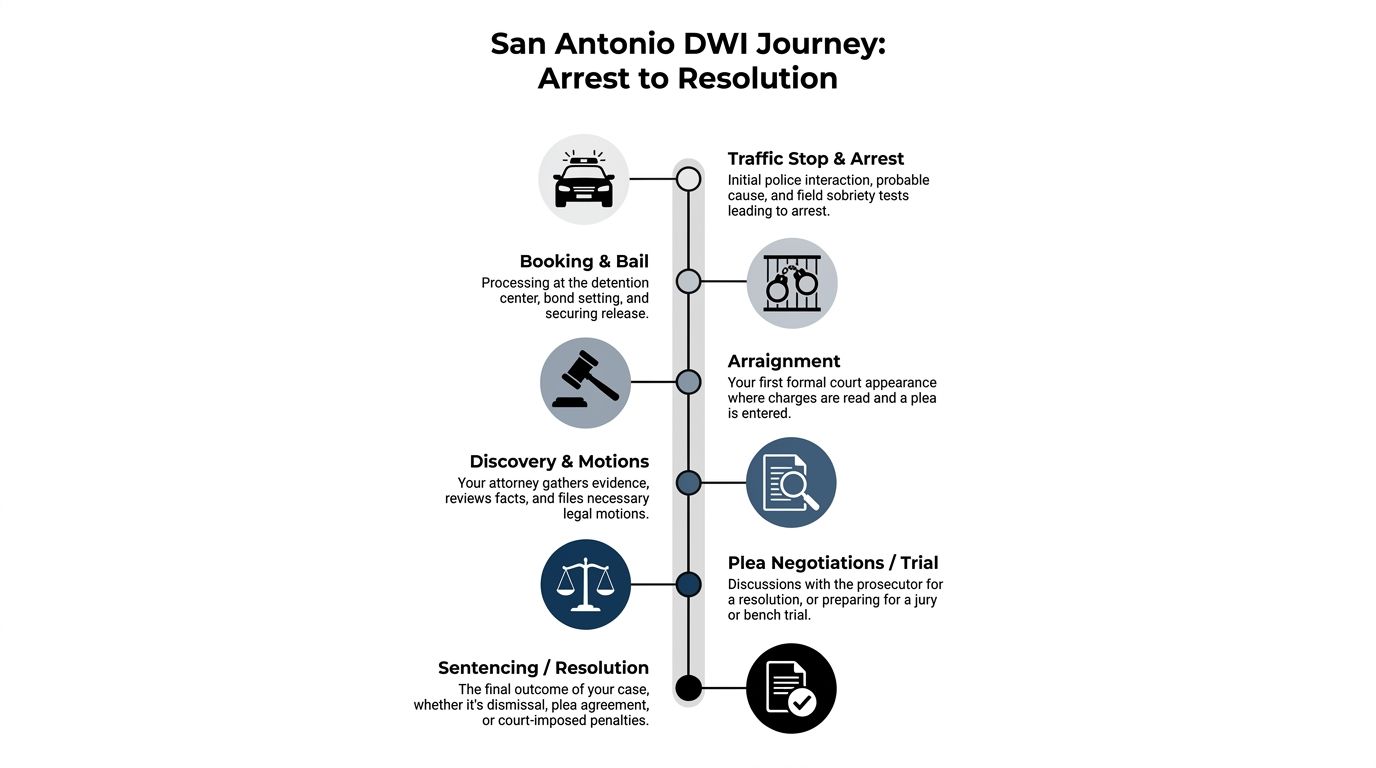
The traffic stop
A DWI case usually begins with a traffic stop or a checkpoint-style interaction tied to an officer’s observations. The officer may say you were speeding, drifting, braking oddly, or violating another traffic rule. The legal issue is whether the officer had a valid reason to stop you in the first place.
After the stop, the officer watches for what they describe as signs of intoxication, such as speech, balance, odor, or confusion.
The roadside investigation
At this stage, the officer may ask you to perform field sobriety tests. These are physical and mental exercises used to build evidence. One common example is the Horizontal Gaze Nystagmus, often called HGN, where the officer watches the eyes for involuntary movement.
Roadside tests are not the same as a conviction. They are part of the officer’s evidence collection.
You may also hear the term implied consent. In Texas, implied consent refers to the legal framework that says drivers on Texas roads are considered to have agreed to requested breath or blood testing, subject to the consequences and procedures set by law. That does not mean every test request or every suspension is valid. It means refusal and failure can trigger separate license consequences.
Arrest, booking, and release
If the officer believes there is enough evidence, you may be arrested and taken for booking. Booking usually includes fingerprints, photographs, inventory of your property, and paperwork related to bond or release.
This is the point where people often think they should wait and “see what happens.” Waiting is risky.
Practical tip: Keep every document you receive after release in one folder. Deadlines, hearing dates, and temporary driving notices often appear on separate papers.
The license deadline
One of the most important deadlines in a Texas DWI case arrives almost immediately. Under the Texas Transportation Code, you have only 15 days from the date of your arrest to request an Administrative License Revocation hearing. Missing this deadline results in an automatic license suspension, according to the Texas DPS Administrative License Revocation program.
That hearing focuses on your driving privileges, not guilt or innocence in criminal court. Still, it can be a powerful early opportunity to test the state’s evidence.
The first court settings
Your criminal case then moves through local court settings. The details vary, but a typical path may include:
- Initial appearance or arraignment: The court identifies the charge and your plea.
- Pretrial settings: The defense and prosecution exchange information and discuss the status of the case.
- Motions: Your attorney may challenge evidence, procedure, or the lawfulness of the stop.
- Negotiation or trial setting: If the case does not resolve, it moves toward trial.
A lot happens between those dates that clients do not see. Lawyers review video, subpoena records, compare police reports to bodycam footage, and evaluate whether the state can prove the charge.
Discovery and defense preparation
Discovery is the process of obtaining and reviewing evidence. This may include offense reports, testing records, witness information, video, and lab materials.
A defense lawyer may ask questions such as:
- Did the officer have a lawful reason for the stop
- Did the video match the written report
- Were the tests administered correctly
- Was the blood draw or breath procedure properly handled
- Did the officer skip required steps
These details can shape whether the defense seeks dismissal, suppression, reduction, or trial.
Resolution paths
A DWI case can end in more than one way. The possible paths include dismissal, a negotiated plea, a plea to a reduced offense in some cases, or trial. Your lawyer’s job is to match the strategy to the facts, your goals, and the risks involved.
For some people, the main concern is protecting a professional license. For others, it is avoiding a conviction, jail exposure, or a damaging record. For a CDL holder, protecting the ability to work may be the central issue.
Texas DWI Penalties Explained
The stakes in a DWI case are serious. A conviction can affect your freedom, driving privileges, job, insurance, and professional standing. It can also influence how future charges are treated.
Texas data shows why a passive approach is dangerous. In 2020, Texas saw 83,088 DWI charges, but only 6,771 were dismissed. With over 33,000 guilty pleas, these statistics highlight the difficult odds defendants face without skilled representation to challenge the state's case, according to Winning or Losing in DWI Defense, What Are the Statistics.
That does not mean guilt is inevitable. It means the system moves forward unless someone actively challenges the evidence.
Penalties depend on the charge and your history
Texas separates DWI offenses by factors such as prior convictions, alleged facts, and whether the state claims the case rises to a felony level. The exact outcome in any case depends on the court, the evidence, and the defense strategy.
The chart below gives a plain-language view of how penalties are commonly discussed.
| Offense | Jail Time | Fine | License Suspension |
|---|---|---|---|
| First DWI in Texas | Possible jail exposure under Texas law | Possible fine under Texas law | Possible suspension or other DPS action |
| Second DWI | Greater jail exposure than a first offense | Higher financial consequences may apply | Increased risk to driving privileges |
| Third or felony-level DWI | Much more serious criminal exposure | Higher financial penalties may apply | Major long-term impact on driving status |
What these penalties mean in daily life
A DWI case is not only about a courtroom sentence.
It can also affect:
- Employment: Some employers act on pending charges, not just convictions.
- Driving: A DWI license suspension can disrupt work, school, medical appointments, and parenting responsibilities.
- Insurance: Coverage and rates may change after an arrest or conviction.
- Professional standing: Nurses, teachers, pilots, lawyers, and other licensed professionals may face reporting obligations or board review.
The first-offense misunderstanding
Many people search for help after a first DWI in Texas because they assume a first arrest will be treated lightly. Courts may view a first offense differently than a repeat case, but “first offense” does not mean “minor.” It still deserves an organized defense.
Important point: The best time to fight a DWI is early, before deadlines pass and before the state’s narrative hardens into the case file.
Why strategy matters
A defense lawyer’s work is not limited to trying to “win at trial.” Sometimes the key move is suppressing evidence. Sometimes it is exposing a weak stop. Sometimes it is resolving the case in a way that reduces the long-term damage to your record and livelihood.
If you are trying to fight DWI Texas charges, the core question is not whether the process is serious. It is. The better question is whether the state can prove its case after the defense closely tests every piece of evidence.
Common DWI Defenses and Procedural Challenges
A DWI arrest is not the same as a valid DWI case. Officers can make mistakes. Machines can be questioned. Reports can omit details. Video can tell a different story than the narrative in the paperwork.

The stop can be challenged
One of the most important defense questions is simple. Why were you stopped?
If the officer lacked a lawful reason to initiate the stop, that can affect everything that came after it. The defense may challenge whether there was probable cause or reasonable suspicion for the traffic stop and the later arrest.
A primary defense involves challenging the probable cause for the stop. For example, the Horizontal Gaze Nystagmus test requires strict adherence to NHTSA protocols; improper administration can lead to false positives in up to 30% of cases, as noted in this discussion of Texas DWI defense strategies.
That matters because roadside tests often become the foundation for the arrest decision.
Field sobriety tests are not foolproof
People often think roadside tests are scientific. In reality, they depend heavily on officer training, conditions, and interpretation.
A lawyer may ask:
- Was the surface uneven
- Was the lighting poor
- Did the officer give clear instructions
- Did a medical condition affect balance or eye movement
- Did the officer rush the test
A person can perform poorly on a roadside test for many reasons that have nothing to do with intoxication. Nervousness, fatigue, injuries, footwear, weather, and traffic conditions all matter.
If you want a deeper look at how lawyers analyze these issues, this page on defenses for DUI cases in Texas is a useful starting point.
Breath and blood evidence can be attacked
Chemical evidence often sounds stronger than it really is. A number on a printout does not explain how the sample was obtained, stored, tested, or interpreted.
Defense work may include reviewing:
| Evidence type | Common defense question |
|---|---|
| Breath test | Was the machine functioning properly and operated according to procedure? |
| Blood sample | Was the sample collected, labeled, stored, and tracked correctly? |
| Officer observations | Do the videos support the officer’s written claims? |
A strong defense often means slowing the state’s case down and forcing it to prove each step.
Here is a short video overview that can help you understand how lawyers approach these cases:
Procedural mistakes can change the case
DWI defense is often about process. Courts care whether officers followed rules, whether evidence was lawfully obtained, and whether the chain of custody makes sense.
Examples of procedural issues include:
- An unlawful stop
- Poorly administered field sobriety tests
- Missing or inconsistent video
- Problems with test administration
- Errors in reports or notice forms
Some cases turn on a single issue. Others turn on several smaller problems that, together, weaken the prosecution’s proof.
Defense mindset: The question is not just “Were you arrested?” The question is “Can the state prove this case with reliable, admissible evidence?”
Special Considerations for Your DWI Case
Some DWI cases carry extra pressure because the client has more to lose than a typical driver. That includes commercial drivers, licensed professionals, underage drivers, and people arrested while visiting Texas.
CDL holders and commercial drivers
For a truck driver, bus driver, or anyone who depends on a commercial license, a DWI case can threaten income immediately. Under federal rule 49 CFR 383.51, a first-time DWI conviction results in a minimum one-year disqualification of a Commercial Driver's License, even if the offense occurred in a personal vehicle, as summarized in this San Antonio DUI and DWI attorney resource.
That means a CDL case is not just about criminal court. It is about your livelihood.
A commercial driver should focus on:
- Fast review of the stop: If the stop or arrest is weak, early challenges may matter even more.
- License strategy: You need advice that considers both your regular driving privileges and CDL consequences.
- Employment planning: Many drivers need to address company policy, reporting obligations, and scheduling at the same time.
Licensed professionals
Nurses, physicians, attorneys, pilots, teachers, and other credentialed workers often ask the same question first: “Do I have to report this?”
The answer depends on your profession, your licensing board, your employer’s rules, and the stage of the case. Some people need immediate advice on disclosure. Others need help framing a response if a board or employer asks questions later.
In these cases, the legal defense has to account for more than criminal penalties. It must also consider background checks, renewals, and disciplinary exposure.
Underage drivers and DUI concerns
Texas often distinguishes DUI and DWI based on age and the alleged facts. In plain terms, underage alcohol-related driving cases can involve a different legal framework than adult DWI charges.
Parents are often shocked by how quickly a traffic stop becomes a school issue, scholarship issue, or disciplinary issue. Fast legal guidance can help preserve options and reduce avoidable damage.
Out-of-state drivers
Visitors arrested in San Antonio face extra logistics. Court dates may conflict with work travel. Driving consequences can affect a home-state license. It can also be harder to gather records and appear in person on short notice.
A Texas DUI attorney handling an out-of-state case should be thinking about both the local court process and the practical reality of getting the client through it with minimal disruption.
Why Choose The Law Office of Bryan Fagan
You want clear answers, a plan, and a legal team that treats your case like it matters. That is exactly what people should look for after a DWI arrest.
The right lawyer should be able to move quickly on deadlines, explain Texas DWI law in plain English, and build a defense around the facts instead of assumptions. That includes looking at probable cause, field sobriety testing, chemical evidence, ALR hearing strategy, and the consequences you are trying to avoid.
If you are comparing options, focus on practical questions:
- Will the firm respond quickly
- Do they handle both the license case and the criminal case
- Can they explain your options without talking over you
- Do they understand high-stakes situations like CDL cases or professional licensing concerns
For readers who want a San Antonio-specific resource before making a call, this San Antonio DWI attorney guide offers more detail on the local process.
A DWI case is serious, but it is manageable with the right help. Good defense work gives you structure during a chaotic moment. It also gives you someone to stand between you and a system that moves fast when nobody pushes back.
Frequently Asked Questions About Texas DWI Cases
What is the difference between DUI and DWI in Texas
In general, DWI usually refers to adult intoxicated driving cases. DUI often comes up in underage alcohol-related driving situations. The exact charge depends on the facts and the driver’s age.
What if I refused a breath test
A refusal can still lead to license consequences and can become part of the state’s case. It does not mean you cannot defend the charge. Refusal cases often require close review of the stop, the arrest decision, and the notice paperwork.
Can a DWI come off my record
Some cases may qualify for relief such as expunction or record-sealing-related options, depending on the result and your circumstances. Eligibility depends on the exact outcome of the case and your history.
Do I need a lawyer for a first DWI in Texas
Yes. Even a first case can affect your license, employment, insurance, and record. A first arrest is still worth defending carefully.
Can I still drive after an arrest
Sometimes, but you need to act quickly and review the license paperwork right away. The answer depends on where you are in the ALR process and whether your driving privileges are still active.
If you were arrested for DWI in San Antonio, do not wait for the case to sort itself out. The Law Office of Bryan Fagan, PLLC helps Texans challenge DWI evidence, protect driving privileges, and make informed decisions from the start. You can request a free consultation or case evaluation to discuss your arrest, your deadlines, and the next steps for your defense.