
A DWI arrest can be overwhelming, but you don’t have to face it alone.
If you were stopped in San Antonio, taken to jail, handed paperwork you barely had time to read, and released with more questions than answers, that reaction is normal. Individuals in your position are worried about their license, their job, their family, and whether one bad night is about to define everything that comes next.
It won’t, if you respond the right way.
I’ll be direct. The worst move after a DWI arrest is waiting. The second worst is assuming this will sort itself out because it’s your first arrest, or because you were “only a little over,” or because the officer seemed polite. None of that decides your case. Details do. Timing does. A disciplined defense does.
You've Been Arrested for DWI in San Antonio What Happens Now
The first night usually feels the same. You see flashing lights. You answer a few questions. You’re asked to step out. You try to stay calm. Then you’re in a patrol car wondering how this got out of hand so fast.
By the time you get home, you’re exhausted and rattled. You may have court paperwork, a temporary driving notice, and a dozen people giving you bad advice. Ignore the noise and focus on the next move.

San Antonio has a deep bench of defense lawyers. Avvo lists 1,090 criminal defense attorneys in San Antonio in its local directory, which shows just how active and crowded this legal market is in Bexar County through Avvo’s San Antonio criminal defense listings. That matters because you need a lawyer who handles DWI cases strategically, not a generalist who treats your case like paperwork.
What your case really is right now
At this stage, your case is not a conviction. It is an accusation plus a stack of evidence the State will try to use against you. That evidence may include:
- The traffic stop: Why the officer pulled you over in the first place.
- Officer observations: Speech, balance, odor, red eyes, or statements you made.
- Field sobriety tests: Roadside exercises that officers often describe as proof of impairment.
- Breath or blood evidence: Chemical testing that can be challenged depending on how it was obtained and handled.
A strong defense starts by testing every one of those pieces. Was the stop legal? Were the tests handled properly? Did the officer jump to conclusions? Was your license warning clear? Those questions matter more than your panic right now.
You are not expected to know how to fight a DWI case on your own. You are expected to act quickly enough to protect your options.
Your job today
Your job is simple. Stop talking about the arrest with friends, coworkers, or on social media. Keep every paper you received. Write down what happened while it’s still fresh. Then get legal advice before you make another statement or miss a deadline.
Your First 24 Hours A Step-by-Step Guide After a DWI Arrest
The first day after a DWI arrest is about damage control. Not panic. Not guessing. Not trying to talk your way out of it after the fact.
Use this window well and you give your defense room to work.
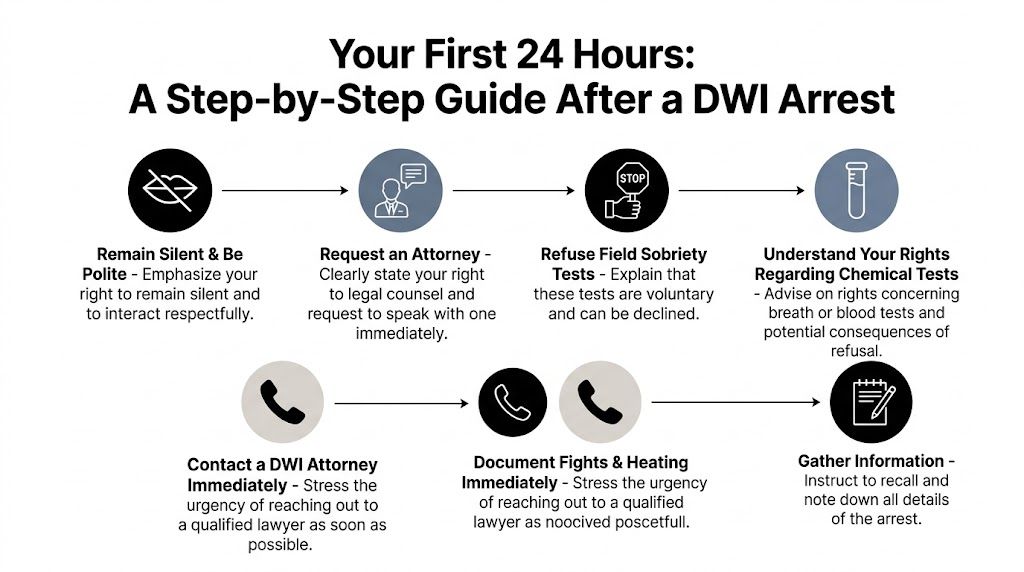
Step 1. Stay quiet and stay respectful
You have the right to remain silent. Use it.
That doesn’t mean being rude. It means giving your name, identifying information, and basic booking information, but not answering questions about where you were, what you drank, how much you slept, whether you feel okay to drive, or whether you think you were impaired.
A simple line works: “I want to remain silent and I want a lawyer.”
Step 2. Don’t try to explain your way out of it
People hurt their cases by filling silence with excuses. They say things like “I only had two drinks,” “I was tired,” or “I’m nervous because I hate cops.” Those statements don’t help. They become evidence.
If you’ve already said too much, don’t spiral. Stop talking now.
Step 3. Understand field sobriety tests
Field sobriety tests are the roadside exercises officers use to claim they saw signs of impairment. These often include balance tasks, following an object with your eyes, and walking in a line.
These tests are not the same as a chemical test. They are physical tasks performed on the side of the road, often at night, under stress, with traffic nearby. People perform poorly on them for all kinds of reasons that have nothing to do with intoxication.
Step 4. Know what implied consent means
Implied consent means that by driving in Texas, you’ve agreed to the rules tied to lawful requests for chemical testing after a DWI arrest. Usually that means a breath test or blood test.
Refusing a chemical test can trigger a separate license problem. Taking one can create evidence the State will use. There is no one-size-fits-all answer after the fact, but there is one clear rule now: once you’re released, get legal advice immediately so the response to the testing issue is built into your defense.
Step 5. Get your paperwork in order
As soon as you can, gather:
- Your release papers: Keep every page.
- Any notice about your license: This may control deadlines.
- Bond information: Save court dates and conditions.
- A personal timeline: Write down where you were, what you remember, and who was with you.
If you want a practical checklist, review this Texas DUI post-arrest checklist and work through it the same day.
Step 6. Protect your phone and memory
Don’t delete texts, photos, ride-share receipts, or call logs. Some of that information may help establish timing, location, or who saw you before the stop.
Also write down things people forget fast:
- Where the stop happened.
- What the officer said first.
- Whether you were asked to step out immediately.
- Whether there was a dash cam or body cam.
- Whether you were told you were under arrest before or after testing.
Practical rule: Your memory is strongest right after the arrest. Treat your notes like evidence.
Step 7. Talk to a DWI lawyer before your first court move
Don’t walk into court planning to “just explain.” Court is not customer service. It is a process with rules, deadlines, and consequences. The right defense starts before the first appearance, not after you’ve already made avoidable mistakes.
Understanding the Two Battles You Face The ALR Hearing and Criminal Case
A San Antonio DWI arrest creates two separate problems. Often, only one is recognized.
They think, “I have a court case.” You do. But you also have a license case moving on a different track, with different rules, and it starts fast.

The ALR case
Administrative License Revocation, often shortened to ALR, is the process used to decide whether your driver’s license will be suspended after a DWI arrest.
This is not the criminal trial. It’s an administrative case tied to your driving privileges. The issue is usually whether the officer had grounds to arrest you and whether you refused or failed the chemical testing process under Texas rules.
A San Antonio DWI defense lawyer needs to know Bexar County practice and DPS procedure, because the deadline here is brutal. You must request an ALR hearing within 15 days of arrest under Transportation Code §524.035 or your license faces automatic suspension, as noted in this San Antonio DWI defense discussion of ALR procedure.
The criminal case
The criminal case is separate. That case deals with whether the prosecution can prove you committed DWI under Texas law.
That means different evidence, different hearings, and a different path. The State may rely on the stop, officer observations, roadside testing, video, breath or blood results, and your statements. Your defense may challenge any or all of that.
Here’s the simplest way to look at it:
| Proceeding | Main issue | Who decides |
|---|---|---|
| ALR hearing | Whether your license should be suspended | Administrative process |
| Criminal case | Whether the State can prove DWI | Criminal court |
Key terms you need to understand
Some terms show up in almost every DWI case. You should know what they mean.
- Implied consent: By driving in Texas, you accept rules tied to chemical test requests after a lawful DWI arrest.
- BAC: Blood Alcohol Concentration. This is the measurement the State may use to argue intoxication through a breath or blood test.
- Administrative license suspension: A loss of driving privileges triggered through the ALR process, separate from the criminal charge.
- Field sobriety test: A roadside physical or attention-based exercise used by officers to claim they observed impairment.
If you want a side-by-side breakdown of these two tracks, this comparison of ALR hearings and criminal DWI cases in Texas is a useful starting point.
Why the ALR hearing matters even if you care most about court
Many people treat the license issue like a side problem. That’s a mistake.
The ALR hearing can help your defense in practical ways. It may give your lawyer an early chance to examine the officer’s version of events, challenge the basis for the stop or arrest, and preserve testimony before the criminal case moves deeper into court.
Later in the process, this overview can help you understand how the two tracks interact:
The license case and the criminal case don’t wait for each other. If you ignore one, it still moves forward.
What to do with this information
Do three things immediately:
- Find the arrest date on your paperwork.
- Count the days carefully.
- Get legal help before the ALR deadline runs.
This part is not optional. Missing that deadline hands away the advantage you may need.
Common Texas DWI Penalties and Consequences
The point of knowing the stakes isn’t to scare you. It’s to show you what your defense is trying to avoid or reduce.
Texas DWI consequences can affect your freedom, your license, your work, and the way your record follows you. Some cases also come with court-ordered conditions that make daily life harder while the case is pending.
Texas DWI penalties at a glance
The exact penalty range depends on the charge filed, your history, the facts of the stop, and whether there are aggravating allegations. Here is a simple overview:
| Offense | Jail Time | Fine | License Suspension |
|---|---|---|---|
| First DWI in Texas | Possible jail exposure | Possible fine | Possible suspension |
| Second DWI | Higher jail exposure | Higher fine exposure | Longer or more serious suspension issues |
| Felony DWI | State prison exposure | Significant fine exposure | Serious license consequences |
That table is intentionally broad because penalties depend on charge level and case facts. If someone promises a specific outcome before reviewing your paperwork, they’re selling comfort, not legal analysis.
Consequences that hit before conviction
A DWI problem often starts affecting your life before a final result in court.
- Driving problems: You may face a DWI license suspension issue through the administrative process.
- Work disruption: Missed shifts, travel limits, employer questions, or professional licensing concerns can start early.
- Insurance trouble: A pending DWI can trigger headaches even before your case ends.
- Bond conditions: Some people must comply with restrictions while the case is active.
Why first-time cases still need a real defense
People often search for a “Houston DWI lawyer” or a “Texas DUI attorney” because they think location is the main issue. It’s not. Strategy is.
A first arrest can still carry serious consequences. It can also create future problems if it isn’t handled carefully. The right approach is not to assume leniency. It’s to challenge the case and pursue the best available result, whether that means dismissal, reduction, suppression of evidence, or another outcome that protects your future.
A first offense is still a criminal case. Treat it like one.
Penalties are only part of the story
The legal penalty is one side of the problem. The practical impact is the other. If you drive for work, carry a professional license, travel often, or have child custody concerns, your defense needs to account for those realities from day one.
That’s why “fight DWI Texas” isn’t just a search phrase. It’s the right mindset. Not with panic. With preparation.
How a San Antonio DWI Attorney Fights Your Case
You are not waiting around for court and hoping the prosecutor cuts you a break. A real DWI defense starts the same day the file lands on the lawyer’s desk. The job is to test every part of the State’s case early, find the weak points, and use them before the case hardens.

Start with the stop
If the officer did not have a lawful reason to pull you over, that issue can affect everything that came after it.
A defense lawyer should get the dash cam, body cam, dispatch records, and offense report fast. Then compare them line by line. Did the officer describe a real traffic violation, or use vague phrases that sound good on paper? Does the video show what the report claims? If the answer is no, the case may be much weaker than it looks at first glance.
Then examine the roadside investigation
Field sobriety tests are not automatic proof of intoxication. They depend on how the officer gave instructions, where the tests happened, what you were wearing, how tired you were, and whether you have medical or balance issues.
That part of the case often gets overstated by police and misunderstood by drivers. A careful lawyer checks the surface, lighting, traffic conditions, camera angle, and the officer’s scoring. Small mistakes matter here. They often decide whether the jury sees the stop as solid police work or a rushed arrest.
Attack the breath or blood evidence
Chemical testing is not above challenge.
In a breath test case, the defense looks at the machine records, the testing procedure, and the timing. In a blood test case, the focus shifts to the warrant, the draw, storage, transport, lab work, and chain of custody. If the State cannot show the sample was handled properly from start to finish, that problem needs to be pushed hard.
BAC also needs to be kept in perspective. Blood Alcohol Concentration is one piece of evidence. It is not the whole case, and it does not erase bad police work.
File motions that force the State to prove its case
Many of the best defense moves happen before trial.
A prepared lawyer may challenge the stop, the arrest, your statements, or the way evidence was collected and tested. Those hearings do real work. They can cut out damaging evidence, expose weak testimony, and improve plea options if a negotiated result makes sense. They also show the prosecutor that the defense is paying attention.
Use local court knowledge the right way
DWI defense in Bexar County is not just about knowing the statute. It helps to know how local judges handle suppression issues, how prosecutors evaluate weaknesses, and what details tend to matter in San Antonio courtrooms.
The San Antonio Criminal Defense Lawyers Association provides training and resources for criminal defense attorneys in Bexar County. That matters because DWI defense changes with case law, forensic issues, and local practice. Your lawyer should stay current and should know how to apply that knowledge to your specific facts.
Strategy changes based on who you are
A good defense is not one-size-fits-all. If you hold a CDL, travel across state lines for work, or were arrested while visiting San Antonio, the defense has to account for those real-world consequences from the start.
That means gathering records quickly, protecting testimony at hearings, and avoiding careless plea decisions that create problems far beyond one courtroom. For some drivers, the smartest move is pressing hard on the stop. For others, it is challenging the testing process or creating a strong case for a reduction. The point is simple. Your case should be built around your facts, your risks, and your goals, not a generic DWI template.
What strong DWI defense usually looks like
A methodical san antonio criminal defense attorney often does five things well:
- Gets the evidence early. Video, reports, lab records, and notices should be requested before anything disappears or gets buried.
- Breaks the case into parts. The stop, arrest, tests, and officer credibility should be examined separately.
- Uses hearings to pin down testimony. Officers commit to a version of events under oath, and weak details start showing.
- Negotiates only from a position of strength. Prosecutors take defense counsel more seriously when the case has been challenged properly.
- Prepares for trial from the beginning. Trial readiness improves decisions at every stage, even if the case resolves earlier.
Special Considerations for CDL Holders and Out-of-State Drivers
Some DWI cases are harder because the driver has more to lose immediately.
That’s especially true for commercial drivers and people arrested while visiting Texas. Generic advice won’t cut it in either situation.
If you hold a CDL
If you drive for a living, your case is not just about a court date. It’s about your livelihood.
A DWI conviction can trigger mandatory disqualification under 49 CFR § 383.51, which is why CDL cases need targeted defense planning, as noted in this San Antonio criminal attorney discussion of CDL and out-of-state DWI issues. That’s one reason many general criminal practices don’t do enough for CDL holders. They treat the case like a standard first DWI in Texas when it isn’t.
Use a stricter checklist if you have a CDL:
- Tell your lawyer you drive commercially: Don’t assume they’ll ask the right follow-up questions.
- Protect the license issue early: The administrative side can affect your work fast.
- Document job impact: Scheduling, routes, employer policies, and credential concerns can shape legal strategy.
- Avoid casual pleas: A quick plea can create consequences far beyond the courtroom.
If you want a focused overview, review this guide on Texas DUI cases involving a CDL license.
If you hold a CDL, a “good enough” defense usually isn’t good enough.
If you live in another state
Out-of-state drivers often think they can go home and deal with the case later. That’s risky.
The same source notes that Texas DPS processed over 12,000 cases involving out-of-state drivers in 2025, and those drivers can face home-state license consequences through the Driver License Compact. In plain English, what happens in Texas may follow you home.
That changes the advice.
What out-of-state drivers should do
- Do not ignore Texas paperwork: Your home state may still act on what Texas reports.
- Don’t assume distance protects you: It usually doesn’t.
- Coordinate quickly: A local defense strategy may need to account for home-state consequences.
- Keep travel and work records: These may matter if appearances or scheduling become an issue.
Why these cases need a tailored plan
A CDL holder may need a defense built around preserving commercial driving privileges. An out-of-state visitor may need a plan that accounts for both Texas procedure and home-state fallout. Those aren’t side issues. They are central to the case.
If your situation fits either category, say it at the first consultation. Don’t wait for your lawyer to discover it buried in intake paperwork.
Take Control of Your Future Today with The Law Office of Bryan Fagan
Here’s the bottom line. An arrest is not the end of your case, and it does not define your future.
What matters now is speed, discipline, and judgment. You need to protect your license issue, stop giving the State extra evidence, and get a defense strategy built around the actual facts instead of wishful thinking. That applies whether this is your first DWI in Texas, a repeat case, a CDL problem, or an arrest that happened while you were just passing through San Antonio.
Be realistic and be proactive.
If you want to fight a DWI in Texas, act like it. Save your paperwork. Write down everything you remember. Don’t miss deadlines. Don’t walk into court unprepared. And don’t assume the officer’s version of events is the final version.
A careful defense can challenge the stop, the roadside investigation, the chemical evidence, and the administrative license process. It can also pursue outcomes that reduce the damage and protect your ability to move forward.
If you’re ready to get control back, request a free consultation and get a case evaluation now. A calm, strategic conversation today can put you in a much better position tomorrow.
Frequently Asked Questions About San Antonio DWI Defense
What happens if I refused a breath or blood test
You still have a case to fight.
A refusal can trigger a license suspension through Texas implied consent rules, but it does not hand the State an automatic win in court. The arrest, the stop, the officer’s observations, the testing request, and the paperwork still need to hold up under scrutiny. For out-of-state drivers, that license problem can follow you home. For CDL holders, the consequences can hit your job fast.
Can I clear my record after a DWI
Sometimes. The result of the case controls the answer.
Expunction and non-disclosure are different remedies with different rules. Expunction destroys eligible records. Non-disclosure limits who can see certain records. Whether you qualify depends on the charge, the outcome, and your history. Get advice based on your actual disposition in Bexar County, not barstool advice from someone whose case ended differently.
Why do I need a lawyer if this is my first arrest
Because first arrests create first mistakes.
The early issues matter most. Was the stop legal. Did the officer have a valid basis to investigate further. Were the field sobriety tests explained and scored correctly. Was the breath or blood evidence collected and handled the right way. Did you miss the deadline to contest a license suspension. A first case can affect your record, insurance, travel, and employment, especially if you drive for work or live outside Texas.
What does BAC mean in a DWI case
BAC means blood alcohol concentration.
It is one piece of evidence, not the whole case. A number on a report does not answer whether the stop was lawful, whether the machine or lab result is reliable, or whether the officer followed procedure. Good defense work examines the full chain of events, not just the final reading.
If you were arrested for DWI in San Antonio, act today. Call the Law Office of Bryan Fagan, PLLC for a free consultation and confidential case evaluation. Bring your paperwork, say less than you want to say, and get a plan that fits your situation, especially if you hold a CDL or were arrested while visiting Texas.