
A DWI arrest can be overwhelming, and the legal jargon that follows can make things even more confusing. Let's cut through the noise: understanding the difference between a license suspension and a revocation is critical to your defense. Think of a suspension as a temporary timeout for your driving privileges—it has a clear end date. A revocation, on the other hand, is like getting fired from driving. Your license is terminated, and you have to start over from square one to get it back.
Knowing which one you’re up against is the first step in building a strategic defense, but you don’t have to face it alone.
Understanding Your Rights After a DWI Arrest
A DWI arrest is disorienting, and it's easy to feel like you've already lost. But you have rights, and the system uses specific terms that you need to understand to protect them. For most people facing a first DWI in Texas, the most immediate worry is what happens to their driver's license.
In Texas, both a suspension and a revocation will take you off the road legally. The key difference lies in why they happen and what it takes to get back behind the wheel. A suspension is usually an administrative penalty, handled outside the criminal courtroom. A revocation is far more serious and almost always tied directly to a criminal conviction.
Key Differences at a Glance
To make it crystal clear, let's put them side-by-side. This table breaks down exactly how a DWI license suspension and revocation differ in Texas.
| Feature | License Suspension | License Revocation |
|---|---|---|
| Nature of Penalty | A temporary pause on your driving privileges. | A complete termination of your license. |
| Typical Trigger | Administrative action (e.g., failing an ALR hearing). | Criminal court conviction for a serious or repeat DWI. |
| Duration | A specific, defined period (e.g., 90 days, 180 days). | Indefinite until you successfully reapply. |
| Reinstatement | Pay fees, file SR-22 insurance, complete courses. | Re-apply as a new driver, retake all tests. |
What Happens After the Arrest
The moment you're arrested for DWI and either fail or refuse a breath or blood test, a clock starts ticking. The state kicks off a civil process called an Administrative License Revocation (ALR). This is entirely separate from your criminal DWI case.
You have only 15 days from the date of your arrest to request an ALR hearing to challenge this automatic suspension. Missing this deadline means forfeiting your right to fight DWI Texas license suspension administratively.
This administrative battle is just the first hurdle. The outcome of your criminal case will decide if the court imposes even more penalties, like a much longer suspension or a full-blown revocation.
This is where an experienced Houston DWI lawyer becomes essential. A skilled attorney can represent you at both the ALR hearing and in criminal court, building a unified strategy to protect your license and minimize consequences. Acting fast is the single best thing you can do to secure a better outcome.
Comparing License Suspension And Revocation In Texas
Getting hit with a DWI charge throws you into a world of confusing legal terms, especially when it comes to your driver's license. You’ll hear "suspension" and "revocation" thrown around, and while they sound similar, in Texas law they mean wildly different things. Getting a handle on this distinction is your first step toward building a solid defense.
Simply put, a license suspension is a temporary time-out on your driving privileges. It comes with a clear end date, and once you hit it, there’s a specific checklist to follow to get back on the road.
A license revocation, on the other hand, is the complete termination of your license. There is no end date. Your privilege to drive has been canceled, and if you want it back, you have to start the entire licensing process from scratch.
The Core Difference: Suspension vs. Revocation
The real difference between a suspension and a revocation boils down to permanence and severity. Think of a suspension as a pause button, while a revocation is a full stop.
This infographic breaks down the two penalties side-by-side.
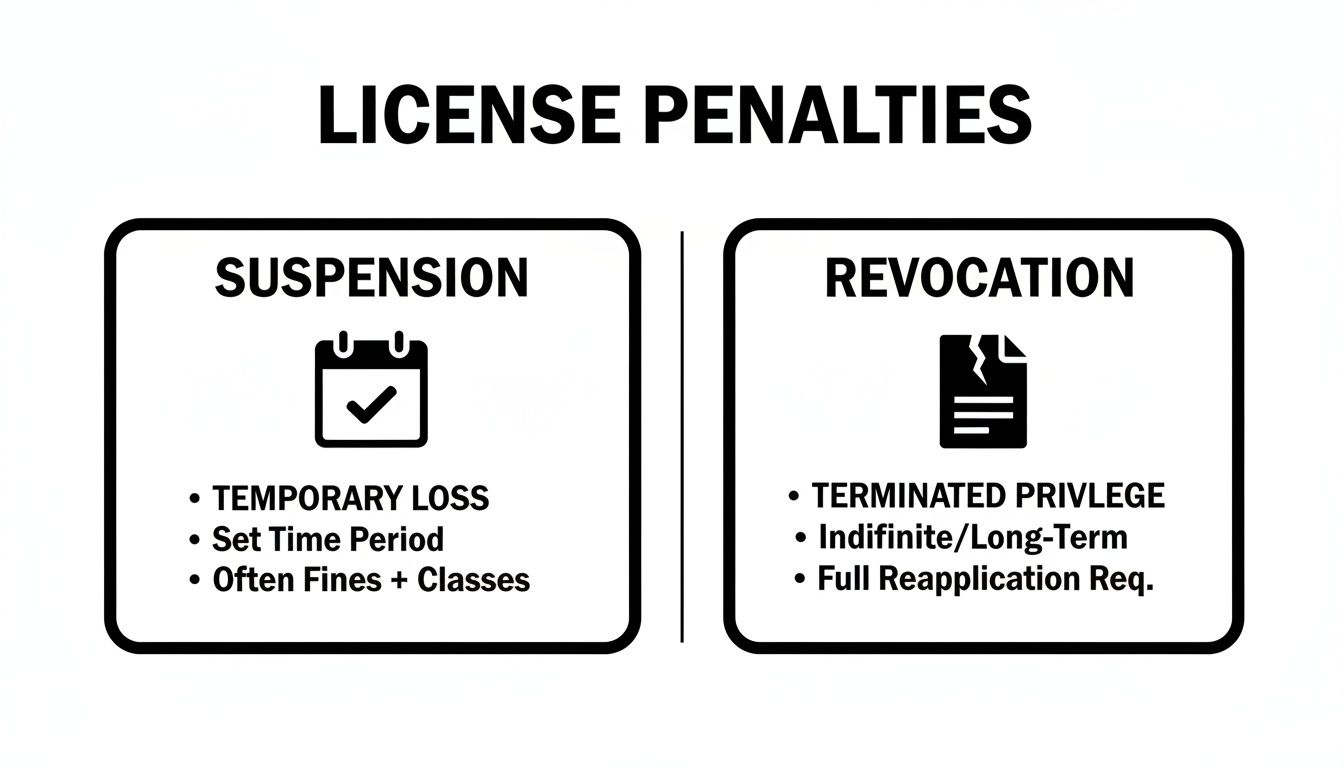
As you can see, a suspension is a defined setback with a clear path to getting your license back. A revocation is a much more permanent and difficult hurdle, forcing you to prove you deserve to drive again.
To give you a clearer picture, this table highlights the key differences you’ll face with each penalty in Texas.
Texas License Suspension Vs Revocation At A Glance
| Attribute | License Suspension | License Revocation |
|---|---|---|
| Nature of Penalty | Temporary loss of driving privileges. | Complete termination of your driver's license. |
| Typical Trigger | Administrative action by DPS (ALR hearing). | Criminal court conviction. |
| Common Causes | Refusing a breath/blood test; BAC of 0.08% or higher. | Felony DWI, Intoxication Manslaughter, repeat offenses. |
| Duration | A specific, defined period (e.g., 90 days, 180 days). | Indefinite; no automatic end date. |
| Reinstatement | Pay fees, file SR-22, complete classes. | Must re-apply for a new license from scratch. |
| Difficulty to Overcome | Administrative process with clear steps. | Difficult; requires petitioning the state and re-testing. |
Ultimately, while both are serious, a suspension is a procedural hurdle you can clear, whereas a revocation puts the entire burden back on you to prove you’re fit to hold a license at all.
What Triggers Each Action
So, how do you end up with one versus the other?
A license suspension is almost always tied to the administrative side of a DWI. This isn't handled by the criminal court but by the Texas Department of Public Safety (DPS) through the Administrative License Revocation (ALR) process. It gets triggered automatically if you:
- Refuse to take a breath or blood test during a traffic stop. This falls under Texas's "implied consent" law.
- Provide a sample that shows a Blood Alcohol Concentration (BAC) of 0.08% or more.
A license revocation is a far heavier penalty, usually handed down by a criminal court judge as part of your sentence after a conviction. Revocations are reserved for the most serious offenses, like a felony DWI, intoxication manslaughter, or being a habitual offender.
While a suspension feels like a major disruption, a revocation is a life-altering event. It requires you to prove to the state that you deserve the privilege to drive again, often facing a far more intensive review process.
The Path To Reinstatement
Getting your license back after a suspension involves a pretty straightforward checklist. You have to wait out the suspension period, pay a reinstatement fee to DPS, file proof of financial responsibility (an SR-22 insurance certificate), and finish any court-ordered DWI education courses. Once you've checked those boxes, your license is typically restored.
Reinstatement after a revocation is a much tougher road. There is no automatic path back. After waiting out a mandatory period, you have to petition the state for a brand-new license. This means retaking and passing both the written and driving exams, potentially undergoing drug and alcohol evaluations, and likely having an ignition interlock device installed as a condition of any new license you might be granted. The state will scrutinize your entire record before deciding if they'll give you the privilege to drive again.
You can get more details on the administrative side of things by reading our guide on the Administrative License Revocation process in Texas.
The Two Legal Battles That Impact Your License
After a Texas DWI arrest, you're suddenly fighting a war on two fronts. Many people think their driver's license is only in jeopardy if they get convicted in criminal court, but that’s a dangerous and costly misunderstanding.
The reality is your case involves two separate and independent legal battles. Losing either one can get your license suspended.

It's absolutely critical to understand that these two processes—one administrative, one criminal—run on parallel tracks. They have different rules, different decision-makers, and completely different goals. A solid defense strategy has to address both at the same time.
The Administrative Front: The ALR Process
The first and most immediate threat to your license comes from the Administrative License Revocation (ALR) process. This isn't a criminal proceeding; it's a civil action kicked off by the Texas Department of Public Safety (DPS). It triggers automatically the moment you either refuse a chemical test (breath or blood) or provide a sample with a Blood Alcohol Concentration (BAC) of 0.08% or higher.
The ALR process moves at lightning speed. From the day you're arrested, you have just 15 days to formally request a hearing and challenge this automatic suspension.
If you miss that deadline, your license will be suspended automatically on the 40th day after your arrest, no matter what happens in your criminal case. This process is designed to be swift, which is exactly why you need to contact a Houston DWI lawyer the moment you get arrested.
"The outcome of your ALR hearing is completely independent of your criminal case. You can win the hearing and prevent the administrative suspension, only to have a judge order a separate suspension later if you are convicted. Conversely, you could lose the ALR hearing but still win your criminal case."
This two-track system makes a proactive defense non-negotiable. If you wait, you could lose your driving privileges before your criminal case even gets off the ground.
The Criminal Front: The Court Case
While the ALR process is unfolding, your separate criminal DWI case starts its journey through the court system. This is the legal battle most people are familiar with—the one involving prosecutors, judges, and maybe even a jury trial. If you are ultimately convicted of DWI, the judge will hand down criminal penalties as part of the sentence.
These penalties often include:
- Fines: Significant monetary penalties that can easily run into thousands of dollars.
- Jail Time: A real possibility, depending on the specifics of the offense and any prior history.
- Court-Ordered License Suspension or Revocation: A separate penalty that can be much longer and more severe than the administrative one.
Unlike the rapid-fire ALR process, a criminal case can take months or even years to resolve. The stakes here are much higher. A criminal conviction doesn't just bring a court-ordered suspension; it leaves you with a permanent criminal record that can haunt your employment, housing, and professional licensing for the rest of your life. The goal of a skilled Texas DUI attorney is to fight for a dismissal, a reduction in charges, or a not-guilty verdict at trial to stop these life-altering consequences in their tracks.
Why Both Battles Matter
The state uses the administrative process to get drivers off the road quickly, without having to wait for a criminal conviction to play out. Research from the National Highway Traffic Safety Administration shows that ALR laws are highly effective, noting a 9% drop in fatal nighttime crashes in states that have them. You can see the full findings on why ALR is a powerful tool for states on the NHTSA's traffic safety facts page.
For you, this means the state has a powerful, fast-acting mechanism to take your license. A comprehensive defense strategy has to be launched on day one—challenging the ALR suspension while simultaneously building a tough defense for the criminal charges. Trying to handle one without the other is a recipe for failure.
A Roadmap To Reinstating Your Driving Privileges
Getting back on the road after a DWI means navigating the reinstatement process, and the path looks very different depending on whether your license was suspended or revoked. Think of a suspension as a temporary pause, while a revocation is a full stop—and getting started again is much harder.
This guide breaks down the practical, step-by-step roadmap you need to regain your driving privileges in Texas, no matter which situation you're in.
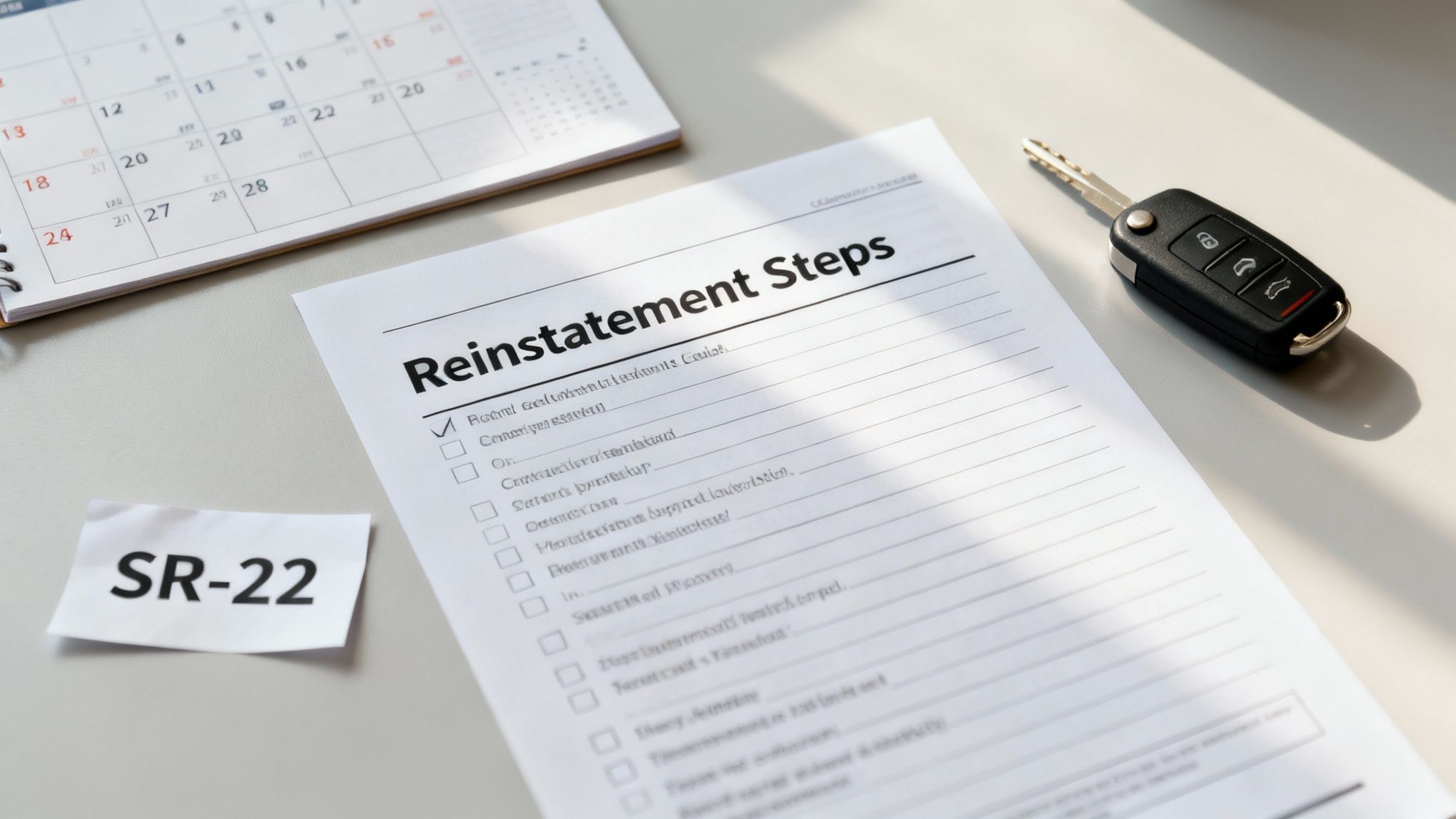
The journey to getting your license back isn't just about waiting out a timeline. It requires you to be proactive, handle paperwork, and follow state requirements to the letter. Knowing what’s coming can make the whole ordeal a lot less stressful.
The Path Back From A License Suspension
A license suspension is a temporary setback with a clear, structured path to getting back behind the wheel. Once you’ve served the suspension period—whether it was ordered by the DPS in an ALR hearing or by a criminal court—you have to check off several key boxes to restore your driving privileges. Miss one item on this checklist, and you'll only delay your return to the road.
The core requirements for lifting a suspension usually include:
- Paying a Reinstatement Fee: You’ll owe a fee directly to the Texas Department of Public Safety (DPS) to get your license revalidated.
- Obtaining an SR-22 Certificate: This is a form your auto insurance company files to prove you have the state-mandated minimum liability coverage. You’re typically required to maintain it for two years from the date of your DWI conviction.
- Completing DWI Education Courses: Depending on the specifics of your case, you might be ordered to complete a 12-hour DWI Education Program or, for repeat offenders, a more intensive DWI Intervention Program.
As soon as all the fees are paid, the SR-22 is on file with the DPS, and you've sent in proof you finished your courses, your license will be reinstated.
The More Demanding Journey After A Revocation
Recovering from a license revocation is a much more complicated and uncertain process. Because a revocation completely terminates your license, you’re basically starting from scratch. You're treated like a brand-new driver who has to prove you’re fit to be on the road again. The burden falls squarely on you to show you are no longer a risk.
Reinstatement after a revocation is not an automatic right; it is a privilege you must re-earn through a demanding re-application process. The state will scrutinize your entire record before making a decision.
The journey begins after a mandatory waiting period, which can be quite long. After that, you must:
- Petition the State: This involves formally requesting permission just to re-apply for a driver's license.
- Retake All Required Exams: You'll have to pass both the written knowledge test and the practical driving skills test, just like a 16-year-old getting their first license.
- Undergo Evaluations: The court or DPS may require you to complete a comprehensive drug and alcohol assessment to evaluate your risk of reoffending.
- Install an Ignition Interlock Device (IID): As a condition of getting a new license, you will almost certainly be required to install an IID in your vehicle at your own expense. This device makes you provide a clean breath sample before the car will even start.
Trying to handle these steps can be incredibly difficult, especially when your job and livelihood depend on being able to drive. For a deeper look into the specifics, our guide offers more on Texas license reinstatement procedures. A skilled DWI lawyer can walk you through each requirement, ensuring you build the strongest possible case for getting back behind the wheel.
Higher Stakes For CDL Holders And Repeat DWI Offenses
For most drivers, a DWI arrest is a massive headache. But if you hold a Commercial Driver's License (CDL) or you've been down this road before, a DWI isn't just a disruption—it can be a career-ending, life-altering event. The line between a temporary license suspension and a permanent revocation gets razor-thin, and the consequences get exponentially more severe.
Understanding just how high the stakes are is the first step in building a defense that protects more than just your driving privileges. When your entire livelihood is on the line, a standard defense just won't cut it.
The Immediate Threat To Your CDL
For a professional driver, a CDL isn't just another card in your wallet; it's the key to your livelihood. Texas law understands this, and that's why it brings the hammer down on CDL holders convicted of DWI. The rules are incredibly strict and leave absolutely no room for error.
A first-time DWI conviction means an automatic one-year disqualification of your CDL. And here's the kicker: this happens even if you were arrested in your personal pickup truck on a Saturday night. A second DWI conviction brings a lifetime disqualification, effectively slamming the door on your professional driving career for good.
The law doesn't care if you were on the clock or not. A DWI in your personal vehicle carries the exact same devastating CDL penalties as one that happens in your big rig during work hours.
This is precisely why you have to fight the charge aggressively from day one. An experienced Houston DWI lawyer knows the specific angles needed to protect your commercial license. To dig deeper into how a DWI impacts professional drivers, check out our guide on getting a CDL with a DWI in Texas.
When Suspension Turns Into Revocation For Repeat Offenses
If you're facing a second, third, or subsequent DWI charge, the game changes entirely. The penalties quickly shift from temporary setbacks to long-term or even permanent consequences. A first DWI in Texas usually leads to a license suspension of 90 days to one year, but a repeat offense puts you at high risk for a much longer suspension—or a full-blown revocation.
Second DWI Offense: A conviction for a second DWI can get your license suspended for anywhere from 180 days up to two years. That's a huge leap from a first offense, and the requirements to get your license back are far more demanding.
Third DWI Offense (Felony): A third DWI is a third-degree felony in Texas. A conviction here almost guarantees a license revocation. This isn't a suspension; your driving privilege is completely terminated. You'll have to petition the state to re-earn it after a mandatory waiting period, and there's no promise they'll say yes.
With repeat offenders, the state's goal isn't just to punish you; it's to remove what they see as a chronic danger from the roads. That’s why the penalties become so extreme, moving from the inconvenience of a temporary suspension to the life-changing reality of a revocation.
Data from across the country confirms that states use revocation as their heaviest hammer to deter repeat offenders. For example, studies have shown that while 32% of suspended second-time offenders reoffended, that number jumps to 61% for revoked third-time offenders. This kind of data illustrates why states reserve this severe penalty for those they consider the highest risk. Learning more about these suspension and revocation findings shows you the state's perspective and drives home why a powerful legal defense is non-negotiable for anyone facing another DWI charge.
Building Your Strategic DWI Defense Today
If you're facing a DWI arrest, it's easy to feel like the fight is already over. But let's be clear about one thing: an arrest is not a conviction. You have the right to challenge every piece of evidence against you, and the time to start exercising that right is now.
The first step is understanding the immediate threat to your driver's license. The state doesn't wait for a criminal conviction to try and take away your driving privileges. The most critical deadline you're up against is the 15-day window to request your Administrative License Revocation (ALR) hearing.
This isn't just another court date—it's your only opportunity to fight the automatic suspension of your license by the Texas Department of Public Safety. If you miss this deadline, you forfeit the chance to protect your ability to drive and lose a golden opportunity to gather evidence for your criminal case.
Taking The First Step
The road back begins with one decisive action. You don't have to navigate the ALR hearing or the criminal justice system on your own. A skilled DWI attorney can step in immediately to build a defense strategy aimed at protecting you at every turn.
We dig into everything. From the reason for the initial traffic stop and the administration of field sobriety tests to how any chemical tests were administered, our goal is to find the weaknesses in the state’s case and use them to your advantage.
Your defense begins the moment you decide to fight back. By taking proactive steps today, you give yourself the best possible chance to minimize the consequences of a DWI arrest and protect your professional and personal life.
Why You Cannot Afford To Wait
Every day that passes is a day the state uses to build its case against you. Meanwhile, critical deadlines are expiring, evidence can get lost, and witnesses' memories begin to fade. Your legal options start to shrink.
A Houston DWI lawyer can intervene immediately to preserve evidence, take over all communications with law enforcement, and ensure your rights are being protected.
We understand what’s on the line—your job, your family, your entire future. At The Law Office of Bryan Fagan, PLLC, we have spent years helping Texans through these exact situations, from fighting a first DWI in Texas to defending against serious felony charges. Our job is to stand between you and the prosecution and make sure your side of the story is heard.
Don’t let uncertainty control your next move. Call us for a free, confidential consultation. We’ll listen to what happened, go over the details of your arrest, and lay out your legal options in plain English. Let's work together to build a plan to protect your license and your future, starting right now.
When you're staring down a DWI charge, your mind is probably racing with questions and a heavy dose of uncertainty. It's completely normal. Here, we’ll tackle some of the most common concerns we hear about license suspension and revocation in Texas, giving you clear, straightforward answers to help you figure out what’s next.
Can I Get An Occupational License If My License Is Suspended In Texas?
Yes, in most cases, you can petition the court for what’s called an Occupational Driver's License (ODL). Many people know this as an "essential needs license" because that's exactly what it's for—it gives you the limited ability to drive for necessary trips like getting to work, attending school, or handling critical household duties.
Getting an ODL isn't automatic, though. A judge has to approve it, and your eligibility really depends on the specifics of your case. Things like whether this is your first DWI in Texas or if you refused a breath or blood test will definitely play a role. A skilled Houston DWI lawyer can file the petition for you and build a strong argument to convince the judge that you need to stay on the road.
How Long Will A DWI Suspension Stay On My Driving Record?
This is a big one. A DWI-related suspension or the conviction itself will stay on your official Texas driving record permanently. But there’s a critical difference between your driving record and your criminal record that you need to understand.
While the offense never truly leaves your driving history, you might be able to keep the criminal conviction out of the public eye. For certain first-time offenses, you could be eligible to have the conviction sealed with an order of non-disclosure after a specific waiting period.
This isn't a simple DIY process; it requires precise legal steps. Getting guidance from an experienced attorney is crucial if you want to protect your future opportunities for jobs and housing.
What Happens If I Drive With A Suspended License In Texas?
Don't do it. Driving While License Invalid (DWLI) is a serious criminal offense in Texas, and the consequences can snowball quickly, making a bad situation much worse. A first-time offense is usually a Class C misdemeanor, but it gets more severe from there.
If you have prior DWLI convictions or you were caught driving without insurance, the charge can be bumped up to a Class B or even a Class A misdemeanor. The penalties can be steep:
- Significant fines that can easily run into the thousands.
- An extension of your original license suspension period.
- The very real possibility of additional jail time.
It is absolutely vital to get your license legally sorted out before you even think about driving again. Trying to get by with a suspended license will only dig you into a deeper legal hole.
A DWI charge can feel overwhelming, but you have the right to fight back with a powerful defense. At The Law Office of Bryan Fagan, PLLC, our team is here to protect your rights, your license, and your future. We invite you to request a free and confidential case evaluation to talk about your situation and see how we can help. Contact us today.