
A DWI arrest can be overwhelming, but getting your records expunged in Texas is the single most powerful way to legally erase a past arrest—making it as if the whole thing never even happened. This isn’t just about hiding a record; it’s a legal process that completely destroys all files held by government agencies, giving you a true fresh start and the right to deny the arrest ever occurred. You don’t have to face it alone.
Your Path to a Fresh Start After a Texas Arrest

A DWI arrest in Texas can leave you feeling uncertain about what comes next. It’s natural to worry about how a criminal record could impact your career, your ability to find a good place to live, or even your personal relationships. But an arrest doesn't have to define your future, and you don’t have to face this challenge alone.
Thankfully, the Texas legal system provides a powerful tool for clearing your name called an expunction, sometimes called expungement. It goes far beyond just sealing a record from the public. It’s the complete legal destruction of it, a strategic move to protect your rights and minimize consequences.
What an Expunction Truly Means for You
Think of an expunction as hitting the reset button on a specific moment in your life. Once a judge signs that expunction order, every government entity involved—from the police department that arrested you to the court that handled the case—is required to physically destroy or obliterate every document, file, and digital entry related to your arrest.
This process gives you several life-changing benefits:
- Complete Privacy: You can legally deny the arrest ever happened on job applications, loan forms, and housing requests without fear of committing perjury.
- Restored Opportunities: It removes a major roadblock to getting professional licenses, securing educational goals, and advancing your career.
- Peace of Mind: You regain control of your own story, ensuring a past mistake doesn't unfairly define who you are today.
An expunction isn't just a legal filing; it's a strategic move to reclaim your reputation. It ensures a charge that never led to a conviction can't be used against you by employers, landlords, or licensing boards.
Understanding Your Next Steps
While an expunction offers a complete solution, not everyone qualifies. The eligibility rules are strict. Generally, you may be eligible if your case was dismissed, you were found not guilty at trial, or you received a pardon. It’s critical to understand this is entirely different from an order of nondisclosure in Texas, which only seals a record from public view.
Navigating the complexities of getting your records expunged in Texas demands precision and a deep knowledge of the law. A minor mistake on the petition or failing to notify the right agencies can lead to long delays or even an outright denial. This is where having a strategic Houston DWI lawyer in your corner is essential. Our team can evaluate your case, confirm your eligibility, and guide you through every step to secure the clean slate you deserve.
Expunction vs. Nondisclosure: What's the Difference?
When you’re trying to move past a Texas arrest, you'll encounter two key legal terms: expunction and nondisclosure. They might sound alike, but they are completely different tools with vastly different outcomes. Getting this distinction right is the first—and most critical—step toward getting a truly clean slate.
Many people use these terms interchangeably, but that's a mistake that can lead to confusion about what's actually possible for your case.
Think of an expunction as the gold standard for clearing your name. It’s a legal process that orders the complete and permanent destruction of all records tied to an arrest. Once a judge signs that expunction order, every government agency, from the police department that arrested you to the court clerk, is commanded to obliterate their files. It’s as if the arrest never happened.
A nondisclosure, on the other hand, is a legal tool for sealing a record from public view. The record isn't destroyed; it's just hidden. For example, an expunction is like shredding a document into confetti, making it impossible to ever piece back together. A nondisclosure is like taking that same document and locking it away in a secure filing cabinet.
Which Path Is Right for Your Case?
The specific facts of your case will determine which option, if any, is available to you. Eligibility for an expunction is narrow and usually reserved for cases where the state simply couldn’t prove its allegations against you.
You might be eligible for an expunction if your case ended in one of these ways:
- A full dismissal of the charges by the prosecutor.
- An acquittal (a "not guilty" verdict) after a trial.
- A pardon from the Governor of Texas.
- The statute of limitations ran out before charges were ever filed.
Nondisclosure is generally the path for people who successfully completed a deferred adjudication community supervision program. In that scenario, you plead guilty or "no contest," but the judge puts off a finding of guilt while you complete probation. Once you finish successfully, the case gets dismissed, but it's not eligible for an expunction—only for nondisclosure. You can learn more by reading our detailed guide on the order of nondisclosure in Texas.
The biggest difference comes down to your legal right to deny the incident. With an expunction, you can legally state you were never arrested. With a nondisclosure, you generally cannot, because the record still exists for law enforcement and certain state licensing agencies to see.
A Clear Comparison
This distinction is crucial, especially in DWI cases. A DWI arrest that gets dismissed because of weak evidence or a strong defense from a Texas DUI attorney is a perfect candidate for expunction. On the flip side, a first-time DWI offender who completes deferred adjudication may only qualify to have their record sealed with a nondisclosure.
The data shows that while hundreds of thousands of Texans could be eligible to clear their records, many never take the necessary steps. One study found that in Harris County alone, over 640,000 cases were identified as potentially eligible for sealing or expungement, showing just how many people have an opportunity to reclaim their futures. You can discover more insights from this research on criminal record clearing in Texas.
To make these concepts even clearer, let's break down the key differences between getting your record expunged and having it sealed.
Expunction vs. Nondisclosure Key Differences
This table shows a side-by-side comparison of how these two powerful legal tools work in Texas.
| Feature | Expunction (Expungement) | Nondisclosure (Record Sealing) |
|---|---|---|
| Record Status | Permanently Destroyed: All files related to the arrest are completely obliterated. | Sealed from Public View: Records are hidden from the public but not destroyed. |
| Legal Denial | Yes: You can legally deny the arrest ever occurred on most applications. | No: You cannot legally deny the arrest to government or licensing agencies. |
| Who Can See It | No one: The record is gone for everyone, including law enforcement. | Limited Access: Law enforcement and certain state agencies can still view the record. |
| Typical Eligibility | Dismissals, acquittals ("not guilty"), pardons, or unfiled charges. | Successful completion of deferred adjudication community supervision. |
| Outcome | A true "clean slate" as if the event never happened. | A "second chance" by limiting public access to the record. |
Ultimately, one path erases the past, while the other simply hides it. Knowing which one you qualify for is the first step toward putting a criminal charge behind you for good.
Determining Your Eligibility for Expunction
Figuring out if you qualify to have your records expunged in Texas is the single most critical step toward getting your life back. The law sets a high bar, reserving this powerful legal tool for very specific situations where a case didn't end in a final conviction. This is a remedy designed to make sure an arrest that didn't stick doesn't follow you around forever.
To be eligible, your case has to have wrapped up in a way that legally clears your name. If you were found guilty and convicted, expunction is almost always off the table—unless you get a rare pardon from the governor. Your entire chance at eligibility rides on getting a favorable outcome in your original criminal case, which is exactly why having a sharp, strategic defense from day one is so important when you need to fight a DWI in Texas.
The decision tree below breaks down the fundamental choice in clearing your record: are you aiming for the complete destruction of an expunction, or the limited access of a nondisclosure?
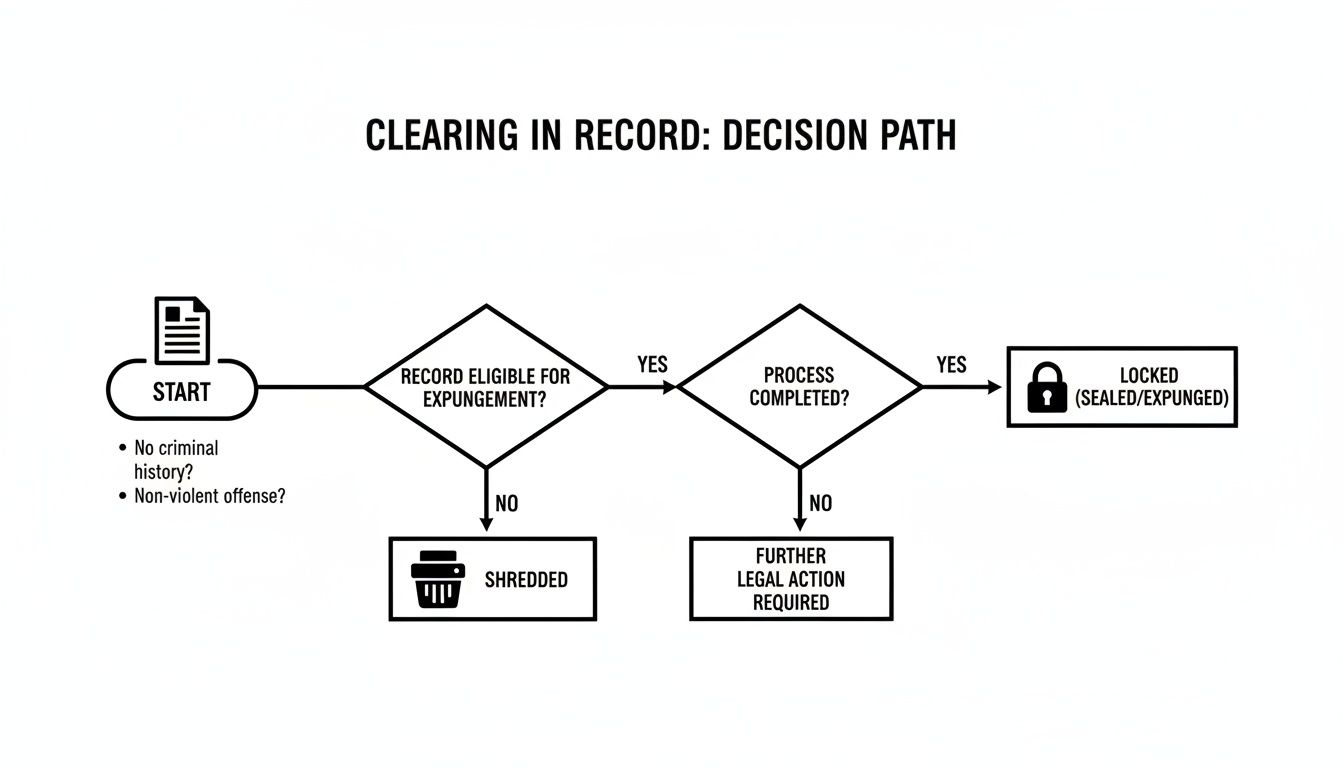
As you can see, the outcome of your case directly dictates whether your record can be "shredded" (expunged) or just "locked away" (sealed). It all comes back to how that initial case was resolved.
The Primary Pathways to Expunction
Texas law lays out a few clear paths to eligibility. Each one boils down to the same core idea: the criminal justice system couldn't—or didn't—prove you were guilty of what you were arrested for. An experienced Houston DWI lawyer can dig into your case history and see if it fits into one of these buckets.
You're generally eligible for an expunction if your situation looks like one of these:
- Your Case Was Dismissed: The prosecutor dropped the charges. This could happen for many reasons—not enough evidence, a witness issue, or your attorney successfully getting evidence thrown out (like a failed field sobriety test).
- You Were Acquitted at Trial: A judge or jury found you "not guilty." An acquittal is the ultimate green light for an expunction, giving you an immediate right to seek one.
- You Received a Pardon: This one is extremely rare, but if the Governor of Texas pardons you for the offense, you become eligible to have the entire record of that arrest and conviction destroyed.
- Charges Were Never Formally Filed: You were arrested, but the prosecutor’s office decided not to move forward with the case. Once the statute of limitations for that crime runs out, you can pursue an expunction.
For a DWI case, this means if your lawyer gets the traffic stop declared illegal or proves the breath test was unreliable, leading to a dismissal, you're on the right track for a full expunction. To learn more about the specific outcomes that make a DWI eligible, check out our comprehensive guide on whether a DWI can be expunged in Texas.
Who Is Not Eligible for Expunction
Knowing who doesn't qualify is just as crucial. The rules here are strict, with very little wiggle room.
You are not eligible for an expunction in Texas if you received a final conviction for the offense you were arrested for, whether through a plea bargain or a guilty verdict at trial.
Another common roadblock is deferred adjudication. If you received deferred, you are typically ineligible for an expunction. While a successfully completed deferred adjudication ends in a dismissal, it's different because it requires you to first plead "guilty" or "no contest." The law sees that differently. So, even though the case is dismissed, the record sticks around and may only be eligible for an order of nondisclosure (sealing), not total destruction.
Getting this first step right—determining your eligibility—is everything. A mistake here can cost you time, money, and hope. A qualified attorney can review the final disposition of your case and give you a clear, honest assessment of what your options really are.
Navigating the Texas Expunction Process

The legal system can feel like a maze, but getting your records expunged in Texas is actually a very structured journey. At its core, an expunction is a formal lawsuit you file against the State of Texas. Every step demands precision, and there's no room for error. Think of it as a methodical campaign to win back your clean slate.
Let's walk through each stage of this journey. This step-by-step guidance will demystify the process and show you exactly what to expect, making it clear why having an experienced Houston DWI lawyer by your side isn't just helpful—it's essential.
Step 1: Drafting and Filing the Petition for Expunction
It all starts with a legal document called a Petition for Expunction. This is no simple form you can just fill out. It’s a detailed lawsuit that has to be drafted perfectly, containing your personal information, the specifics of the arrest you want erased, and a comprehensive list of every government agency that might have a copy of those records.
Getting this list right is absolutely critical. It often includes:
- The arresting police department or sheriff's office
- The county or district clerk's office
- The prosecutor's office (like the District Attorney)
- The Texas Department of Public Safety (DPS)
- Any other agency involved in your arrest or booking
Once drafted, the petition has to be filed in the right court—usually the district court in the county where the arrest happened. A single mistake here, like forgetting to list an agency, can torpedo the whole effort and leave a stray record behind to haunt you later.
Step 2: Serving Notice to Government Agencies
After the petition is filed, you can't just sit back and wait. You have to formally notify every single agency listed in your lawsuit. In legal terms, this is called "serving" the petition. This step puts each agency on official notice about your lawsuit and gives them a chance to respond.
This isn't as simple as dropping a letter in the mail. It’s a formal legal procedure that requires proof of service for the court. Your attorney handles this complex web of communication, ensuring every entity is properly notified according to strict legal standards.
The law requires a mandatory 30-day waiting period after the agencies are served. This gives the prosecutor’s office time to review your case and decide if they want to fight it.
If the prosecutor agrees you're eligible, the process moves forward without a hitch. If they object, it’s time for a court hearing to settle the dispute.
Step 3: The Hearing and the Judge’s Final Order
If no one objects after the 30-day waiting period, your attorney can present a Final Order to the judge for their signature. In many cases, you won't even need to show up to court. But if the State pushes back, a formal hearing becomes necessary.
This is where having a skilled advocate is crucial. During the hearing, your lawyer will argue on your behalf, presenting evidence and legal arguments to prove you meet the strict eligibility requirements under Texas law. They’ll counter the state's objections and fiercely protect your right to a clean slate.
Once the judge is convinced, they will sign the Order of Expunction. This is the golden ticket—the official court command telling every agency to destroy your records.
Step 4: Verifying Record Destruction
Getting the judge’s signed order is a huge victory, but the job isn't done. The final, and arguably most important, step is making sure every single agency actually follows the court's command.
Government agencies are given a window of time—sometimes up to a year—to dig through their files and destroy every trace of your arrest. An experienced attorney doesn't just hope for the best; they follow up with each agency to get written confirmation that they've complied. This verification is your ultimate peace of mind, confirming your past is truly gone and no forgotten digital file or piece of paper can resurface years down the road.
How a Clean Record Transforms Your Future

Getting an expunction isn’t just about winning a legal case—it’s about reclaiming your life. When you get your records expunged in Texas, you’re not just hiding a past mistake. You’re legally erasing it. This is a critical distinction, and it unlocks doors that may have been slammed shut, giving you a genuine fresh start.
The single most powerful benefit? You regain the legal right to say "no" on applications asking if you've ever been arrested. In a world where background checks are everywhere, this is invaluable. It puts an end to awkward explanations and stops a dismissed case from being unfairly held against you.
Rebuilding Your Professional Life
An arrest record, even one that didn't lead to a conviction, can be a massive roadblock to your career. A successful expunction tears that roadblock down, opening up a world of professional opportunities that might have felt out of reach.
Just think about these advantages:
- Employment: You can apply for jobs with confidence, knowing a background check for that specific arrest will come back clean. It levels the playing field, letting you compete based on your actual skills and experience.
- Professional Licensing: Fields like nursing, real estate, teaching, and commercial driving have strict character and fitness requirements. An expunged record helps ensure a past arrest doesn't stop you from getting or renewing the license you need to do your job.
- Educational Goals: Many higher education programs, especially in specialized or graduate-level fields, run background checks. A clean slate ensures your academic future isn't derailed by an old charge.
Securing Personal Stability and Peace of Mind
The impact of a clean record goes far beyond the workplace. An expunction restores your personal freedom and quiets that constant worry that a past mistake could resurface at the worst possible moment. It fundamentally changes how you move through the world.
The true value of an expunction is the freedom it provides. It’s the ability to move forward without having to constantly look over your shoulder, allowing you to build the life you deserve without the weight of an unfair stigma.
This newfound freedom also makes a difference when you’re looking for a place to live, since landlords almost always run background checks. It can make it easier to get a loan or even volunteer in your community. You are no longer defined by a single moment in time.
The need for this fresh start is huge. Over 9 million Texans—a staggering 32% of adults—are burdened by criminal records, making it clear just how many people face these same challenges. This data reinforces that taking decisive legal action can turn the tide, helping you move past a DWI without a lifelong label. You can explore more about these findings on criminal record clearing in Texas to see the full scope of the issue.
Ultimately, pursuing an expunction is a strategic investment in yourself. It's a powerful step toward securing a brighter, unburdened future.
Why an Attorney Is Crucial for Your Expunction Case
It's tempting to think of an expunction as just a matter of filling out some forms. But here’s the reality: an expunction is a formal lawsuit you file against the State of Texas. Trying to handle this complex legal battle on your own isn't just difficult—it’s a huge risk. A single mistake can get your entire case thrown out, forcing you to start all over and costing you precious time and money.
Hiring a skilled criminal defense attorney isn't a luxury; it's a strategic move to make sure your case is handled with the precision it demands. An experienced lawyer does a lot more than just fill out paperwork. They act as your guide and your champion, shielding you from common but costly pitfalls that can derail your fresh start.
Avoiding Common DIY Pitfalls
Without a solid grasp of Texas expunction law, it's incredibly easy to make critical errors that put your whole case in jeopardy. Many people who try to file on their own quickly run into problems that a lawyer could have easily sidestepped.
Some of the most common mistakes include:
- Filing in the Wrong Court: Your petition has to be filed in the correct district court. Get this wrong, and your case can be dismissed before it even gets started.
- Failing to Notify All Agencies: You are required to identify and legally serve every single government entity that has a record of your arrest. This takes meticulous research, and missing even one can invalidate the entire process.
- Missing Critical Deadlines: The legal system is built on strict timelines. Missing a deadline for a filing, a response, or a court appearance can be fatal to your petition.
- Incorrectly Drafting the Petition: The legal language and specific information required in the petition have to be perfect to meet the court's standards. Any ambiguity can be used against you.
The Strategic Advantage of Legal Representation
At The Law Office of Bryan Fagan, PLLC, our team lives and breathes the specific nuances of getting records expunged in Texas, especially when they’re tied to a DWI arrest. We know the local court procedures in Houston and the surrounding counties, and we know how to build a rock-solid petition that leaves no room for error or objections from the state. You can learn more about the benefits of having a professional in your corner by reading our article on why you should hire a lawyer for a DUI expungement.
An expunction is your one shot at a truly clean slate. Having an attorney in your corner maximizes your chances of success and removes the stress of navigating a complicated legal system on your own.
If a prosecutor decides to challenge your right to an expunction, we'll be ready to stand up in court and argue forcefully on your behalf. We will present the evidence and legal precedent needed to prove you meet the strict eligibility requirements. Our entire goal is to take this burden off your shoulders so you can focus on your future, confident that your case is in capable hands. Don’t leave your fresh start to chance.
Common Questions About Texas Expunctions
The legal system can feel like a maze, and when you’re trying to clear your record, it’s only natural to have a lot of questions. People often feel uncertain about the process, how long it takes, and what the outcome will really be. We've put together straightforward answers to the questions we hear most often, helping you understand your rights so you can move forward with confidence.
How Long Does the Expunction Process Take?
The total time it takes to get a record expunged varies quite a bit depending on the county you’re in and the specific details of your case. Generally speaking, you should plan for the entire process to take somewhere between three to six months. That clock starts the moment your petition is filed and ends when every state agency has officially wiped the record clean.
This timeline includes a mandatory 30-day waiting period where government agencies have a chance to respond. If no one objects, a judge can sign off on the order shortly after that. But if a prosecutor challenges your petition, a hearing will be scheduled, which could add several more weeks to the process.
Can a DWI Conviction Be Expunged?
This is a critical point that trips up many people: a final DWI conviction cannot be expunged in Texas. Expunction is a remedy reserved only for arrests that didn't lead to a conviction. This means your case is eligible if the charges were dismissed, you were acquitted (found "not guilty") at trial, or if charges were never formally filed in the first place.
If you were actually convicted of DWI, that mark on your record is permanent unless you secure a gubernatorial pardon—which is extremely rare. This is exactly why it’s so important to fight a DWI charge from day one. The outcome of your criminal case directly determines whether you'll ever have the chance to get a truly clean slate.
The inability to expunge a conviction makes a strong initial defense crucial. The outcome of your DWI case directly determines whether you have a path to a truly clean slate later on.
What Happens If I Don't Expunge My Record?
Let's say your arrest record is eligible for an expunction, but you decide not to follow through. What happens? That arrest will stay on your public criminal history. Forever. It will keep popping up on background checks for jobs, apartment applications, professional licenses, and even when you try to volunteer at your kid's school.
Even though the case was dismissed, a potential employer or landlord might see the arrest and assume the worst, creating unfair roadblocks that follow you for years. Choosing not to expunge your record means letting one past mistake cast a long shadow over your entire future, keeping you from the complete fresh start that Texas law provides.
At The Law Office of Bryan Fagan, PLLC, we believe one mistake shouldn't define your future. A DWI arrest is a serious matter, but you have rights and options. If you are ready to put an arrest behind you, our experienced Houston DWI lawyers are here to help. We are committed to defending Texans and will fight to protect your rights and minimize consequences. Contact us today for a free, confidential consultation to discuss your case and find out if an expunction is the right path for you.