
A DWI arrest can be overwhelming—but you don’t have to face it alone. Yes, you can absolutely negotiate plea deals for DUI charges in Texas, and a skilled DWI attorney does this all the time. A plea deal isn't about admitting defeat. Think of it as a strategic negotiation aimed at reducing charges, minimizing penalties like jail time and fines, and ultimately, protecting your future.
Your First Steps After a Texas DWI Arrest
A DWI arrest in Texas can leave you feeling uncertain about what’s next, and it’s easy to feel like your life has been turned upside down. It’s critical to remember that an arrest is not a conviction. You have rights, and more importantly, you have options. This is the beginning of your defense strategy, and every decision you make from this point forward matters.
The moments and days after an arrest are often filled with confusing legal jargon and procedures. Understanding these concepts is the first step toward regaining control.
Key Terms You Need to Know
- DWI (Driving While Intoxicated): In Texas, you can be charged with DWI if you operate a motor vehicle in a public place while intoxicated. Intoxication is defined not only by alcohol level but also by impairment due to drugs or a combination of substances.
- BAC (Blood Alcohol Concentration): This is the metric used to measure the amount of alcohol in your system. The legal limit for most drivers over 21 in Texas is 0.08%. For commercial drivers, that limit drops to 0.04%, and for anyone under 21, any detectable amount of alcohol is illegal.
- Implied Consent: When you obtain a Texas driver's license, you automatically agree to provide a chemical sample (breath or blood) if lawfully arrested for DWI. Refusing this test carries its own consequences, including an automatic driver's license suspension.
The Two Battles You Must Fight
After a DWI arrest, you are fighting two separate cases simultaneously. The first is the criminal charge, which carries penalties like steep fines, probation, and potential jail time.
The second battle is the civil case, known as the Administrative License Revocation (ALR) hearing. This process determines the fate of your driving privileges and is entirely separate from the criminal court proceedings. A plea deal in your criminal case does not automatically resolve your license suspension. You must address the ALR hearing separately, and you only have 15 days from the date of your arrest to request one to fight the suspension.
Understanding this dual-front battle is essential. A knowledgeable Houston DWI lawyer can guide you through both processes, ensuring that a decision in one case doesn't negatively impact the other. The goal is to build a comprehensive defense that protects both your freedom and your ability to drive.
What Is a DWI Plea Deal in Texas?
A DWI plea deal is not a surrender—it’s a strategic negotiation. It’s a calculated legal process where your attorney and the prosecutor work out an agreement to resolve your case without the risks of a trial.
Think of it this way: facing a DWI is like a high-stakes bet with an unpredictable outcome. A plea bargain is your chance to negotiate a guaranteed, more favorable settlement instead of gambling on a jury’s verdict. It’s about taking control of a situation that can feel completely out of your hands.
The goals behind pursuing plea deals for dui charges are direct and powerful:
- Reduce the Charge: The best-case scenario is often getting the DWI reduced to a lesser, non-alcohol-related offense, like Obstruction of a Highway or Reckless Driving.
- Minimize Penalties: Negotiations aim to soften the blow—think lower fines, no jail time, and preventing a lengthy driver's license suspension.
- Avoid Trial: A trial is expensive, stressful, and the outcome is never guaranteed. A plea deal offers certainty and allows you to move on with your life.
Why Would a Prosecutor Negotiate a DWI Case?
It might seem strange that a prosecutor would be willing to make a deal, but the criminal justice system relies on these agreements. Prosecutors in busy Texas counties like Harris, Dallas, and Travis manage massive caseloads. Their primary goal is to secure convictions efficiently.
This pressure creates an opportunity for your defense. A sharp Houston DWI lawyer can expose weaknesses in the state’s case—perhaps the breathalyzer was calibrated incorrectly, or the initial traffic stop was illegal. When a prosecutor faces a legitimate challenge that could lead to a "not guilty" verdict, they are often more willing to offer a favorable deal rather than risk losing in court. A plea deal isn't a sign that your case is weak. More often, it's a sign that the prosecutor's case has weaknesses that your attorney has successfully exposed.
This strategic pressure is key. By preparing every case as if it's going to trial, we build the leverage to negotiate from a position of strength.
The Overwhelming Majority of Cases End in Plea Deals
If you are considering a plea deal, you are not alone. It's the standard way criminal cases are resolved. In fact, a staggering 95% of state criminal convictions, including DWIs, result from plea agreements, not trials. For federal cases, that rate is even higher at 98%, showing just how much prosecutors rely on them to manage dockets.
This statistic isn't just a number; it demonstrates that negotiation is a normal, effective part of the legal system. It's also helpful to understand how plea bargains in Texas compare to other states to get a complete picture. A plea deal is an active, strategic decision you make with the help of a legal professional who knows the local courts and prosecutors. It's about turning a moment of crisis into a clear plan to protect your future.
What a DWI Plea Deal Actually Looks Like in Texas
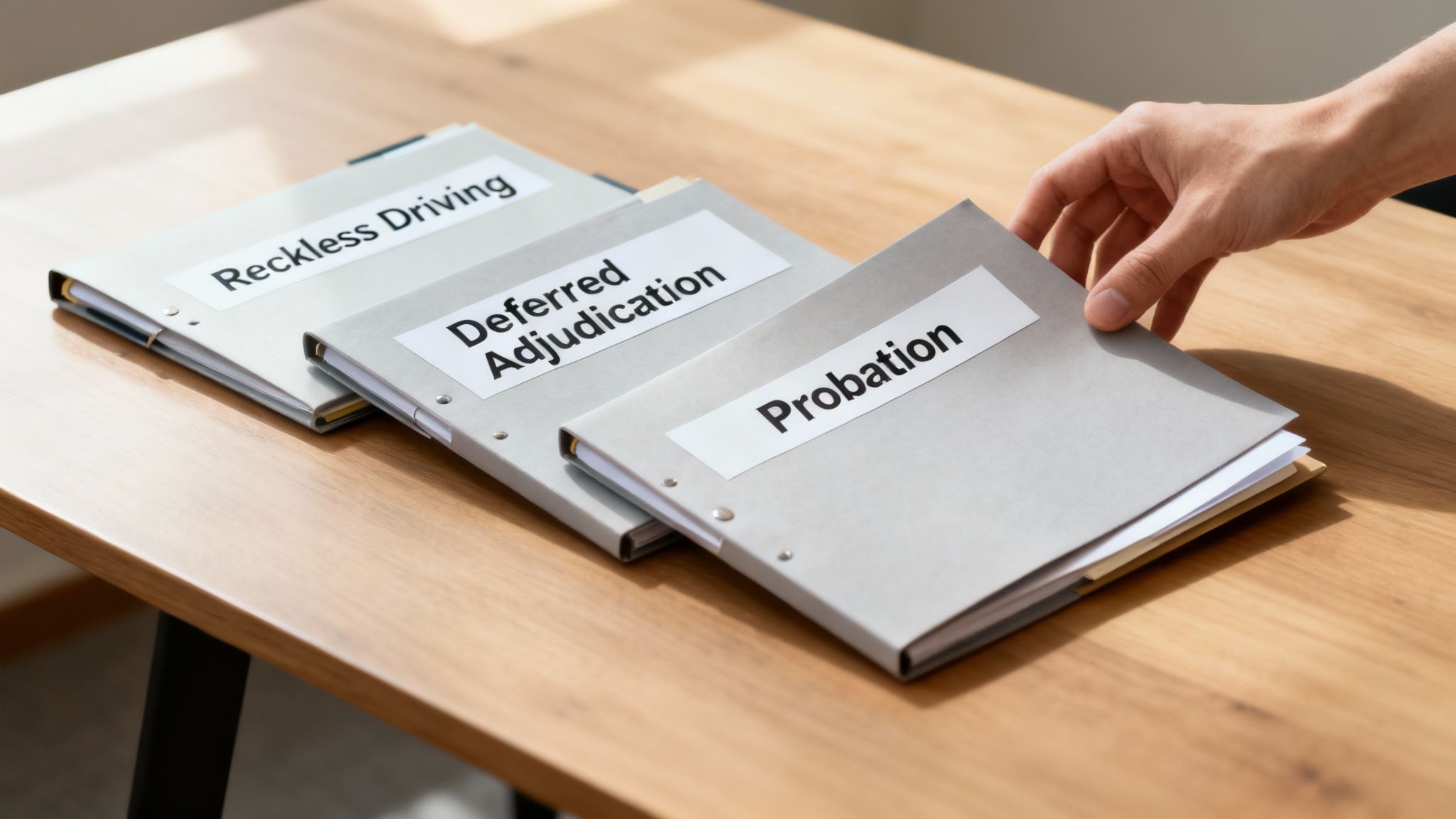
When you're facing a DWI charge in Texas, your options are not one-size-fits-all. The best path forward depends on the specific facts of your case, the strength of the prosecutor's evidence, and your personal priorities.
A skilled defense attorney isn’t just looking for any deal; they're fighting for an agreement that addresses what matters most to you. Whether your priority is keeping a conviction off your record, avoiding jail time, or protecting your driver's license, the goal is to find the most favorable resolution possible. Let's break down some of the most common plea agreements we fight for in Texas DWI cases.
Getting a DWI Reduced to a Non-Alcohol Offense
This is often the gold standard in DWI plea negotiations. Having a DWI charge reduced to a non-alcohol-related traffic offense is a significant victory. It removes the stigma of a DWI from your record and helps you avoid many of the harshest consequences.
Two common reductions we aim for are:
- Obstruction of a Highway: This Class B misdemeanor sounds much better on a background check than "Driving While Intoxicated." It essentially states you were blocking a public road, which carries far less weight with employers and licensing boards.
- Reckless Driving: Also a Class B misdemeanor, this charge suggests you drove with a "willful or wanton disregard for the safety of persons or property." While still a serious traffic violation, it crucially avoids the automatic driver's license surcharges and skyrocketing insurance premiums tied to a DWI conviction.
Securing this type of reduction can be a difference-maker for your career, especially if you hold a professional license.
Deferred Adjudication: A Path to Dismissal
For many first-time offenders, deferred adjudication is an excellent outcome. It is a form of probation that gives you a chance to earn a complete dismissal of your case. However, it is not available to everyone. You generally won't qualify if you have a Commercial Driver’s License (CDL) or if your BAC was 0.15 or higher.
The process typically works as follows:
- You enter a plea of "guilty" or "no contest."
- The judge "defers" a finding of guilt and places you on community supervision (probation) for a set period.
- During that time, you must follow all court-ordered conditions, which may include paying fines, attending DWI education classes, and installing an ignition interlock device on your vehicle.
If you successfully complete the probation period, the judge dismisses the charge. While the arrest remains on your record, you avoid a final conviction. Later, you may be able to have the record sealed from public view with an order of non-disclosure.
Straight Probation: Avoiding Jail Time
Sometimes, the facts of a case make a dismissal or reduction unlikely. In those situations, negotiating for "straight probation" becomes the primary goal. This plea deal does result in a final DWI conviction but allows you to serve your sentence in the community instead of in jail. While a conviction will appear on your record, straight probation is a critical outcome that prevents jail time, allowing you to maintain your job and support your family.
The conditions are similar to deferred adjudication—fines, classes, and regular check-ins with a probation officer. The key difference is that the conviction remains on your record permanently and cannot be sealed. Still, understanding how plea deals can affect the overall costs of a DWI makes it clear that staying out of jail is a massive financial and personal victory.
Comparing Common Texas DWI Plea Deal Outcomes
| Outcome Type | Typical Plea Deal Result (e.g., Deferred Adjudication) | Result of DWI Conviction After Trial |
|---|---|---|
| Criminal Record | No final conviction; charge is dismissed after probation. Record may be sealed later. | Permanent DWI conviction that cannot be sealed or expunged. |
| Jail Time | No jail time is served. | Potential jail sentence ranging from 3 days to 180 days for a first offense. |
| Driver's License | Shorter suspension period, often with eligibility for an occupational license. | Longer suspension period (90 days to 1 year) and mandatory annual surcharges. |
| Future Impact | Minimal impact on most jobs and housing once the record is sealed. | Significant negative impact on employment, professional licenses, and insurance rates. |
| Overall Cost | Lower overall costs due to avoiding jail, fewer surcharges, and shorter probation. | Higher costs from fines, court fees, surcharges, and lost income if jail time is served. |
Each of these options represents a strategic maneuver to control the damage from a DWI arrest. A knowledgeable DWI attorney will analyze the evidence to determine which path gives you the best chance to protect your freedom and your future.
Key Factors That Influence Your Plea Offer
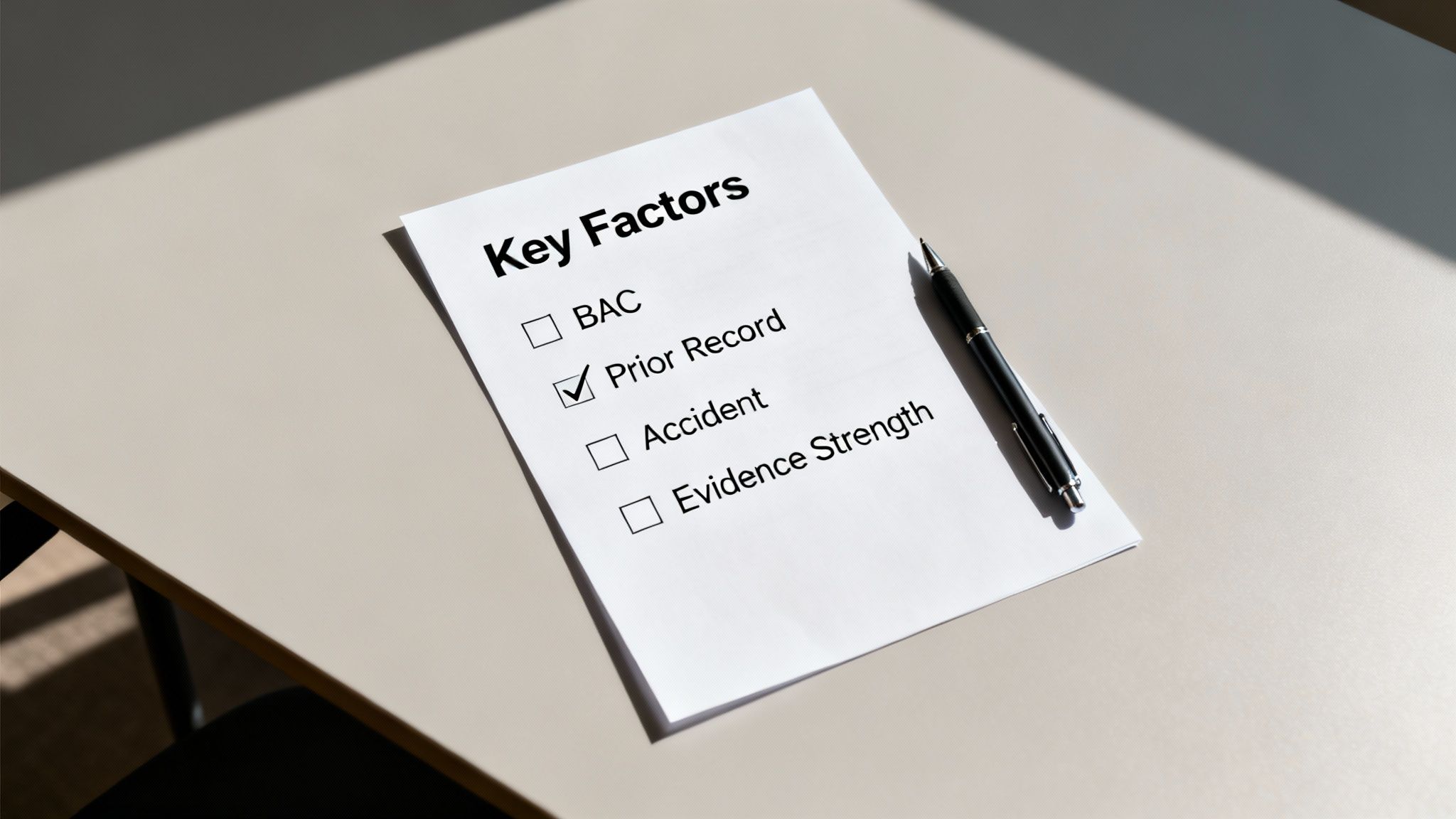
The quality of a plea offer from a prosecutor comes down to one powerful concept: leverage. A prosecutor’s initial offer is based on how strong they believe their case is. Our job is to find the weaknesses in their evidence and systematically dismantle their confidence. Every negotiation is a strategic process where they weigh the facts of your arrest, your personal history, and the strength of the evidence. The more weaknesses we expose, the more motivated they become to offer a better deal.
Your Personal and Case-Specific Details
The first things a prosecutor looks at are the fixed facts of your case. These details create the initial baseline for any plea offer.
These factors can make negotiations tougher:
- Your Criminal History: A clean record is a significant asset. A first DWI in Texas is viewed much differently than a second or third offense. Prosecutors are less inclined to show leniency to repeat offenders.
- Your Blood Alcohol Concentration (BAC): A BAC of 0.15% or higher is an aggravating factor in Texas, which can trigger tougher penalties and disqualify you from options like deferred adjudication.
- Aggravating Circumstances: The presence of an accident, property damage, injury, or a child under 15 in the car can elevate a standard DWI to a more serious charge, making a favorable plea deal harder to secure.
The Strength of the Evidence Against You
This is where a skilled Texas DUI attorney makes a difference. You can’t change your BAC or your prior history, but you can challenge the evidence the state plans to use against you. This is how we build the leverage needed to negotiate from a position of strength.
We dig into every report, video, and maintenance log to find procedural mistakes and constitutional violations that can turn their "slam dunk" case into a risky bet. A prosecutor's confidence is built on their evidence. When your attorney successfully challenges the legality of the traffic stop or the accuracy of a breath test, that confidence crumbles—and the door to a better plea deal opens.
We leave no stone unturned, asking critical questions:
- Was the traffic stop lawful? Did the officer have "reasonable suspicion" to pull you over? If not, all evidence gathered afterward could be thrown out of court.
- Were the field sobriety tests administered correctly? These standardized tests have strict protocols. Any deviation by the officer can make the results unreliable and inadmissible.
- Was the breathalyzer working properly? We demand the machine’s maintenance and calibration logs. An improperly maintained device is known to produce false high readings.
These are not minor technicalities; they are powerful bargaining chips. Each flaw gives the prosecutor a reason to avoid the risk of a jury trial. Rather than risk losing in court, they become more willing to offer a reduced charge or a more lenient sentence. This dynamic is why a majority of cases are resolved through pleas, a trend supported by data from organizations like MADD reports.
How a DWI Attorney Builds a Winning Negotiation Strategy
Securing a favorable plea deal doesn't happen by waiting for a prosecutor's generous offer. A successful outcome is earned through a proactive, aggressive defense strategy designed to force a better result. A strong defense isn't just for a jury trial; it's the leverage you need to win the negotiation.
The work begins the moment you hire our firm. We immediately start dissecting the State's evidence in a deep-dive into every report, video, and log tied to your arrest. This painstaking review is what creates the pressure needed to challenge the State’s case.
Systematically Taking Apart the Prosecution's Case
Our first move is to demand all evidence through the "discovery" process. Once we have it, we scrutinize every detail for weaknesses, procedural errors, and constitutional violations.
Our evidence review process is exhaustive and includes:
- Dashcam and Bodycam Footage: We watch every second, looking for contradictions between the officer's actions and their report. Did they have a legal reason for the stop? Were the field sobriety tests administered by the book?
- Police Reports: We cross-reference every statement in the report against the video evidence. Vague language or contradictions can become powerful arguments in your favor.
- Breathalyzer and Blood Test Records: We never take chemical test results at face value. We demand maintenance logs, calibration records, and lab procedures to ensure everything was done correctly. An improperly handled sample or a poorly maintained machine can render the results invalid.
By identifying these errors, we weaken the prosecutor's case long before ever setting foot in a courtroom. Our comprehensive approach to DWI defense strategies is built to create this critical leverage from day one.
Turning Their Weaknesses Into Our Bargaining Chips
Every mistake we find becomes a bargaining chip. For example, if we can prove the initial traffic stop was illegal, any evidence gathered after that point—including the breath or blood test—could be thrown out. This is called suppression, and it can gut the prosecutor's case. When a prosecutor faces the real possibility of losing at trial, they are suddenly much more willing to offer a significant reduction.
This is what strategic pressure looks like. While it was once common to plead DWIs down to non-alcohol-related charges, recent reforms have changed the landscape. Today, a successful negotiation might focus on a creative compromise that softens the consequences, like avoiding jail or protecting a professional license. You can learn more about these nationwide trends in plea deal reforms. A strong defense strategy isn't just about fighting in court; it's about creating a scenario where the prosecutor decides that offering a favorable plea is a smarter move than risking a trial they might lose.
This isn't about finding "loopholes." It's about holding the government to its high burden of proof and ensuring your constitutional rights were protected. By building an aggressive and thorough defense, we create the leverage needed to negotiate for the best possible outcome for you.
Should You Accept a Plea Deal or Go to Trial?
Deciding whether to accept a plea bargain or take your DWI case to trial is the single most important choice you will make. It’s a tough decision, pitting the certainty of a known outcome against the chance of complete exoneration. You are not in this alone. Our job is to provide the clear, strategic counsel you need to weigh the risks and benefits with confidence.
Accepting a plea deal offers a predictable result. You know exactly what penalties you’ll face, which often means reduced fines, no jail time, and less stress. It puts an end to the uncertainty. However, it almost always results in some kind of mark on your record.
Going to trial, on the other hand, is your shot at a "not guilty" verdict. A win means total vindication. But that path comes with significant risk. If a jury finds you guilty, the judge could impose penalties far harsher than what the prosecutor originally offered.
A Strategic Risk-Benefit Analysis
Think of this decision as a strategic calculation. We will meticulously analyze the prosecutor’s evidence, every weakness we've uncovered, and the likely outcomes of a trial before a local judge and jury.
Plea Deal Pros: Certainty, reduced penalties, lower legal costs, and less emotional strain.
Plea Deal Cons: Usually results in some form of conviction or probation on your permanent record.
Trial Pros: The chance for a "not guilty" verdict and complete exoneration.
Trial Cons: The risk of a conviction with more severe penalties, higher legal costs, and a long, stressful process.
The negotiation strategy we build together directly influences this decision. We follow a clear process designed to put you in the strongest possible position.
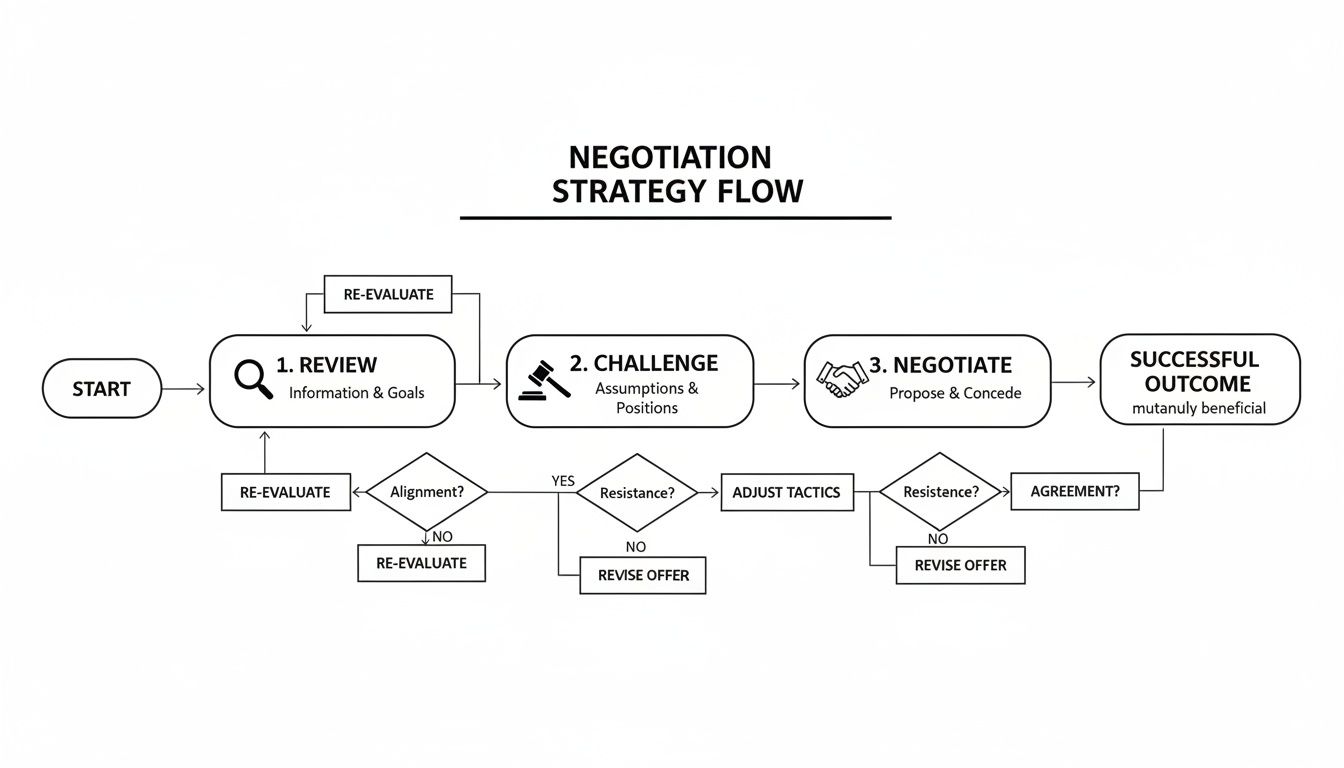
This process shows how we start by reviewing the evidence, then systematically challenge its validity, and finally, negotiate from a position of strength.
Making an Informed Decision Together
Ultimately, the choice is always yours, but our guidance is here to light the way. We will give you an honest assessment of your chances at trial versus the specific terms of any plea deals for dui charges on the table. Our commitment is to ensure you fully understand the pros and cons of each path. We lay out the facts and provide our professional recommendation so you can make an empowered, informed decision that aligns with your goals and protects your future.
Whether you're facing a first DWI in Texas or a more complex charge, you deserve a defense team that respects your role in the process. We are here to provide the strategic insight you need to navigate this critical decision.
Unpacking DWI Plea Deals: Your Questions Answered
If you’re facing a DWI arrest, your mind is probably racing with questions. Getting clear, straightforward answers is the best way to regain a sense of control. Here are some of the most common questions we hear about plea deals for dui charges in Texas.
Can a DWI Be Knocked Down to Something Less Serious?
Yes, this is often our primary goal in negotiations. A savvy Houston DWI lawyer can frequently make a strong case for reducing a DWI charge to a non-alcohol offense like Obstruction of a Highway or Reckless Driving. This is a significant win, as it helps you avoid the heavy stigma and lasting damage of a permanent DWI conviction on your record, protecting everything from your reputation to your job prospects.
Does Taking a Plea Deal Mean I’m Admitting I’m Guilty?
Not necessarily. Texas law allows you to plead "no contest," also known as nolo contendere. This means you are not admitting guilt, but you are agreeing to accept the court’s punishment for the charge. This is an important distinction, as a no-contest plea generally cannot be used against you as an admission of guilt in a related civil lawsuit, such as one filed after a car accident connected to the DWI arrest.
Will This Plea Deal Haunt My Record Forever?
It depends on the specific deal. Some outcomes, like deferred adjudication, offer a clear path to keeping your record clean. If you successfully complete the terms of your community supervision, the judge dismisses the case. Once dismissed, you can often petition the court for an order of non-disclosure, which seals the record from the public, meaning most employers and landlords will never see it. We will walk you through the long-term implications of any deal on the table.
Can I Still Lose My License Even if I Take a Plea?
Yes. This is a crucial point that many people misunderstand. The process to suspend your driver’s license—the Administrative License Revocation (ALR) hearing—is a separate civil case from your criminal DWI charge. A plea bargain only resolves the criminal side. You must still fight the license suspension separately in the ALR process to protect your driving privileges. Our firm handles both of these critical proceedings to ensure your defense is coordinated and comprehensive.
A DWI charge can feel like a crushing weight, but you don’t have to carry it alone. At The Law Office of Bryan Fagan, PLLC, our experienced Texas DWI attorneys are ready to build a strategic defense aimed at securing the best possible outcome for you. Contact us today for a free, confidential case evaluation to understand your options and start protecting your future.