
A DWI arrest can be overwhelming—but you don’t have to face it alone. Being charged with Driving While Intoxicated (DWI) in Texas is a deeply unsettling experience, but it's important to know that a plea bargain can offer a strategic path forward. In simple terms, a plea bargain is a negotiated settlement between your lawyer and the prosecutor. The goal is to resolve your case without the uncertainty of a trial, often leading to a much better outcome than you might otherwise face.
Your Guide to Navigating a Texas DWI Plea Bargain

If you're facing a DWI charge in Texas, your mind is probably racing. You're worried about your driver's license, the threat of jail time, and the impact this will have on your record. The first thing to remember is that an arrest is not a conviction. You have rights and options, and one of the most powerful tools in a skilled defense attorney's arsenal is the plea bargain.
This isn't about giving up; it's a calculated, strategic move meant to protect your future and minimize the consequences. A sharp Houston DWI lawyer will analyze every detail of your case—from the legality of the initial traffic stop to the accuracy of the breath or blood test—to find leverage for negotiations. It's all about fighting for a resolution that allows you to move on with your life.
Understanding Your Options
When we discuss a DWI plea bargain, the primary goal is to secure a deal that is far better than the worst-case scenario of a trial conviction. Your attorney will advocate for several possible outcomes on your behalf.
Here are the most common goals we aim for:
- Reduced Charges: This is a significant victory. We work to have the DWI charge reduced to a lesser, non-alcohol-related offense like Obstruction of a Highway or Reckless Driving.
- Deferred Adjudication: This can be a game-changer. You complete a term of probation, and if you meet all the conditions, the judge dismisses the case. This means no final conviction goes on your public record.
- Probation Instead of Jail: For a first DWI in Texas, keeping you out of jail is our top priority. We can often negotiate for community supervision, educational classes, and other conditions instead of time behind bars.
A plea bargain provides certainty in an uncertain situation. Instead of gambling on the outcome of a jury trial, you and your attorney take control by agreeing to a specific, manageable resolution.
Think of it like settling a lawsuit. Both sides evaluate the strengths and weaknesses of their case and realize a negotiated agreement is more sensible than a costly, unpredictable trial. For you, it means sidestepping the immense stress of a court battle and getting a clear, defined end to this ordeal. A seasoned Texas DUI attorney knows exactly how to present the strong points of your defense to convince a prosecutor that a favorable plea is the right move. You don't have to figure this out alone.
Here’s a quick breakdown of how these different outcomes compare.
Common DWI Plea Bargain Outcomes at a Glance
This table summarizes potential outcomes from a DWI plea bargain, helping you quickly understand the key differences between various resolutions.
| Plea Outcome | Description | Potential Benefit | Impact on Record |
|---|---|---|---|
| Charge Reduction | Pleading to a lesser, non-alcohol offense like Reckless Driving. | Avoids the specific stigma and penalties of a DWI conviction. | Results in a conviction for the lesser charge, not a DWI. |
| Deferred Adjudication | Completing probation successfully to have the case dismissed. | No final conviction appears on your public criminal record. | Arrest record remains but can often be sealed later. |
| Probation | Serving a sentence in the community instead of jail. | Avoids incarceration and allows you to maintain work/family life. | Results in a final DWI conviction on your permanent record. |
Understanding these distinctions is the first step in mapping out a defense strategy that aligns with your specific needs and priorities.
Why Plea Bargains Are a Reality in Texas DWI Cases
When you are charged with a DWI, your mind probably jumps to a courtroom drama with a judge and jury. The reality is that the vast majority of DWI cases in Texas—and across the country—are not resolved by a trial verdict. They're resolved through a plea bargain.
Understanding why this is the norm is the first step toward a strong defense. It's not about giving up; it's about being strategic.
A System Under Pressure
The simple truth is that our courts are overloaded. Prosecutors in Texas manage immense caseloads, and the entire system would grind to a halt if every single DWI case went to a full trial. Plea bargains serve as a practical pressure-release valve that keeps the justice system moving.
It's All About Managing Risk
At its core, a plea bargain is a risk-management tool for both sides. A trial is a high-stakes gamble. You might be completely exonerated, which is the best-case scenario. Or, you could be convicted and face the maximum penalties allowed by law. That’s a huge amount of uncertainty for you and the prosecutor.
The prosecutor knows they could lose at trial. If there's a weak spot in their case—perhaps the traffic stop was questionable, the breathalyzer wasn't properly calibrated (BAC testing issues), or there was a procedural error—they may be eager to secure a guaranteed conviction, even if it’s for a lesser charge. For you, a plea deal removes the worst-case scenario and provides a predictable outcome you can plan for.
A plea bargain is simply a negotiated settlement. You agree to a specific, known outcome to avoid the stress and uncertainty of a trial, often resulting in a much more favorable resolution.
This is a calculated legal move. A skilled Texas DUI attorney knows how to analyze the prosecution's case, identify the cracks, and negotiate from a position of strength to secure a deal that truly protects your future.
The Numbers Don't Lie
This reliance on plea deals is fundamental to the American justice system. The statistics are revealing: at the federal level, approximately 98% of all convictions result from plea bargains. At the state level, it's around 95%. This reality creates a powerful incentive to negotiate, as defendants who go to trial and lose often face far harsher sentences. You can explore more about how plea deals work and see just how common they are.
This is precisely why having an experienced negotiator in your corner is essential. The system is built around these agreements. Your attorney’s ability to fight DWI Texas charges begins the moment they open communication with the prosecutor. They will dissect the evidence, challenge every weakness, and build the leverage needed to secure a resolution that serves your best interests, not just accept the first offer on the table.
Exploring Reduced Charges and Alternative Sentences
When an attorney negotiates a plea bargain, they are fighting for specific outcomes that can dramatically alter the course of your life after a DWI arrest. A smart negotiation can be the difference between a permanent, life-altering conviction and a resolution that lets you move on and protect your future.
The primary goal is to steer your case away from the serious category of alcohol-related driving offenses and toward something far less damaging. This is where an experienced Houston DWI lawyer proves their worth—by finding weaknesses in the prosecutor's case and using them as leverage to secure a better deal for you.
Securing a Reduced Charge
One of the best possible results of a DWI plea bargain is having the charge reduced to something that isn't alcohol-related. A DWI conviction carries a heavy stigma and harsh penalties that can follow you for years. A lesser charge, while still a criminal offense, removes that damaging "DWI" label from your permanent record.
In Texas, we often see reductions to charges like:
- Obstruction of a Highway: This is a Class B misdemeanor, the same classification as a first-time DWI. The critical difference is that it doesn't come with the automatic DWI license suspension or the social baggage of a DWI.
- Reckless Driving: This charge indicates you drove in a dangerous manner, but it completely removes the element of intoxication from the official record.
Achieving this kind of reduction is a major win. It helps you avoid mandatory driver's license surcharges, significant insurance rate hikes, and having to disclose a DWI conviction on job applications. Your attorney makes this possible by highlighting problems with the evidence—like a questionable traffic stop or breathalyzer issue—and convincing the prosecutor that a guaranteed conviction on a lesser charge is a smarter move than risking losing the case at trial.
The Power of Deferred Adjudication
For many people facing a first DWI in Texas, deferred adjudication is the absolute best-case scenario. It's a unique legal pathway that offers a chance to keep a DWI conviction off your public criminal record entirely.
You technically plead "guilty" or "no contest," but the judge defers a finding of guilt.
Deferred adjudication is an opportunity to prove yourself. If you successfully complete the community supervision (probation) terms set by the court, the judge will dismiss the case, and you will not have a final conviction on your record.
This outcome is a game-changer for your future. Once the case is dismissed, you can legally and truthfully say you have not been convicted of the crime. Later, you may be eligible to have the arrest record sealed from public view through a petition for non-disclosure, giving you a truly clean slate.
Understanding Probation and Its Conditions
Whether you receive deferred adjudication or straight probation as part of your plea, you must follow a strict set of court-ordered rules. These conditions are not just punitive; they are designed to be rehabilitative and prevent future offenses.
Common terms of probation almost always include:
- Ignition Interlock Device (IID): You will likely have to install a device that requires a clean breath sample before your vehicle will start.
- DWI Education Classes: Completing a state-approved alcohol education course is standard.
- Community Service: Expect to perform a set number of hours of unpaid work.
- Regular Check-ins: You must report to a probation officer regularly.
- Fines and Court Costs: Paying all associated fees is mandatory for successful completion of your probation.
While these requirements demand commitment, they are a world away from sitting in a jail cell. A good attorney's job is to negotiate probation terms that are fair, reasonable, and manageable for your specific situation.
To help you see how these different outcomes compare, here is a quick comparison of the most common plea bargain results in Texas.
Comparing DWI Plea Outcomes in Texas
This table breaks down the key differences between common DWI plea results, focusing on their long-term impact on your criminal record and ability to drive.
| Outcome | Final Conviction? | Eligibility for Record Sealing | Impact on Driver's License | Common Conditions |
|---|---|---|---|---|
| Reduced Charge | Yes (for the lesser offense) | Yes, after a waiting period | Avoids automatic DWI suspension | Fines, classes, possible probation |
| Deferred Adjudication | No (if completed successfully) | Yes (Petition for Non-Disclosure) | License may still be suspended (ALR) | IID, probation, classes, fines |
| Straight Probation | Yes (DWI Conviction) | No | Automatic suspension + surcharges | IID, probation, classes, fines |
Understanding these distinctions is critical. A plea bargain is all about securing a resolution that allows you to move forward with the least possible damage to your life. For a deeper look, you can read more about the various alternative sentencing options for DUI offenders that might be on the table in your case.
How Your Attorney Fights for a Better Deal

Securing a favorable plea bargain isn't a passive process. It’s a fight, and a prosecutor's first offer is rarely their best one. For a skilled Texas DWI attorney, the real work starts long before any negotiation begins. It begins with a comprehensive investigation of every piece of evidence.
This deep dive is the foundation of your entire defense. Your lawyer will do more than just scan the police report; they are searching for procedural errors, constitutional rights violations, and questionable science that can dismantle the state’s case. Every weakness they uncover becomes leverage in your favor.
Finding the Cracks in the Prosecution's Case
A DWI case is only as strong as its evidence. An experienced defense lawyer knows exactly where to apply pressure to see if that evidence will crack. The objective is simple: create enough reasonable doubt to make a prosecutor reconsider going to trial.
This investigative work involves asking tough questions:
- Was the initial traffic stop legal? An officer cannot pull you over on a whim. Without a legitimate reason, like a clear traffic violation, any evidence gathered after the stop could be suppressed in court.
- Were the field sobriety tests administered correctly? These tests (SFSTs) are not arbitrary; they follow strict, standardized protocols. Any deviation by the officer—or a failure to consider factors like your medical history or road conditions—can render the results unreliable.
- Can we trust the breath or blood test? A Blood Alcohol Concentration (BAC) test must be accurate. Breathalyzers require regular calibration and maintenance logs. Blood samples demand an unbroken chain of custody. Any procedural slip-up can make that critical BAC number inadmissible.
A plea negotiation is a strategic exchange. Your attorney leverages the weaknesses in the prosecutor’s case to trade the risk of a trial for the certainty of a more favorable outcome for you.
When your lawyer successfully exposes holes in the key evidence, the prosecutor's "slam dunk" case suddenly appears much less certain. That is precisely when they become more willing to discuss a reduced charge or an alternative sentencing option.
The Art of Strategic Negotiation
With a clear understanding of the state's vulnerabilities, your attorney can negotiate from a position of strength, not desperation. They are not just asking for a better deal; they are demonstrating to the prosecutor why you deserve one. Often, they will file motions to suppress evidence, signaling that they are fully prepared to go to court and win.
This is where having a lawyer with local courtroom experience provides a significant advantage. An attorney who regularly practices in the courts of Houston, Austin, or Dallas-Fort Worth knows the prosecutors and judges. They understand who is tough, who is reasonable, and which arguments are most effective. This local knowledge helps them craft a strategy tailored for success in that specific courthouse.
The negotiation itself is a give-and-take. Your lawyer presents the case's weak points and the risks the prosecutor faces at trial. In return, the prosecutor might offer a plea to a lesser offense or agree to deferred adjudication to avoid a fight they could lose. You can explore a detailed overview of what a DWI lawyer does to help you fight your charges and prepare a robust defense. The ultimate goal is to find a resolution that minimizes the damage to your life and future.
Deciding if a Plea Bargain Is Right for You
Accepting a plea deal is a major decision. It’s something you and your attorney must agree on with complete clarity. This is not a moral admission of wrongdoing; it’s a strategic legal move based on the evidence against you, the risks of a trial, and the outcome that best protects your future.
To make an informed choice, you need a clear-eyed assessment of what you gain and what you give up. Think of it as a cost-benefit analysis for your life, with your lawyer serving as your most important advisor in the process.
The Advantages of a Negotiated Plea
The primary reason to accept a plea bargain is certainty. A trial is unpredictable, no matter how strong your case seems. A plea agreement removes that uncertainty and puts you back in control with a defined, manageable outcome.
Other significant advantages include:
- Avoiding Trial Stress and Costs: A jury trial is incredibly stressful and can be expensive. A plea bargain resolves the case much faster, allowing you to move on with your life.
- Securing Reduced Penalties: This is the core of the negotiation. A good plea deal often means avoiding jail time, paying lower fines, and receiving manageable probation terms.
- Protecting Your Record: A plea can be a major victory for your record. It might mean reducing the charge to a less serious offense or securing a path to dismissal through deferred adjudication.
Understanding the Trade-Offs
While the benefits can be substantial, you must also be honest about what you are giving up. Accepting any plea, even a favorable one, involves consequences and waiving some of your fundamental rights.
Here’s what you need to be ready to discuss with your lawyer:
- Waiving Your Right to Trial: This is the most significant trade-off. You are relinquishing your constitutional right to have a jury of your peers hear the evidence and determine your fate.
- Accepting Consequences: Even the best plea deal is not a free pass. You will almost certainly face probation, fines, mandatory classes, and the installation of an ignition interlock device in your vehicle.
- Facing a Permanent Record: If you do not secure a deal like deferred adjudication, pleading to a DWI or even a reduced charge will result in a permanent conviction on your criminal record.
A plea bargain is not an admission of defeat. It is a strategic move to secure the most favorable outcome possible when the risks of a trial outweigh the potential rewards.
Ultimately, this is a deeply personal choice. Some individuals will do anything to avoid a conviction, while others might prefer the certainty of a set probation term over the all-or-nothing gamble of a trial. Your Texas DUI attorney is there to help you determine your priorities and build a legal strategy around them.
Special Considerations for Young Drivers
For drivers under 21, the decision to accept a plea bargain becomes even more complex. It can seem like the quickest way out of a frightening situation, but it can also have hidden long-term consequences.
For most people, a plea deal does not significantly change their odds of reoffending. However, there is a crucial exception for young drivers. Research has shown that for those under 21, accepting a plea is linked to a nearly doubled risk of another DUI-related offense within a year—the rate jumps from under 6% to almost 11%. You can explore the research about plea bargains and recidivism rates yourself to see the data.
This statistic underscores how critical it is to explore every possible defense before a young person, whose entire future is at stake, accepts a plea.
How a Plea Deal Impacts Your License and Future
When you are arrested for a DWI in Texas, you are essentially fighting a war on two fronts. One battle is the criminal case, where you face fines, probation, or even jail time. The other is a civil case known as the Administrative License Revocation (ALR) process, which deals exclusively with your driver's license.
It is absolutely crucial to understand that these two cases are separate. A plea bargain in your criminal case does not automatically save your license from suspension by the Texas Department of Public Safety (DPS). This is part of the state's "implied consent" law, which states that by driving, you have already consented to a breath or blood test if lawfully arrested for DWI. Refusing a test triggers an automatic administrative license suspension.
The clock on the ALR process starts the moment you're arrested. You have just 15 days from that date to request a hearing to challenge the suspension. If you miss that deadline, your license is suspended automatically, regardless of what happens in your criminal case. This is one of the most urgent deadlines you face.
The Two Arenas of a DWI Charge
Think of it this way: the criminal court and the ALR hearing are two different venues with different rules. A victory in one does not guarantee a victory in the other.
- Criminal Court: This is where plea negotiations occur. A good deal can reduce your charge or keep a conviction off your record, but the judge in this court cannot reverse the ALR suspension.
- ALR Hearing: This is your only opportunity to prevent the automatic license suspension. A skilled lawyer will use this hearing to challenge the details of the stop and arrest to protect your driving privileges.
Because you must fight both battles simultaneously, you need an attorney who can develop a comprehensive strategy. To learn more about this process, you can find out how to fight a DWI license suspension in Texas and keep your life moving forward.
Looking Beyond the Courtroom
The consequences of a DWI conviction or plea deal extend far beyond court fines and probation. The ripple effects can impact your finances and career for years.
Your car insurance rates will likely skyrocket, and some providers may drop your policy entirely. If you are a professional who requires a license to work—a commercial driver, nurse, pilot, or realtor—any DWI-related outcome could trigger a review by your licensing board, putting your entire career at risk.
The ultimate goal of any plea bargain is to find an outcome that does the least amount of long-term damage. The best-case scenario is a deal that leaves the door open for a clean slate down the road.
This is why those initial negotiations are so critical. A smartly structured deal, like one for deferred adjudication, can eventually lead to an order of non-disclosure. This legal process seals the record from public view, giving you the chance to move on without one mistake defining your future.
The infographic below breaks down the key pros and cons you'll need to weigh when considering any plea deal.
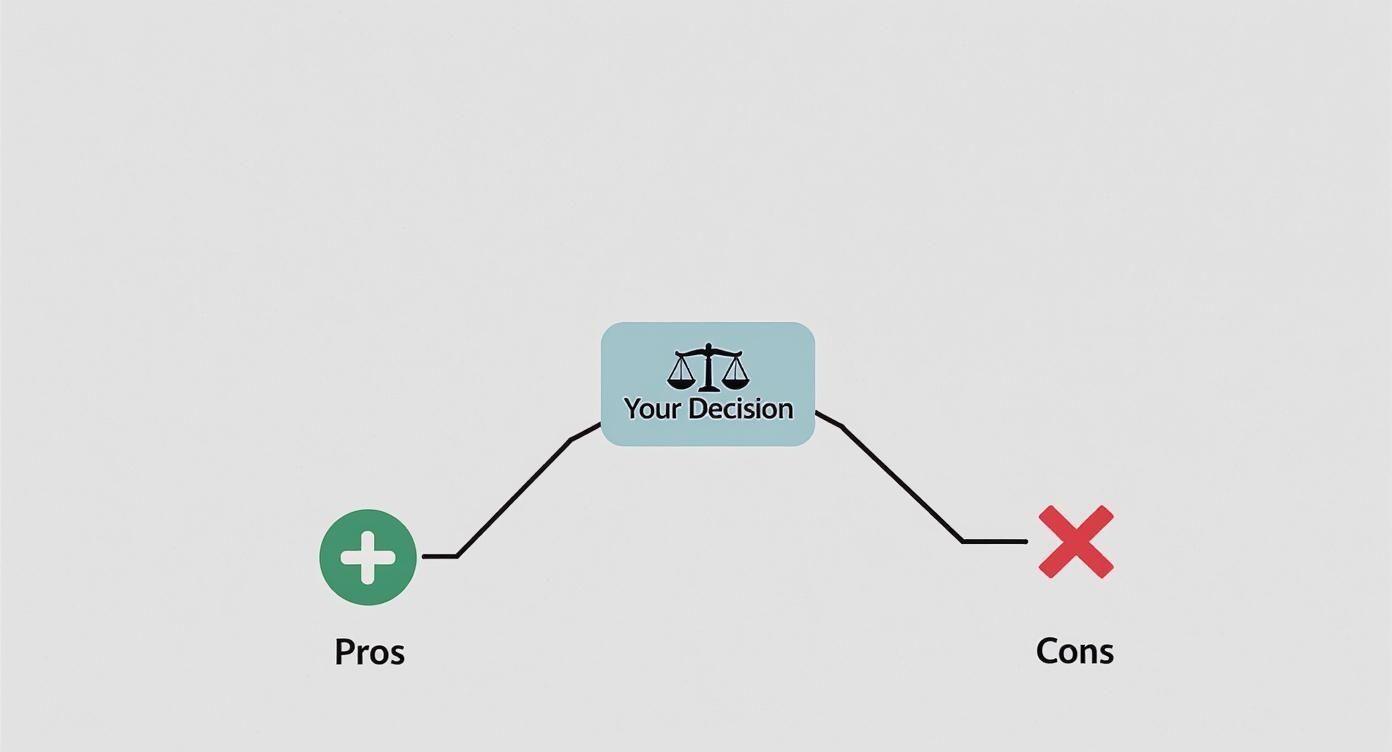
As the visual shows, a plea offers a predictable outcome and lesser penalties, but it means giving up your right to a trial and accepting immediate consequences. The goal is to work with your attorney to land a deal where the pros overwhelmingly outweigh the cons for your unique situation.
Answering Your Questions About Texas DWI Plea Bargains
Going through the legal system after a DWI arrest can feel like navigating a maze. It's completely normal to have questions, especially when you hear legal terms like "plea bargain." Here are clear answers to some of the most common concerns we hear from clients in Texas.
Does Taking a Plea Bargain Mean I’m Admitting Guilt?
Not necessarily, and certainly not in the way most people think. Legally, accepting a plea is a strategic decision. You are choosing a predictable outcome over the uncertainty of a jury trial.
In Texas, you often have the option to plead "no contest," or nolo contendere. This is a powerful tool. It means you are accepting the punishment without formally admitting you did anything wrong. A good Houston DWI lawyer knows how to frame this as a practical decision to protect your record, not an admission of guilt.
Is It Possible to Get My DWI Charge Knocked Down to Something Less Serious?
Absolutely. In fact, this is one of the primary goals of plea bargains for dui. An experienced attorney will put the prosecution's case under a microscope, looking for every weakness. Was the traffic stop justified? Were the field sobriety tests administered correctly? Was the breathalyzer calibrated properly?
Identifying these flaws creates leverage. We use them as bargaining chips to negotiate for a reduction to a non-DWI offense, such as Obstruction of a Highway or Reckless Driving. Securing a deal like this is a major win, as it helps you avoid the severe stigma and lasting consequences of a permanent DWI conviction.
If I Take a Plea Deal for a First DWI, Will I Go to Jail?
For most first-time DWI cases in Texas, a well-negotiated plea bargain can keep you out of jail. The court's focus is typically on education and prevention rather than pure punishment.
Instead of jail time, the terms of a plea deal will likely include conditions like:
- Attending a DWI education program
- Performing community service hours
- Having an ignition interlock device installed in your vehicle
Your lawyer’s number one priority is to negotiate a resolution that keeps you out of jail so you can get on with your life.
What if I Reject the Prosecutor's Offer?
If you and your attorney determine the prosecutor's offer is not in your best interest, you can reject it. When that happens, your case proceeds toward trial. This puts the burden back on the prosecutor—they must now prove to a judge or jury that you are guilty "beyond a reasonable doubt."
Turning down a plea is a significant strategic decision. It is the right move when you have a strong chance to fight your DWI in Texas and win, or when the offered deal is simply unreasonable. This is a critical conversation to have with your defense attorney before making any final choice.
A DWI arrest can throw your world into chaos, but you do not have to face this challenge alone. The legal team at The Law Office of Bryan Fagan, PLLC is dedicated to protecting your rights, providing clear answers, and fighting for the best possible outcome in your case. We offer a free, confidential consultation to discuss what happened and explain all your options. Call us today and take the first crucial step toward protecting your future.