
A DWI arrest can be overwhelming—but you don’t have to face it alone. On one hand, you’re facing a criminal charge with possible jail time and hefty fines. On the other, you’re racing against the clock to keep your driver’s license.
Both paths demand swift, informed action. An experienced Houston DWI lawyer can guide you through the process, protect your rights, and work to minimize the consequences.
What Happens After A DWI Arrest In Texas
The moment you are pulled over, two separate legal processes begin:
- A criminal case where the state tries to prove you committed a crime. A conviction can lead to jail sentences, fines, and a permanent criminal record.
- An administrative license suspension process, which is a civil matter that determines whether you get to keep your driving privileges.
It is crucial to act quickly to protect your right to drive. In Texas, this starts with an Administrative License Revocation (ALR) hearing.
You have only 15 days from the date of your arrest to request an ALR hearing. If you miss this deadline, your license will be automatically suspended.
It’s important to understand that these two cases are independent. Winning your ALR hearing doesn’t dismiss the criminal charge, and getting the criminal case dismissed doesn't automatically restore your license. A skilled Texas DUI attorney can manage both battles for you simultaneously.
For a complete overview of this critical first step, see our detailed guide to the administrative license revocation process in Texas.
Understanding Key Terms In Your Case
As you navigate your DWI case, you will encounter specific legal terms. Here are clear definitions to help you understand what they mean for you:
- Blood Alcohol Concentration (BAC): This is the measurement of alcohol in your bloodstream. In Texas, the legal limit for adults is 0.08%. For commercial drivers, it's 0.04%, and for anyone under 21, it is illegal to have any detectable amount of alcohol in their system.
- Implied Consent: Texas law states that by operating a vehicle on public roads, you have automatically agreed to provide a breath or blood sample if law enforcement has probable cause to suspect you of DWI. Refusing a test carries its own penalties, including a longer automatic license suspension.
- Field Sobriety Tests (FSTs): These are the standardized roadside exercises (like the walk-and-turn or one-leg stand) that officers use to look for signs of impairment. These tests are highly subjective and often performed under poor conditions, making their results a key area to challenge in your defense.
An arrest is just the beginning of the legal process, not the end. The strategic decisions you make now, including hiring the right lawyer, can significantly impact the outcome of your case.
Penalties for a First DWI Offense
Being charged with your first DWI in Texas is a stressful and confusing experience. It is natural to worry about your job, family, and future. However, it is essential to remember that an arrest is not a conviction.
Understanding the potential penalties is the first step toward building a strong defense. With a strategic approach, it is possible to fight the charges and protect your future.

A standard first-time DWI in Texas is a Class B Misdemeanor. While it is the lowest level of DWI charge, the penalties are severe and can impact your freedom, finances, and ability to drive.
Criminal Penalties for a First DWI
If convicted in criminal court, a judge can impose the following penalties. These are handled through the criminal justice system and are separate from the administrative license suspension.
For a Class B Misdemeanor DWI conviction, you could face:
- Jail Time: A mandatory minimum of 72 hours in jail, with a maximum sentence of up to 180 days.
- Fines: A fine of up to $2,000, which does not include court costs or other legal fees.
- Community Service: An order to complete between 24 and 100 hours of community service.
These are the maximum penalties allowed by law. The actual sentence depends on the specifics of your case. An experienced Texas DWI attorney can identify weaknesses in the prosecution's evidence to argue for reduced penalties or alternatives that minimize the disruption to your life.
Driver's License and Other Consequences
Beyond the criminal court penalties, a conviction triggers other consequences that affect your daily life—your ability to get to work, run errands, and support your family.
An arrest is not the end of the road. It is the beginning of a legal process where you have rights that must be protected. A strategic defense can challenge the evidence and work toward a dismissal or reduction of charges.
Additional consequences of a first DWI conviction include:
- Driver's License Suspension: Your license can be suspended for 90 days to one year.
- Annual Surcharges: To maintain your license after a conviction, you must pay an annual fee to the Texas Department of Public Safety (DPS). This surcharge is typically between $1,000 and $2,000 each year for three years.
- DWI Education Program: You will be required to complete a 12-hour DWI education class.
- Ignition Interlock Device (IID): A judge may order you to install an IID in your vehicle. This device requires you to provide a clean breath sample before the car will start and is often a condition for obtaining an occupational license to drive during your suspension period.
Texas has some of the toughest DWI laws in the nation, and the penalties increase significantly with each subsequent offense. You can discover more insights about DWI charges in Texas to learn how these consequences can impact your future.
How a DWI Charge Can Become More Serious
A first-time DWI is a serious Class B Misdemeanor, but certain circumstances—known as "aggravating factors" or "enhancements"—can elevate the charge to a more severe offense with much harsher penalties.
Understanding these factors is crucial for grasping the seriousness of your situation and why an immediate, strategic defense is necessary. The two most common enhancements involve a high Blood Alcohol Concentration (BAC) or the presence of a child passenger.
High BAC of 0.15 or Greater
If a breath or blood test indicates your BAC was 0.15% or higher (nearly double the legal limit), the charge is automatically upgraded from a Class B Misdemeanor to a Class A Misdemeanor.
This is a significant escalation. The prosecution will argue that you were not merely impaired but in a state of extreme intoxication. A conviction for a Class A Misdemeanor DWI carries much steeper penalties, including up to 1 year in jail and a fine of up to $4,000. To understand the full impact, you can learn more about the differences between Class A and Class B DWI penalties in Texas.
DWI with a Child Passenger
If you are arrested for DWI with a passenger under the age of 15 in your vehicle, the charge is automatically elevated to a state jail felony.
A state jail felony conviction is life-altering. It carries potential prison time of up to two years, fines up to $10,000, and the lifelong consequences of being a convicted felon.
The presence of a child passenger is enough to trigger this felony charge, regardless of your BAC or prior record. This can also lead to separate child endangerment charges, adding further complexity to your legal defense.
Standard DWI vs. Enhanced DWI Penalties (First Offense)
This table illustrates how enhancements dramatically increase the potential penalties for a first-time DWI.
| Penalty Type | Standard DWI (Class B) | DWI with High BAC (Class A) | DWI with Child Passenger (Felony) |
|---|---|---|---|
| Classification | Class B Misdemeanor | Class A Misdemeanor | State Jail Felony |
| Jail/Prison Time | Up to 180 days | Up to 1 year | Up to 2 years |
| Maximum Fine | Up to $2,000 | Up to $4,000 | Up to $10,000 |
| License Suspension | Up to 1 year | Up to 2 years | Up to 2 years |
| Annual Surcharges | Up to $2,000 for 3 years | Up to $2,000 for 3 years | Up to $2,000 for 3 years |
| Ignition Interlock | May be required | Often mandatory | Mandatory |
As you can see, the penalties escalate quickly. To fight DWI Texas charges with enhancements, you need a defense that can meticulously challenge every piece of evidence, from the legality of the stop to the procedures used during your arrest.
The Escalating Consequences of Repeat Offenses
While any DWI charge is serious, the situation changes dramatically if you have a prior conviction. Texas law is designed to punish repeat offenders far more severely, with consequences that increase at an alarming rate.
This is not just about higher fines; it is a fundamental shift in how the state prosecutes your case. What was once a misdemeanor can become a life-altering felony, making an aggressive and strategic defense more critical than ever.
Penalties for a Second DWI Offense
A second DWI arrest results in an automatic upgrade from a Class B to a Class A Misdemeanor, bringing significantly tougher penalties.
For a second DWI conviction in Texas, you face:
- Mandatory Jail Time: A minimum of 30 days in county jail, with a potential sentence of up to one year.
- Increased Fines: The maximum fine doubles to $4,000, plus court costs and administrative fees.
- Lengthy License Suspension: Your driver’s license can be suspended for 180 days to two years.
- Mandatory IID: An Ignition Interlock Device (IID) is almost certain to be required on your vehicle at your expense.
A second DWI charge signals a pattern to the prosecutor and judge. To effectively fight back, you need an attorney who can dissect the new charge while also challenging the validity of the prior conviction.
A skilled lawyer will investigate if your rights were violated in the first case and if that conviction can be legally used against you now. This is a vital strategy to combat the escalating penalties for a DWI in Texas.
This infographic gives a clear picture of how different factors can make a DWI charge even more severe.
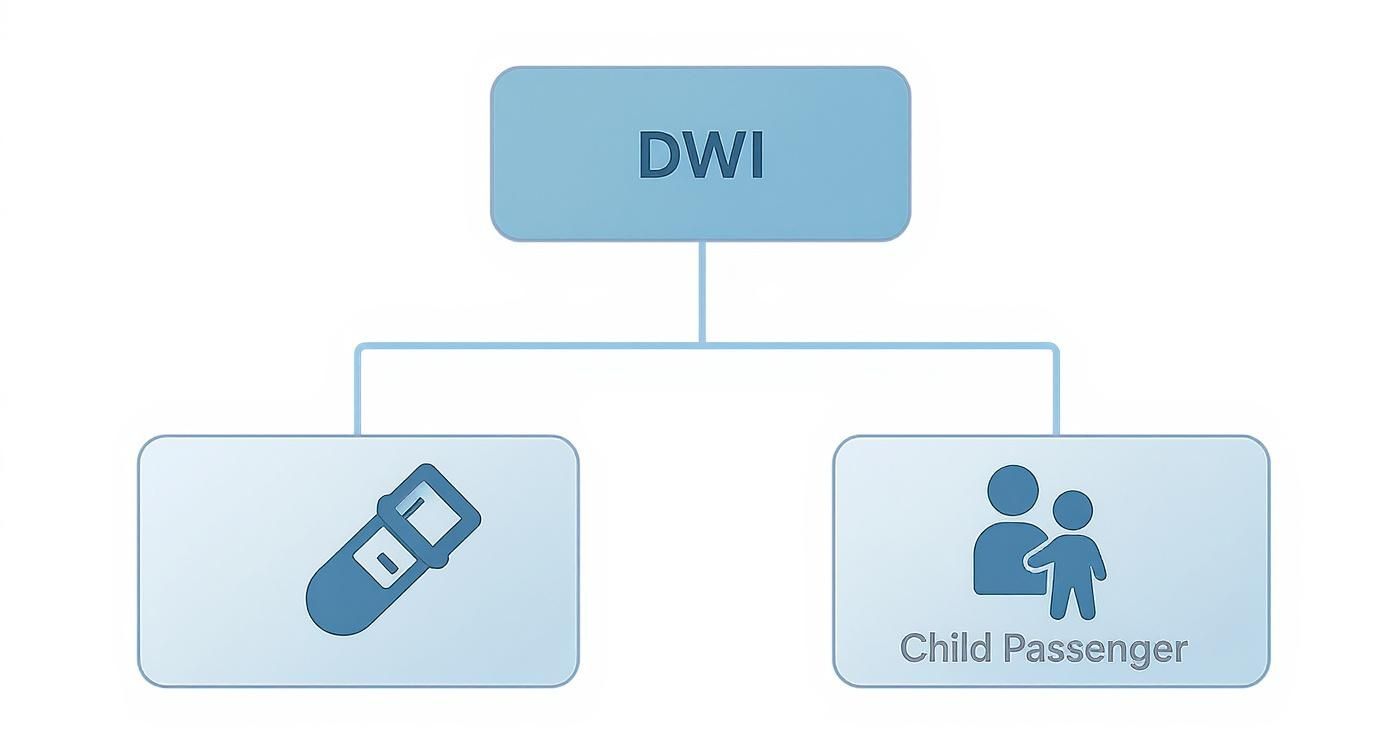
As you can see, factors like a high BAC or a child passenger can dramatically increase the charges and penalties you face from the start.
When a DWI Becomes a Felony
A third DWI arrest is a major turning point. It is no longer a misdemeanor but a third-degree felony. A felony conviction will follow you for life, impacting your career, civil rights, and future.
Crucially, Texas has no "lookback period" for DWI offenses. It does not matter if your last conviction was 5, 15, or even 25 years ago—it still counts and will be used to upgrade a new charge to a felony.
The penalties are severe:
- State Prison Time: A conviction can result in 2 to 10 years in a Texas state prison.
- Substantial Fines: The maximum fine increases to $10,000.
- Felon Status: As a convicted felon, you lose the right to vote and own a firearm, and you may be barred from certain professional licenses and careers.
The path from a first-offense misdemeanor to a third-offense felony is steep. With a third DWI charge, your freedom is on the line, making an experienced defense your only option to protect your future.
The Hidden Costs of a DWI Conviction
The official penalties for a DWI in Texas—fines, jail time, and license suspensions—are only the beginning. A conviction triggers a series of hidden costs and collateral consequences that can affect your life for years after the court case is over.
Understanding these long-term effects is essential to grasping what is truly at stake and why a strong defense is about protecting more than just your freedom—it's about protecting your future.
The Immediate Financial Drain
Beyond court-ordered fines, a DWI conviction comes with a long list of mandatory, out-of-pocket expenses that add up quickly.
Common financial burdens include:
- Annual DPS Surcharges: To keep your driver's license, you will be forced to pay the Texas Department of Public Safety an annual surcharge of up to $2,000 for three consecutive years.
- DWI Education Programs: You must pay for and attend a mandatory DWI education class. For more serious offenses, a more intensive "repeat offender" program may be required at a higher cost.
- Ignition Interlock Device (IID): If an IID is required, you are responsible for all costs, including installation, monthly calibration fees, and removal.
- Skyrocketing Insurance Premiums: A DWI conviction labels you a "high-risk" driver, causing your auto insurance rates to soar, often doubling or tripling for years. Learn more in our guide to the impact of a DWI on your insurance.
Long-Term Professional and Personal Consequences
The damage from a DWI conviction extends far beyond your finances. It creates a permanent criminal record that can limit opportunities for years to come.
Texas tragically leads the nation in DWI-related fatalities, with someone being hurt or killed in an intoxicated driving accident every 20 minutes. This sobering reality is a key reason the state imposes such severe and lasting consequences on those convicted. You can read more about these statistics and their impact on Texas law.
A DWI conviction can impact your life by:
- Threatening Your Job: Many employers conduct background checks, and a conviction can be grounds for termination, especially if your job involves driving or a professional license.
- Blocking Future Employment: A criminal record can make it extremely difficult to find new employment and limit your career growth.
- Affecting Professional Licenses: Nurses, pilots, teachers, and other licensed professionals may face review by their licensing boards, potentially leading to suspension or revocation.
- Complicating Personal Matters: A conviction can be used against you in child custody disputes and may impact your ability to rent an apartment or secure a loan.
These hidden costs reveal the full scope of what’s at risk. An experienced Houston DWI lawyer works to minimize not just the immediate legal penalties but these devastating long-term consequences as well.
How a Houston DWI Lawyer Builds Your Defense
When you are facing the penalties for DWI in Texas, it is easy to feel defeated. But remember this: an arrest is not a conviction. The prosecution has the burden of proving every element of its case beyond a reasonable doubt. A skilled DWI lawyer’s job is to dismantle that case, piece by piece.
There are numerous opportunities to challenge the state's evidence and protect your rights.

A strong defense begins the moment the police lights flash in your rearview mirror. Every action the officer takes is subject to legal scrutiny. Your lawyer will meticulously review every detail of your arrest, searching for procedural errors and weaknesses that can form the foundation of your defense.
Questioning the Initial Traffic Stop
The entire DWI case depends on the legality of the initial traffic stop. An officer must have reasonable suspicion of a traffic violation to pull you over. They cannot act on a hunch; they need a specific, factual reason, such as speeding, failing to signal, or weaving.
If the officer cannot legally justify the stop, all evidence gathered afterward—including field sobriety tests and breathalyzer results—can be suppressed. This is a powerful defense strategy that can lead to a dismissal of the entire case.
Challenging Field Sobriety Tests
Field Sobriety Tests (FSTs) are notoriously unreliable. They are often administered on uneven surfaces, in poor lighting, and are highly subjective. Your physical condition, the weather, and even your nerves can affect your performance. An experienced attorney knows how to expose these flaws.
Your lawyer will investigate:
- Proper Administration: Did the officer provide clear and correct instructions as required by the National Highway Traffic Safety Administration (NHTSA)?
- Environmental Factors: Were you asked to perform balance tests on a sloped road or in windy conditions?
- Medical Conditions: Do you have any health issues that would make it difficult to perform these tests even when sober?
By demonstrating the unreliability of these tests, your attorney can argue that the officer lacked the probable cause needed to make a lawful arrest.
A successful defense is built on challenging every assumption the prosecution makes. From questioning the legality of the traffic stop to exposing the flaws in chemical testing, your attorney's role is to ensure your rights are protected at every turn.
Scrutinizing Breath and Blood Test Results
Even scientific-seeming evidence like breath and blood tests is prone to error. Breathalyzer machines require precise calibration, and blood samples must be handled according to strict protocols to avoid contamination.
A thorough defense will investigate:
- Whether the breathalyzer machine was properly maintained and calibrated.
- If the officer who administered the test was certified to operate the device.
- The chain of custody for a blood sample to ensure it was not contaminated or improperly stored.
Any procedural misstep can render the BAC results inadmissible in court. Successfully challenging this evidence removes the prosecution's strongest weapon and significantly improves your chances of a favorable outcome.
A DWI charge threatens your freedom, your finances, and your future. You don’t have to face this complex battle alone. The dedicated attorneys at The Law Office of Bryan Fagan, PLLC are ready to build a strategic defense tailored to the specifics of your case. We will meticulously examine every detail, protect your rights, and fight to minimize the consequences you face.
Contact us today for a free, confidential consultation to discuss your case.
Schedule Your Free Case Evaluation with The Law Office of Bryan Fagan, PLLC