
A DWI arrest can be overwhelming — but you don’t have to face it alone. When you’re on deferred adjudication for a DWI, you’re walking a tightrope. You follow the rules, and at the end, your case gets dismissed. But what happens if the prosecutor claims you slipped up? You get a notice for a motion to adjudicate, and suddenly, that second chance you were counting on feels like it's about to vanish.
A motion to adjudicate is the State’s formal way of telling the judge, "This person broke the rules of their probation, and we want you to find them guilty of the original DWI charge." It’s a serious legal challenge, but it’s important to remember: this is not a final conviction. It’s the start of a new fight, and an experienced Houston DWI lawyer can protect your rights and minimize the consequences.
What a Motion to Adjudicate Means for Your DWI Case
A DWI arrest is stressful enough. Receiving a notice for a motion to adjudicate can feel like a gut punch. You thought you were on the path to putting this behind you, working through your deferred adjudication to keep a conviction off your record. This new legal document throws all of that into jeopardy.
Think of your deferred adjudication as a contract with the court. You hold up your end of the bargain—follow all the rules for a specific time—and the State agrees to dismiss your DWI charge. This opens the door to getting your record sealed later on. But if the prosecutor believes you've broken even one of those rules, they can file this motion, asking the judge to tear up that contract and find you guilty.
Understanding the Stakes
This motion shifts the entire focus of your case. We're no longer debating whether you were intoxicated behind the wheel months or years ago. Instead, the only question is whether you violated a condition of your probation. If the judge agrees with the prosecutor, you could face the full range of punishment for the original DWI, including jail time and a permanent conviction.
So, what kind of slip-ups can trigger this? Prosecutors often file these motions for things like:
- Failing an alcohol or drug test
- Getting arrested for a new offense, even a minor one
- Missing a scheduled meeting with your probation officer
- Failing to finish a required DWI education class
- Falling behind on court-ordered fines or fees
It is critical to understand that a motion to adjudicate does not automatically mean you will be found guilty. You have the right to a hearing where your attorney can challenge the prosecutor's allegations and defend your freedom.
Receiving a motion to adjudicate can feel like the ground is crumbling beneath your feet. The future you were working so hard to protect is suddenly at risk. This is the moment to act, not to panic. An experienced Houston DWI lawyer can step in immediately, dissect the State’s allegations, and start building your defense.
Your strongest move is to get legal help to fight this motion and preserve that second chance. You don’t have to face this alone.
Deferred Adjudication vs Guilty Adjudication at a Glance
To really grasp what's on the line, it helps to see the two potential outcomes side-by-side. One path keeps your record clean, while the other leads to a permanent criminal conviction.
This table breaks down the difference between successfully finishing your deferred adjudication and what happens if the judge sides with the prosecutor after a motion to adjudicate hearing.
| Outcome | Successful Deferred Adjudication | Guilty Adjudication After Motion |
|---|---|---|
| Criminal Record | No final conviction. The case is dismissed. | You are found guilty of the original DWI. |
| Future Impact | Eligible to petition for an Order of Nondisclosure. | Permanent criminal conviction on your record. |
| Punishment | No further penalties. | Face the full range of original DWI penalties. |
| Driver's License | No new suspensions related to this outcome. | Potential for further license suspension. |
| Next Steps | You're free from court supervision. | Begin serving the sentence imposed by the judge. |
As you can see, the stakes couldn't be higher. A guilty adjudication erases all the progress you've made and puts you right back at square one, but with fewer options. That's why to fight a DWI in Texas, fighting the motion is not just an option—it's a necessity.
Understanding Deferred Adjudication for a Texas DWI
Before we can really dig into what a motion to adjudicate is, we have to talk about the incredible opportunity it puts at risk: deferred adjudication. In the world of Texas DWI law, this is one of the best possible outcomes. It’s a special kind of probation that, if you complete it successfully, lets you avoid a permanent DWI conviction on your public record.
Think of it as a lifeline the court offers you. You and the court enter a high-stakes agreement: you follow a strict set of rules for a specific period, and in return, the judge dismisses your case. While the charge doesn't vanish completely, you are never formally found "guilty." But if you stumble—if you break even one rule—the prosecutor can file a motion asking the judge to pull that lifeline back and find you guilty, landing you with all the original consequences.
The Terms of Your Agreement
Deferred adjudication isn't a "get out of jail free" card. The court sees it as a privilege you have to earn, and it comes with serious responsibilities. To hold up your end of the bargain, you’ll have to comply with a list of conditions, all while being closely watched by a probation officer.
These rules are there to prove you’re taking the situation seriously and are committed to safe, sober driving.
Common terms for DWI deferred adjudication probation often include:
- Regular Meetings: You'll almost certainly have to check in with your probation officer on a regular schedule, usually once a month.
- DWI Education Courses: Completing state-mandated classes on the dangers of intoxicated driving is a standard requirement.
- Ignition Interlock Device (IID): Many people on deferred adjudication must have an IID installed in their car. This device is a small breathalyzer that stops your car from starting if it detects any alcohol on your breath.
- Fines and Fees: You will be responsible for paying all court costs, fines, and monthly probation fees on time.
Missing a meeting, failing a breath test, or falling behind on payments can all be considered a violation. That’s all the opening a prosecutor needs to file a motion to adjudicate.
A motion to adjudicate puts this entire opportunity in jeopardy. It is the legal tool the State uses to try and take away your second chance and replace it with a permanent DWI conviction.
A Favorable but Fragile Outcome
Even with the strict rules, getting deferred adjudication is a huge win in a DWI case. It’s an outcome a skilled Texas DUI attorney will fight tooth and nail for because it gives you a clear path to protecting your record and your future. While a straight conviction is far more common, deferred adjudication is an achievable goal for many.
Because this outcome is so valuable, defending it from a motion to adjudicate becomes our number one priority. The whole point of accepting the deal was to keep a conviction off your record, and we are ready to fight aggressively to keep that goal within reach. You can learn more about the specifics in our guide on what deferred adjudication in Texas entails.
A single violation doesn't have to be the end of the road. With the right defense, you can challenge the prosecutor’s claims and work to preserve the future you’ve been fighting for.
Common Reasons Prosecutors File These Motions
That notice in the mail about a “motion to adjudicate” can feel like a punch to the gut. You thought you were on the right track with your deferred adjudication, so why is this happening? What did you do wrong? Getting to the bottom of the prosecutor’s reasoning is the first step toward defending your future.
Bottom line: the prosecutor believes you didn't hold up your end of the deal. They're telling the judge you broke one of the rules of your deferred adjudication, and they want you found guilty of the original DWI.
These alleged violations usually come in two flavors: technical slip-ups and substantive new offenses.
Technical Probation Violations
Technical violations are all about failing to keep up with the administrative rules of your community supervision. You haven't committed a new crime, but you’ve missed a step or a deadline. While they might seem minor, a prosecutor can absolutely use them to try and revoke your deferred status.
These are often simple mistakes or misunderstandings, like:
- Missing an appointment with your community supervision officer (your probation officer).
- Failing to pay fines or court-ordered fees on time.
- Not finishing a required class, like a DWI education course or victim impact panel, by the deadline.
- Forgetting to complete your required community service hours.
Even a small slip-up can be enough to trigger a motion. One prosecutor might give you a warning, but another might move to adjudicate immediately. This is where having an experienced Houston DWI lawyer step in can make a huge difference by communicating with the prosecutor on your behalf.
Substantive Probation Violations
This is where things get much more serious. A substantive violation means you’re being accused of committing a new crime or directly breaking a major sobriety-related rule. Prosecutors pursue these violations aggressively.
The most serious substantive violations are:
- Getting arrested for a new crime, especially another DWI or any alcohol-related offense.
- Failing a drug or alcohol test given by your probation officer.
- Tampering with your ignition interlock device (IID) or failing one of its tests.
A new arrest while you're on deferred adjudication is a massive red flag for any prosecutor. They see it as a sign that you didn't take your second chance seriously and will often act swiftly to have you found guilty of the original DWI.
Prosecutors in Texas have a lot of leeway in deciding whether to file a motion to adjudicate. They often consider whether it’s easier to win on the motion—which only requires a "preponderance of the evidence" (meaning "more likely than not")—or to pursue an entirely new criminal charge that requires proof "beyond a reasonable doubt."
When a new DWI is the trigger, the prosecutor can file the motion immediately, forcing you to fight a legal battle on two fronts. Because even a tiny misstep can lead to a motion to adjudicate, it's vital to know the rules and have a plan. If you're in this spot, you should check out our in-depth guide on how to handle a DWI probation violation. Often, an attorney can de-escalate a minor issue before it ever threatens your future.
Navigating the Adjudication Hearing Process: What Happens After a DWI Arrest
Once a prosecutor files a motion to adjudicate, the clock starts ticking on a very specific legal process. This isn't some chaotic, unpredictable event—it’s a series of structured steps that lead to a hearing. Knowing what to expect can take away a lot of the fear and show you exactly where an experienced attorney can step in to defend your future.
This simple flowchart maps out the typical path from a single alleged slip-up to your day in court.
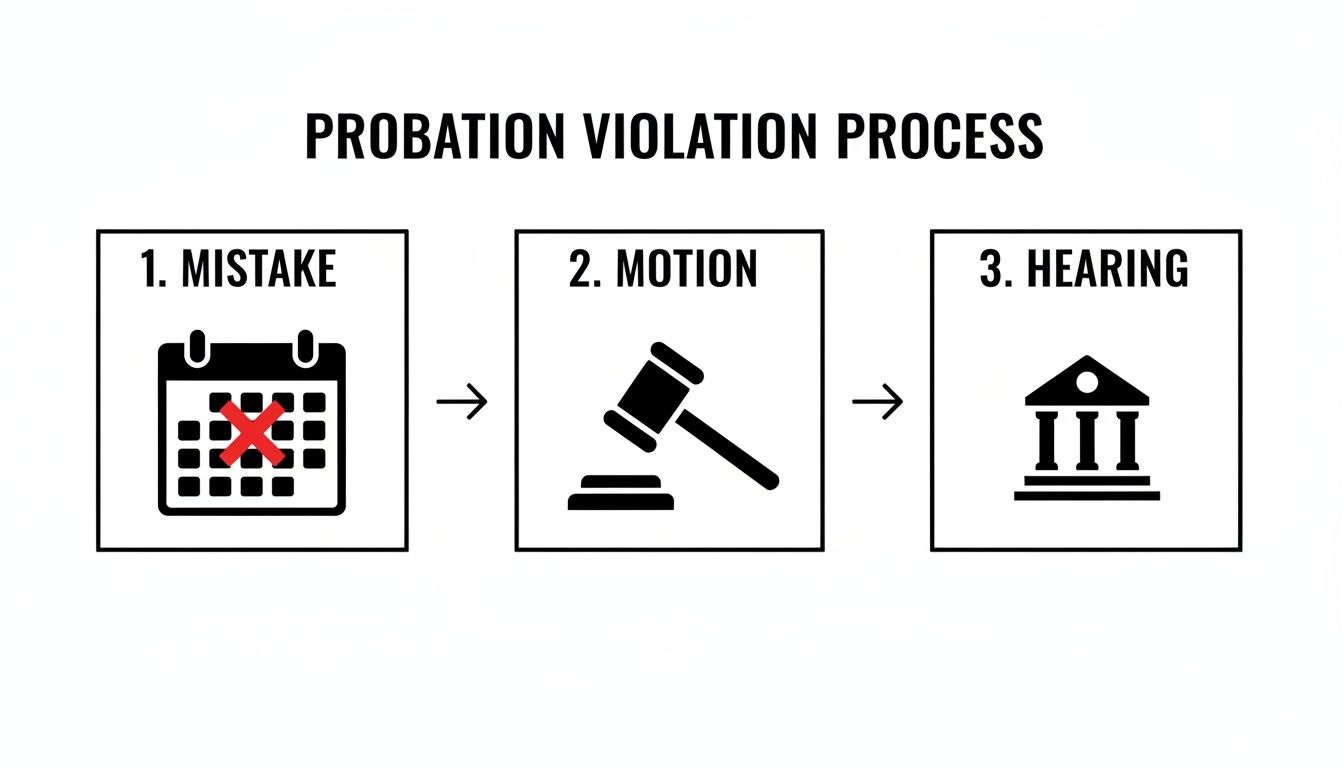
It all begins with one mistake—or even just an accusation of one. That triggers the prosecutor's motion, which sets the stage for a formal hearing where a judge will decide your fate. Let’s walk through what really happens at each stage.
The Arrest and Bond
After the motion is filed, the first thing a judge will do is sign a warrant for your arrest. For most people, this is the most shocking part of the process, especially if you had no idea a motion was even filed against you. An active warrant means you can be taken into custody at any time—during a routine traffic stop, at your job, or even at home.
Our first job is to tackle that warrant immediately. An attorney can arrange for you to turn yourself in on your own terms, avoiding a public or embarrassing arrest. We can then get to work right away on getting you released on bond, arguing for a reasonable amount so you can get out of jail quickly and help us prepare your defense.
The Arraignment
Once you’re out on bond, the court will schedule an arraignment. This is a very brief and formal court appearance where the judge will read the allegations listed in the prosecutor’s motion to adjudicate. The judge then asks you one critical question: how do you plead to those allegations?
You have two options here:
- True: Pleading "true" is an admission. You are telling the court that you did, in fact, violate your probation as the State claims. The case immediately skips to the punishment stage.
- Not True: This is a formal denial of the allegations. Pleading "not true" asserts your right to a full hearing where the prosecutor is forced to prove their claims against you.
In nearly every case, pleading “not true” is the right call. It’s a crucial strategic move that gives your attorney the time and legal footing needed to fight the State's case.
The Hearing and Burden of Proof
If you plead "not true," the court sets a date for your adjudication hearing. This is the main event. The prosecutor will call witnesses and present their evidence to try and convince the judge you violated your probation terms. Your attorney will be right there to cross-examine those witnesses, challenge the evidence, and tell your side of the story.
But this is where the rules of the game change dramatically. In a regular criminal trial, the State has to prove you are guilty "beyond a reasonable doubt." For a motion to adjudicate, the standard is much, much lower: a preponderance of the evidence.
"Preponderance of the evidence" means the prosecutor only has to prove that it is "more likely than not" (think 50.1%) that you committed the violation. This lower bar gives the State a significant advantage.
This lower standard is a huge hurdle for the defense and a major advantage for prosecutors. It means that even flimsy or circumstantial evidence can be enough for a judge to rule against you. You can't just deny the accusation; you need a sharp, aggressive defense designed to pick the prosecutor's evidence apart, piece by piece. This strategic fight over evidence is common in many court proceedings, and you can see how it plays out by reading our guide on the Omnibus DWI hearing process in Texas.
How to Fight a Motion to Adjudicate and Protect Your Future
An adjudication hearing can feel like the end of the road in your DWI case, but we’re here to tell you it’s not. Facing a motion to adjudicate is definitely overwhelming, but a powerful, strategic legal defense can completely change the outcome. This isn't the time to give up; it's the time to fight back with a clear plan.
Let’s first be clear about what’s at stake. If the judge agrees with the prosecutor and adjudicates you guilty, any previous plea deal you made is off the table. The judge has the full authority to sentence you within the entire range of penalties for the original DWI charge. For a first DWI in Texas, a Class B Misdemeanor, that could mean up to 180 days in county jail, crushing fines, and a permanent criminal conviction stamped on your record.
This is exactly why just crossing your fingers and hoping for the best isn't a strategy. You need an experienced Houston DWI lawyer who will actively get in the ring and defend you.
Challenging the Prosecutor's Evidence
Just because the prosecutor alleges you violated your probation doesn't automatically make it true. Remember, the State has the burden of proof here. Our first line of defense is always to pick apart the State's case against you piece by piece.
We will challenge their evidence by asking the hard questions:
- Was that drug or alcohol test even administered correctly? We dig into the lab procedures, check the machine calibration records, and trace the chain of custody to spot errors that could invalidate the results.
- Is the probation officer's testimony truly reliable? We can cross-examine the officer in court, highlighting any inconsistencies, biases, or simple mistakes in their report.
- Was there a legitimate reason you missed an appointment or were late on a payment? Things happen. A family emergency, a medical issue, or a simple, honest misunderstanding can be a powerful and very human defense.
By attacking the very foundation of the prosecutor’s claims, we work to show the judge that the State simply can't meet its burden of proof.
Negotiating a Favorable Resolution
Sometimes, the smartest move isn't a full-blown courtroom battle. An aggressive courtroom presence is just one tool in our arsenal. As your legal advocate, we can open a direct line of communication with the prosecutor to work toward a solution that keeps your record clean, often before the hearing even starts.
An experienced attorney can often resolve a motion to adjudicate without a contested hearing. We can negotiate to have the motion withdrawn in exchange for a reasonable modification of your probation.
For instance, we might be able to get the State to agree to one of these common-sense solutions:
- A brief extension of your probation period.
- Completing a handful of extra community service hours.
- Attending one additional educational class.
This approach can put the issue to bed quickly and efficiently, letting you get right back on track with your deferred adjudication and protecting your future.
Presenting a Strong Mitigation Case
What if the evidence of a violation is undeniable? It happens. In that case, our strategy pivots to mitigation. This means we build a compelling case to the judge that, despite a mistake, you still deserve the chance to successfully complete your deferred adjudication.
We do this by painting a full picture of who you are. We’ll present evidence of your steady employment, your family responsibilities, and all the positive steps you’ve taken since the original arrest. The goal is to show the judge that this violation was a one-time slip-up, not a pattern of defiance.
By presenting you as a person, not just a case number on a docket, we can often persuade the judge to give you that critical second chance. They might decide to reinstate your deferred adjudication—maybe with slightly stricter terms—instead of adjudicating you guilty and sending you to jail. At The Law Office of Bryan Fagan, PLLC, our job is to explore every single path to protect your freedom and preserve the future you’ve been working so hard to build.
Frequently Asked Questions About Motions to Adjudicate
Getting a notice for a motion to adjudicate can feel like the floor has dropped out from under you. The uncertainty is overwhelming, and you’re bound to have a lot of urgent questions. Getting straight answers is the first step to getting back in control. We’ve answered some of the most common questions we hear from clients who are in your exact shoes.
Remember, though, that every case is different. These answers will give you a solid foundation, but the best advice always comes from talking one-on-one with a skilled Texas DUI attorney about your specific situation.
Can I get a bond for a motion to adjudicate warrant?
Yes, in most Texas DWI cases, you have the right to a bond after being arrested on a warrant for a motion to adjudicate. The judge will set the bond amount, and you should be prepared for it to be higher than the bond on your original DWI charge.
An experienced lawyer can get to work right away arguing for a reasonable bond. We can often arrange for a "walk-through" bond, which is a streamlined process where you can post bond and get released quickly, often without spending much, if any, time in a jail cell. Acting fast is key to making this go smoothly and getting your life back on track.
What is the difference between a motion to adjudicate and a motion to revoke?
This is a critical difference that trips a lot of people up, but it’s actually pretty simple. It all comes down to whether you were officially found guilty before you started probation.
- A motion to adjudicate is what you face when you’re on deferred adjudication. Think of deferred adjudication as a second chance—the court "defers" a finding of guilt to see if you can complete probation successfully. If the motion succeeds, the judge "adjudicates" you guilty, and you get your very first conviction for that DWI.
- A motion to revoke is filed if you’re on regular probation (sometimes called "straight probation"). This type of probation only happens after you’ve already been convicted. If the motion succeeds, the judge "revokes" your probation and imposes the jail sentence that was handed down when you were first convicted.
The bottom line: a motion to adjudicate threatens to give you a brand-new criminal conviction, while a motion to revoke threatens to send you to jail for a conviction you already have.
What sentence will I get if I am adjudicated guilty?
If the judge agrees with the prosecutor and finds you guilty, the judge can sentence you to anything within the full punishment range for the original DWI offense. There are no guarantees.
For a first-offense DWI in Texas (a Class B Misdemeanor), this could mean a sentence of up to 180 days in county jail, plus fines and court costs.
This is where your attorney’s most important work comes in. Our job is to build a powerful mitigation case, showing the judge all the positive steps you’ve taken and giving them every reason to choose the most lenient outcome. That could mean continuing you on probation (sometimes with new conditions) instead of imposing jail time.
Will I lose my license if adjudicated guilty?
Yes, a final conviction for DWI automatically triggers a driver's license suspension. For a first DWI offense, you can expect to lose your license for anywhere from 90 days to one year. This is a totally separate penalty from the Administrative License Revocation (ALR) process you may have gone through when you were first arrested.
This DWI license suspension creates a huge hardship for most people, but you have options. We can help you apply for an occupational driver's license, which would give you the legal ability to keep driving for work, school, and essential family duties.
A motion to adjudicate is a serious legal fight, but it doesn't have to mean losing your second chance. You have the right to a strong defense, and our team is ready to build one for you. If you’re facing a motion to adjudicate for a DWI in Texas, don't wait. Contact The Law Office of Bryan Fagan, PLLC today for a free, confidential case evaluation to understand your rights and start fighting back. We are here to help you protect your future. Visit us at https://texasduilawfirm.com.