
A DWI arrest can be overwhelming—but you don’t have to face it alone. The moves you make in the first few days are absolutely critical to protecting your driver's license. The most urgent deadline? The Administrative License Revocation (ALR) hearing request. You have exactly 15 days to challenge the automatic suspension of your license, and this fight is completely separate from your criminal case.
Your First Steps After a Texas DWI License Suspension

When the officer arrested you, they likely confiscated your plastic driver’s license and handed you a piece of paper. This document, often titled a "Notice of Suspension," is more than just a temporary driving permit—it's your ticking clock. It states clearly that you have just over two weeks to formally demand an ALR hearing to fight the DWI license suspension.
If you miss this deadline, your license will be automatically suspended on the 41st day after your arrest. It doesn't matter if your criminal DWI case is eventually dismissed; the administrative penalty will still take effect.
This immediate threat exists because of Texas's implied consent law. The moment you get behind the wheel on a Texas road, you have legally agreed to provide a breath or blood sample if an officer has probable cause to suspect you're intoxicated.
Understanding the Two Paths to an Administrative Suspension
The state can suspend your license through the ALR process in two primary ways, each with its own timeline:
- Failing a Chemical Test: If your Blood Alcohol Concentration (BAC) was 0.08% or higher, the state will move to suspend your license. For a first DWI in Texas, this suspension period is typically 90 days.
- Refusing a Chemical Test: If you refused the breath or blood test, the penalty is much harsher—a 180-day suspension for a first-time refusal.
It’s easy to confuse these two battles, but the administrative suspension is a separate challenge from the criminal penalties. You can win your criminal DWI case in court and still lose your driving privileges if you ignore the ALR process. This is why your first call should be to an experienced Houston DWI lawyer who can help you fight your DWI in Texas.
To help you keep these critical first actions straight, here’s a quick summary of what needs to happen and when.
Critical Timelines and Actions After a Texas DWI Arrest
This table summarizes the immediate deadlines and actions required to protect your driving privileges following a DWI arrest in Texas.
| Event | Critical Deadline | Action Required | Consequence of Inaction |
|---|---|---|---|
| DWI Arrest | 15 Days from date of arrest | Request an Administrative License Revocation (ALR) hearing. | Automatic license suspension on the 41st day after arrest. |
| ALR Hearing | Typically 30-60 days after request | Your attorney challenges the suspension by questioning the officer and evidence. | The administrative suspension is upheld, and your license is suspended for 90-180 days. |
| Temporary Permit Expires | 40 Days from date of arrest | Secure a win at the ALR hearing or obtain an Occupational Driver's License. | It becomes illegal for you to drive, even for essential needs like work or school. |
| Criminal Case Begins | Varies (weeks to months) | Your attorney begins building a defense for your criminal DWI charge. | Without legal counsel, you face the full force of criminal penalties, including jail time and fines. |
Missing any of these deadlines can create significant and often irreversible problems for both your license and your criminal case.
Why the ALR Hearing Is Your First Line of Defense
Don't mistake the ALR hearing for a criminal trial. It’s a civil proceeding where the Texas Department of Public Safety (DPS) must prove the officer had a legitimate reason to stop you and request a test. This is your first—and often best—opportunity to challenge the state's case.
A skilled DWI attorney uses the ALR hearing to cross-examine the arresting officer under oath. This testimony can lock them into a story, expose weaknesses in their report, and potentially get the entire administrative suspension thrown out.
This hearing is far from a guaranteed loss for you. In fact, law enforcement mistakes frequently lead to wins for drivers. Recent data shows that from 2022 onward, motions to dismiss were granted in 34% of the 53,090 ALR hearings held across Texas. These dismissals often happen because of procedural errors like improper warnings or delays in testing.
You can explore the data on ALR dismissal chances in Texas for yourself. With the right legal strategy, the ALR hearing isn't just about saving your license—it's about laying the groundwork for a strong defense in your criminal case.
First, Why Was Your License Suspended?
Getting your Texas driver's license back starts with one simple, non-negotiable step: you have to know exactly why it was suspended in the first place. The Texas Department of Public Safety (DPS) has a different playbook for every type of suspension. If you try a generic, one-size-fits-all approach, you're just setting yourself up for frustrating delays and rejected paperwork.
Your entire strategy for getting back on the road hinges on the specific reason for the hold on your license.
Now, while a DWI arrest is a common culprit, it's crucial to understand that not all DWI-related suspensions are the same. In fact, they happen on two completely separate tracks.
The Two Different DWI License Suspensions
A single DWI arrest actually kicks off two independent legal fights, and either one can take away your driving privileges. Understanding this distinction is the key to building a smart defense with your attorney from day one.
- Administrative License Revocation (ALR): This is the civil side of things and the most immediate threat to your license. As we’ve covered, the DPS initiates this suspension automatically if you fail a breath or blood test (a 90-day suspension) or refuse to provide one (a 180-day suspension). This can happen months before your criminal case ever sees the inside of a courtroom.
- Criminal Court Suspension: This suspension only happens if you are actually convicted of DWI by a judge in criminal court. It’s a penalty for the crime itself, and for a first offense, it can last anywhere from 90 days to one year.
It's entirely possible to win your ALR hearing and keep your license, only to have it suspended later if you're convicted on the criminal charge. On the flip side, you could lose the ALR hearing but eventually get your DWI charges dismissed. Because you're fighting on two fronts, you need a defense strategy that addresses both from the very beginning.
Other Common Reasons Your License Might Be on Hold
Beyond DWI, a whole host of other issues can put a stop to your driving privileges. I’ve had clients who thought their suspension was just from a recent DWI, only for us to discover an old, unresolved problem was also blocking their reinstatement.
These other roadblocks can include:
- Lapsed SR-22 Insurance: If you were previously required to carry SR-22 insurance and let the policy cancel, the insurance company is required to notify the DPS. That notification triggers a new suspension.
- Too Many Traffic Tickets: Texas uses a point system. Rack up too many points on your driving record in a short period, and you'll face an automatic suspension.
- Unpaid Accident Judgments: If you cause an accident while you're uninsured and don't pay for the damages, your license can be suspended until that debt is paid off.
How the Repeal of the Driver Responsibility Program Changed Everything
For years, the biggest nightmare for many Texas drivers was the Driver Responsibility Program (DRP). This program tacked on massive annual surcharges for certain convictions, and failing to pay them resulted in indefinite license suspensions for hundreds of thousands of people. It was a cycle of debt that was nearly impossible to escape.
In 2019, Texas finally repealed the DRP. It was a monumental shift that gave countless drivers immediate relief. The change wiped out the program's crippling surcharges, making it possible for thousands who were trapped to finally get their licenses back.
The impact was massive and immediate. The day the law changed—September 1, 2019—an estimated 600,000 drivers instantly became eligible for reinstatement. Another 350,000 were able to get their licenses back after just paying standard fees. The ACLU of Texas figured that around one million DRP-related suspensions were cleared the day the program ended, giving a lot of people a much-needed fresh start.
You can learn more about this huge legislative change and what it means for Texas drivers in reports covering the repeal of the Driver Responsibility Program.
By pinpointing the exact cause of your suspension—whether it's an old DRP issue, an ALR action, or a stack of traffic tickets—you and your attorney can create a targeted plan to get your license back as quickly and painlessly as possible.
How to Navigate the Texas License Reinstatement Process
Once you understand why your license was suspended, you can start tackling the actual steps to get it back. A DWI arrest is overwhelming, but the reinstatement process with the Texas Department of Public Safety (DPS) is a series of manageable tasks. Think of it like a checklist—every item you complete gets you one step closer to legally driving again.
The path to license reinstatement in Texas isn’t a mystery; it's a specific procedure with clear rules. Your job is to follow the instructions, provide the right paperwork, and pay the fees. Missing even one small step can cause frustrating delays, so it pays to be methodical.
Your First Step: Check Your Official Reinstatement Status
Before you do anything else—before paying a single fee or signing up for a class—you need to get your official list of requirements straight from the source. The Texas DPS has an online portal where you can check your eligibility status, and it’s the most important tool you’ll use.
You will need your driver’s license number, date of birth, and the last four digits of your Social Security number. The system will then generate a complete list of every single issue, or "hold," that stands between you and a valid license. This report takes all the guesswork out of the process. It will tell you exactly what fees you owe, which courses you need to take, and any other compliance items that need your attention.
It is critical that you treat this DPS report as your personal roadmap. Don't rely on what you think you need to do.
Taking a few minutes to pull your official status report can save you a ton of wasted effort and money. I've seen countless drivers assume their DWI is the only problem, only to find out an old, unpaid traffic ticket from another county is also holding up their reinstatement. Verifying everything upfront is the only smart way to start.
The infographic below shows the most common reasons drivers in Texas find their licenses suspended.
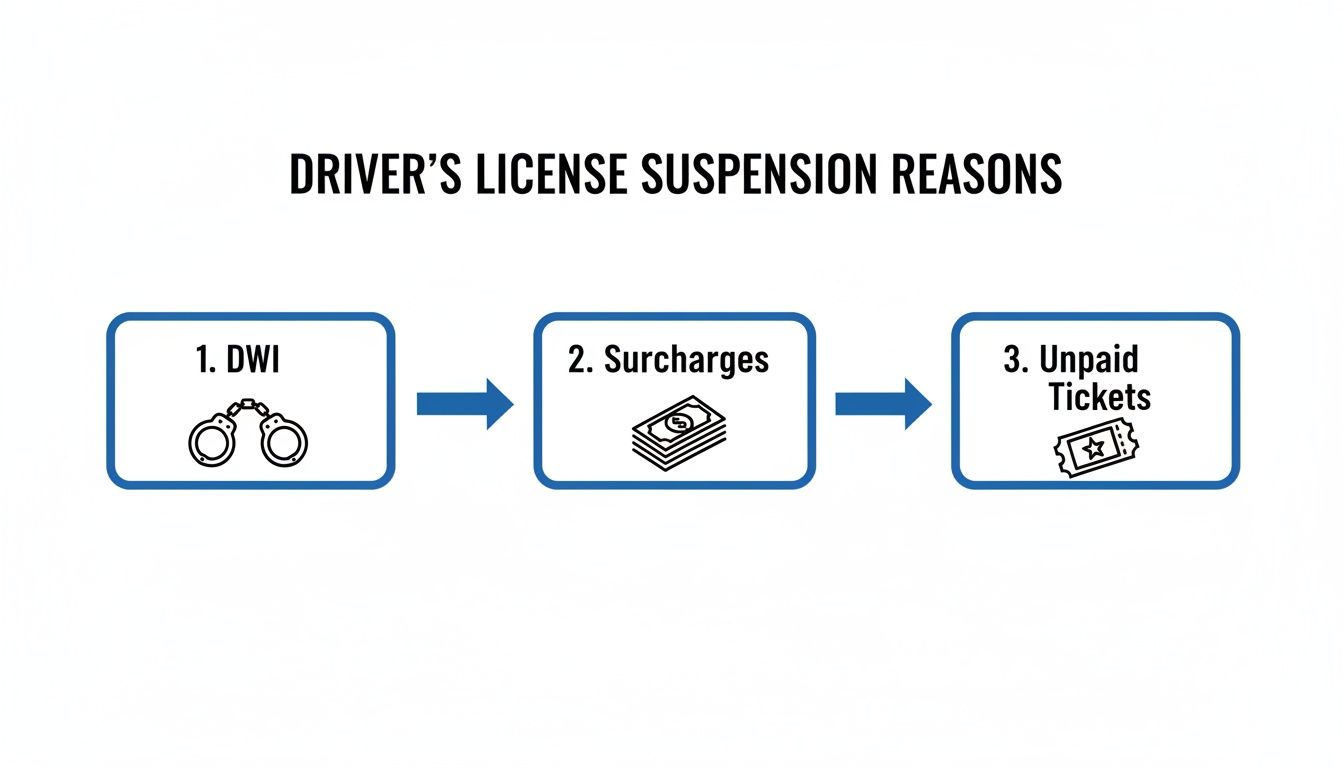
As you can see, a suspension can come from a criminal issue like a DWI, a financial problem like surcharges, or even an unresolved civil matter like old traffic tickets.
Knocking Out the Core Reinstatement Requirements
With your official list from the DPS in hand, you can start checking things off one by one. While the details vary from case to case, most DWI-related suspensions involve a few common requirements.
- Pay All Reinstatement Fees: Every suspension has a reinstatement fee attached to it. It’s a standard charge you have to pay before the DPS will lift the hold on your license. You can usually pay this online right through the same portal where you check your status.
- Complete DWI Education Courses: A judge will almost always order you to complete a DWI education or intervention program. These are state-approved classes designed to teach people about the real dangers of drunk driving. Once you're done, you have to send the certificate of completion to the DPS as proof.
- Obtain an SR-22 Certificate: An SR-22 isn't actually an insurance policy. It's a certificate that your insurance company files with the DPS to prove you have at least the state-minimum liability coverage. After a DWI conviction, you'll typically be required to maintain an SR-22 for two years. If you let your policy lapse for even a day, your license will be suspended all over again.
Submitting your paperwork correctly is just as important as getting it done. The DPS lets you submit documents online, by mail, or by fax. The online portal is usually the fastest and gives you instant confirmation that they received everything.
A Quick Word on the ALR Hearing
While these steps are for getting your license back after a suspension, don’t forget about your first chance to fight it. The Administrative License Revocation (ALR) hearing is your best opportunity to challenge the suspension from the very beginning.
An experienced Texas DUI attorney can represent you at this hearing, question the arresting officer, and work to get the suspension thrown out before it ever starts. You can learn more about this critical part of the case by reading about the Administrative License Revocation process in Texas and seeing how it affects you.
Winning the ALR hearing can save you from having to do any of these reinstatement steps at all. If your attorney finds a flaw in the stop or the arrest procedure, the DPS may not be able to suspend your license in the first place. A proactive defense is always the best strategy.
Getting an Occupational License to Keep Driving

A license suspension can bring your life to a screeching halt. Suddenly, the simple act of getting to work, picking up your kids from school, or running to the grocery store becomes a massive challenge.
Fortunately, Texas law offers a practical solution to keep you on the road for the important stuff: the Occupational Driver License (ODL).
An ODL, often called an essential need license, is a special, court-ordered license that lets you drive for specific, necessary reasons while your regular license is suspended. It’s not a free pass to drive whenever you want, but it’s an absolute lifeline for maintaining your job and managing your family’s needs.
Who Qualifies for an Occupational License?
You don't just get an ODL by asking for one. You have to formally petition the court and prove that not being able to drive creates a genuine hardship. The judge needs to see a legitimate, essential need.
You might be eligible for an ODL if your license suspension is due to:
- An Administrative License Revocation (ALR) after a DWI test failure or refusal.
- A conviction for a first-time DWI in Texas.
- Suspensions related to certain traffic tickets.
The entire process hinges on demonstrating that your need to drive is truly essential. This usually means driving for work, school, or critical household duties like medical appointments and grocery shopping. A skilled DUI attorney knows how to frame your petition to clearly show the court why this restricted license is so critical for you.
How to Petition the Court for an ODL
Getting an ODL is a formal legal process. It involves filing a petition in a Justice, County, or District court—usually in the county where you live. This is more than just filling out a form; it demands specific documents and a strict adherence to court rules.
Your petition package will need to include:
- A Verified Petition: This is the core legal document. It lays out your personal details, why your license was suspended, and a detailed explanation of your essential need to drive.
- Proof of SR-22 Insurance: A judge won’t even look at your request until you have an SR-22 certificate on file. This is non-negotiable proof that you carry the state-required liability insurance.
- A Drafted Court Order: Your lawyer will prepare a proposed order for the judge to sign. This document outlines the specific rules and restrictions of your ODL.
Filing this paperwork correctly is absolutely crucial. One small mistake—a missing document or a poorly explained need—can get your petition denied, leaving you stranded even longer. An attorney makes sure every detail is handled perfectly the first time.
You’ll also have to pay court filing fees, which typically run between $50 and $100. Once the judge signs the order, you get a certified copy that you must carry with you at all times when driving. You’ll then submit that order to the Texas DPS to get your official ODL card.
Understanding ODL Restrictions and Requirements
An ODL comes with very strict rules. The court order will spell out exactly when, where, and why you’re allowed to drive.
Common restrictions include:
- Limited Driving Hours: You may be allowed to drive for up to 12 hours a day, but only during times that match your work or school schedule.
- Approved Counties: The order will name the specific counties you can drive in.
- Driving Log: Some judges require you to keep a detailed log of every trip you take.
- Ignition Interlock Device (IID): If the suspension is DWI-related, the court will almost certainly require an IID in your vehicle as a condition of the ODL.
Before granting an ODL, the court has to see a clear distinction between what a standard license permits and what an ODL allows.
Standard Texas License vs. Occupational License
| Feature | Standard Driver's License | Occupational Driver License (ODL) |
|---|---|---|
| Driving Purpose | Unrestricted personal and commercial use | Restricted to essential needs (work, school, groceries) |
| Driving Hours | 24/7 | Limited, specified hours (e.g., up to 12 hours/day) |
| Geographic Area | Anywhere in the U.S. | Limited to specific, court-approved counties |
| Required Documents | Standard license card | Certified Court Order + Photo ID |
| Special Conditions | None (unless specified) | Often requires SR-22, IID, and a driving log |
| Issuing Authority | Texas Department of Public Safety (DPS) | A specific Texas court (Justice, County, or District) |
This table makes it clear: an ODL is a privilege with tight controls, designed only to prevent hardship, not for convenience.
This is a powerful but limited tool. We provide a detailed guide on how to get an Occupational Driver License in Texas that walks through the specific steps in more detail. In most cases, courts will grant limited driving privileges for essential needs, provided the suspension is not related to a physical disability or unpaid child support.
Why a Houston DWI Lawyer Is Your Strongest Ally

Trying to handle a DWI license suspension yourself can feel like walking through a minefield of legal jargon and tight deadlines. A single missed form or a misunderstood rule can easily add months to your suspension and pile on unnecessary costs.
That's why bringing an experienced Houston DWI lawyer on board isn't just a good idea—it's a critical strategic move. A skilled attorney is your advocate from the very first phone call, and the fight to save your license starts immediately with the Administrative License Revocation (ALR) hearing. This hearing is your first, and often best, shot at challenging the state's case, and it's a battle you shouldn't go into alone.
Fighting the Suspension From Day One
At the ALR hearing, our primary goal is to stop the suspension before it ever begins. We dig into every last detail of your arrest, looking for procedural mistakes, technical errors, or any violation of your rights.
This deep dive into the evidence frequently uncovers significant weaknesses in the state's argument.
- Did the officer even have a legal reason to pull you over? A traffic stop made without reasonable suspicion is illegal, meaning any evidence they gathered after that point could be thrown out.
- Were the field sobriety tests done by the book? These tests are governed by strict protocols, and any deviation from them can make the results completely unreliable.
- Was the breathalyzer machine working right? We can subpoena the device's maintenance logs and the officer's training records to see if the machine was properly calibrated and operated.
Finding these kinds of mistakes can lead to the administrative suspension being dismissed entirely, saving you from months of hardship. An experienced lawyer knows exactly what to look for and how to leverage it for you.
Consider a real-world scenario: An officer pulls a driver over for "weaving" inside their own lane. During the ALR hearing, the attorney's cross-examination gets the officer to admit their patrol car camera was broken. With no objective proof of the alleged weaving, the judge rules the initial stop was unjustified, dismisses the case, and the driver’s license is never suspended.
Managing the Complexities of Reinstatement
Even if a suspension can't be avoided, your lawyer’s job is far from finished. Outside the courtroom, they become your project manager, taking charge of all the complicated paperwork and communication necessary for your license reinstatement in Texas.
This includes walking you through every step, like getting an SR-22 certificate, signing up for the right DWI education program, and submitting all your compliance documents to the DPS on time. We make sure every detail is handled correctly, preventing the simple administrative errors that can sideline your reinstatement for weeks or even months.
An attorney takes the guesswork and anxiety out of the process, letting you focus on your life.
The Strategic Advantage of Legal Counsel
The bottom line is this: a DWI case is really two separate fights happening at the same time. There’s the administrative battle for your driver's license and the criminal defense of your freedom. A seasoned Texas DUI attorney builds a comprehensive strategy that tackles both.
Evidence and testimony we gather during the ALR hearing can be incredibly useful in your criminal case. By locking the arresting officer into their story under oath, we can expose inconsistencies that create reasonable doubt down the road. This proactive approach is why a strong defense against a DWI license suspension in Texas often lays the groundwork for a successful outcome in the criminal court.
Having a legal professional in your corner means you have a guide, a shield, and a strategist. We protect your rights, dismantle the state’s evidence, and create the clearest, quickest path to getting you back on the road. You don’t have to face this overwhelming process by yourself.
Answering Your Top Texas License Reinstatement Questions
After a DWI arrest, your head is probably swimming with questions. Getting straight answers is the first step toward getting back on the road and moving on with your life. We hear these same concerns from clients every day, so let's tackle them head-on.
How Long Will My License Be Suspended for a First DWI in Texas?
This is where things get tricky. For a first DWI in Texas, you’re not facing just one suspension—you’re up against two separate ones. Knowing the difference is critical.
First up is the Administrative License Suspension. This is a civil action, totally separate from your criminal case. If you had a BAC of 0.08 or higher, the Texas Department of Public Safety (DPS) will try to suspend your license for 90 days. If you refused a chemical test, that jumps to a 180-day suspension. This is automatic unless you fight back by requesting an ALR hearing within 15 days of your arrest.
The second suspension only kicks in if you're actually convicted of DWI in court. A judge can then add another suspension, usually from 90 days to one year. A skilled Houston DWI lawyer can attack both of these suspensions, aiming to keep you on the road as much as possible.
What Is an SR-22 and How Long Do I Need It?
People often think an SR-22 is a type of insurance, but it's not. Think of it more like a report card. It's a certificate your insurance company files directly with the DPS to prove you’re carrying at least the minimum liability coverage required by Texas law.
After a DWI-related suspension, you'll almost certainly be required to keep an SR-22 on file for two years starting from your conviction date. It is absolutely crucial not to let your policy lapse during this time. If you do, your insurer has to tell the DPS, and your license will be suspended all over again.
Can I Reinstate My License If I Have Multiple Suspensions?
Yes, it's definitely possible, but it takes organization and a methodical approach. You can't just fix one problem; you have to resolve the specific requirements for each and every suspension before your license is fully reinstated.
Each hold on your driving record comes with its own fees, compliance rules (like finishing a certain course), and specific paperwork. The best way to start is by checking your eligibility status on the Texas DPS online portal. This will give you a full checklist of every active issue holding you back.
Trying to clear multiple suspensions can feel like untangling a knotted mess of fishing line—you have to address each tangle in the right order. An attorney can map out a clear plan to tackle each issue one by one, making sure nothing gets missed and you don't face frustrating setbacks.
What Happens If I Drive With a Suspended License?
Driving with a suspended license in Texas is a crime called Driving While License Invalid (DWLI). Don't do it. The penalties are harsh and will only dig you into a deeper hole.
A first-time DWLI is typically a Class C misdemeanor, which means a fine of up to $500. But it gets serious fast. A second offense can be charged as a Class B misdemeanor, carrying penalties of up to 180 days in jail and a fine up to $2,000. On top of that, a DWLI conviction will extend your original license suspension, pushing your reinstatement date even further away. It's simply not worth the risk.
A DWI charge can feel overwhelming, but you don't have to navigate it alone. At the Law Office of Bryan Fagan, PLLC, our team has the strategic experience to defend your rights and guide you through every step of the license reinstatement process. Contact us today for a free, confidential consultation to discuss your case.