
A DWI arrest in Texas can be overwhelming, and the fear that your driver's license might be suspended adds a layer of stress you don’t need. But you don’t have to face it alone. The good news is that you can get a clear answer quickly. The Texas Department of Public Safety (DPS) provides an online portal where you can check your license status directly. It gives you the immediate information you need to understand your situation and take the first step toward a strong legal defense.
That Sinking Feeling: "Is My License Suspended in Texas?"
The moment you suspect your license is suspended is gut-wrenching. You're not alone in this—many Texans face this same uncertainty, especially after a DWI arrest. Your driver's license is more than a piece of plastic; it’s your key to getting to work, taking your kids to school, and living your life. Losing that freedom, even temporarily, can feel like everything is grinding to a halt.
Let’s cut through the confusion and get straight to the answers you need.
Finding out where you stand is the first step toward a solution. It's a proactive move that shifts you from a place of worry to one of action. Whether you just had a run-in with law enforcement or received a confusing notice in the mail, knowing the facts is essential.

Why You Need to Act Immediately
Ignoring a potential license suspension is one of the worst things you can do. The consequences of driving on a suspended license, known as Driving While License Invalid (DWLI), are severe and can make a bad situation much worse.
The penalties can include:
- Hefty Fines: You could be on the hook for hundreds or even thousands of dollars in new fines.
- Longer Suspension: The original suspension period can be extended, keeping you off the road even longer.
- New Criminal Charges: DWLI is typically a Class C misdemeanor, but it can be elevated to a Class A or B misdemeanor with potential jail time, depending on the circumstances.
Facing a DWI charge in Texas feels like the ground is shifting beneath your feet. But remember this: an arrest is not a conviction, and a suspension notice is not the final word. You have rights, and more importantly, you have options.
Our goal is to give you a clear, reassuring path forward. Understanding how to check your status is the first move in a smart defense. Even a serious charge doesn't have to slam the door on your driving privileges, and a skilled Houston DWI lawyer can help you fight to protect them from the very beginning.
How to Get a Definitive Answer on Your Texas License Status
The uncertainty after a DWI arrest can be one of the most stressful parts of the ordeal. Waiting for a letter that may or may not come, or hearing conflicting information, just adds to the anxiety.
Let’s cut through the noise and get you a concrete answer. Thankfully, Texas makes it fairly straightforward to check the status of your driver's license.
The Fastest Way: Use the Texas DPS Online Portal
Your first and best stop should always be the official Texas Department of Public Safety (DPS) online eligibility portal. This is your direct line to the DPS database, giving you instant, up-to-the-minute information on whether you're clear to drive. No waiting, no guessing.
To log in and see your status, you’ll need three simple things:
- Your Texas Driver License (or ID card) number
- Your date of birth
- The last four digits of your Social Security number

Once you enter your details, the system will immediately show your current eligibility. If there are any issues, it will list any outstanding fees or specific requirements you need to handle to get your license reinstated.
What If the DPS Portal Shows Nothing Yet? Check County Court Records
Sometimes, especially right after a DWI arrest, the DPS system hasn't caught up yet. The information might not appear online for a few days.
If that's the case, your next move is to check your county clerk's website. Most Texas counties offer online access to public court records. By searching your name or case number, you can often find documents related to your arrest, like bond conditions or initial rulings that mention the status of your driving privileges.
This isn't as direct as the DPS portal, but it can provide crucial early clues. For a Houston DWI lawyer, these records are often the first place we look to start building a defense strategy.
When you need a quick answer, you have a few options, each with its own pros and cons.
Here's a quick comparison of the methods available to check your Texas driver license eligibility.
Three Ways to Check Your Texas License Status
| Method | What You Need | Speed | Cost |
|---|---|---|---|
| DPS Online Portal | Driver License #, DOB, Last 4 of SSN | Instant | Free |
| Phone Call to DPS | Driver License #, Patience | Slow (long wait times) | Free |
| Mail Request | A completed form and a check | Very Slow (weeks) | A small fee |
The online portal is almost always the best choice for speed and convenience, but it's good to know you have backups if needed.
Other Options for Verifying Your Status
If you can't get online, you still have a couple of other options.
- By Phone: You can call the DPS customer service line. Be prepared for a potentially long wait. When you get a representative on the line, have your driver's license number handy and ask them to confirm your "eligibility status" and list any "enforcement actions" on your record.
- By Mail: This is the slowest method, but requesting a copy of your complete driving record via mail gives you a certified history. This official document can be useful for legal proceedings.
The most important thing you can do right now is be proactive. Finding out your license status is the first step toward regaining control. It transforms you from someone just waiting for things to happen into someone who is making things happen.
Whatever you find out, remember this information is just a starting point. An administrative suspension can often be challenged, and a criminal charge can be fought. The key is to act quickly and build a smart strategy. We can help you understand exactly what your license status means and create a plan to protect your freedom to drive.
Why Your License Was Suspended: Administrative vs. Criminal Penalties
If you've been arrested for a DWI in Texas, discovering your license is suspended can be a confusing and frustrating experience. Most people don't realize that a single DWI arrest actually initiates two separate processes that can take away your driving privileges.
Understanding which one you're dealing with—or if you're up against both—is the first critical step in building your defense. They are not the same, and the "why" behind your suspension dictates what you need to do right now to get back on the road. One is a fast-moving civil action, while the other is tied directly to the outcome of your criminal court case.
The Administrative License Revocation (ALR)
The first and most immediate threat to your license is the Administrative License Revocation (ALR). This isn't a criminal penalty; it's a civil action taken directly by the Texas Department of Public Safety (DPS).
The ALR process is triggered because of Texas's implied consent law. In short, this law states that by driving on a Texas road, you have automatically agreed to provide a breath or blood sample if you are lawfully arrested for DWI.
The DPS will move to suspend your license through the ALR process if you either:
- Refuse to provide a breath or blood sample after a lawful arrest.
- Provide a sample that shows a Blood Alcohol Concentration (BAC) of 0.08% or higher.
This process is notoriously quick. The moment the officer hands you a notice of suspension (which often serves as a temporary driving permit), a timer starts.
You have only 15 days from the date of the notice to request an ALR hearing. If you miss this deadline, your license is automatically suspended 40 days after your arrest, and you lose your single best chance to fight the initial suspension.
Challenging an ALR requires immediate action. An experienced DWI lawyer who knows the unique rules of these administrative hearings is your best ally in protecting your license.
The Court-Ordered Criminal Suspension
The second type of suspension is a criminal penalty. This is what most people think of—it’s handed down by a judge, but only if you are ultimately convicted of DWI.
This suspension is completely separate from the ALR. It's entirely possible to win your ALR hearing and keep your license, only to face a new, court-ordered suspension months or even years later if you're convicted in your criminal case.
For a first offense, an ALR suspension typically lasts between 90 and 180 days. A court-ordered suspension can also range from 90 days up to two years, depending on the facts of your case and whether you have prior offenses.
Other Reasons Your License Might Be Suspended
While a DWI is a common reason for a license suspension, other issues can arise. You could also be facing a suspension for issues like:
- Unpaid traffic tickets and court fines.
- Failing to pay surcharges under the old Driver Responsibility Program.
- Driving without valid auto insurance (which can lead to SR-22 requirements).
These problems can stack up, making it even harder to understand what's going on. That's why identifying the exact reason for your suspension is so important. Because of its tight deadlines, understanding the administrative license revocation process in Texas is especially critical. A sharp Texas DUI attorney can pick apart every reason for your suspension and build a strategy to fight each one, ensuring no opportunity to save your license is missed.
The Real-World Impact of a Suspended License in Texas
Losing your driving privileges isn't just a legal penalty—it’s an event that can turn your life upside down. A suspended license doesn't just mean you can't drive. It means you might not be able to get to work, pick up your kids from school, or handle basic errands like going to the grocery store.
For many hardworking Texans, being unable to legally drive creates an impossible choice. Do you risk getting behind the wheel on a suspended license and face new criminal charges, or do you stay home and risk losing the income your family desperately needs? It's a stressful position that countless people find themselves in.
The Cycle of Debt and Legal Trouble
What starts as a simple license suspension can quickly spiral into a much bigger problem, especially when tied to financial issues rather than a dangerous driving offense. Many suspensions are triggered by unpaid fines or fees, trapping people in a cycle that feels impossible to escape. Once your license is gone, earning the money to pay off the original fines becomes a monumental challenge.
This situation is far more common than most people realize. Approximately 1.7 million Texans are legally unable to drive because of programs like the Driver Responsibility Program or the Omnibase Program.
What's really shocking is that about 7 in 10 of these suspensions are because of unpaid fines and fees, not because someone was a menace on the road. You can dig deeper into these findings in Texas Appleseed's report on debt-based license suspensions.
A DWI charge is serious, but the ripple effects of a license suspension can feel just as devastating. We understand that your case isn't just about a legal document; it's about protecting your job, your family, and your financial stability.
It's More Than Just a Legal Case
When we take on a DWI case, we see the whole picture. We know the real-world struggles that come with a potential DWI license suspension, so we build a defense strategy designed to solve these life-altering problems—not just shuffle paperwork for a court date.
A Houston DWI lawyer doesn't just fight the charges against you; they fight to keep your life intact. This means aggressively challenging the administrative license suspension from day one and exploring every option to keep you on the road legally, such as securing an Occupational Driver License. Your ability to drive is essential, and our entire defense is built around protecting that necessity while we take on the underlying DWI charge.
Your Roadmap to Reinstating Your Texas Driver License
Finding out your license is suspended can feel like hitting a brick wall. But what if you saw it as the starting point for a strategic comeback? Knowing where you stand is the first step, and the next is building a clear, actionable plan to get back on the road. This isn’t just about waiting out a penalty; it’s about actively taking control of the process.
The path to getting your license back involves a few specific, manageable steps. You’ll have to tackle any reinstatement fees the DPS requires, which can often be paid online. You will also almost certainly need to get a special type of car insurance known as an SR-22. This isn't traditional insurance; it's a certificate your insurance company files to prove to the state that you meet Texas's minimum liability coverage.
Can I Drive While My License Is Suspended?
For most people, the immediate, pressing concern is simple: "How do I get to work tomorrow?" This is where an Occupational Driver License (ODL) becomes an absolutely essential tool. An ODL, sometimes called an essential need license, is a special, restricted license granted by a court.
It allows you to drive legally for specific, court-approved reasons, such as:
- Getting to and from your job
- Traveling to and from school or required educational classes
- Handling essential household duties, like grocery shopping or going to medical appointments
Not everyone qualifies for an ODL, and the petition process requires precise legal paperwork that leaves no room for error. An experienced attorney can quickly determine your eligibility and file the necessary petition on your behalf, giving you the best shot at approval and helping you keep your life moving during the suspension period.
The consequences of a license suspension can ripple through every part of your life, from your job security to your family's stability. It's not just an inconvenience; it can be a genuine crisis.
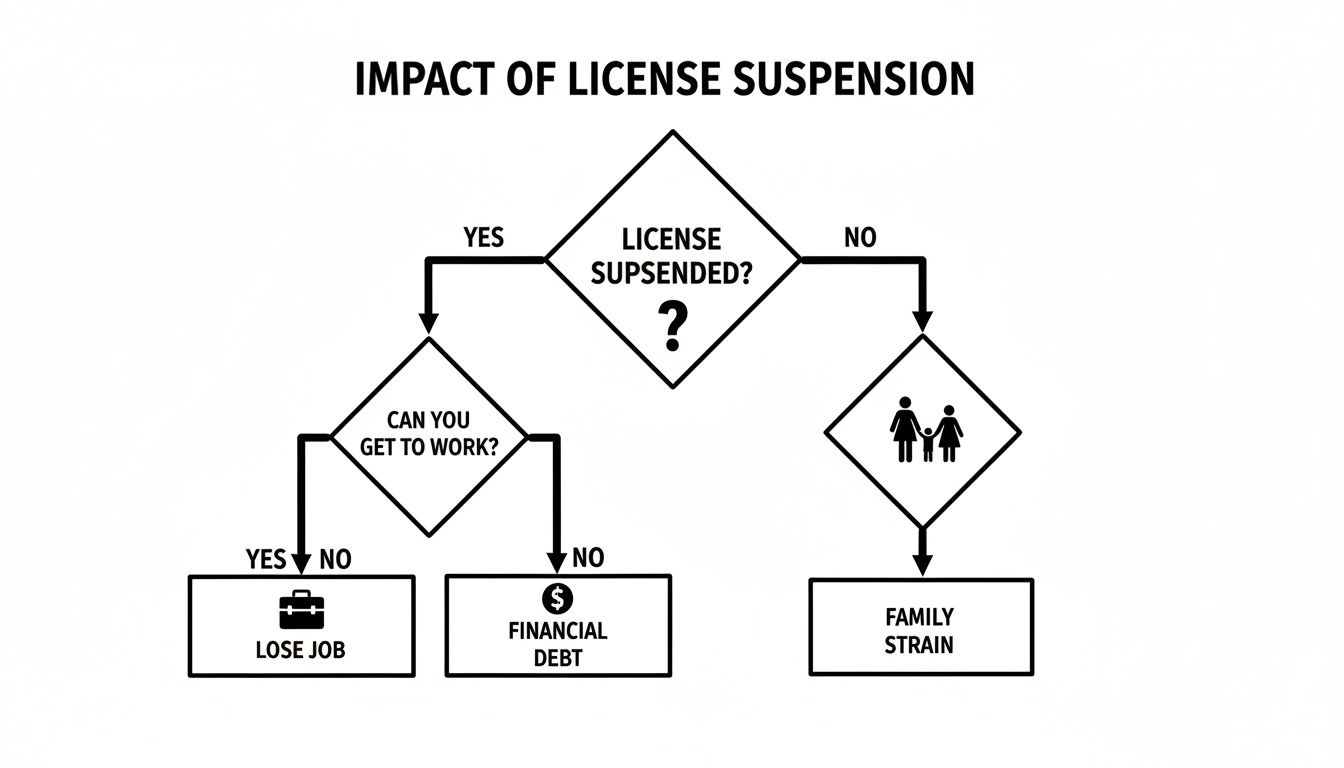
As the flowchart shows, losing your ability to drive often leads directly to job loss, financial hardship, and significant strain on your family. This is exactly why a proactive approach is so critical from day one.
The Steps to Getting Your License Back
Beyond the SR-22 and fees, you might also have to complete court-mandated programs, like a DWI education course. Keeping a careful file of all required paperwork and tracking every deadline is crucial. For a detailed guide on the specific requirements you'll likely face, you can learn more about the complete process for how to reinstate your suspended license in Texas.
Taking these steps methodically transforms a daunting problem into a solvable one. Each fee paid and form filed is a concrete move toward getting your full driving privileges back and putting this chapter behind you for good.
A DWI-related suspension is complicated, but it doesn't have to derail your life. By understanding the requirements and strategically using tools like the ODL, you can create a clear path forward. Your first move should always be to challenge the initial ALR suspension within the crucial 15-day deadline, but even if that window has closed, you still have powerful options to get back on the road.
Answering Your Top Questions About Texas License Suspensions
When your license is on the line, your mind starts racing with questions. It's a completely normal reaction. Getting clear, direct answers is the best way to cut through the stress and figure out what to do next. We hear these same questions from clients every day, so let's get you the clarity you need right now.
How Long Will My License Be Suspended for a First DWI in Texas?
With a first DWI in Texas, you're looking at two separate potential suspensions.
First, there’s the immediate administrative license suspension. If you fail a breath or blood test (meaning a BAC of .08 or higher), that suspension is typically 90 days. If you refuse to provide a sample, the penalty jumps to 180 days.
This administrative action is separate from any criminal suspension you might get from a DWI conviction in court. A conviction-based suspension can last anywhere from 90 days up to a full year. An experienced attorney can challenge the administrative suspension right away, giving you a fighting chance to keep your driving privileges while the criminal case unfolds.
What if I Missed the 15-Day Deadline to Request an ALR Hearing?
Missing that strict 15-day window to request your Administrative License Revocation (ALR) hearing has an immediate consequence: the administrative suspension will automatically kick in 40 days after your arrest. You can't go back in time to fight that specific suspension.
But your case is far from over.
You can—and absolutely should—still fight the criminal DWI charge itself. More importantly, you may still be able to drive for essential needs. Find out more about applying for an occupational driver license in Texas to keep your life moving and handle your work and family duties. It's critical to talk to a Houston DWI lawyer to figure out what options you still have on the table.
Even if you've missed a deadline, don't assume you've lost all your rights. Strategic legal action can still protect your ability to drive and defend you against the primary DWI charge.
What Are the Penalties for Driving with a Suspended License?
Getting caught driving while your license is invalid (DWLI) in Texas is a serious offense that can pile on new legal problems. A first offense is usually a Class C misdemeanor, which comes with a fine of up to $500.
However, the penalties escalate quickly. If it happens again, or if you're caught driving without insurance or cause an accident, the charge can be bumped up to a Class A or B misdemeanor. That means potential jail time and much bigger fines. It is crucial to fight a DWLI charge to stop your legal and financial troubles from spiraling out of control.
A DWI charge can threaten your freedom, your finances, and your ability to drive. You don’t have to face this uncertainty alone. The experienced attorneys at the Law Office of Bryan Fagan, PLLC are ready to build a strategic defense to protect your rights and your future. For a free, confidential case evaluation to discuss your options, contact us today at https://texasduilawfirm.com.