
A DWI arrest can be overwhelming, but you do not have to face it alone.
If you are reading this after a fatal crash, you may be carrying fear, guilt, confusion, and a hundred urgent questions at once. You may be wondering whether you are going to prison, whether probation is possible, what happens to your license, and whether anything can still be done to protect your future.
In Texas, intoxication manslaughter is one of the most serious charges tied to impaired driving. The legal stakes are high, but this is still a case, not a conclusion. A charge is not the same as a conviction. A sentencing range is not the same as the sentence a judge or jury will impose. And the facts that feel fixed in the first days after an arrest often look very different after a careful legal review.
People often search for intoxication manslaughter sentence texas because they want one simple answer. The situation is more complicated. The law sets a range. The evidence shapes the risk. The details of the crash, the testing, the officers’ actions, and your personal history all matter.
What helps most right now is clear information and a strategic plan.
Facing an Intoxication Manslaughter Charge in Texas
A person charged with intoxication manslaughter usually does not walk into this process with a clear head and a checklist. Individuals often arrive in shock.
One client may have been released on bond and is trying to answer family members without saying the wrong thing. Another may still be in custody, hearing fragments of legal language like “felony,” “blood draw,” and “license suspension” without knowing what those terms mean in real life. A spouse may be the one searching online, trying to figure out what happens next.
That reaction is normal.
What makes this charge feel different
This is not handled like a routine first DWI in Texas. A death changes everything. Police investigate more aggressively. Prosecutors review the case more closely. Judges treat bond conditions more seriously. The emotional weight in the courtroom is heavier from the beginning.
You may also feel pressure to explain yourself right away.
That is where many people make a damaging mistake. They try to “clear things up” before they understand what the State has to prove, what the testing really shows, or whether the crash can be tied to intoxication in the way the prosecution claims.
Key point: The first useful step is not guessing what will happen. It is getting a disciplined review of the arrest, the crash investigation, and the evidence the State plans to use.
Regaining control early
Even in a very serious case, there are still decisions to make:
- Protect your statements: Do not volunteer details to police or investigators without counsel.
- Secure records quickly: Video, dispatch information, medical records, and witness accounts can become critical.
- Address license issues early: A DWI-related arrest can trigger a separate process affecting your driving privileges.
- Build a sentencing strategy now: In a felony case, mitigation does not start at the end. It starts immediately.
This charge can alter your life. It does not erase your rights.
What Is Intoxication Manslaughter in Texas
Under Texas law, intoxication manslaughter is not “someone died and alcohol was involved.” The State has to prove specific legal elements.
In plain language, prosecutors must show that you were operating a motor vehicle in a public place, that you were intoxicated, and that your intoxication caused another person’s death.
Intoxication does not only mean a number
Many people think the whole case turns on one BAC result. BAC means blood alcohol concentration, which is the measured amount of alcohol in a person’s blood.
Texas uses 0.08% BAC as the legal intoxication threshold for DWI prosecutions, but intoxication manslaughter cases are not always that simple. As explained in this overview of intoxication manslaughter law in Texas, prosecutors may still pursue the charge when BAC is below 0.08% if they claim other evidence proves impairment.
The State can rely on things like:
- Field sobriety test performance: These roadside exercises are used by officers to claim loss of normal mental or physical faculties.
- Driving behavior: Weaving, braking patterns, acceleration, and lane position may be used as circumstantial evidence.
- Witness observations: Officers or civilians may describe speech, balance, odor, or behavior.
- Toxicology findings: Chemical tests may be part of the picture, but they are not always the whole picture.
The verified rule is that prosecutors must prove beyond a reasonable doubt that the driver was impaired and that the conduct directly caused death. A BAC of 0.15% or higher triggers a mandatory $6,000 surcharge in addition to base fines, according to this discussion of intoxication manslaughter evidence standards.
Causation is often where cases become technical
The word caused matters.
If a person was impaired, that alone does not resolve every issue in the case. Prosecutors still have to connect the alleged intoxication to the fatal result. That can become complicated if there were road hazards, mechanical problems, another driver’s conduct, poor visibility, or disputed crash reconstruction findings.
Think of it this way. Murder cases usually focus on intent. Intoxication manslaughter focuses on impairment and causation. The legal question is not whether you meant for someone to die. The question is whether the State can prove that intoxication led to the death in the way the law requires.
A few key terms people often confuse
| Term | Plain-English meaning |
|---|---|
| BAC | Blood alcohol concentration |
| Field sobriety test | Roadside exercises officers use to claim impairment |
| Implied consent | By driving in Texas, you are considered to have agreed to provide a breath or blood specimen in certain lawful DWI investigations |
| Administrative license suspension | A separate process that can suspend your license apart from the criminal case |
That last item matters. The criminal case and the license case are related, but they are not the same proceeding.
The Statutory Sentence Range for Intoxication Manslaughter
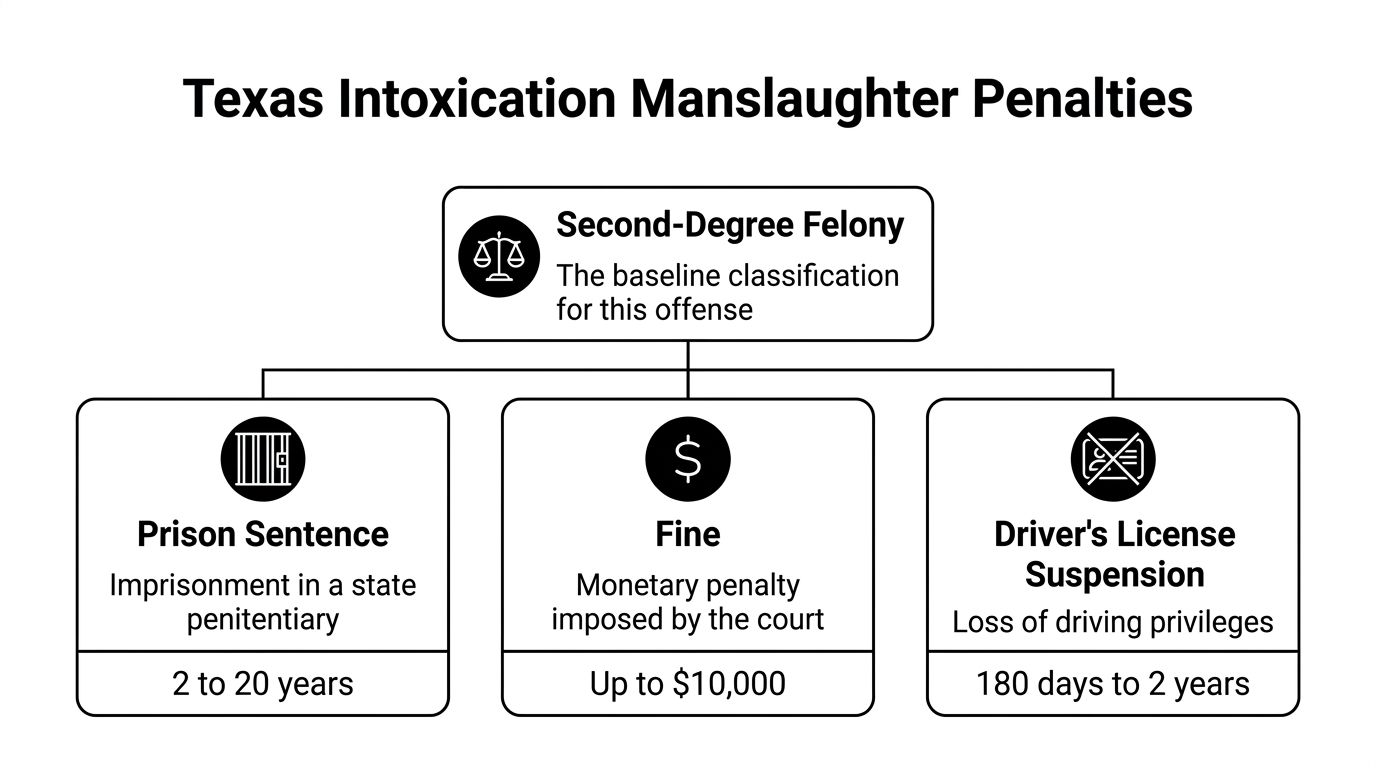
Texas treats intoxication manslaughter as a felony offense with prison exposure from the start. Under Texas Penal Code Section 49.08, the baseline offense is a second-degree felony.
That means the statutory range is 2 to 20 years in prison, a fine of up to $10,000, and a driver’s license suspension from 180 days to 2 years, as summarized in this Texas intoxication manslaughter penalties analysis and this Texas DWI penalties resource.
What the range means
People often hear “2 to 20 years” and ask whether that means they will probably get something in the middle. It does not work that way.
A sentencing range is the legal window. The sentence depends on the facts, the evidence, the presence of enhancements, the way the case is presented, and who decides punishment. In some cases, a plea negotiation shapes the outcome. In others, a judge or jury sets punishment after hearing evidence.
Why Texas approaches these cases so harshly
Texas has taken an aggressive approach to intoxication manslaughter prosecutions. Reports indicate a significant number of alcohol-related traffic fatalities annually. Furthermore, recent contested intoxication manslaughter cases have shown a high conviction rate, often resulting in substantial imprisonment.
Those numbers do not tell you what will happen in your case. They do tell you how seriously the State treats these prosecutions.
Practical takeaway: The baseline sentence range is only the starting point. A defense often involves limiting how the State frames the facts inside that range.
Penalties outside prison time
A prison sentence is only one part of the consequence.
A conviction can also affect:
- Your driver’s license: Suspension is built into the penalty structure.
- Your employment: Many jobs cannot survive a felony conviction.
- Professional licensing: Nurses, commercial drivers, teachers, and other licensed professionals can face separate disciplinary problems.
- Family life: Custody disputes, transportation limits, and financial strain often follow.
What happens after arrest and before sentencing
The process often includes several separate tracks:
Bond and release conditions
A judge may impose alcohol monitoring, travel limits, or no-driving restrictions.Administrative license suspension issues
An ALR hearing may come into play. ALR stands for Administrative License Revocation. It is the civil process tied to a DWI arrest that can affect your license apart from the criminal case.Criminal court proceedings
These include charging decisions, evidence exchange, motions, negotiations, and possibly trial.
Understanding the statutory range matters. Understanding how quickly the process moves matters just as much.
Factors That Can Enhance Your Sentence
The baseline range is serious enough. Some facts can make it much worse.
Texas uses sentencing enhancements to push certain intoxication manslaughter cases into a higher punishment category. When that happens, the conversation changes from “how do we handle a second-degree felony?” to “can the State prove the enhancement it is alleging?”

Grayson’s Law changed the situation
Effective September 1, 2025, Texas implemented Grayson’s Law, which increased punishment in certain intoxication manslaughter cases. According to this summary of Grayson’s Law changes, the law raised the mandatory minimum sentence for some cases to 10 years in prison without parole.
The same verified source states that when more than one person dies in the crash, the offense can be charged as a first-degree felony, carrying 5 to 99 years or life in prison. Judges also gained authority to stack sentences for multiple victims, which can lead to decades of imprisonment.
The most important enhancement triggers
Another verified source explains that Texas sentencing uses a tiered felony structure, with certain facts increasing exposure dramatically. In practical terms, the common enhancement pathways include:
Multiple fatalities
If more than one person dies in the same criminal transaction, the charge may move into first-degree felony territory.Victim status
If the person killed was emergency personnel or another protected official acting in official duties, the punishment level may increase.Prior intoxication-related history combined with specific statutory conditions
In some situations, a prior record can affect how prosecutors frame the charge and sentencing position.
What sentence stacking means
People hear “stacking” and assume it is automatic. It is not. It refers to consecutive sentencing.
That means one sentence starts after another ends, rather than running at the same time. In a case involving multiple victims, that issue can become as important as the base punishment range itself.
Here is the practical difference:
| Sentencing structure | What it means |
|---|---|
| Concurrent | Sentences run at the same time |
| Consecutive or stacked | One sentence begins after the other ends |
That distinction can shape plea negotiations, trial strategy, and sentencing arguments from the earliest stage of the case.
Defense focus: When the State alleges an enhancement, your lawyer should test the factual basis for that allegation, not accept the harsher range as a given.
Why enhancements change strategy
A case with an enhancement is not just a “bigger penalty” case. It is a different defense problem.
The lawyer has to ask:
- Did the State correctly allege the enhancement?
- Can the prosecution prove the facts required for it?
- Is there room to negotiate around the enhancement?
- If multiple charges are involved, can the defense argue for concurrent rather than stacked time?
That is where the human and strategic side of the case starts to matter as much as the statute.
What Judges Consider During Sentencing
The law gives a range. Judges and juries decide where within that range a person falls.
That decision is never made in a vacuum. Sentencing hearings are about facts, but they are also about narrative. The prosecution tells one story about danger, responsibility, and harm. The defense has to present a fuller story about the person, the evidence, and what punishment is fair under the law.
The facts that usually carry weight
Judges often pay close attention to the parts of a case that feel concrete and hard to argue with.
That can include:
Criminal history
Prior DWI-related allegations or convictions often affect how a court sees risk and accountability.Chemical test evidence
A high BAC reading can make the prosecution’s punishment argument stronger. If the testing is questionable, the defense may push back hard.Crash circumstances
Speed, road conditions, vehicle condition, and whether there is a real dispute about causation all matter.Conduct after the crash
Statements, cooperation, medical facts, and behavior at the scene can influence how the court views the case.
The less obvious factors can matter just as much
A sentencing hearing is one of the few times when the court sees more than the police report.
The judge may hear about treatment efforts, work history, family responsibilities, military service, medical conditions, counseling, and community support. None of that erases a death. It can, however, affect how the court evaluates punishment.
Victim impact is powerful and real
In these cases, victim impact statements often shape the emotional tone of sentencing.
A defense lawyer cannot and should not try to erase that reality. The better approach is to respect the loss while still advocating for a lawful, measured sentence grounded in the evidence and the person standing before the court.
What often confuses families: Remorse matters, but it is not a magic fix. It has to be credible, consistent, and presented carefully.
Why mitigation is not the same as excuse-making
Many clients worry that presenting background evidence will sound like making excuses.
Done correctly, mitigation does something different. It gives the judge a complete record. It helps the court distinguish between a headline and a human being. It can also help explain why a sentence at the lower end of the range is appropriate, or why certain prosecution claims should not drive punishment upward.
The sentencing phase is its own case
A strong defense does not stop at guilt or innocence.
The sentencing phase may involve:
- Collecting treatment records
- Preparing witnesses
- Organizing work and family evidence
- Addressing prior allegations strategically
- Framing a clear request for a specific punishment outcome
That is one reason experienced counsel matters so much. A lawyer is not only arguing legal rules. A lawyer is shaping how the court understands your case.
Is Probation Possible for Intoxication Manslaughter
This is one of the first questions families ask, and for good reason.
Yes, probation can come up in conversations about intoxication manslaughter. But it is difficult, highly case-specific, and often far less available than people hope.

Why probation is so hard in these cases
A death makes the case different from a lower-level DWI. Courts approach punishment with much more caution, and prosecutors often resist community supervision aggressively.
Another issue is the possibility of a deadly weapon finding. In Texas, a motor vehicle can be treated as a deadly weapon depending on the facts alleged and proved. That issue can sharply affect eligibility and sentencing options.
Deferred adjudication and probation are not the same thing
People often use these terms interchangeably. They are different.
- Deferred adjudication means the court postpones a finding of guilt while the person serves supervision.
- Probation, also called community supervision, usually means a sentence exists but the person serves supervision under court-ordered conditions instead of going straight to prison.
If you want a broader explanation of how these outcomes work in Texas criminal cases, this guide to probation and deferred adjudication is a useful starting point.
If probation is on the table, expect strict conditions
In a serious felony DWI-related case, probation is not a light outcome. It can feel demanding and intrusive.
Conditions may include:
- No alcohol or drug use
- Regular testing and reporting
- Treatment requirements
- Ignition interlock use
- Travel restrictions
- Community supervision fees and court-ordered programs
One violation can create major problems.
Important reality check: In an intoxication manslaughter case, the defense should treat probation as a possibility to fight for when supported by the facts, not as the default result to expect.
When probation arguments are stronger
The best probation arguments usually depend on a combination of factors, not one single point.
For example, the defense may be in a better position if:
- causation is contested,
- the evidence of intoxication is less clear,
- the client has little or no criminal history,
- the client has taken meaningful treatment steps early,
- and the case allows room for a punishment presentation focused on accountability and structure.
Even then, there are no guarantees.
That is why the strategic goal is often broader than “get probation.” The goal is to preserve every available sentencing option and to avoid decisions early in the case that close off better outcomes later.
How a Houston DWI Lawyer Can Fight for Your Future
An intoxication manslaughter case is not defended with one argument. It is defended in layers.
A Houston DWI lawyer or Texas DUI attorney looks at the stop, the arrest, the testing, the crash reconstruction, the charging language, the enhancement allegations, the license consequences, and the punishment strategy as connected parts of one case.

A verified source notes that Texas intoxication manslaughter sentencing uses a tiered felony structure that shapes plea negotiations. It also explains that defense lawyers create negotiating power by challenging the factual basis for enhancements and by addressing whether sentences should run concurrently or consecutively, as discussed in this analysis of Texas intoxication manslaughter sentencing structure.
Early intervention changes cases
The first stage is often about protecting the record.
A lawyer may examine:
The traffic stop or initial contact
Did officers have legal grounds to stop or detain you?Blood draw procedures
Was the warrant valid? Was the sample handled correctly? Is there a chain-of-custody issue?Field sobriety testing
Were the exercises administered correctly, and were medical or environmental factors ignored?Administrative license suspension issues
A separate defense may be needed to fight DWI license suspension through the ALR process.
Causation is often the battlefield
In many cases, the question is not only “was my client impaired?” It is also “did the State prove that impairment caused the death?”
That may require:
- accident reconstruction experts,
- review of vehicle data,
- analysis of road design or weather,
- medical record review,
- and close examination of what other drivers or pedestrians did.
If you want to fight DWI Texas cases effectively at the felony level, you have to test every link in the State’s chain.
Plea negotiations are strategic, not passive
A skilled lawyer does more than wait for an offer.
Counsel may negotiate around:
- enhancement allegations,
- the wording of key facts,
- deadly weapon disputes,
- sentencing recommendations,
- and whether the court should consider concurrent rather than stacked punishment.
That work can affect the final outcome even when dismissal is not realistic.
Here is a helpful overview of how defense strategy is discussed in practice:
Sentencing advocacy matters as much as trial preparation
Some lawyers focus heavily on guilt and give too little attention to punishment preparation. That is a mistake in this type of case.
A serious sentencing presentation may include treatment records, expert input, family testimony, employment evidence, and a direct plan for accountability. The Law Office of Bryan Fagan, PLLC represents clients in Texas DWI and related felony matters, including administrative license hearings and courtroom defense, which is the kind of coordinated approach these cases often require.
What a good defense really does
A strong defense does not promise miracles. It does something more useful.
It works to:
- Protect your rights after arrest
- Challenge weak or overstated evidence
- Reduce exposure where possible
- Preserve favorable sentencing options
- Present you as a person, not just a charge
That is how lawyers help clients facing an intoxication manslaughter sentence texas problem move from panic to a real defense plan.
Take the First Step to Protect Your Freedom
When people call after an intoxication manslaughter arrest, they are usually looking for two things. They want honesty, and they want to know whether anything can still be done.
The honest answer is that this is a severe charge with life-changing consequences. The other honest answer is that the case is not over just because an arrest happened. There may be issues with the stop, the blood evidence, the crash analysis, the enhancement allegations, the sentencing posture, or the separate license process.
You do not need to solve all of that tonight.
You do need to stop guessing.
A strategic defense starts with a careful review of what the State can prove, what it cannot prove, and what steps can still protect your future. That includes the criminal case, the possibility of an ALR hearing, your bond conditions, your risk of DWI license suspension, and the sentencing factors that may shape the road ahead.
If you or someone you love is facing this charge, get legal advice early. The sooner a defense lawyer can preserve evidence, challenge assumptions, and start building mitigation, the more options you may have.
No two cases are identical. Your defense should not be either.
If you are facing an intoxication manslaughter charge, request a free consultation with Law Office of Bryan Fagan, PLLC. A confidential case evaluation can help you understand the charge, the possible sentence range, your license issues, and the defense strategy available in your case.
