
A DWI arrest can be overwhelming, but you don’t have to face it alone.
Many who call a Houston DWI lawyer after an arrest are asking the same thing in different words. “Was I charged?” “Am I indicted?” “Do I lose my license now?” “Is this already on my record?” That confusion is normal. Texas criminal procedure uses words that sound interchangeable in everyday life, but they mean very different things in court.
Here’s the direct answer. Arrested and indicted are not the same. If you understand that difference early, you make better decisions early. And in a DWI case, early decisions matter more than commonly understood.
Arrested for DWI Understanding What Comes Next
A driver gets pulled over late at night in Harris County. The officer says there was probable cause for the stop. The driver answers questions, tries the field sobriety tests, gets handcuffed, and spends the night worried about jail, work, family, and a suspended license. By morning, one fear takes over all the others: “Have they already built the whole case against me?”
Usually, no.
An arrest is the beginning of the process, not the end of it. It means law enforcement took you into custody. It does not mean the prosecutor has proved the case. It does not mean a grand jury has reviewed anything. And it definitely does not mean you’re convicted.
That gap matters. In the federal system, 94,411 federal arrests were recorded in FY 2023, while only 71,954 defendants faced federal criminal cases in the preceding year, according to the Federal Justice Statistics 2023 report from the Bureau of Justice Statistics. The lesson is simple. An arrest can start a case, but it doesn’t guarantee the case will move all the way forward.
For a Texas DWI, that early window is where a smart defense does real work. The officer’s reason for the stop can be challenged. The field sobriety tests can be reviewed. The breath or blood issue can be examined. The paperwork can be tested for errors. And the license deadline starts running right away.
If you’re trying to understand the first few hours and days after a stop, this guide on being arrested for DWI in Texas gives a practical overview.
Practical rule: Treat the first days after a DWI arrest as a defense window, not a waiting period.
That mindset changes everything. Instead of assuming the system has already decided your fate, you start protecting your license, your job, and your criminal case while there’s still room to move.
What it Means to Be Arrested vs Indicted in Texas
An arrest means police physically take you into custody based on probable cause. In plain English, that means the officer believes there was a fair basis to think you committed an offense.
An indictment is different. It is a formal criminal accusation issued by a grand jury after reviewing evidence presented by a prosecutor. As noted in this discussion of arrested versus indicted legal standards, indictments are much rarer and are generally used for about 5-10% of state felonies and most federal cases.

Why this matters in Texas DWI cases
Many find this confusing. Most DWI arrests in Texas do not begin with an indictment.
A first DWI in Texas is often a misdemeanor. Many second-offense cases are also handled as misdemeanors, depending on the facts and prior history. Misdemeanor cases are usually filed by a prosecutor using a charging document called an information, not a grand jury indictment. So if you were arrested for a typical misdemeanor DWI, asking “Have I been indicted?” may be the wrong question.
The better question is: Has the State formally filed the criminal charge yet, and what can be challenged before that happens?
The short version
Use this chart to keep the terms straight.
| Issue | Arrest | Indictment |
|---|---|---|
| Who starts it | Police officer or law enforcement agency | Grand jury after prosecutor presents evidence |
| Legal standard | Probable cause | Formal accusation based on evidence package presented to grand jury |
| When it happens | Immediately | Later, usually in felony matters |
| What it means | You were taken into custody | The State formally accuses you of a felony |
| Common in Texas DWI | Yes | Usually only in felony DWI cases |
| What often applies in misdemeanor DWI | Arrest first | Information filed instead of indictment |
Terms every Texas driver should know
Some words show up in almost every DWI case. You need to know them.
- Implied consent means that by driving on Texas roads, you’ve agreed to provide a breath or blood specimen under certain circumstances. Refusing can trigger an administrative license suspension process.
- BAC stands for blood alcohol concentration. It’s the measurement prosecutors often rely on in alcohol-based DWI cases.
- Field sobriety test usually refers to roadside exercises such as balance, walking, turning, or eye movement testing. Officers use them as claimed signs of intoxication, but they are not foolproof.
- Administrative license suspension is the civil process that can affect your license after a DWI arrest, separate from the criminal case.
An arrest puts you inside the system. An indictment puts a felony accusation on paper. Those are very different problems, and they require different responses.
If your case is misdemeanor DWI, your immediate focus should usually be the arrest itself, the license issue, and whether the prosecutor can even build a reliable case. If your case is felony DWI, then indictment becomes a much bigger concern.
Arrest vs Indictment A Step-by-Step Timeline
Individuals often calm down once they can place their case on a timeline. Confusion drops when the process becomes visible.
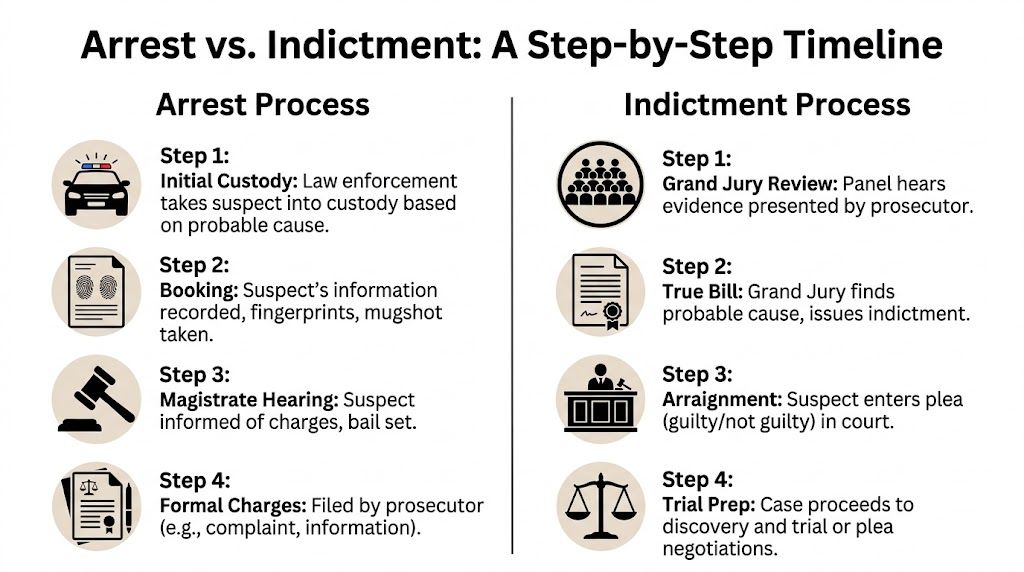
Side-by-side comparison
| Stage | Arrest path in a Texas DWI case | Indictment path in a felony case |
|---|---|---|
| Initial event | Traffic stop, investigation, roadside contact | Prosecutor gathers evidence for grand jury review |
| Decision point | Officer decides whether probable cause exists | Grand jury decides whether to return a true bill |
| Custody | Immediate custody can happen on the spot | Person may be arrested before or after indictment |
| Early court event | Magistrate warning, bond setting, first appearance | Arraignment after indictment or warrant service |
| Typical charging method | Complaint or information in misdemeanor DWI | Indictment in felony DWI |
| Best defense opportunity | Right after arrest and before evidence hardens | After indictment through motions, challenges, and negotiation |
Step 1. The traffic stop and investigation
Most DWI cases begin with a stop. The officer may claim you were speeding, drifting, driving without headlights, or committing some other traffic violation. Sometimes the officer says there was a welfare concern. Sometimes the stop itself is the weak point.
Then comes the investigation. The officer asks questions about where you’ve been, whether you had anything to drink, and whether you’ll perform roadside tests. At this point, field sobriety tests usually enter the picture. These tests are not science in the way many drivers assume. They are officer-administered exercises that are often affected by lighting, footwear, fatigue, nerves, weather, roadside slope, medical conditions, and simple misunderstanding.
Step 2. The arrest decision
If the officer believes there is probable cause, you’re arrested. That is a quick decision. It does not require a grand jury. It does not require full laboratory results. It does not require the prosecutor to finish reviewing the file.
According to this explanation of charged versus indicted timelines, an arrest generally requires immediate action, with arraignment typically occurring within 48-72 hours, and the legal standard is a “fair probability” of a crime. By contrast, an indictment can take 30-90 days and requires a stronger prima facie case. That same source notes that 15-25% of U.S. felony cases are dropped before charges are filed because of evidentiary problems.
That should change how you think about your case. The officer may have acted fast. Your defense should act faster.
If the State’s evidence is weak at the arrest stage, waiting quietly only helps the prosecution.
Step 3. Booking, bond, and the first appearance
After arrest, the booking process starts. Your fingerprints, photo, and personal information are taken. Then comes a magistrate warning or first appearance. Bond conditions may be set. In DWI cases, those conditions can include no alcohol use, ignition interlock requirements, travel restrictions, or check-ins.
For many clients, this is the first moment the case feels real. But it’s still early. This is still the point where records can be requested, body cam footage preserved, dash cam reviewed, witness accounts collected, and medical or mechanical explanations developed.
Step 4. The charging path splits
At this point, indicted vs arrested becomes a practical question instead of a vocabulary question.
For many misdemeanor DWI cases, the prosecutor moves forward by filing an information. No grand jury indictment is required. The case proceeds through county court or another misdemeanor court track.
For felony DWI cases, the State may seek an indictment from a grand jury. That often applies in more serious allegations such as repeat felony DWI, intoxication assault, or intoxication manslaughter.
If your case reaches the grand jury stage, this article on what happens after a grand jury indictment helps explain the next court steps.
Step 5. The defense window before formal charging
This is the most overlooked part of a DWI case.
The time between arrest and formal charging is where your attorney can test the State’s foundation. That includes questions like these:
- Was the stop legal: If the officer lacked a valid reason to stop you, the evidence that followed may be vulnerable.
- Were the field sobriety tests administered correctly: A poor roadside investigation can weaken the State’s narrative.
- Was there a real refusal issue or specimen problem: Breath and blood cases often turn on procedure, timing, and reliability.
- Did body cam match the report: Officers sometimes summarize events in ways that don’t hold up on video.
- Did the client’s appearance have another explanation: Fatigue, anxiety, injury, illness, allergies, or speech issues can matter.
Step 6. What changes if there is an indictment
Once a felony indictment is returned, the case becomes more formal and more serious. The fight does not end. But the posture changes.
The defense focus often shifts toward motions to suppress, review of grand jury and police procedures, deeper forensic analysis, negotiations with the prosecutor, and trial preparation. In other words, the case is now more entrenched.
That’s why I tell people the same thing every week. The best time to protect a DWI case is not after months of waiting. It’s right after the arrest, while the case is still soft.
Your Record Your Job Your License DWI Consequences
The legal distinction between arrest and indictment matters. The practical consequences matter even more.
A DWI arrest can start affecting your life before the prosecutor decides how to charge the case. Your job may ask questions. A background check may show the arrest. A professional board may expect disclosure. And your license issue can begin almost immediately.

The license problem starts first
For many drivers, the most urgent problem isn’t the courtroom. It’s getting to work next week.
A Texas DWI arrest triggers the Administrative License Review, often called the ALR process. This is separate from the criminal case. You can be fighting the license case even before any indictment question exists. According to this discussion of indictment versus arrest and Texas ALR deadlines, you have only 15 days to request an ALR hearing, and over 80,000 DWI arrests in Texas annually lead many drivers into that process. The same source states that 65% of those arrested face ALR suspensions before any grand jury is involved.
That’s why waiting to “see if they indict me” is a mistake in a Texas DWI case. Your license issue usually can’t wait.
Why employers and professionals care about stage
An arrest can raise concern. An indictment, especially in a felony case, raises the stakes much more.
If you hold a professional license, work in healthcare, education, finance, energy, government, or operate under a company driving policy, even the arrest itself can create immediate pressure. Employers often care about reliability, insurability, and disclosure obligations. If the charge later becomes a felony matter, the reputational and licensing impact can get much worse.
Here’s the practical difference:
- Arrest consequences often hit fast. License risk, bond conditions, public record concerns, missed work, towing fees, embarrassment, and family stress.
- Formal felony charging consequences often hit deeper. More severe criminal exposure, more pressure from employers, more scrutiny from licensing boards, and a harder road to clean up the record later.
- Misdemeanor information cases still matter. They may not involve indictment, but they can still affect your freedom, finances, and driving privileges.
Before going further, this short video gives useful context on what these differences can look like in real life.
Administrative license suspension explained
This term confuses people because it sounds like part of the criminal punishment. It isn’t.
Administrative license suspension is a civil action tied to the arrest and the implied consent process. It can be based on an alleged test failure or an alleged refusal. The hearing is an opportunity to challenge the basis for the stop, the arrest, the warning procedure, and the officer’s account.
A DWI license suspension fight can begin before your criminal case is fully formed. If you miss that window, you lose leverage you can’t recreate later.
Definitions that matter in this stage
| Term | Plain-English meaning |
|---|---|
| Implied consent | By driving in Texas, you agree to certain breath or blood testing rules after a lawful DWI arrest |
| BAC | Blood alcohol concentration |
| Field sobriety test | Roadside exercises officers use to claim signs of intoxication |
| Administrative license suspension | License action handled through the ALR process, separate from the criminal case |
This is why a Texas DUI attorney should evaluate both tracks immediately. The criminal file matters. The license file matters just as much.
How We Fight a DWI Charge at Every Stage
A good DWI defense isn’t passive. It’s an organized attack on the weak parts of the State’s case.

Right after arrest
The first phase is about speed and preservation. Evidence disappears fast. Officers write reports early. Recollections harden. Video can be lost if nobody acts.
That means the defense should move on the details that matter most:
The stop itself
We look at why the officer pulled you over. If the stop was weak, everything after it may be challengeable.Officer observations
“Bloodshot eyes,” “odor of alcohol,” “slurred speech,” and “unsteady balance” sound powerful on paper. In real life, each one needs context. Fatigue, allergies, stress, injury, and roadside conditions can change the picture.Field sobriety testing
We examine whether the tests were explained correctly, demonstrated correctly, and captured accurately on video. These tests often look less convincing when reviewed carefully.Breath or blood issues
A breath machine result is not automatically accurate. A blood result is not automatically unbeatable. Collection, handling, timing, and chain issues all matter.
The ALR hearing is more important than most people think
Many drivers assume the ALR hearing is only about saving the license. That’s too narrow.
In a strong defense, the ALR hearing can also function as an early preview of the State’s evidence. It may allow the defense to question the officer under oath, pin down details, and expose gaps between the report and the actual facts. That can help both the license case and the criminal case.
Defense insight: The ALR hearing is often the first chance to test the officer’s version before the criminal case gains momentum.
That’s one reason people looking to fight DWI Texas charges should move immediately after arrest instead of waiting for the first court date.
After formal charging
Once the prosecutor files the case, the defense becomes more technical.
A misdemeanor DWI filed by information may call for motions attacking the stop, detention, arrest, statements, test procedures, or other evidence. A felony case can require more extensive litigation, especially if the State is pushing a repeat-offender theory or alleging serious injury or death.
This phase often includes:
Discovery review
Every report, video, lab document, dispatch note, and witness statement needs to be compared, not just read.Motions to suppress
If the stop, arrest, or evidence collection violated legal standards, the court can be asked to exclude that evidence.Negotiation from strength
Prosecutors negotiate differently when the defense has identified actual weaknesses instead of making generic pleas.Trial preparation
Trial advantage matters even if the case ultimately resolves short of trial. The State takes the defense more seriously when the file is trial-ready.
What strategy looks like in plain terms
A seasoned Houston DWI lawyer does not treat every DWI case the same. A first-offense roadside stop with shaky field tests is not the same as a felony allegation involving an accident. A CDL holder has different pressure points than a college student. A nurse worried about a licensing board needs a different plan than an out-of-state visitor worried about travel and court appearances.
The right strategy is built around your facts, your deadlines, and your vulnerabilities.
That may mean pushing hard at the ALR stage. It may mean focusing on a suppression issue. It may mean working toward a reduction, a dismissal, deferred adjudication when available, or a later record-clearing option such as expunction or nondisclosure if the outcome allows.
If you’re concerned about record cleanup later, it’s smart to learn early how options like expunctions can fit into the long-term plan. The best record strategy usually starts before the case is over.
Your Next Steps After a Texas DWI Arrest
If you’ve been arrested, don’t sit back and hope the system sorts itself out. That approach costs people licenses, advantage, and options.
Use this checklist instead.
What to do now
Request help immediately
Talk to an experienced Texas DUI attorney as soon as possible. Early review of the stop, the arrest paperwork, and the testing issues can shape everything that follows.Calendar your ALR deadline
The license deadline comes fast. Missing it can trigger avoidable damage.Write down the facts
As soon as you can, record everything you remember. Why you were stopped, what the officer said, whether there was body cam, what tests were requested, what you took, what you refused, what medical issues existed, and who saw the stop.Keep every document
Bond paperwork, notice of suspension, temporary driving permit, towing papers, court date information, and release papers all matter.Stay off social media
Don’t post about the arrest, the stop, your drinking, the officer, or your frustration. Screenshots travel fast and age badly.
What to expect next
Your case may involve a bond condition review, an ALR hearing decision, formal criminal filing, and one or more court settings. If this is your first encounter with the system, this guide to a first court appearance in a Texas DUI case can help you understand the basic flow.
What not to do
Don’t assume no news means good news.
Don’t assume a polite officer wrote an accurate report.
Don’t assume a breath result ends the case.
Don’t assume a misdemeanor DWI is minor just because it isn’t a felony indictment.
The best time to protect your future is before the case hardens into the State’s version of events.
If you want to protect your license, your record, and your ability to move forward, act like the first days matter. They do.
Frequently Asked Questions About Arrests and Indictments
Can you be arrested for DWI and never indicted?
Yes. In Texas, many DWI cases are misdemeanors and are not charged by indictment at all. Instead, prosecutors commonly file them by information. If the case is not a felony, indictment may never be part of the process.
Can you be indicted without being arrested first?
Yes. In some cases, a grand jury can return an indictment before the person is taken into custody. That is more common in felony matters, investigations that take time, or cases where prosecutors want to control the timing of the arrest.
Does an arrest mean I’m guilty?
No. An arrest means law enforcement believed there was probable cause to take you into custody. It does not mean the prosecutor can prove the case in court.
Is a DWI license suspension the same as the criminal case?
No. The administrative license suspension issue is separate from the criminal charge. That’s why drivers can be dealing with license consequences while the criminal case is still developing.
What is implied consent in Texas?
Implied consent means that by driving in Texas, you accept certain testing rules tied to a lawful DWI arrest. The exact consequences depend on the facts, including whether the case involves an alleged refusal or a claimed test result over the legal limit.
What is BAC?
BAC stands for blood alcohol concentration. Prosecutors often use BAC evidence in alcohol-based DWI prosecutions, but BAC evidence still has to be collected, handled, and presented properly.
Are field sobriety tests mandatory?
Officers often ask drivers to perform field sobriety tests, but these tests are not the same thing as a final conviction. Their value depends heavily on how they were administered, what the video shows, and whether other explanations exist for the driver’s performance.
If my case is filed by information instead of indictment, is it less serious?
Not necessarily. A misdemeanor filing by information can still carry serious consequences for your freedom, driving privileges, record, and employment. The charging method changes procedure, not the need for a strong defense.
If you were arrested for DWI in Houston, Dallas-Fort Worth, Austin, San Antonio, or a nearby Texas community, the Law Office of Bryan Fagan, PLLC can help you take control quickly. Our team defends clients at every stage, from ALR hearings and first-time DWI cases to felony allegations and record-clearing strategies. If you need a Houston DWI lawyer, help with a DWI license suspension, or a plan to fight DWI Texas charges, request a free consultation today. You’ll get clear answers, strategic guidance, and a practical path forward.