
A DWI arrest can be overwhelming — but you don’t have to face it alone. The immediate threat to your driving privileges adds another layer of stress, but the first step to getting your license back isn't just about waiting out a suspension. It's about understanding why it was suspended and taking decisive action to protect your rights from day one with the help of a strategic Houston DWI lawyer.
Your First Moves After a DWI License Suspension
When you're arrested for DWI, it can feel like your world has been turned upside down. The most urgent concern for most people is simple: what happens to my driver's license? You have rights, and an experienced Texas DUI attorney can help you protect them.
In Texas, a DWI arrest kicks off two separate legal processes, both of which can lead to a license suspension. Understanding how they work is the key to building a strong defense. One is the administrative process, and the other is the criminal process. They run on parallel tracks, and you must address both to protect your right to drive.
Many people mistakenly believe that if they win their criminal case, their license is automatically safe. That couldn't be further from the truth. The administrative suspension can happen long before your criminal case ever sees the inside of a courtroom.
The Two Paths to License Suspension
After a DWI arrest, your license is at risk in two primary ways. It's critical to know which battle you're fighting, as the strategy for each is completely different.
Here’s a breakdown of the two main suspension triggers to help you understand what you're up against.
| Suspension Type | What Causes It | Which System Handles It | Your Immediate Next Step |
|---|---|---|---|
| Administrative License Revocation (ALR) | Failing a chemical test (BAC ≥ 0.08%) or refusing to take one. | Texas Department of Public Safety (DPS) | Request an ALR hearing within 15 days of your arrest. |
| Criminal Court Suspension | Being convicted of the DWI charge in court. | The criminal court system (as part of your sentence). | Fight the DWI charge itself with a criminal defense attorney. |
This table shows that the administrative suspension is an immediate process triggered by the arrest itself, independent of whether you're ultimately found guilty of a crime. This is why you need to fight DWI Texas charges on both fronts.
Administrative License Revocation (ALR): This is the first and most direct threat to your license. It’s a civil, administrative process handled by the Texas Department of Public Safety (DPS), not the criminal courts. An administrative license suspension is automatically triggered if you either refuse to provide a breath or blood sample or if you provide a sample that shows a Blood Alcohol Concentration (BAC) of 0.08% or higher.
Criminal Court Conviction: If you are eventually convicted of the DWI charge in criminal court, the judge will order a separate license suspension as part of your sentence. This suspension is a penalty for the crime itself and is completely independent of what happens with the ALR process.
This decision tree shows exactly how failing or refusing a chemical test immediately starts the clock on an administrative suspension.
As the infographic makes clear, this administrative penalty is a direct consequence of the arrest details, not the final verdict in your criminal case.
Understanding Key Texas DWI Terms
The ALR system is built on a legal concept called implied consent. In Texas, this law says that by driving on a public road, you have automatically agreed to submit to a chemical test (breath or blood) if lawfully arrested for DWI.
Here are a few other key terms you'll encounter:
- Blood Alcohol Concentration (BAC): The percentage of alcohol in your bloodstream. The legal limit for most drivers in Texas is 0.08%.
- Field Sobriety Test: A series of physical and mental coordination tests an officer may ask you to perform during a traffic stop to gauge impairment.
- Administrative License Suspension: A civil penalty imposed by the DPS, separate from any criminal court sentence.
You still have the right to refuse a chemical test, but that refusal comes with an immediate consequence: the DPS will automatically start the process to suspend your license. This is why you can lose your driving privileges even if you are never formally convicted of a first DWI in Texas.
Your most critical deadline after a DWI arrest is the 15-day window to request an Administrative License Revocation (ALR) hearing. Failing to meet this deadline results in an automatic suspension, which often starts just 40 days after your arrest.
This hearing is your first—and often best—opportunity to fight the suspension. A Houston DWI lawyer can file this request for you, preserving your right to drive while they get to work defending your case. Taking this step isn't an admission of guilt; it’s a smart, strategic move to protect your rights and challenge the state's evidence from the very beginning.
Using the ALR Hearing to Protect Your License

After a DWI arrest, your first and most powerful opportunity to fight a DWI license suspension isn't in criminal court—it's at the Administrative License Revocation (ALR) hearing. This is a critical battleground that's completely separate from your criminal DWI case, but its outcome can make or break your ability to drive.
Many people are surprised to learn this hearing has nothing to do with proving whether you were actually intoxicated. Instead, it’s a focused administrative proceeding where the Texas Department of Public Safety (DPS) must prove a few very specific things about your arrest. That distinction is a huge strategic advantage.
Think of it this way: your criminal case asks, "Were you driving while intoxicated?" The ALR hearing, on the other hand, asks much narrower questions, like, "Did the officer even have a legal reason to pull you over?" Winning here can stop the license suspension before it ever starts.
The Critical 15-Day Deadline
Once you're arrested for DWI in Texas, a clock starts ticking. You have exactly 15 days from the day you get the suspension notice to request an ALR hearing.
This is not a deadline you can afford to miss. If you let it pass, you automatically forfeit your right to the hearing, and your license will be suspended on the 40th day after your arrest. There are no extensions and no do-overs.
Requesting this hearing is a proactive, strategic move. It forces the state to prove its case and shows you’re serious about fighting for your driving privileges. A skilled Houston DWI lawyer can handle this request for you, ensuring it's filed correctly and on time—the first essential step in building a strong defense.
What the State Must Prove at the Hearing
During the ALR hearing, an administrative law judge is in charge, and the burden of proof is entirely on the DPS. The state’s attorney must present evidence to establish several key facts about your arrest.
Specifically, the DPS must prove that:
- Reasonable suspicion existed for the initial traffic stop. The officer needs a specific, articulable reason to believe you were violating a traffic law.
- Probable cause existed for the arrest. The officer must show there was enough evidence to believe you were driving while intoxicated.
- You were properly read the consequences of refusing or failing a chemical test under Texas's implied consent laws.
If you provided a breath or blood sample, the DPS must also prove your Blood Alcohol Concentration (BAC) was 0.08% or higher. If you refused the test, they only need to prove you were lawfully asked and you declined.
A Strategic Advantage for Your Criminal Case
The ALR hearing is more than just a chance to save your license. It's an invaluable opportunity to gather intelligence for your criminal DWI case. In essence, it acts as a mini-trial where your attorney can cross-examine the arresting officer under oath.
This gives your defense team an early shot to:
- Hear the officer’s testimony and lock them into a specific version of events.
- Find inconsistencies in the state's evidence.
- Challenge the legality of the stop or the arrest itself.
- Get police reports, dashcam videos, and other discovery materials much earlier than usual.
Information uncovered here can be used to file motions to suppress evidence in your criminal case, which can lead to reduced charges or even a full dismissal. To see how this plays out in detail, you can explore our complete guide on the Texas ALR hearing process.
The ALR hearing is a critical strategic tool. It allows your attorney to question the arresting officer and challenge the evidence against you long before your criminal trial begins, giving you a powerful head start in your defense.
Even if you don't win the ALR hearing, the testimony and evidence you collect are priceless. It provides a clear roadmap for your criminal defense, highlighting the strengths and weaknesses of the prosecutor’s case. Protecting your right to this hearing by acting within that 15-day window is one of the most important things you can do after a DWI arrest.
Breaking Down the Costs of Reinstatement

The financial side of a DWI often catches people by surprise. Dealing with a DWI isn't just about court dates and legal strategy; it comes with a significant financial impact. Getting your license back isn't as simple as just waiting out your suspension. You have to settle up with the state, and the costs can pile up fast, becoming a roadblock to getting back on the road.
Knowing what you're up against financially from the start is critical. These aren't just one-time fees. In many cases, you're looking at recurring charges that can last for years. Our goal is to give you a clear, no-nonsense look at the financial hurdles you're facing so you can plan for them.
This is where a good DWI attorney proves their worth. It's not just about fighting the charge in court. A huge part of a solid defense is working to slash these financial penalties. It's an investment in protecting both your freedom and your wallet.
Core Reinstatement Fees and Court Costs
The most straightforward cost you'll face is the reinstatement fee paid directly to the Texas Department of Public Safety (DPS). To get your license back after it's been suspended, you have to pay this fee, which is typically $125. The DPS won't start the process of restoring your driving privileges until it's paid.
On top of that administrative fee, you're also responsible for any court costs tied to your DWI case. These can vary widely depending on the county and the details of your situation, but they can easily add up to hundreds or even thousands of dollars. This is separate from any fines that are part of your sentence.
The Driver Responsibility Program Surcharges
One of the heaviest financial burdens Texas drivers faced was the old Driver Responsibility Program (DRP). Thankfully, this program was repealed in 2019, but its legacy of massive annual surcharges is a stark reminder of the long-term financial pain a DWI can cause. Under that system, drivers with convictions had to pay yearly surcharges for three years just to keep their license.
While the DRP is history, a DWI conviction still kicks off a domino effect of fees that go beyond the initial fine. Today, those costs are rolled into other court-mandated penalties. To get a better handle on how these expenses are structured now, check out our detailed guide on Texas DWI fines and fees.
It's not just Texas. The financial and bureaucratic maze of license reinstatement is a nationwide issue. These burdens vary wildly from state to state, often creating huge obstacles. For example, reinstatement fees can be as low as $20 in Iowa or as high as $275 in Alabama, which shows just how different state policies can be.
When you combine these costs with mandatory suspension periods, it can hit people with limited income the hardest, sometimes making it financially impossible to get reinstated. You can learn more about these national trends and how different states tackle reinstatement by looking at findings on driving-related policies across the country.
How a DWI Attorney Can Help Minimize Costs
Staring at a growing pile of bills can feel overwhelming, but you don't have to face it alone. A strategic legal defense is your single best tool for reducing the financial damage from a DWI arrest. A sharp Houston DWI lawyer will challenge the state's case at every step, from questioning the reason for the traffic stop to finding holes in the evidence against you.
A win in court—or even a strategic negotiation—can bring huge financial relief:
- Reduced Fines: Getting a charge reduced, for example from a DWI to reckless driving, almost always means much lower fines.
- Avoiding Conviction-Based Fees: If your case is dismissed or you're found not guilty, a whole category of fees tied directly to a DWI conviction disappears.
- Negotiating Alternatives: An attorney can sometimes negotiate for options like community service to take the place of certain fines, saving you money.
When you invest in a strong legal defense, you're investing in your financial future. The mission is to minimize the conviction's impact, which directly leads to fewer fees, lower insurance rates, and a faster return to your normal life.
Putting the Pieces Together: SR-22s and Reinstatement Requirements
Once your suspension period is over, you’re on the home stretch—but the process isn’t finished yet. Getting your license back in Texas isn't automatic. It requires you to proactively submit a complete package to the Texas Department of Public Safety (DPS), proving you’re ready to be a responsible driver again.
This isn’t just about paying a fee. It involves specific paperwork, proof of financial responsibility, and evidence that you’ve completed any court-ordered programs. It can feel like navigating a maze, but breaking it down step-by-step makes it manageable.
Let's walk through exactly what you need to do.
The SR-22: More Than Just Insurance
One of the first hurdles is getting an SR-22. This term causes a lot of confusion. Many people think SR-22 is a special, expensive type of car insurance, but that's not quite accurate.
An SR-22 is actually a certificate your insurance provider files directly with the Texas DPS. It's their way of telling the state that you have the minimum liability coverage required by law. Think of it as the state's way of keeping a closer eye on you after a high-risk incident like a DWI.
You'll typically need to maintain an SR-22 for two years starting from the date of your DWI conviction. This is non-negotiable. If your policy lapses for any reason, your insurance company is legally required to notify the DPS. The result? Your license gets suspended again, and you're back to square one.
The SR-22 isn't insurance—it's a financial responsibility filing. It proves to the DPS that you are complying with Texas's mandatory insurance laws, a critical step for anyone trying to get their license back after a DWI.
To get an SR-22, you'll need to contact your current insurance company or shop for a new provider. Be prepared—your premiums will almost certainly be higher than what you paid before. For a better sense of what to expect financially, our firm put together a guide on understanding Texas DUI SR-22 insurance costs.
Completing Your Court-Ordered Programs
Beyond the financial requirements, the state wants to see that you've taken steps to address the behavior that led to the DWI. This is where mandatory educational programs come into the picture.
Depending on your case, the court may order you to complete one or more of these:
- 12-Hour DWI Education Program: This is the standard course for all first-time DWI offenders in Texas. It’s designed to teach you about how alcohol affects driving, the state’s DWI laws, and better decision-making skills.
- DWI Intervention Program: If this isn't your first offense, you'll likely be required to attend a more intensive 32-hour "repeat offender" program.
- Victim Impact Panel (VIP): Many courts also require defendants to attend a VIP session, where you listen to people whose lives have been impacted by drunk drivers.
For every program you complete, you will receive a certificate. Hold onto these. They are the official proof you've met the court's educational requirements and are essential for your application.
Submitting Your Reinstatement Application
With all your documents in hand, it's finally time to apply for reinstatement. You'll need to submit a complete package to the Texas DPS.
Here's your checklist:
- Proof of SR-22: Your insurance company should file this electronically, but it’s always a good idea to have your own copy.
- Payment of All Fees: This includes the standard reinstatement fee, which is usually $125, plus any other outstanding court costs or administrative penalties.
- Certificates of Completion: You must include the official certificates from your DWI education courses.
- A Completed Application Form: Double-check that all information is accurate and matches your official records.
Submitting an incomplete application is the fastest way to cause delays. Even a small mistake can set you back weeks. This is where a Houston DWI lawyer can be invaluable, helping you review every document to ensure your submission is flawless the first time.
How to Get an Occupational License to Keep Driving
For most people in Texas, a suspended license brings daily life to a grinding halt. It’s not just an inconvenience—it can stop you from getting to work, picking up your kids, or even making a grocery run. The good news is that a suspension doesn't have to leave you stranded.
The State of Texas offers a practical solution: the Occupational Driver's License (ODL).
An ODL, sometimes called an essential need license, is a special, restricted license granted by a court. It gives you the legal ability to drive for specific, pre-approved reasons even while your main license is suspended. This is a critical tool designed to help you keep your life on track and meet your responsibilities.
Who Is Eligible for an ODL?
Most people facing a first-time DWI license suspension can apply for an ODL. The process hinges on proving an "essential need" to drive. You have to convince a judge that without a license, you would face a genuine and significant hardship.
"Essential need" usually includes:
- Work: Commuting to and from your job to earn a living.
- School: Getting to and from classes or other required educational programs.
- Household Duties: Everyday tasks like grocery shopping, taking your kids to school, or getting to doctor's appointments.
While most first-time offenders are eligible, certain situations can create roadblocks, especially with prior DWI convictions. An experienced Texas DUI attorney can quickly tell you where you stand and what to expect.
The Process of Petitioning the Court
Getting an ODL is a formal legal process. You must petition the court that has jurisdiction over your case and make a compelling argument to a judge.
Here’s a quick look at the steps involved:
- File a Petition: Your attorney will draft and file a formal legal document with the court that lays out why you have an essential need to drive.
- Gather Your Documents: You'll need to provide specific paperwork, including proof of SR-22 insurance, a letter from your employer, and your school schedule.
- Get the Court Order: If the judge is convinced, they will sign a court order that lays out the exact terms of your ODL.
That signed court order is your temporary license, and you must carry a certified copy with you at all times when you're behind the wheel.
Getting a license back after any suspension has gotten tougher over the years. For instance, one analysis showed that only 13.3% of drivers who lost their licenses due to point accumulation managed to pass the required re-testing. While an ODL is a different path, that low success rate shows just how seriously the state is cracking down on road safety. You can learn more about the challenges drivers face during reinstatement.
Understanding ODL Restrictions
An ODL isn't a free pass to drive whenever and wherever you please. It comes with strict limitations that are spelled out in your court order.
Your driving will be restricted by:
- Hours of Operation: You'll be limited to a specific number of hours per day, which can be up to 12 hours in a 24-hour period.
- Locations and Purpose: Your driving privileges are tied to the specific counties and tasks detailed in your petition.
- Ignition Interlock Device (IID): For almost all DWI-related suspensions, the court will make installing an IID in your vehicle a mandatory condition for getting the ODL.
Violating any of these restrictions is a serious offense that can lead to new criminal charges and the immediate revocation of your ODL, putting you right back at square one.
Common Questions About Reinstating Your License
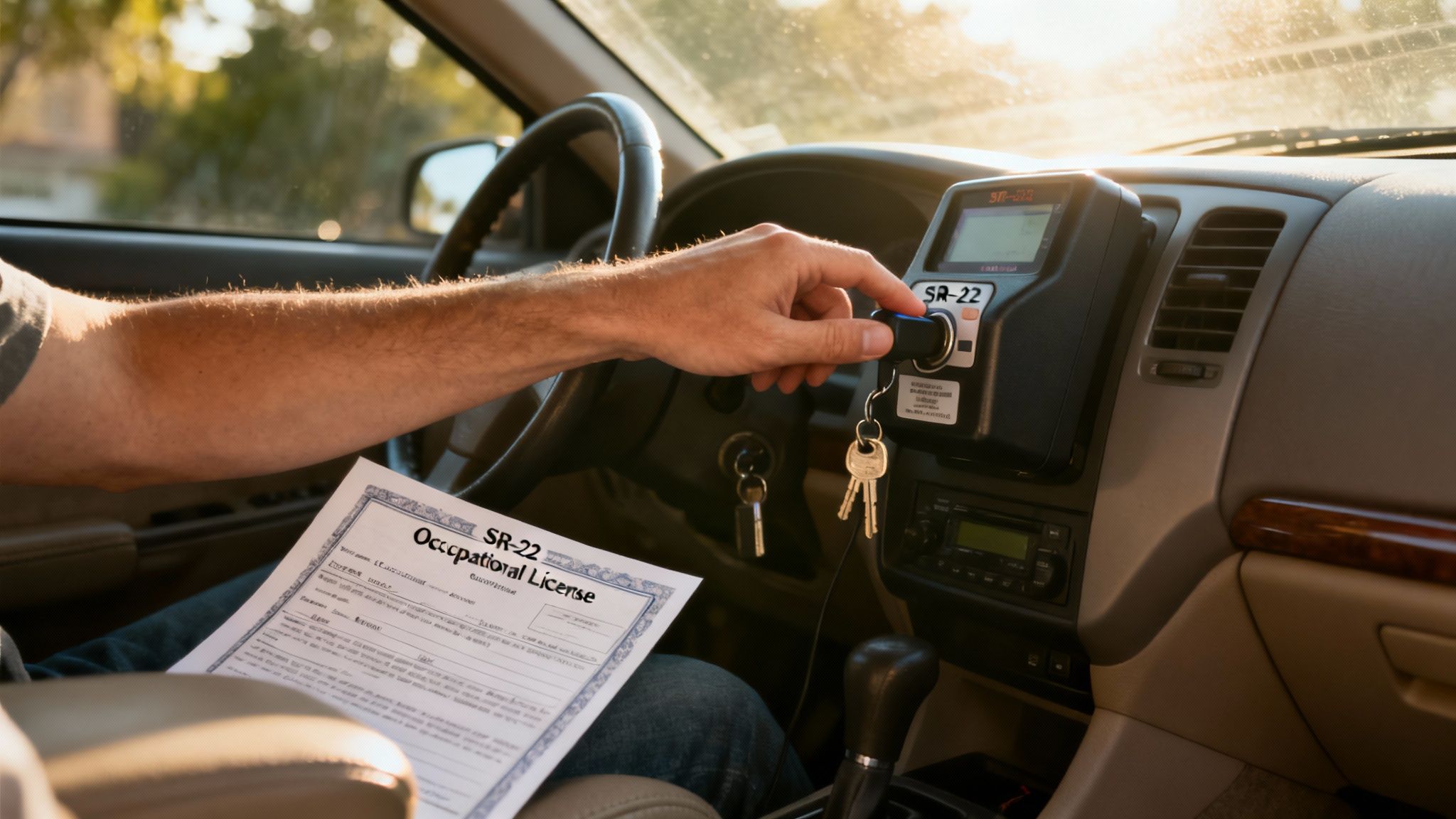
Trying to get your license back can feel like you're piecing together a puzzle. You're probably wondering where to even begin, what deadlines are looming, and what happens if you miss a step. You're not alone.
The goal here is to give you straight answers to the most common questions we hear from people trying to get back on the road in Texas.
How Can I Check My License Status Online?
Before you do anything else, you need to know exactly where you stand. The Texas Department of Public Safety (DPS) has an online portal that gives you a complete picture of your license status.
To find out what's going on, head over to the Texas DPS "License Eligibility" website. You'll need three key pieces of information:
- Your Texas Driver License or ID card number
- Your date of birth
- The last four digits of your Social Security number
Once you log in, the system will tell you if your license is valid or suspended. More importantly, it lists every fee you owe and every requirement you need to fulfill. Think of this as your personal reinstatement checklist.
How Long Will My License Be Suspended for a DWI?
This answer depends heavily on your specific situation—especially whether this is your first offense or if you have a history of DWI.
The suspension periods for a DWI conviction in Texas can vary dramatically. Here's a quick look at what you can generally expect:
| Offense Type | Typical Suspension Period | Important Details |
|---|---|---|
| First DWI | 90 days to 1 year | This is the standard range for a first-time conviction. |
| DWI with an Open Container | Adds a 6-month minimum | Having an open container in the car automatically tacks on extra suspension time. |
| Second DWI | 180 days to 2 years | Penalties get significantly tougher for repeat offenses. |
| Third DWI (Felony) | 1 year to 2 years | A third DWI is a felony and comes with the most severe suspension periods. |
Keep in mind, these timelines are for the criminal conviction. The administrative suspension from an ALR hearing can kick in much sooner and runs on its own schedule.
What Happens If I'm Caught Driving with a Suspended License?
Getting behind the wheel while your license is suspended is a massive gamble. Driving While License Invalid (DWLI) isn't just a traffic ticket in Texas; it’s a serious criminal offense.
If you're convicted of DWLI, you're looking at fresh criminal charges, thousands in new fines, and a much longer suspension period. It resets the clock and makes everything worse.
It also harms your chances of getting an occupational license and makes the reinstatement process more difficult. The court and DPS will see it as a disregard for the law, which destroys your credibility. The short-term convenience isn't worth the long-term legal and financial consequences.
A huge number of license suspensions across the country aren't even related to dangerous driving. Unpaid fines and fees are the main reason for an estimated 11 million driver's license suspensions, highlighting a massive problem where people lose their ability to drive simply because they can't afford to pay. You can learn more about how fee-based suspensions impact drivers nationwide.
This is exactly why getting an Occupational Driver's License is so critical. It gives you a legal way to handle essential driving needs without risking another arrest and digging yourself into a deeper hole.
A DWI arrest can feel like a maze of confusing deadlines, paperwork, and legal challenges, but you don't have to navigate it alone. At The Law Office of Bryan Fagan, PLLC, our experienced Houston DWI lawyers are here to provide the clear guidance and strategic defense you need. We will fight to protect your rights, minimize the consequences, and help you get back on the road. For a free, confidential case evaluation, contact us today.