 Skip to content
A letter from the Texas Department of Public Safety (DPS) stating your driver’s license has been suspended can be overwhelming—but you don’t have to face it alone. Suddenly, your ability to get to work, run errands, and live your life is on the line. This isn't the end of the road; it's the beginning of a process you can manage with the right strategy.
Your first move should be to visit the Texas DPS website and check your license eligibility status online. This report is your roadmap. It will spell out exactly why your license was suspended and list all the "compliance items"—the specific steps you need to take to get it back.
Your First Moves After a Texas License Suspension
Getting arrested for a DWI in Texas kicks off a confusing storm of legal procedures, but you don't have to navigate it alone. Understanding what’s coming is the first step toward taking back control. That DPS notice isn't a final verdict; it's the start of a process that you can manage with a clear game plan.
Most importantly, act fast and do not get behind the wheel. Driving with a suspended license can lead to a new charge for Driving While License Invalid (DWLI), which brings its own harsh penalties and makes the reinstatement process much more difficult.

Understanding the Two Types of Suspensions
After a DWI arrest, you are essentially fighting two different battles at the same time, and both can result in your license being suspended. It’s critical to understand the difference.
- Administrative License Revocation (ALR): This is a civil action taken by the DPS, completely separate from your criminal case. The ALR process is automatically triggered if you refuse a breath or blood test, or if your test shows a Blood Alcohol Concentration (BAC) of 0.08% or higher. According to Texas’s “implied consent” law, all drivers have already consented to these tests simply by driving on public roads.
- Criminal Suspension: This is a penalty handed down by a judge if you are convicted of the DWI in criminal court. If you plead guilty or are found guilty at trial, the judge’s sentence can include a separate and often longer license suspension.
These two processes run on parallel tracks. This means your criminal DWI charges could be dismissed, but you could still lose your license through the ALR process if you don't take action right away. A skilled Texas DUI attorney can help you fight both.
Your Initial Action Checklist
It’s easy to feel overwhelmed, but there are clear, immediate steps you can take to protect your driving privileges. The most urgent task is to address the automatic administrative suspension.
You have only 15 days from the date of your arrest to request an Administrative License Revocation (ALR) hearing. If you miss this deadline, your license will be automatically suspended, usually 40 days after the arrest.
This hearing is your first and often best chance to challenge the suspension. It gives your attorney an opportunity to cross-examine the arresting officer and challenge the legal grounds for the traffic stop and arrest. You can learn more about how a lawyer can fight a DWI license suspension in Texas in our detailed guide.
After requesting the ALR hearing, your next step is to log into the Texas DPS online portal and pull your official driving record. This document is your game plan. It will show every "hold" or compliance item keeping you from having a valid license, from unpaid fines and required classes to SR-22 insurance mandates. By seeing the full picture, you and your attorney can build an efficient strategy to clear every hurdle.
Figuring Out Why Your License Was Suspended in the First Place
Before you can think about getting back on the road, you must diagnose the problem. Why, exactly, was your license suspended? In Texas, it's rarely a simple issue. The path to reinstatement starts with a clear understanding of every hold on your license, because different problems require different solutions.
Think of it like a doctor treating an illness. You can't just address symptoms without knowing the cause. It's the same here—you must identify every single hold on your license to build a plan that works. Missing one compliance item could leave you stuck in neutral indefinitely.
DWI-Related Suspensions: The Two-Front Battle
If your suspension is tied to a DWI arrest, you're fighting a battle on two separate fronts. The first is an Administrative License Revocation (ALR). This is a civil penalty handled by the DPS, and it kicks in automatically if you refuse a breath or blood test, or if you take one and your Blood Alcohol Concentration (BAC) is 0.08% or higher.
The second is a criminal suspension, which is a penalty handed down by a judge only if you are convicted of the DWI charge in court. These are separate legal issues that must be dealt with individually. It's entirely possible to win your ALR hearing and avoid that suspension, only to face a criminal suspension later if you're convicted.
It's Not Always About the DWI: Other Holds and Surcharges
While a DWI is a common reason for a license suspension, it's often not the only one. We frequently see cases where other problems are stacked on top, creating a complex puzzle that needs to be carefully pieced together. Understanding these non-DWI holds is critical to getting your license fully reinstated.
A few of the most common issues include:
- Omnibase Holds: A court puts this hold on your license when you fail to appear for a court date or haven't paid a traffic ticket. You can't renew or reinstate your license until you have settled the matter with the specific court that placed the hold.
- Unpaid Child Support: Under the Texas Family Code, your license can be suspended if you fall more than three months behind on child support payments.
- Too Many Traffic Violations: If you accumulate too many points on your driving record in a short period, it can trigger an automatic suspension from the state.
These issues often appear as a surprise when someone is trying to fix their main suspension, leading to frustration and unexpected delays.
To help you get a clearer picture, we've put together a table of the most common reasons for license suspensions in Texas. This should give you a good starting point for figuring out who to contact and what kind of timeline you might be looking at.
Common Reasons For License Suspension In Texas
| Reason for Suspension | Typical Suspension Period | Primary Contact for Resolution |
|---|---|---|
| DWI – ALR (Failed or Refused Test) | 90 days to 2 years | Texas Department of Public Safety (DPS) |
| DWI – Criminal Conviction | 90 days to 2 years | The Court of Conviction & DPS |
| Unpaid Traffic Tickets (Omnibase Hold) | Indefinite (until resolved) | The specific Municipal or Justice Court |
| Driving Without Insurance (No SR-22) | Up to 2 years | Texas Department of Public Safety (DPS) |
| Too Many Traffic Points | 1 year | Texas Department of Public Safety (DPS) |
| Unpaid Child Support | Indefinite (until resolved) | Office of the Attorney General & DPS |
This table isn't exhaustive, but it covers the vast majority of cases we see. The key is to remember that you might be dealing with issues from multiple agencies at the same time.
The Financial Weight of Suspensions
For years, many license suspensions in Texas had less to do with dangerous driving and more to do with an inability to pay massive fees. The state's old Driver Responsibility Program, which has since been repealed, created a nightmare scenario where thousands of Texans were trapped in a cycle of debt they couldn't escape. At its worst, that program was the cause of roughly 65% of all active suspensions.
While that program is gone, financial hurdles are still a huge barrier for many people. This history is a stark reminder of how easily suspensions can pile up, often stemming from money problems rather than direct public safety threats. If you're interested in the backstory, you can read the full research about the Driver Responsibility Program to understand the massive impact it had.
A classic scenario we see is a client working to clear a DWI suspension, only to discover an old Omnibase hold from a forgotten speeding ticket in another county. Just dealing with the DWI requirements won't be enough; both holds must be cleared before the DPS will consider reinstatement.
Creating Your Reinstatement Game Plan
The first step you need to take is to get your official driving record from the Texas DPS. Think of this document as your personalized diagnostic report. It will list every single thing you need to do—every compliance item required—before you can become "eligible" to drive again.
This checklist might include things like:
- Paying specific reinstatement fees to the DPS.
- Getting an SR-22 insurance certificate.
- Finishing a state-approved DWI education course.
- Resolving holds with individual city or county courts.
Once you understand the "why" behind your suspension, you can turn a confusing situation into a clear, manageable checklist. An experienced Texas DWI attorney can help you read between the lines of your driving record, prioritize what needs to be done first, and handle communications with the DPS and the courts to ensure nothing is missed.
The Texas License Reinstatement Process Explained
Once you know why your license was suspended, you can stop feeling overwhelmed and start taking action. Think of this next phase as a checklist—a series of concrete steps that will get you closer to being back on the road. It takes attention to detail, but it’s a process you can absolutely manage.
Your journey starts with the compliance items listed on your official driving record from the Texas Department of Public Safety (DPS). This is your personalized roadmap. For most DWI-related suspensions, the requirements boil down to paying fines, getting special insurance, and finishing state-mandated courses.
This flowchart gives you a good visual of the common pathways that lead to a suspension, helping you pinpoint where things went wrong.
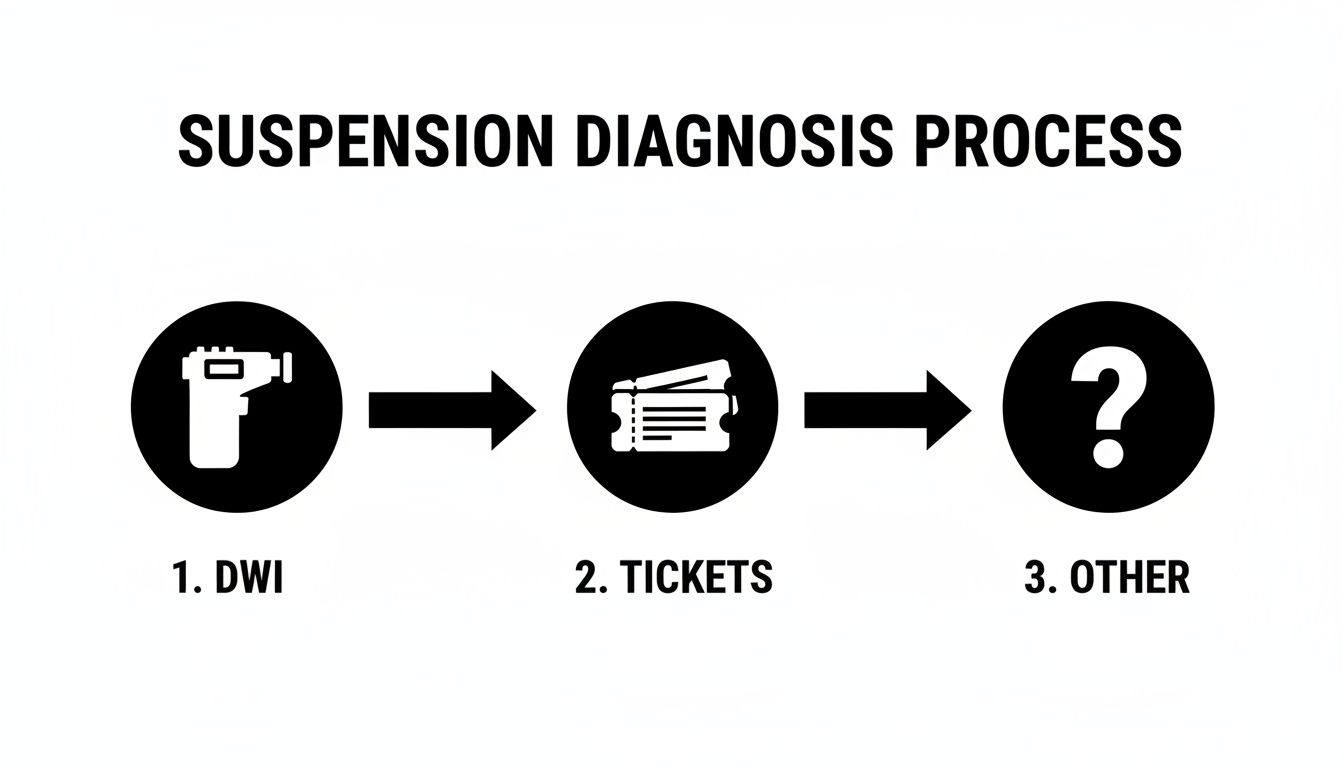
Whether your suspension came from a DWI, unpaid tickets, or something else entirely, understanding the root cause is the first step to building a solid reinstatement strategy.
Paying Fines and Fees
The first, and most straightforward, step is often financial. You’ll have to settle any outstanding court costs tied to your DWI case and pay a separate reinstatement fee directly to the DPS. The standard reinstatement fee hovers around $125, but that number doesn't include court fines, which can be significantly higher.
My advice? Get a receipt for every single payment you make, whether it's to a court clerk or the DPS. Keeping a meticulous paper trail is your best defense against the kind of bureaucratic mix-ups that can stall your reinstatement for weeks.
Securing an SR-22 Insurance Certificate
This is one of the most common—and most confusing—requirements. Many people mistakenly think an SR-22 is a special type of insurance policy. It’s not.
An SR-22 is simply a certificate your insurance company files with the DPS. It proves you have the minimum liability coverage required in Texas and serves as a guarantee of your financial responsibility.
If you’ve been convicted of a DWI, you will almost certainly be required to keep an SR-22 on file for two years from your conviction date. If your insurance lapses for even a day during that time, your provider is legally required to notify the DPS, which will trigger another immediate suspension of your license.
Completing Mandatory Educational Courses
Depending on the details of your case, you'll probably be ordered to complete one or two educational programs. These aren't optional. You must provide the DPS with a certificate of completion before they'll consider reinstating your license.
The two most common programs are:
- DWI Education Program: This is a 12-hour course for first-time DWI offenders that covers how alcohol impairs driving, Texas DWI laws, and the basics of substance abuse.
- Drug Offender Education Program: A 15-hour course required for anyone convicted of a drug-related offense.
You must enroll in a course approved by the Texas Department of Licensing and Regulation (TDLR). Once you finish, you'll get an official certificate to submit as proof.
Submitting Your Compliance Documents to the DPS
After you’ve paid your fees, secured your SR-22, and finished your courses, it’s time to pull everything together and send it to the DPS. You have a few ways to do this, but one method is hands-down the most efficient.
While you can mail your paperwork, the fastest and most reliable way is to use the official Texas DPS online portal. Uploading your documents directly gets them into the system faster and gives you an electronic receipt of your submission. From my experience, this simple choice can shave weeks off your wait time compared to snail mail.
It’s worth noting that Texas drivers used to face even bigger financial hurdles. Before 2019, the state's Driver Responsibility Program (DRP) trapped hundreds of thousands of people in a cycle of debt with massive annual surcharges. Thankfully, Texas repealed this program, a move that made over 600,000 Texans immediately eligible to get their licenses back. It’s a powerful reminder to stay updated on current laws, because old, outdated policies no longer stand in your way. You can read more about how the DRP repeal cleared the path for thousands of drivers.
Once all your compliance items are submitted, your final step is to keep checking your license status on the DPS website. Do not get behind the wheel until your status officially changes from "Suspended" to "Eligible." When it does, you have successfully navigated the reinstatement process.
Challenging Your Suspension with an ALR Hearing
After a DWI arrest in Texas, a clock starts ticking that most people don't realize is running. You have exactly 15 days to request an Administrative License Revocation (ALR) hearing. If you miss this incredibly tight deadline, your driver's license will be automatically suspended—usually 40 days after your arrest—no matter what happens in your criminal case.
This hearing is your first, and often most important, line of defense against losing your ability to drive. It’s a powerful tool, and when used strategically, it can stop a suspension from ever taking effect. A Houston DWI lawyer can file this request for you, making sure you don't miss this critical window.
What Is the ALR Hearing?
It's crucial to understand that the ALR hearing has absolutely nothing to do with your criminal DWI proceedings. This is a civil, administrative process run by the Texas Department of Public Safety (DPS), not a criminal court. Its purpose is narrow and specific.
The administrative judge at an ALR hearing is only concerned with two questions:
- Did the officer have reasonable suspicion to pull you over?
- Did the officer have probable cause to believe you were driving while intoxicated, which led to your arrest?
This hearing isn’t about proving your guilt or innocence in the criminal sense. It's a procedural review of the traffic stop and the arrest itself.
Why This Hearing Is Your Secret Weapon
Many people facing a first DWI in Texas wonder if going through the ALR hearing is worth the trouble. The answer is a resounding yes. This hearing gives you a unique and invaluable advantage that impacts your entire defense strategy. It's the only opportunity your lawyer will get to question the arresting officer under oath before your criminal trial ever begins.
During the hearing, we can lock the officer into their testimony. We can dig into their report, searching for inconsistencies in their story, weaknesses in their recollection, and procedural errors.
Think of the ALR hearing as a legal rehearsal. It’s a chance to test the strength of the state’s evidence and gather intelligence we can use to dismantle the prosecutor's case against you in criminal court.
For instance, we might discover the officer failed to properly administer field sobriety tests or can't clearly articulate the real reason for the initial traffic stop. Information like this is pure gold for your criminal defense and often wouldn't come to light without this hearing, which can help you fight your DWI in Texas.
The Two Possible Outcomes
If you win the ALR hearing, the judge rules that the state failed to meet its burden of proof. When that happens, the DPS is legally barred from suspending your license through this administrative process. It's a massive victory that keeps you on the road while your criminal case moves forward.
But if the state wins the hearing, your license will be suspended. The length of that suspension depends on what happened during your arrest:
- Failing a chemical test (BAC of 0.08% or higher): A 90-day suspension for a first offense.
- Refusing a chemical test: A 180-day suspension for a first offense, thanks to Texas's "implied consent" laws.
Even if you lose the hearing, the information we gather is incredibly valuable. It helps your attorney build a much stronger, more informed defense for your criminal case, where the stakes—jail time, fines, and a permanent record—are far higher.
A skilled lawyer knows how to use this hearing not just to fight the suspension, but to set the stage for a better outcome in your main DWI case. The process can seem complicated, but you can learn more about what to expect by reading our comprehensive Texas ALR hearing process guide. Don't let that crucial 15-day window slam shut without a fight.
Securing an Occupational License to Stay on the Road
Just because your primary license is suspended doesn't mean your life has to come to a screeching halt. In Texas, you might be able to get what’s known as an Occupational Driver's License (ODL), often called an essential need license. Think of it as a legal lifeline that allows you to keep driving for work, school, and other critical household responsibilities.
Getting an ODL isn’t a simple administrative task; it’s a formal court process. You have to file a sworn petition with the court, making a clear and compelling case for your absolute need to drive. This is about more than just convenience. You must prove that without a license, you cannot perform your job, get to your classes, or handle essential family duties like taking your kids to school or a parent to a doctor's appointment.
Petitioning the Court for an ODL
To build a strong case, you can't just show up and ask. You need to gather specific documents that provide concrete evidence of your essential need to drive. The court requires precision here.
Your petition must include several key items:
- A Sworn Petition: This is the core legal document where you’ll outline exactly why you need to drive, complete with work hours, school schedules, and any other necessary travel details.
- An SR-22 Certificate: Just like with a standard license reinstatement, you have to show proof of high-risk auto insurance.
- A Letter from Your Employer: A formal letter, preferably on company letterhead, that confirms your employment, schedule, and job duties can be incredibly persuasive.
- Proof of Other Essential Needs: This is where you include things like class schedules, the address of your child’s school, or confirmations for recurring medical appointments.
Having an experienced attorney draft a petition that tells your story effectively can make all the difference. You can get a closer look at the specifics in our detailed guide to getting a DWI occupational license in Texas.
Understanding ODL Restrictions
It’s crucial to understand that an occupational license isn't a free pass to drive whenever and wherever you feel like it. The judge will set very strict limits on your driving privileges.
Your ODL will specify the exact hours you are allowed to drive, the counties you can drive in, and the specific purposes for which you can drive. Violating these restrictions is a serious offense that can lead to additional criminal charges.
On top of that, the court might order you to install an Ignition Interlock Device (IID) in your vehicle as a condition of getting the ODL. This device requires you to provide a clean breath sample before the car will start, ensuring you are not drinking and driving.
While it sounds daunting, an ODL is often the best plan B available to keep your life on track during a suspension.
How a DWI Attorney Makes Reinstatement Less Painful
Trying to get your license back from the DPS and the court system can feel like you're trapped in a maze of red tape. It's frustrating, confusing, and it's easy to make a wrong turn. But you don’t have to do it alone. A good Houston DWI lawyer is more than just a legal advisor—they’re your guide through the entire process, handling every last detail to get you back on the road.
We take over all the phone calls and paperwork, dealing directly with the courts and the DPS so you don't have to. Our team knows exactly what to look for, uncovering hidden problems that can bring your reinstatement to a dead stop. Think old, unpaid tickets creating an Omnibase hold you didn't even know existed. We find them and clear them, saving you from maddening delays that could reset the clock on your suspension.
A Strategic Partner from Day One
Your defense starts the second you hire us. We’ll be in your corner for the critical Administrative License Revocation (ALR) hearing, which is often the first—and best—opportunity to stop the suspension before it even starts.
Losing your license in Texas isn't just an inconvenience; it can be financially devastating. A 2022 analysis showed that Texans with renewal holds because of debt lose an average of $12,700 in yearly income. Our entire goal is to prevent that from happening to you by making this process as quick and painless as possible. You can discover more insights about these financial impacts and see for yourself why getting professional help is so crucial.
Think of our firm as your dedicated project manager for getting your life back on track. Our job is to clear the path, handle the bureaucracy, and fight for your rights so you can keep focusing on work and family.
The next step toward getting your license back is building a strong defense. Contact The Law Office of Bryan Fagan, PLLC for a free, confidential consultation. Let us take the weight off your shoulders and start working to get you back behind the wheel today.
Answering Your Top Questions About Texas License Reinstatement
Dealing with the aftermath of a DWI charge brings a storm of questions and a whole lot of uncertainty. Below, we’ve put together some straightforward, no-nonsense answers to the most common concerns we hear from clients trying to get their Texas driver's license back. Our goal here is to cut through the confusion and give you the clear information you need to move forward.
How Much Does It Really Cost to Reinstate a License in Texas?
The total cost to get your license back can swing wildly depending on your specific situation. While there’s a standard DPS reinstatement fee—usually around $125—that’s just the starting point. Think of it as the base price before all the other required expenses get tacked on.
You'll also need to budget for court fines, SR-22 insurance premiums (which are always higher), and fees for mandatory DWI education programs. These can easily pile on several hundred more dollars to your total bill.
And if you need an Occupational License just to keep driving for work? You're looking at additional court filing fees and, quite possibly, the cost of installing and maintaining an Ignition Interlock Device. An experienced attorney can look at the specifics of your case and give you a realistic breakdown of what you'll actually end up paying.
I Did Everything They Asked. How Long Until I Can Drive Again?
Once you’ve submitted all your compliance paperwork and paid every last fee, the processing time can still vary. The fastest path, without a doubt, is using the Texas DPS online portal. In our experience, online submissions are often processed within just a few business days.
Mailing your documents, on the other hand, is a different story. That can stretch your timeline out significantly, sometimes taking several weeks before everything is processed and your status is updated.
Crucial Tip: Never assume your license is valid just because you’ve sent everything in. You must log in to the DPS website and see with your own eyes that your license status has officially changed to "Eligible." Getting behind the wheel even one day too soon can land you in serious trouble all over again.
What Is an SR-22 and How Long Am I Stuck With It?
This is one of the most misunderstood requirements out there. An SR-22 isn't actually a type of car insurance. It’s a certificate that your insurance company files directly with the DPS to prove you’re carrying at least the minimum liability coverage Texas law demands. It’s basically a guarantee to the state that you are financially responsible.
For a DWI-related suspension, you are typically required to maintain an SR-22 filing for two years starting from the date of your criminal conviction.
It is absolutely vital to maintain continuous coverage. If your insurance policy lapses for any reason—even for a day—your provider is legally required to notify the DPS immediately. This will trigger a brand new suspension of your license, putting you right back at square one.
Can I Reinstate My License If I Have an Omnibase Hold?
No, you absolutely cannot. If there is an active Omnibase hold on your driving record, it acts as a complete block on your ability to renew or reinstate your license. This type of hold is placed by a municipal or justice court when you fail to show up for a court date or don't pay a fine for a traffic ticket.
To get this resolved, you must contact the specific court that put the hold on your record, handle the old ticket or warrant, and get proof of compliance from them. Only then can you submit that proof to the DPS to have the hold lifted. A Houston DWI lawyer can often track down these hidden holds and help you clear them efficiently, preventing them from becoming a frustrating roadblock in your reinstatement process.
A DWI arrest can be overwhelming—but you don’t have to face it alone. At The Law Office of Bryan Fagan, PLLC, we are here to protect your rights, explain Texas DWI laws in clear terms, and guide you through every step of getting your license back. We invite you to Contact us today for a free, confidential case evaluation to start building your defense.

