 Skip to content
A DWI arrest can be overwhelming — but you don’t have to face it alone. The flashing lights, the confusing questions, and the fear of what comes next can make anyone feel powerless. However, the strategic decisions you make from the very beginning can shape the outcome of your case. The first steps are always to protect your rights by remaining silent and politely declining voluntary tests. Then, it's time to partner with a skilled Houston DWI lawyer who can build a defense to protect your future.
Your First Steps After a Texas DWI Arrest
A DWI arrest is disorienting and stressful. In those moments, it's critical to remember that you have rights, and calmly exercising them is the first step toward building a strong defense. Your immediate goal is simple: limit the evidence the state can use against you.
What you say—and more importantly, what you don't say—matters immensely. You have the right to remain silent, and you should use it. Beyond providing your name and ID, you are not obligated to answer questions like "Where are you coming from?" or "Have you had anything to drink tonight?" A simple, "Officer, I choose to remain silent," is a complete and powerful response.
Politely Refuse Field Sobriety Tests
The officer will almost certainly ask you to perform Standardized Field Sobriety Tests (SFSTs), like the walk-and-turn or the one-leg stand. Here's what you need to know: these tests are voluntary in Texas. You can, and almost always should, politely decline to participate.
These tests are notoriously subjective and are often difficult for even a completely sober person. Many factors can make you appear impaired when you're not:
- Nervousness or anxiety from the traffic stop itself.
- Pre-existing medical conditions that affect your balance or coordination.
- Poor lighting, an uneven road surface, or distracting traffic.
- The shoes you're wearing or just being physically tired.
By refusing these tests, you deny the prosecution a key piece of subjective video evidence that a jury could easily misinterpret.
The most powerful tool you have during a DWI stop is your right to say "no." A simple, "Officer, I respectfully decline any tests," is a complete and legally sound response. It protects your rights without being confrontational.
Understanding Key Terms: Implied Consent, BAC, and Chemical Tests
While field sobriety tests are optional, chemical tests—a breath or blood test—are a different story because of Texas's "implied consent" law.
- Implied Consent: By driving on public roads, you have legally consented to provide a breath or blood sample if you are lawfully arrested for DWI.
- BAC (Blood Alcohol Concentration): This is the measurement of alcohol in your system. In Texas, the legal limit for adults is 0.08%.
- Chemical Tests: These are the breathalyzer or blood tests used to determine your BAC.
Even with implied consent, you can still refuse a chemical test. A refusal will likely trigger an automatic Administrative License Suspension, but it also prevents the prosecution from getting its most powerful piece of evidence: your BAC. A skilled Texas DUI attorney can then fight that suspension in a separate hearing. Our guide on what to do after a DWI in Texas dives deeper into this crucial decision.
Without a doubt, the most important step you can take after being arrested is to contact a DWI defense attorney immediately. The sooner a lawyer gets involved, the better they can protect your rights, preserve evidence, and start building a defense strategy tailored to your case.
The 15-Day Deadline: Your First Chance to Fight Back
After a DWI arrest in Texas, you are fighting on two fronts. The first is the criminal case, which deals with potential jail time, fines, and a criminal record. The second is an immediate civil case aimed at taking away your driver's license.
And the clock on that second case is ticking.
You have just 15 days from the date of your arrest to request an Administrative License Revocation (ALR) hearing. This is the most critical and time-sensitive deadline in the entire DWI process. If you miss this 15-day window, the Texas Department of Public Safety (DPS) will automatically suspend your license.
What is an Administrative License Revocation (ALR) Hearing?
The ALR hearing is a civil proceeding focused only on your driving privileges; it has nothing to do with your criminal guilt or innocence. The state’s goal is to prove they had the right to suspend your license because you either refused a breath/blood test or provided a sample with a BAC of 0.08% or higher.
This hearing is your first opportunity to challenge the state's case. While winning means you can prevent a DWI license suspension, the hearing's strategic value goes far beyond just keeping your license. For a savvy DWI lawyer, it's an invaluable opportunity to gather information.
This infographic breaks down the immediate aftermath of an arrest and the crucial first moves you need to make.
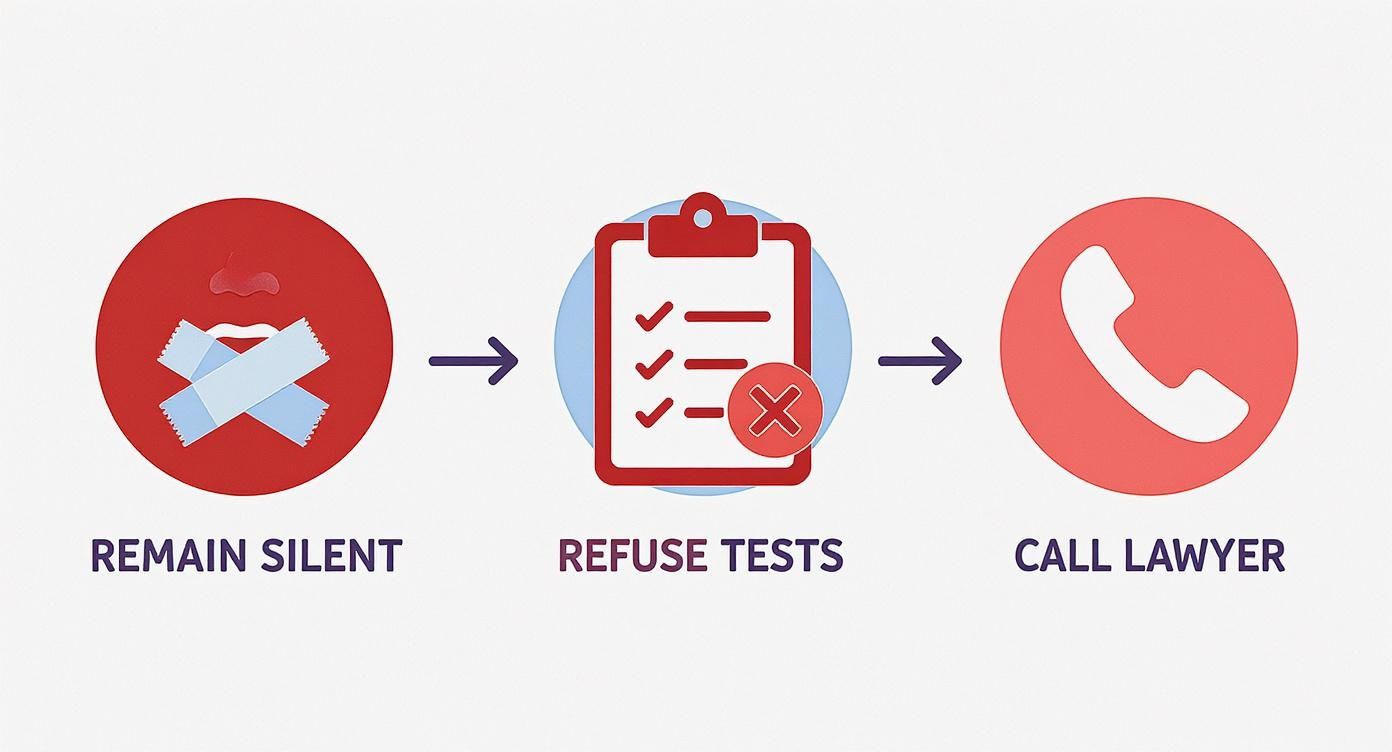
As you can see, the game plan starts the moment you're pulled over. Exercising your rights and getting your lawyer involved immediately sets the stage for everything that follows, starting with that critical ALR hearing.
Turning the ALR Hearing into a Strategic Advantage
A good attorney uses the ALR hearing as a powerful discovery tool to strengthen your criminal defense. It provides a unique, early chance to put the state's evidence under a microscope.
During the hearing, your lawyer can:
- Question the Arresting Officer Under Oath: This is a major advantage. We can cross-examine the officer long before a criminal trial, lock them into their story, and expose inconsistencies in their report.
- Expose Weaknesses in the State's Evidence: We can subpoena and scrutinize police reports, dashcam videos, and the maintenance logs for the breathalyzer. Any procedural mistake found here becomes powerful ammunition for the criminal case.
- Preview the Prosecution's Strategy: The ALR hearing forces the officer and state to show their cards. We get a preview of their arguments and evidence, which is invaluable for building a stronger defense for the criminal trial.
Letting that 15-day deadline expire is like forfeiting the first round. Requesting the hearing is your first and best chance to go on the offensive, challenge the official story, and gather the intelligence needed to win.
For instance, I’ve had cases where an officer testified at the ALR hearing that my client "swayed a little," but his sworn police report claimed the person "could barely stand up." When a jury sees that glaring contradiction, the officer's credibility is damaged.
The Texas ALR Hearing Timeline
The moments after a DWI arrest are a blur, but this timeline is non-negotiable if you want to protect your driving privileges.
| Event | Deadline | Consequence of Inaction |
|---|---|---|
| DWI Arrest | Day 0 | The 15-day clock starts now. |
| Request ALR Hearing | Within 15 days of arrest | Automatic license suspension. You forfeit your right to a hearing. |
| DPS Processes Request | Up to 120 days | Your license remains valid during this period. |
| ALR Hearing Scheduled | Usually within a few months | This is your chance to challenge the suspension and gather evidence. |
| Automatic Suspension Begins | 40th day after arrest | If you missed the 15-day deadline, your suspension starts on this day. |
Missing that initial 15-day deadline is the most common and damaging mistake people make. Don't let it happen to you.
What Happens If You Miss the Deadline?
The consequences are swift and automatic. If you fail to request the ALR hearing within 15 days, your license suspension begins on the 40th day after your arrest. There are no do-overs.
Depending on your record, that suspension could last anywhere from 90 days to two years. You lose your ability to drive to work and manage your daily life—all because a critical deadline was missed.
Protecting your freedom starts with meeting this urgent deadline. To learn more, read our in-depth guide covering the ALR hearing process after a DWI in Texas. Taking immediate, informed action is the only way to effectively fight DWI Texas charges.
Challenging the Prosecution's Evidence
Winning a DWI case is about strategically dismantling the state's case, piece by piece. The prosecutor must prove your guilt beyond a reasonable doubt, and every piece of their evidence can be challenged.
A successful defense starts by putting the state’s entire story under a microscope. An experienced DWI attorney knows exactly where to find the weak spots, procedural mistakes, and constitutional violations that can turn a case toward a dismissal or a "not guilty" verdict.
Scrutinizing the Initial Traffic Stop
The entire case depends on one question: did the officer have a legally valid reason to pull you over? The Fourth Amendment protects you from unreasonable searches and seizures, which includes being stopped without proper justification.
An officer needs "reasonable suspicion" to initiate a traffic stop. This isn't just a hunch; they must be able to point to specific facts suggesting a traffic violation or crime occurred.
Common reasons an officer might give for a stop include:
- Moving violations: Speeding, running a stop sign, or failing to signal.
- Equipment failures: A burned-out taillight or expired registration.
- Erratic driving: Weaving within your lane, driving unusually slow, or making wide turns.
Your defense lawyer will immediately obtain the dashcam and bodycam footage to see what the officer really saw. If the video doesn't support the officer's story—for example, if you weren't actually weaving—we can file a Motion to Suppress. If the judge agrees the stop was illegal, all evidence gathered from that point on can be thrown out. This often guts the prosecution's case, leading to a dismissal.
How to Fight a Field Sobriety Test Result
As we covered, Standardized Field Sobriety Tests (SFSTs) are a pillar of most DWI arrests, but they are far from scientific. They are really just divided-attention tests designed to be difficult for anyone—sober or not—especially on the side of a busy road with flashing lights in your eyes. The results are incredibly subjective and can be challenged effectively.
Countless factors that have nothing to do with alcohol can cause someone to "fail" these tests:
- Medical Conditions: Inner ear problems, old injuries, or neurological issues can affect your balance.
- Environmental Factors: Poor lighting, sloped pavement, bad weather, or the flashing lights of a patrol car are incredibly distracting.
- Physical Attributes: Your age, weight, and general physical fitness play a role in performance.
- Nervousness: Simply being pulled over is enough to make anyone anxious and appear unsteady.
A sharp attorney will highlight these flaws for the jury, arguing that the officer’s conclusion was based on shaky observations, not hard proof.
How to Fight a Breath Test Result
The prosecution presents BAC results from a breathalyzer or blood test as if they are infallible scientific fact. They are not. The procedures for administering these tests and maintaining the equipment are incredibly strict. Any mistake can make the results unreliable and inadmissible in court.
An experienced DWI lawyer knows that a number on a machine is not the end of the story. It’s the beginning of a deep investigation into how that number was produced and whether it can be trusted.
When we challenge chemical tests, we investigate every angle:
- Improper Machine Calibration: Breathalyzers are complex machines that require constant maintenance. We subpoena the device’s maintenance logs to find missed inspections or a history of errors.
- Procedural Errors: The officer administering the test must be certified and follow a rigid protocol, including a mandatory 15-minute observation period to ensure you don’t burp, vomit, or put anything in your mouth, all of which can contaminate the sample.
- Medical Conditions: Health issues like acid reflux (GERD) or diabetes can create "mouth alcohol" or produce ketones that a breathalyzer can misread as ethyl alcohol, giving a falsely high reading.
- Contaminated Blood Samples: With blood tests, the chain of custody is critical. We investigate whether the blood was drawn by a qualified person, if the vial was properly preserved, and if it was stored correctly to prevent fermentation, which can artificially inflate the BAC.
Each of these issues is a potential game-changer. You can learn more about how to challenge breathalyzer results in Texas and see just how vulnerable this evidence is. Successfully dismantling the science behind the state's numbers is one of the most powerful ways to fight a DWI charge.
Navigating the Texas DWI Court System
The Texas criminal court system can feel like a labyrinth. Understanding the step-by-step process is not just about satisfying curiosity; it's about empowerment. When you know what to expect, you and your attorney can make smarter, more strategic decisions at every stage.
Step 1: The First Court Appearance and Arraignment
Your first official stop in the court system is the arraignment. This is a formal hearing where the judge reads the official DWI charge against you and you enter a plea. In virtually every case, that plea will be "not guilty."
Pleading "not guilty" does not commit you to a jury trial. It is a critical legal formality that preserves all of your rights and gives your attorney the time needed to investigate the evidence, challenge the state's case, and build your defense.
Step 2: Pre-Trial Motions and Suppressing Evidence
During the pre-trial phase, your lawyer will file a series of legal challenges called motions. The most powerful is the Motion to Suppress, which asks the judge to throw out illegally obtained evidence.
For example, if the officer did not have a valid reason to pull you over or if the breathalyzer test was not administered correctly, we can argue that any evidence gathered from that point on is tainted and should be excluded. Winning a motion to suppress can cripple the prosecution's case, sometimes forcing them to dismiss the charges.
Step 3: Plea Negotiations
Not every DWI case ends in a trial. A significant part of DWI defense involves plea negotiations with the prosecutor to secure a better outcome. An experienced DWI lawyer's reputation and relationships are invaluable here. Prosecutors are more willing to negotiate with a defense attorney they know is prepared to go to trial and win.
Our primary goal in many negotiations is to get the DWI charge reduced to a non-alcohol-related offense, like Obstruction of a Highway or Reckless Driving. These charges don't carry the automatic license suspensions or the stigma of a DWI conviction.
This kind of resolution protects your driving record and keeps a DWI off your criminal record, allowing you to move forward with minimal long-term impact.
Step 4: The Trial Process (Jury vs. Judge)
If your case proceeds to trial, you will face a critical choice: a jury trial (decided by a group of your peers) or a bench trial (decided by a judge alone). This is a strategic decision based on the specific facts of your case.
- Jury Trial: Twelve citizens must all agree—unanimously—that you are guilty beyond a reasonable doubt. Juries can sometimes be more skeptical of police procedures or open to arguments about human error.
- Bench Trial: The judge decides both the facts and the law. This can be an advantage if your defense rests on a complex technical or legal argument that a jury might not fully grasp.
This is one of the most important decisions you and your attorney will make together. A skilled Texas DUI attorney will guide you through the pros and cons, aligning your trial strategy for the best possible chance at a "not guilty" verdict.
Why Texas Takes a Hardline Stance on DWI
To effectively fight a DWI in Texas, it helps to understand the landscape. A DWI is one of the most aggressively prosecuted misdemeanors in the state. Prosecutors and judges face immense public and political pressure to secure convictions and impose tough penalties.
This stance is a direct response to the state's long history with impaired driving. Understanding this context helps frame the challenge you face. You aren't just facing a single prosecutor—you're facing a system designed to crack down on DWI offenses.
A System Built for Conviction
Texas courts and law enforcement are well-funded and highly motivated in DWI cases. This creates an environment where the scales can feel tilted in the prosecution's favor. The state invests heavily in training officers for DWI stops and equipping prosecutors for courtroom battles.
This means a proactive, strategic legal defense isn't just a good idea—it's a necessity. You need a defense team prepared to challenge the state's narrative at every turn, from the legality of the traffic stop to the accuracy of chemical tests.
The Statistics Driving the Prosecution
The aggressive prosecution is fueled by sobering statistics. In 2021 alone, Texas recorded 1,906 deaths in alcohol-impaired driving crashes—the highest number of any state. For anyone fighting a DWI, recognizing that you're in a state that has made this a top priority helps explain the unforgiving attitude you may face in court. You can explore more of these traffic safety statistics from the state's official data.
When you walk into a Texas courtroom for a DWI case, you are facing more than just the evidence against you. You are facing the weight of these statistics and the public pressure they create on the entire legal system.
This is why a skilled Houston DWI lawyer is so critical. An attorney who understands this environment knows how to build a defense that counteracts the system's inherent bias from day one.
Why This Knowledge Empowers You
Understanding why Texas is tough on DWI isn't meant to scare you; it's meant to empower you. When you recognize the forces at play, you can appreciate the value of a robust legal defense. It clarifies why every piece of evidence must be scrutinized and why every procedural rule must be enforced.
Knowing the deck is stacked against you clarifies the mission: you need an advocate who is not afraid to challenge an officer's testimony, question the science behind the tests, and force the prosecution to prove every single element of their case beyond a reasonable doubt.
Common Questions About Fighting a DWI in Texas
If you’re facing a DWI charge in Texas, your mind is probably racing. Getting clear answers is the first step toward regaining control of your situation.
Here are some of the most common questions people have when they decide to fight back.
How Much Does It Cost to Hire a DWI Lawyer?
Hiring a skilled DWI attorney is a significant investment, but it's important to weigh it against the enormous costs of a conviction. A DWI on your record can be a financial drain for years, including thousands in fines, skyrocketing insurance premiums, and potential job loss.
The cost of a quality defense attorney varies based on the complexity of your case, whether it's a first offense, and if it goes to trial. Most reputable firms offer a free consultation to discuss the details and be transparent about their fees.
Investing in a strong legal defense isn't just paying a bill—it's an investment in protecting your future. The long-term damage of a conviction almost always dwarfs the cost of a top-tier defense.
Can a First-Time DWI Charge Be Dismissed?
Absolutely. It is a common misconception that an arrest, especially with a failed breath test, automatically leads to a conviction. A first DWI in Texas can be successfully challenged, often resulting in a complete dismissal or a reduction to a lesser charge.
A dismissal can be achieved by:
- Challenging the Traffic Stop: If the officer lacked a legitimate reason to pull you over, all evidence gathered afterward can be thrown out.
- Questioning Test Accuracy: We can expose errors in how a breath or blood test was administered or if the equipment was improperly calibrated.
- Highlighting Procedural Errors: Law enforcement must follow a strict set of rules. Any failure to do so can seriously weaken the state’s case against you.
Even with strong evidence, a skilled negotiator can often secure a plea deal for a lesser charge, like Obstruction of a Highway, which keeps the DWI off your permanent record.
Texas DWI Penalties: Will I Go to Jail for a First DWI?
The thought of jail time is terrifying, but it is not a given for a first DWI in Texas, which is typically a Class B misdemeanor. The law allows for up to 180 days in jail, but judges often grant probation instead, particularly for first-time offenders with a strong defense.
Your attorney's job is to present you as a whole person, not just the events of one night. We argue for alternatives to jail, such as community supervision, alcohol education classes, or an ignition interlock device. The goal is to show this was an isolated mistake and you are not a threat to public safety. With the right legal approach, most first-time offenders do not serve jail time.
At The Law Office of Bryan Fagan, PLLC, we understand the stress and uncertainty you're feeling. A DWI arrest is a serious matter, but it does not have to ruin your life. Our team is here to protect your rights, explain your options in clear terms, and build the strongest possible defense for your case.
You don’t have to face this alone. Contact us today for a free, no-obligation consultation to discuss your case and learn how our experience can help you fight for your future.

