
A DWI arrest can be overwhelming — but you don’t have to face it alone. One minute you're driving, the next you're in handcuffs, and suddenly your entire future feels uncertain. In those first few disorienting hours, it's easy to feel paralyzed. But the decisions you make right now are absolutely critical.
Your first and most important move is to find the right lawyer—not just any lawyer, but a strategic advocate who lives and breathes Texas DWI defense. The right Houston DWI lawyer can be the difference between a conviction and a dismissal.
The Clock Is Ticking Louder Than You Think
Time is not a luxury you have after a DWI arrest. A series of legal clocks start ticking immediately, and the most urgent one governs your right to drive. In Texas, you have just 15 days from the date of your arrest to request an Administrative License Revocation (ALR) hearing.
If you (or your attorney) miss this deadline, your license will be automatically suspended under Texas's implied consent law. This is a civil process separate from your criminal case, and that ALR hearing is your one and only shot to fight the DWI license suspension upfront. A skilled Texas DUI attorney can represent you at this critical hearing.
Here’s a quick look at your immediate priorities.
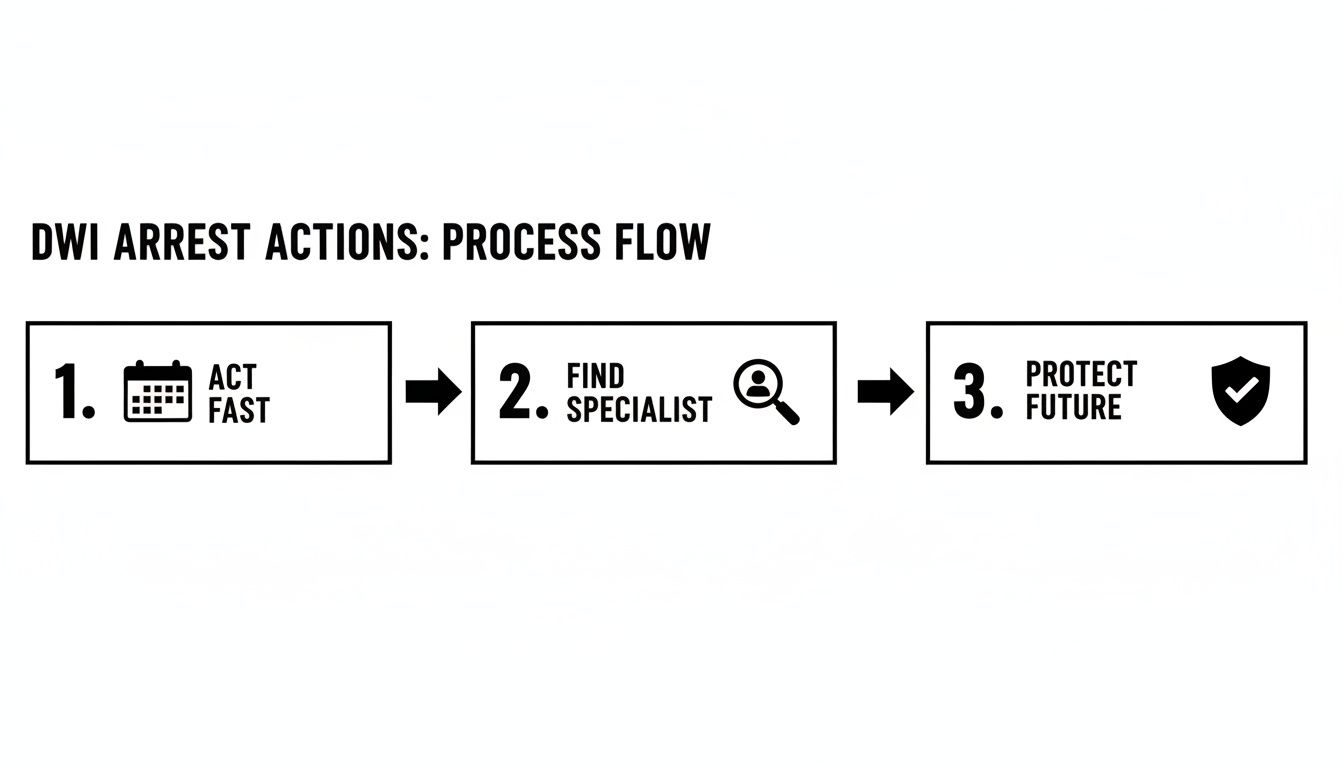
As you can see, the game plan is simple but urgent: act fast, find a specialist, and start protecting your future.
Why a DWI Specialist Is Non-Negotiable
Hiring a general criminal defense attorney for a DWI case is like asking a family doctor to perform heart surgery. They might know the basics, but they lack the focused, deep-seated knowledge needed to protect your rights effectively.
A true DWI specialist understands the complex science behind breath and blood tests, including the concept of Blood Alcohol Concentration (BAC). They know the exact protocols officers must follow during a field sobriety test—and, more importantly, they know how to spot it when they don't. This niche expertise is what uncovers the critical weaknesses in the prosecution's case against you, which is key to learning how to fight DWI Texas charges.
You also need someone who is a regular in the courthouse where your case is pending, whether that's in Harris County, Montgomery County, or elsewhere in Texas. An attorney who knows the local judges, prosecutors, and their tendencies has an undeniable home-field advantage. For a more detailed breakdown, check out our guide on the first steps to take after a DUI arrest.
A huge mistake people make is waiting around, thinking they have plenty of time before their first court date. That delay can cost you your driver's license and give the prosecutor a massive head start.
Choosing your lawyer is the single most important decision you'll make in this entire process. It’s the move that sets the foundation for your entire defense and has a direct line to the final outcome. By acting quickly and choosing a qualified Houston DWI lawyer, you take back control, shifting from a place of fear to a position of strength, ready to fight for the best result possible.
Evaluating an Attorney's Credentials and DWI Experience
Not just any lawyer can handle a Texas DWI charge. These cases are a different beast altogether, built on a tricky mix of science, specific police procedures, and state laws that most general practice attorneys just don't see every day. When you're trying to figure out how to choose a criminal defense attorney, you have to look past the generic claims on a website and dig into the hard facts of their experience. Your future is on the line, and you need a lawyer with proven, specialized expertise.
This isn't just about a quick Google search. It's about actively vetting the credentials that show a real dedication to DWI defense. You need to confirm their qualifications, look into their track record, and understand why having local courtroom experience is an absolute game-changer.

Texas DWI Penalties Explained
Understanding what's at stake helps clarify why an expert is so crucial. The penalties for a first DWI in Texas can be severe and include:
- Jail Time: Up to 180 days in jail.
- Fines: A fine of up to $2,000.
- License Suspension: Up to one year of driver's license suspension.
- Surcharges: Annual fees to the state for three years to maintain your license.
These consequences escalate significantly for subsequent offenses or if there are aggravating factors like a high BAC or an accident.
Verifying an Attorney’s Standing
Before you even pick up the phone for a consultation, there's a crucial first step: check the attorney's professional standing with the State Bar of Texas. This public database is your first line of defense against unqualified or disciplined lawyers.
On the State Bar website, you can quickly confirm that a lawyer is licensed and in good standing. More importantly, you can see their public disciplinary history. This transparent record will show any official reprimands, suspensions, or other sanctions they've ever received. A clean record is non-negotiable.
Choosing the right attorney is a strategic decision that directly influences the outcome of your case. An attorney with a proven track record isn't just a representative; they are your advocate, your strategist, and your shield.
This is also a great place to get a feel for their background—see where they went to law school and when they got their license. This check takes just a few minutes but gives you essential peace of mind. For a deeper look, our guide on top-rated DUI attorneys in your area breaks down the signs of a true professional.
Why Local Courtroom Experience Matters
This is an invaluable asset that people often overlook: how familiar is the attorney with the specific court where your case will be heard? Every courthouse has its own vibe, and every judge and prosecutor has their own tendencies, expectations, and way of doing things. A Houston DWI lawyer who is in Harris County courts every week will understand these nuances in a way an attorney from Dallas or Austin simply can't.
This "home-field advantage" gives you real, tangible benefits. A local specialist knows:
- Which arguments a particular judge finds persuasive.
- The negotiating style of the local prosecutors and what kind of plea deals they're willing to make.
- The little procedural quirks of that specific courtroom, which helps avoid frustrating delays and missteps.
This insider knowledge allows your attorney to build a smarter, more effective defense from day one. They aren't just arguing the law in a vacuum; they're navigating a familiar system and know the key players involved. When your freedom is on the line, that strategic edge can make all the difference.
Asking the Right Questions in Your Consultation
Your free consultation is the single most important meeting you will have in your DWI case. This isn't just a chance to get a price quote; it's your interview to see if an attorney has the strategic mind, specific experience, and dedication needed to protect your future. A DWI arrest is overwhelming, but walking into this meeting prepared with the right questions transforms you from a passive listener into an active participant in your own defense.
Knowing how to choose the right criminal defense attorney means knowing exactly what to ask. If you ask vague questions, you'll get vague, unhelpful answers. You need to come armed with sharp, insightful questions that cut right through the sales pitch and reveal a lawyer’s true expertise in Texas DWI law.
How to Fight a Breath Test Result
Generic promises are a huge red flag. A top-tier Texas DWI attorney should be able to speak confidently and in detail about how they actually attack the prosecution's case. Their answers will show you whether they're a true specialist or just a generalist who dabbles in DWI defense.
To really dig into their expertise, you need a list of specific, strategic questions ready to go. The table below outlines key questions to ask, along with what a strong, experienced attorney's answer should sound like. Weak or evasive responses are a clear sign you should look elsewhere.
Strategic Consultation Questions
| Topic | Question You Should Ask | What a Strong Answer Includes |
|---|---|---|
| Breathalyzer Evidence | "How do you challenge the results of a breathalyzer test in court?" | Details on subpoenaing maintenance logs, challenging the officer’s certification, and verifying the mandatory observation period. They should also mention filing motions to suppress evidence based on a faulty machine or improper procedure. |
| Field Sobriety Tests | "What are the common mistakes you see officers make during Standardized Field Sobriety Tests (SFSTs)?" | Specifics about National Highway Traffic Safety Administration (NHTSA) protocols, improper instructions, poor testing environments (uneven ground, bad lighting), and failure to account for medical conditions. |
| The Initial Stop | "What's your process for reviewing the traffic stop that led to my arrest?" | A breakdown of how they analyze dashcam and bodycam footage to find flaws in the officer’s claim of reasonable suspicion. A good lawyer knows the whole case can be dismissed if the stop was illegal. |
| Case Experience | "How many DWI cases like mine have you taken to trial in this county?" | A confident, specific number or range. They should be able to discuss their familiarity with the local prosecutors and judges, which is a huge advantage. |
An attorney who can't provide detailed, tactical answers to these questions probably doesn't have the deep experience your case requires. You want someone who thinks like a strategist, not just a clerk who processes paperwork.
The goal of a consultation isn't to find an attorney who tells you what you want to hear. It's to find one who shows you, through detailed, strategic answers, that they know how to fight and win.
Understanding Their Process and Communication Style
The legal process is confusing enough without an attorney who leaves you in the dark. How a lawyer manages their cases and communicates with clients is just as critical as their courtroom skill. A lack of clear, consistent communication only adds unnecessary stress to an already difficult situation.
You need to walk away from the consultation knowing exactly how your case will be handled and who will be your main point of contact.
Questions About Caseload and Your Role
- "Who will actually be handling my case?" This is a big one. In some larger firms, you might have a great meeting with a senior partner only to be passed off to a less-experienced junior associate. It’s crucial to know who will be standing next to you in court and answering your calls.
- "What is your typical caseload, and how do you ensure my case gets the attention it deserves?" An overworked attorney is a recipe for disaster. A true professional will have a clear system for case management and will be able to reassure you that they have the time and resources to dedicate to your defense.
- "How will you keep me updated on my case, and what is your policy for returning calls or emails?" A good firm will have a clear communication protocol. They should be able to give you a standard response time (e.g., within 24 business hours) and explain how you'll receive updates on important developments.
Finding the right Houston DWI lawyer means finding a partner you can trust to guide you through this mess. These questions help you look beyond the surface and evaluate an attorney’s practical ability to handle your case with the confidence and clarity you deserve. The answers you get will empower you to make an informed, strategic choice for your defense.
Making Sense of Legal Fees and Attorney Agreements
Let's talk about the elephant in the room: the cost. Worries about legal fees are completely normal, but a lack of clarity from your potential attorney shouldn’t add to your stress.
Discussing money can be uncomfortable, but when you're hiring a Houston DWI lawyer, it's one of the most critical conversations you'll have. This isn't just about a final number; it's about understanding the value you're getting and making sure there are no nasty surprises down the road.
A true professional will be upfront and transparent about their fees. They get that you're in a tough spot and will lay out their financial policies clearly, empowering you to make a solid decision with total confidence.

Comparing Fee Structures: Flat Fees vs. Hourly Billing
As you start meeting with lawyers, you'll run into two main ways they charge for DWI cases in Texas. Knowing the difference is key for your budget and your peace of mind.
Hourly Billing: With this model, you're on the clock. The attorney charges for every minute they spend on your case—phone calls, emails, research, court time, you name it. While it sounds simple, the final cost is a total wildcard. It can skyrocket if your case gets more complicated than expected.
Flat Fees: This is the go-to structure for most reputable DWI defense firms, and for good reason. You pay one single, agreed-upon price that covers the attorney's work for your entire case, or at least for specific, clearly defined stages. This gives you cost certainty and lets you focus on your defense, not on watching the clock.
Honestly, a flat fee aligns everyone's goals. The attorney is motivated to get you the best possible outcome efficiently, not to rack up more billable hours. That’s a huge advantage for you.
What to Look For in a Retainer Agreement
Before anything is official, you'll sign a retainer or fee agreement. This is a binding contract that spells out exactly what the lawyer will do and what it will cost. Never, ever sign an agreement you don't fully understand.
A solid agreement should clearly lay out:
- The Scope of Work: What exactly does the fee cover? Does it include the ALR hearing to save your license, all pretrial motions, and even a potential jury trial? Or will you be charged extra for different stages? Get specific.
- Itemized Potential Costs: The flat fee usually covers the lawyer's time, but not other case-related expenses. The contract should list other potential costs, like fees for hiring an expert witness (like a toxicologist), private investigator fees, or court filing costs.
- Payment Schedule: The document should detail the total fee, how much is due upfront as a retainer, and the schedule for any future payments. Many good firms offer payment plans to make a quality defense more manageable.
A clear, detailed fee agreement is the hallmark of a professional and transparent law firm. Vague language or an attorney who's hesitant to put everything in writing is a massive red flag. Don't ignore it.
Be very wary if an attorney quotes you a fee over the phone without digging into the details of your arrest. A real pro knows every DWI case is different. They need to understand your specific situation—your criminal history, the county you were arrested in, whether it was a breath or blood test—before giving you an accurate price.
Making a financially sound decision starts with having all the facts, and a good attorney will make sure you do.
Spotting Red Flags Before You Hire an Attorney
Choosing a lawyer is a massive decision, and let's be blunt: picking the wrong one can be just as bad as having no lawyer at all. Your search for a qualified Houston DWI lawyer isn't just about finding someone with the right credentials—it's about dodging the ones who can't deliver, or worse, don't have the specific skills your case needs.
Think of this as your playbook for seeing the warning signs before you sign on the dotted line. You have to know the difference between a confident specialist and a generalist who is in over their head. Spotting these red flags will help you avoid the common traps and find someone who is truly committed to protecting your future.
The Unethical Guarantee
This is the big one. If an attorney guarantees a specific outcome, especially a dismissal, walk away. It’s not just unrealistic; it’s a flat-out unethical promise that no reputable lawyer would ever make. The legal system is loaded with variables—the judge, the prosecutor, the specific evidence—that make guarantees impossible.
A confident, experienced attorney will talk about their strategies, their track record in similar cases, and how they plan to fight the charges. They'll sound optimistic and lay out a clear path forward. But they will never promise you a win.
An attorney's job is to build the strongest defense possible to get you the best outcome. Anyone promising a dismissal before they've even seen all the evidence is more interested in your wallet than your case.
This kind of promise is nothing more than a high-pressure sales tactic. It’s designed to get you to sign right then and there, without thinking it through. A true professional gives you an honest, realistic assessment, not a fantasy.
Poor Communication and Disorganization
Pay close attention to how the law firm operates from your very first call. Was it a hassle to schedule a consultation? Are they slow to return your calls? Does the office staff seem professional and on top of things? These first impressions are often a sneak peek of what you'll deal with later.
A disorganized office or a lawyer who’s impossible to reach is a huge warning sign. Your DWI case comes with strict deadlines, like the 15-day window to request an ALR hearing to save your license. A lawyer who can't manage their own schedule is a risk you just can't take. If they're already dropping the ball before you've even hired them, it’s not going to get better once they have your money.
The Generalist Pretending to Be a Specialist
A lot of attorneys will say they "handle" DWI cases, but that’s a world away from being a specialist. DWI defense is a deeply technical field that demands expert knowledge of forensic science, police procedures, and very specific case law. A general practice lawyer who handles a divorce one day and a DWI the next is rarely prepared for that fight.
Here's something to think about: the legal market itself can point you to a true specialist. Major cities are magnets for legal experts. The U.S. has about 402 lawyers per 100,000 people, but legal hubs like Houston attract top-tier talent who specialize. This density creates a competitive environment where the most skilled and experienced DWI attorneys thrive, giving you access to a much deeper pool of experts. You can see how legal markets differ by checking out data on lawyers per capita. When you choose an attorney from a competitive environment like this, you're often getting someone who is truly battle-tested in a busy, demanding court system.
Common Questions About Choosing a DWI Attorney
When you're trying to figure out how to choose the right criminal defense attorney after a DWI arrest, the questions can feel overwhelming. The stress of the situation, mixed with the complexities of the legal system, often leaves people feeling completely lost. Getting clear, direct answers is the first step toward regaining control and making a smart decision.
We've gathered some of the most common questions we hear from people in your exact situation. Our goal is to give you straightforward answers to help you navigate this critical time.
How Soon After My Arrest Should I Hire an Attorney?
Immediately. If possible, you should be on the phone with an attorney within 24 hours.
The most urgent reason is the strict 15-day deadline Texas gives you to request an Administrative License Revocation (ALR) hearing. This hearing is your only shot at fighting the automatic suspension of your driver's license. Miss that deadline, and you forfeit the right to challenge it. Period.
Acting fast also gives your lawyer a massive advantage in preserving crucial evidence, like dashcam or bodycam footage, before it gets erased. It allows them to interview witnesses while memories are still sharp. The moves made in the first few days can set the entire strategic foundation for your defense.
What Is the Difference Between a DWI Specialist and a General Defense Lawyer?
Think of it like seeing a heart surgeon versus a general practitioner for a complex cardiac issue. A general criminal defense lawyer is a jack-of-all-trades, handling everything from theft to assault. A DWI specialist, on the other hand, lives and breathes DWI defense. This isn't just a part of their practice; it is their practice.
That focus is a huge strategic advantage. Defending a DWI case in Texas is a highly technical field that hinges on:
- Complex Science: Understanding the mechanics, flaws, and maintenance logs of breathalyzer machines, plus all the nuances of blood alcohol concentration (BAC) testing.
- Specific Police Procedures: Knowing the National Highway Traffic Safety Administration (NHTSA) standards for field sobriety tests inside and out—and, more importantly, how to spot and challenge improper administration.
- Evolving Laws: Staying on top of every little change to the Texas Penal Code and Transportation Code as it relates to DWI.
A specialist brings a depth of knowledge that a generalist simply can't offer. When your freedom and future are on the line, that expertise is everything.
Should I Just Hire the Cheapest Lawyer I Can Find?
While everyone has a budget, choosing a lawyer based on price alone is a high-risk gamble that can cost you dearly in the long run. A DWI conviction comes with a long tail of consequences: steep fines, license suspension, and a permanent criminal record that can haunt your job, housing, and loan applications for years.
An unusually low fee can be a red flag. It might signal an inexperienced attorney, a high-volume "plea mill" where your case won't get personal attention, or a lawyer whose main strategy is to push every client into a quick guilty plea.
Investing in an experienced, reputable DWI specialist is an investment in protecting your future. A quality Houston DWI lawyer will be upfront about their fees because they know the immense value they provide. It's less of a cost and more of a crucial shield.
How Much Should I Trust Online Reviews?
Online reviews on sites like Google or Avvo can be a decent starting point. They give you a general feel for an attorney's client service and professionalism. Look for reviews that offer specific details about the person's experience, not just generic "they were great" comments.
But reviews should only be one small piece of the puzzle.
Verified credentials and your own gut feeling are far more reliable. An attorney's strategic thinking during your consultation, and a proven track record of actually taking complex DWI cases to trial matter infinitely more than anonymous online ratings. Use reviews to build your shortlist, but make your final call based on tangible qualifications and how well you connect with the attorney.
A DWI charge can feel like your world is caving in, but it doesn't have to define your future. With the right legal advocate in your corner, you can protect your rights, challenge the prosecution's evidence, and fight for the best possible outcome. At The Law Office of Bryan Fagan, PLLC, our team is dedicated to providing the strategic, aggressive defense you deserve.
Don't wait and let the state build its case against you. Your defense starts today. Call us now for a free, confidential consultation to discuss your case and find out how we can help you move forward.