
A DWI arrest can be overwhelming, disorienting, and frankly, terrifying. But you don't have to face it alone. The most important thing to understand right now is that an arrest is not a conviction. The strategic choices you make in the first 24 hours are vital for building a strong defense and learning how to beat a DWI in Texas.
Your most immediate, time-sensitive priority is the 15-day deadline to request an Administrative License Revocation (ALR) hearing. If you miss this, your driver's license will be automatically suspended, regardless of what happens in your criminal case.
Your First Steps After a Texas DWI Arrest
A DWI arrest in Texas immediately launches two separate legal battles. One is the criminal case, which will determine penalties like fines, potential jail time, and whether you end up with a criminal record. The other is a civil case—the Administrative License Revocation (ALR) process—that deals only with your driver's license. Acting quickly and strategically is your first and best opportunity to protect yourself.
The arrest process is designed to be confusing. You'll be booked, fingerprinted, and have your mugshot taken before seeing a magistrate to set your bond. Through all of this, remember your rights. You have the right to remain silent, and you should politely exercise it. Other than providing basic identification, you are not required to answer questions about where you were, what you did, or if you were drinking.
The Most Critical Deadlines
Time is not on your side after a DWI arrest. The state provides a very narrow window to act, and missing these deadlines has immediate consequences, no matter how your criminal case turns out.
- 15-Day ALR Hearing Request: You have exactly 15 calendar days from the date of your arrest to formally request an ALR hearing. If you fail to do this, the Texas Department of Public Safety (DPS) will suspend your license automatically. No exceptions.
- Bond and Arraignment: This usually occurs within 24-48 hours. At the arraignment, you will be formally charged and asked to enter a plea. Pleading "not guilty" at this stage is standard practice; it keeps all your legal options open.
This infographic breaks down the three most important things you need to do immediately.
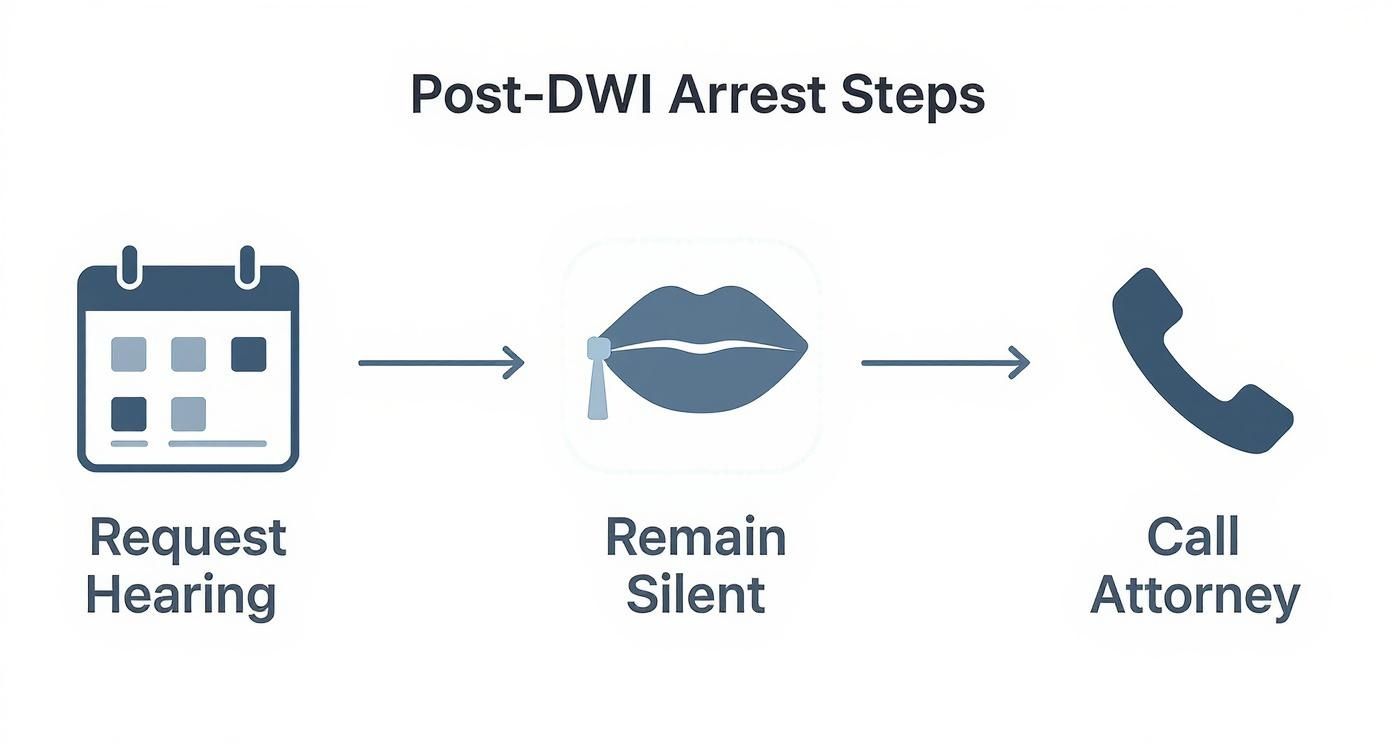
As you can see, requesting your hearing, remaining silent, and contacting an attorney are not just suggestions—they are the foundational pillars of a successful defense strategy.
To make this crystal clear, here’s a quick-glance table of your most urgent tasks.
Your Critical Post-Arrest Action Timeline
This table summarizes the immediate and critical deadlines you must meet after a DWI arrest in Texas to protect your license and rights.
| Action Item | Deadline | Why It's Critical |
|---|---|---|
| Request ALR Hearing | 15 days from arrest | Prevents automatic driver's license suspension. |
| Exercise Right to Remain Silent | Immediately | Prevents you from accidentally providing incriminating evidence. |
| Contact a DWI Attorney | ASAP (within 24 hours) | Ensures deadlines are met and a defense strategy starts immediately. |
| Plead "Not Guilty" | At arraignment (within 48 hours) | Preserves all your legal rights and options for fighting the charge. |
Missing any of these deadlines can put you at a significant disadvantage before your defense has even begun.
Why Contacting a DWI Attorney Is Essential
Engaging a skilled Houston DWI lawyer right away is the single most important action you can take. An experienced attorney does more than offer advice; they take immediate, decisive steps to protect you, ensuring crucial deadlines are met and your rights are shielded from the very beginning.
An attorney’s first move is almost always to file the ALR hearing request on your behalf. This does more than just save your license for the time being. It creates a powerful opportunity to get the arresting officer under oath, gather evidence, and hear their side of the story—all invaluable intel for your criminal defense.
From handling the bond process to representing you at your first court appearance, a good lawyer manages the complex legal maze so you don't have to. They will immediately begin investigating every detail of your case, from questioning the legality of the traffic stop to scrutinizing how field sobriety and chemical tests were conducted. This early analysis sets the stage for dismantling the prosecution's case and building a powerful defense tailored to your situation.
Don’t try to navigate this alone. The decisions you make right now will have a massive impact on your future. If you've been arrested for a DWI in Texas, contact The Law Office of Bryan Fagan, PLLC for a free, confidential case evaluation. We are here to build the strategic defense you deserve.
Challenging the Evidence in Your DWI Case
Every Texas DWI case is built on evidence—the officer’s report, test results, and their testimony. However, that foundation is often shakier than the prosecution wants you to believe.
Successfully fighting a DWI charge isn’t about denying everything. It's about meticulously dissecting the prosecution's case, piece by piece. This process begins with a thorough examination of every action the officer took, from the moment they first saw your vehicle.
The prosecution’s case almost always rests on three pillars: the traffic stop, the field sobriety tests, and the chemical tests (breath or blood). Each one is vulnerable to human error, technical malfunctions, and procedural missteps. That’s where we find the reasonable doubt needed to win.
Your defense starts with one simple but powerful question: was the traffic stop legal? An officer cannot pull you over based on a hunch. They must have reasonable suspicion that you violated a specific traffic law—such as speeding, failing to signal, or weaving out of your lane. They must be able to articulate exactly what they observed.
If the stop itself was unlawful, then all evidence gathered after it—sobriety tests, your statements, the breathalyzer result—can be suppressed. This is known as the "fruit of the poisonous tree" doctrine, and it can end a case before it truly begins.
Questioning the Field Sobriety Tests
Let’s be clear: Standardized Field Sobriety Tests (SFSTs) are not the reliable indicators of intoxication portrayed on television. They are essentially roadside coordination exercises, and many sober people would struggle to pass them, especially under the stress of a traffic stop.
An experienced DWI attorney knows exactly what to look for to challenge the validity of these tests. We investigate factors such as:
- Improper Administration: The instructions for these tests are rigid and standardized. If the officer deviates from the script—even slightly—the results are compromised.
- Environmental Factors: Were you on a sloped road? Was it windy or raining? Were the flashing lights of the patrol car disorienting? All of these can dramatically affect your performance.
- Medical and Physical Conditions: Your age, weight, prior injuries, or even just being tired can make it nearly impossible to perform these tests correctly.
These tests are judged entirely by the officer, leaving significant room for subjective bias. Our job is to expose these weaknesses and demonstrate to a jury that failing a roadside test does not automatically mean you were intoxicated.
A DWI charge is not a conviction. The prosecution has the burden to prove every element of their case beyond a reasonable doubt. Our job is to create that doubt by meticulously picking apart their evidence, one piece at a time.
Dismantling Chemical Test Results
Breath and blood tests may seem like hard science, and prosecutors present them as undeniable proof. But the truth is, they're far from infallible. These tests are highly technical, and for the results to be reliable, every step in the process must be executed perfectly.
With a breathalyzer test, we immediately investigate key questions. Was the machine calibrated correctly? Was it properly maintained? Did the officer who administered the test hold the proper certification? Most importantly, did they follow the mandatory 15-minute observation period to ensure you didn’t burp, hiccup, or have acid reflux, all of which can invalidate the reading? To learn more, see how to effectively challenge breathalyzer results in our detailed guide.
Blood tests have their own set of vulnerabilities. A good lawyer will scrutinize the entire chain of custody. This involves tracking the blood sample from the moment it is drawn until it is tested in the lab. Was it stored at the correct temperature? Was it mislabeled? Could it have been contaminated? Any break in this chain can render the result unreliable and inadmissible in court.
Having a skilled attorney in your corner is critical. Dismissal rates for DWI vary across Texas counties, but one thing is constant: cases with weak evidence are the most likely to be dismissed. An experienced defense lawyer knows how to identify these procedural mistakes and technical errors and use them to your advantage. Early and expert intervention can dramatically increase your chances of a positive outcome.
Getting a Handle on Texas DWI Laws and What You’re Up Against
To have a real shot at beating a DWI charge in Texas, you must first understand the legal landscape. The state takes driving while intoxicated very seriously, and the laws are designed to impose increasingly harsh penalties for repeat offenses. Understanding these rules is the first step you and your Texas DUI attorney will take to build a solid defense.
The case often starts with one number: your Blood Alcohol Concentration (BAC). This is the technical term for the amount of alcohol in your system. For most drivers over 21 in Texas, the legal limit is 0.08%. For commercial drivers, this limit drops to 0.04%, and for anyone under 21, having any detectable amount of alcohol is illegal.
However, you can still be charged with a DWI even if your BAC is under0.08%. Texas law makes it illegal to drive if you’ve lost the “normal use of your mental or physical faculties” due to alcohol or drugs. This gives an officer the authority to arrest you based on their observations—such as erratic driving, poor performance on sobriety tests, or your general demeanor—regardless of what a breathalyzer says later.
The Law You Agreed to Without Knowing It: Implied Consent
One of the most important and often misunderstood laws is Texas’s implied consent law. The moment you obtained your Texas driver's license, you automatically consented to provide a breath or blood sample if a police officer lawfully arrests you for DWI.
Refusing the test does not get you out of trouble. A refusal comes with its own immediate penalty: an automatic driver's license suspension. This is an administrative penalty handled by the DPS, not a criminal one. It happens quickly and can occur even if you are ultimately found not guilty of the DWI. This is why you have only 15 days to request an ALR hearing—it’s your only chance to fight that automatic suspension.
Here's the bottom line: the state gets two swings at you. First, there's the criminal case for the DWI charge itself. Second, there's the civil case (the ALR hearing) trying to take your license. A sharp Houston DWI lawyer knows how to fight both of these battles at the same time, protecting both your freedom and your ability to drive.
The Penalties: A Quick Rundown
In Texas, the consequences for a DWI conviction escalate quickly. There is no "lookback period," meaning a DWI from 15 years ago still counts as a prior conviction and will be used to enhance the penalties for a new charge.
Here is a clear look at what you can expect for typical DWI offenses:
- First DWI Offense (Class B Misdemeanor): This is the most common charge for a first DWI in Texas. If convicted, you face fines up to $2,000, jail time from 3 to 180 days, and a driver's license suspension for up to a year.
- Second DWI Offense (Class A Misdemeanor): The stakes jump significantly. Fines can reach $4,000, with mandatory jail time of 30 days to one year. Your license could be suspended for up to two years.
- Third DWI Offense (Third-Degree Felony): A third DWI is an automatic felony. This carries a potential prison sentence of 2 to 10 years in a state penitentiary and fines up to $10,000.
It's also crucial to know that certain factors can elevate the charges, even for a first offense. For example, if you have a passenger under 15 years old in the car, the DWI charge is immediately enhanced to a state jail felony.
Knowing these realities isn't meant to scare you—it's to prepare you. When you understand exactly what the prosecutor must prove and what is at stake, you can have a more strategic conversation with your attorney about how to dismantle their case.
The ALR Hearing: Your First Chance to Fight a DWI License Suspension
After a DWI arrest, it’s easy to focus only on the criminal charges. But there’s a second, equally urgent battle that begins immediately—the fight to keep your driver's license. This takes place in a separate civil proceeding called an Administrative License Revocation (ALR) hearing.
Do not overlook this critical step. The outcome of your ALR hearing is entirely independent of your criminal case. You could be found not guilty of DWI in court and still have your license suspended if you mishandle the ALR process.
The clock is ticking. You have just 15 days from the date of your arrest to formally request this hearing. If you miss this strict deadline, the Texas Department of Public Safety (DPS) will automatically suspend your license. There are no extensions or second chances.
Why The ALR Hearing Is More Than Just A Hearing
While the primary purpose of the ALR hearing is to determine the fate of your driving privileges, a sharp DWI attorney views it as a valuable opportunity for discovery. Think of it as a legal "dress rehearsal" for your criminal case.
This hearing is often the first—and sometimes only—chance your lawyer gets to cross-examine the arresting officer under oath before a potential criminal trial. This provides a significant tactical advantage. By asking targeted questions, your attorney can lock the officer into their version of events.
At an ALR hearing, we get to challenge the officer's testimony on the critical details: Did they actually have a legitimate reason to pull you over? Were the field sobriety tests administered correctly? Are there inconsistencies between their report and their testimony? Any contradiction or weakness we uncover can be used to poke holes in the prosecution's case down the road.
For example, if an officer testifies at the ALR hearing that you "stumbled once" during the walk-and-turn test, but later tries to tell a jury you were "unsteady on your feet the entire time," that contradiction can destroy their credibility.
What The State Must Prove To Suspend Your License
It's important to know that the ALR hearing is not a criminal trial. The burden of proof is much lower. The state only needs to prove a few key points by a "preponderance of the evidence," which means showing it's more likely than not that their claims are true.
Specifically, DPS has to prove two things:
- Reasonable Suspicion or Probable Cause: The officer had a valid, legal reason to stop your vehicle and subsequently to arrest you.
- Refusal or Failure of a Chemical Test: You either refused to provide a breath or blood sample after a lawful request, OR you provided a sample that showed a BAC of 0.08% or higher.
An experienced lawyer knows exactly how to challenge each of these points. We can argue the initial traffic stop was unlawful, that the arrest lacked probable cause, or that the chemical test results are unreliable. You can learn more in our comprehensive Texas ALR Hearing Process Guide.
Successfully challenging the state's case at the ALR hearing can do more than just save your license—it provides a powerful preview of the weaknesses in the criminal case against you. Don't underestimate how critical this step is to fight DWI Texas charges. It’s your first real chance to go on the offensive.
Weighing Your Legal Options: Plea Bargain or Trial?

After a DWI arrest, many people envision a dramatic courtroom battle. But in reality, your case will likely proceed down one of two paths: a negotiated plea bargain or a trial. Choosing the right path is not a gamble; it's a strategic decision based on the evidence, your personal priorities, and a well-developed legal game plan.
An arrest is simply a fork in the road. Neither path is inherently better—the best route depends entirely on the facts of your case. A skilled DWI lawyer will help you weigh the pros and cons of each, allowing you to make a confident, informed choice about your future.
Understanding the Plea Bargain
A plea bargain is a negotiated agreement between your defense attorney and the prosecutor. In exchange for you pleading guilty or "no contest," the prosecutor agrees to recommend a specific, often reduced, punishment.
The main advantage of a plea bargain is certainty. You know the exact outcome, which eliminates the risk of a jury imposing a much harsher sentence after a trial. For many people, especially when the evidence seems strong, that certainty is invaluable.
A well-negotiated plea bargain isn't giving up. It's a strategic move to control the damage and protect your record. The goal is often to get the DWI charge reduced to a lesser offense that doesn't carry the same devastating, long-term consequences.
For a first-time DWI in Texas, a common goal is to negotiate the charge down to an offense like Obstruction of a Passageway or Reckless Driving. While still misdemeanors, they do not carry the automatic license suspension or the permanent stigma of a DWI conviction. You can learn more about these possibilities in our guide to Texas DUI plea bargain options explained.
When Is Taking Your Case to Trial the Right Move?
Deciding to fight your DWI at trial is a significant step. It means you are forcing the State of Texas to meet its highest burden: proving every single element of the charge against you beyond a reasonable doubt. If they fail to convince a jury, you walk away with a "not guilty" verdict.
This strategy makes sense when we identify significant weaknesses in the prosecutor's case.
Here are a few classic examples:
- The initial traffic stop was illegal.
- The field sobriety tests were administered improperly.
- There are serious doubts about the reliability of the breath or blood test.
- There's simply a lack of credible evidence that you were actually intoxicated.
Of course, a trial has risks. If you are found guilty, the judge or jury determines your punishment, which could be more severe than what the prosecutor offered in a plea deal. But when the evidence is weak and the law is on your side, the potential reward—a complete acquittal and a clean slate—is the best possible outcome.
This is not a decision to be made lightly. Data from 2016 provides insight into Texas DWI outcomes. While about 63% of cases ended with a guilty plea, those who chose to fight had a real chance at a better result. Among cases that went to trial, nearly 45% resulted in either a dismissal or a conviction on a lesser charge. This shows that a strategic fight can pay off.
Ultimately, the choice between a plea and a trial is one of the most critical you'll face. It requires a frank, honest conversation with your attorney about the strength of your case, your tolerance for risk, and what outcome best serves your long-term goals.
Got Questions About Your Texas DWI? We Have Answers.
When you’re facing a DWI charge, your mind is likely racing with a million questions. It’s an overwhelming and stressful experience, and it’s completely normal to feel lost.
This is where we provide clarity. We’ve heard every question from people in your situation, and our goal is to give you direct, honest answers. Let's address some of the biggest concerns right now so you can better understand your position and what comes next.
Can a DWI Charge Actually Be Dropped in Texas?
Yes, absolutely. Getting a DWI charge dropped or dismissed is often the primary goal of a strong defense strategy. It is not a myth, and it happens more often than you might think, but it doesn't happen by accident.
A dismissal typically results from your attorney finding a critical weakness in the prosecutor’s case. Think of it like a house of cards—pull out the right one, and the entire structure can collapse.
This can happen for several key reasons:
- The Traffic Stop Was Illegal: If the officer did not have a legitimate, legal reason to pull you over, any evidence they collected afterward—field sobriety tests, breathalyzer results, everything—can be thrown out.
- Major Mistakes in Testing: There are strict, standardized procedures for how field sobriety and chemical tests must be administered. If the officer failed to follow these procedures, the results can be deemed unreliable and inadmissible in court.
- Evidence Gets Suppressed: Was the breathalyzer machine properly calibrated? Was the blood sample’s chain of custody maintained perfectly? If not, that evidence can be suppressed, leaving the prosecution with a case that may be too weak to prove.
When key evidence is excluded, the prosecutor may not have enough left to convince a jury beyond a reasonable doubt. That’s when dismissals happen.
What Are the Real Odds of Beating a DWI?
No lawyer can ever guarantee a specific outcome—and you should be wary of any who do. But let’s look at the actual numbers, because they tell a story that might surprise you. Too many people assume a DWI arrest means an automatic conviction and plead guilty without a fight. The data shows this can be a significant mistake.
Statewide data from the Texas Department of Public Safety in 2020 showed there were 83,088 DWI charges filed. While it’s true that almost 40% of individuals pleaded guilty, thousands of others fought back and achieved a better result.
Here's the important part: 6,771 of those charges were dismissed completely. Another 10,302 people were convicted of a lesser offense through strategic plea bargaining. That means there's roughly a 14% chance of getting your charges dismissed or reduced if you challenge the case. You can see a full breakdown in this analysis of Texas DWI statistics. The odds are much better than zero.
Is It Really Worth Hiring a Lawyer for a First-Time DWI?
Hiring an experienced Houston DWI lawyer for a first offense is arguably the most important decision you can make for your future. Do not let the words "first time" mislead you into thinking it's not a serious matter. A first-time DWI is a Class B misdemeanor, which can lead to jail time, thousands of dollars in fines, and a suspended driver's license.
A conviction sticks with you. It creates a permanent criminal record that can affect you for years, impacting everything from job applications and professional licenses to your car insurance rates. An attorney’s job is to prevent that long-term damage before it starts.
A good lawyer does much more than just stand beside you in court. They will handle your ALR hearing to fight for your license, scrutinize every piece of evidence for police errors, and negotiate with the prosecutor from a position of strength, not desperation. Their experience is your best shot at securing a dismissal, a reduction to a non-DWI charge, or a creative sentence that keeps a conviction off your record for good.
A DWI arrest feels like a moment that will define the rest of your life, but it doesn't have to. With a strategic and aggressive defense, you can protect your rights and fight for the best possible outcome.
The team at The Law Office of Bryan Fagan, PLLC is ready to build that defense for you. We understand what you're up against and have the experience to guide you through this process. You don't have to face this alone. Request a free, no-obligation case evaluation today, and let's start protecting your future. https://texasduilawfirm.com