
In Texas, first-time DWI bail usually falls between $500 and $2,500. Across DWI charges statewide, the average cash bond was $5,538 in public data from 2022 and 2023, but your actual amount depends on the facts of your arrest and the judge handling release.
A DWI arrest can be overwhelming, but you don't have to face it alone.
If you're reading this from a jail parking lot, a kitchen table in the middle of the night, or while waiting for a call from someone you love, you probably need one thing first. A straight answer about cost. The hard part is that bail in Texas isn't set by one statewide chart for DWI cases. Judges set it case by case, and small details can move the number fast.
That doesn't mean the process is random. It means there are levers that matter. Prior history matters. The reported BAC, or blood alcohol concentration, matters. Whether there was a wreck, an injury, or a child passenger matters. Just as important, the type of release you pursue matters too. In some cases, a strong legal motion can make the difference between paying cash and getting out on a PR bond.
A DWI Arrest Is Overwhelming We Can Help
It is 2 a.m. Your family gets a call from jail, someone asks about bail, and within minutes you are hearing about release conditions, a possible license suspension, and a court date. That scramble is common after a Texas DWI arrest.
The first goal is simple. Get the person out as quickly as possible without creating a bigger problem with money, bond conditions, or a rushed decision that limits your options later.
A Texas DWI case usually begins with booking, then a magistrate sets bail and any release conditions. For a clear timeline of what happens immediately after arrest, read this guide on the first 24 hours after a DWI arrest in Texas.
What families need to know right away
Bail is the amount the court sets to secure release.
Bond is how that release gets handled. The person may post cash, use a bail bond company, or ask for release on a personal recognizance bond.
That distinction matters because the dollar amount alone does not tell you what getting out will cost. In some cases, the smartest move is to push for a lower amount. In others, it is to pursue a PR bond and avoid an upfront cash payment altogether if the court will allow it.
Why early strategy matters
Two people arrested for DWI in Texas can walk out under very different terms, even if the charge sounds similar on paper. Judges look at the facts they have in front of them, and those facts shape both the amount and the conditions of release.
I tell families to focus on the levers that can change the outcome. Prior DWI history matters. A high BAC can matter. So can an accident, an injury allegation, a child passenger, or anything that makes the court view the case as presenting more risk.
The practical takeaway is straightforward. The first number mentioned after arrest is only part of the problem. The key question is how to secure release in the way that makes the most financial and legal sense for the case.
Understanding Bail and Bond in a Texas DWI Case
People often use these words as if they mean the same thing. They don't. If you understand the difference, you'll make better decisions under pressure.
Bail means the total amount set by the court
Think of bail as the court's security deposit. The judge sets a dollar amount to help make sure the person comes back to court and follows release conditions.
In a DWI case, the amount often reflects how the court views risk. A judge may look at whether the accused has prior DWI convictions, whether the stop involved a crash, and whether the person seems likely to appear in court.
Bond means the way release is secured
A bond is the mechanism used to satisfy that bail requirement. The most common paths are:
- Cash bond means paying the full amount directly.
- Surety bond means a bail bond company posts the bond.
- PR bond means release based on a promise to appear, without upfront cash if the court approves it.
A lot of people searching for a Houston DWI lawyer are really trying to solve two separate problems at once. Getting out of jail now, and protecting the case long term.
Key DWI terms you should know
You'll hear legal and technical language immediately after arrest. These terms matter:
- BAC stands for blood alcohol concentration. It refers to the measured amount of alcohol in a person's blood and often affects how the court views the seriousness of the allegation.
- Field sobriety test refers to roadside divided-attention exercises officers use during a DWI investigation. These tests are not the same as a breath or blood test.
- Implied consent means that by driving in Texas, you're considered to have agreed to provide a breath or blood specimen in certain lawful DWI investigations. Refusing a requested specimen can trigger a separate license consequence.
- Administrative license suspension refers to the civil process that can suspend your driver's license after a failed or refused breath or blood test, separate from the criminal DWI case. In Texas, this is commonly handled through an ALR hearing, which stands for Administrative License Revocation.
If you're dealing with the criminal side of a charge under Texas Penal Code 49.04, a Texas DWI Defense Lawyer handles that kind of allegation.
Bail gets you out of custody. It does not resolve the criminal charge or the DWI license suspension issue.
Key Factors That Determine Your Bail Amount
The number set after a DWI arrest usually turns on a few specific facts, and some of those facts can be addressed early. Judges and magistrates are looking at two practical questions: will you come back to court, and can you be released without creating a public safety concern. A good bail argument is built around those points.
Some facts tend to increase the amount or lead to tighter release terms:
- Prior DWI or criminal history suggests a higher risk of reoffending or missing court.
- A very high alleged BAC can make the case look more serious at the outset.
- An accident, property damage, or injury allegation raises concern about public safety.
- A child passenger allegation often pushes the case into felony territory.
- A pending case, probation status, or prior bond violation can make a magistrate less willing to offer a low bond or a personal bond.
Other facts can help keep bail lower, or support a request for release on a personal recognizance bond, sometimes called a PR bond, which may allow release without an upfront surety payment. Steady employment, long-term residence in the county, family support, military service, no prior record, and a history of appearing in court all help. So does having a lawyer ready to present those facts in an organized way instead of leaving the court with only the arrest report.
That trade-off matters. A lower bail amount is helpful, but the conditions attached to release can affect daily life just as much. Many courts add alcohol monitoring, ignition interlock requirements, travel limits, or no-drinking orders. Before agreeing to terms you do not fully understand, review this guide to Texas DWI bond conditions.
County practice also affects the result. Texas does not use one statewide DWI bail schedule, and local procedures can shape how quickly you see a magistrate, how often PR bonds are granted, and how strict the standard conditions are. For example, the Dallas County Criminal Courts misdemeanor bond schedule shows how local courts publish baseline bond amounts, but the actual number in a DWI case can still move up or down based on the facts above.
Focus on identifying the facts in your case that are driving the court's decision and the facts your lawyer can use to argue for a lower amount or a PR bond.
Typical DWI Bail Amounts in Texas by Offense Level
A first-offense DWI and a felony DWI do not start in the same place. Offense level still matters, but it is only the baseline. The number can move fast once a magistrate looks at prior history, accident facts, a blood test allegation, or whether a child was in the car.
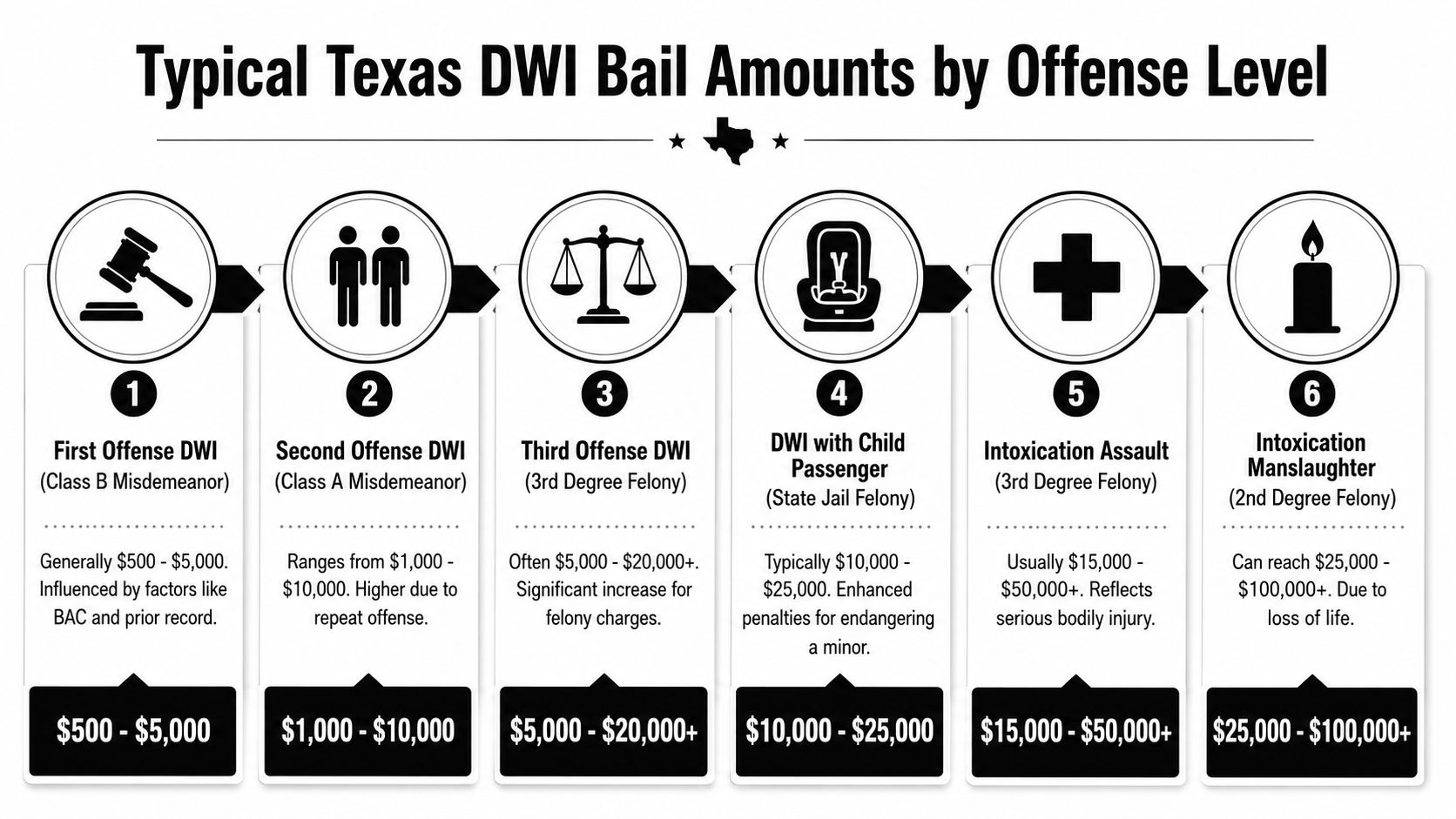
Estimated Texas DWI Bail Amounts by Offense Level 2026
| DWI Offense Level | Classification | Typical Bail Amount Range |
|---|---|---|
| First DWI | Class B misdemeanor | $500 to $2,500 |
| Second DWI | Class A misdemeanor | $2,500 to $5,000 |
| Felony DWI | Felony | $10,000 to $20,000 or more |
These ranges are useful for orientation, not prediction. In practice, I treat them as starting points for strategy. A low-end first DWI may still come with expensive release conditions, while a higher bond can sometimes be reduced with the right facts presented early.
What these ranges usually look like in practice
A first DWI is often the most workable bond situation. If there was no crash, no refusal issues, no child passenger, and no prior record, courts are more open to a manageable amount and, in some counties, a stronger argument for release without a large upfront payment.
A second DWI usually changes the tone of the hearing. Judges often view a repeat allegation as a public-safety problem, which can raise both the bond amount and the restrictions tied to release.
Felony DWI cases are where families feel the financial pressure quickest. Bail often rises sharply, and the conditions can be harder to live with. That is especially true in cases involving an accident, an injury claim, or prior DWI history that pushes the charge out of misdemeanor court.
One practical point matters here. The amount listed on the bond is not always the amount you must pay in cash today. Many families use a surety bond, which usually means paying a percentage to a bondsman rather than the full amount to the court. If you are comparing local release options, this list of Houston bonding companies for DWI-related releases shows the kind of service families often use.
Use the offense level as a starting point, not the final answer
Online charts can help you get your bearings, but they do not tell you what the court will do with your facts. The better question is not just, "What is the usual bail for this charge?" It is, "What is pushing my bond higher, and what can my lawyer present to push it lower?"
If you are dealing with a first arrest and want a fuller picture of exposure beyond bail, this page on First-Offense DWI in Texas: Penalties and Defenses is a useful next read.
How to Post Bail Step by Step
Families usually lose time because they don't know where to start. The process is more manageable when you take it in order.
A visual overview helps first.
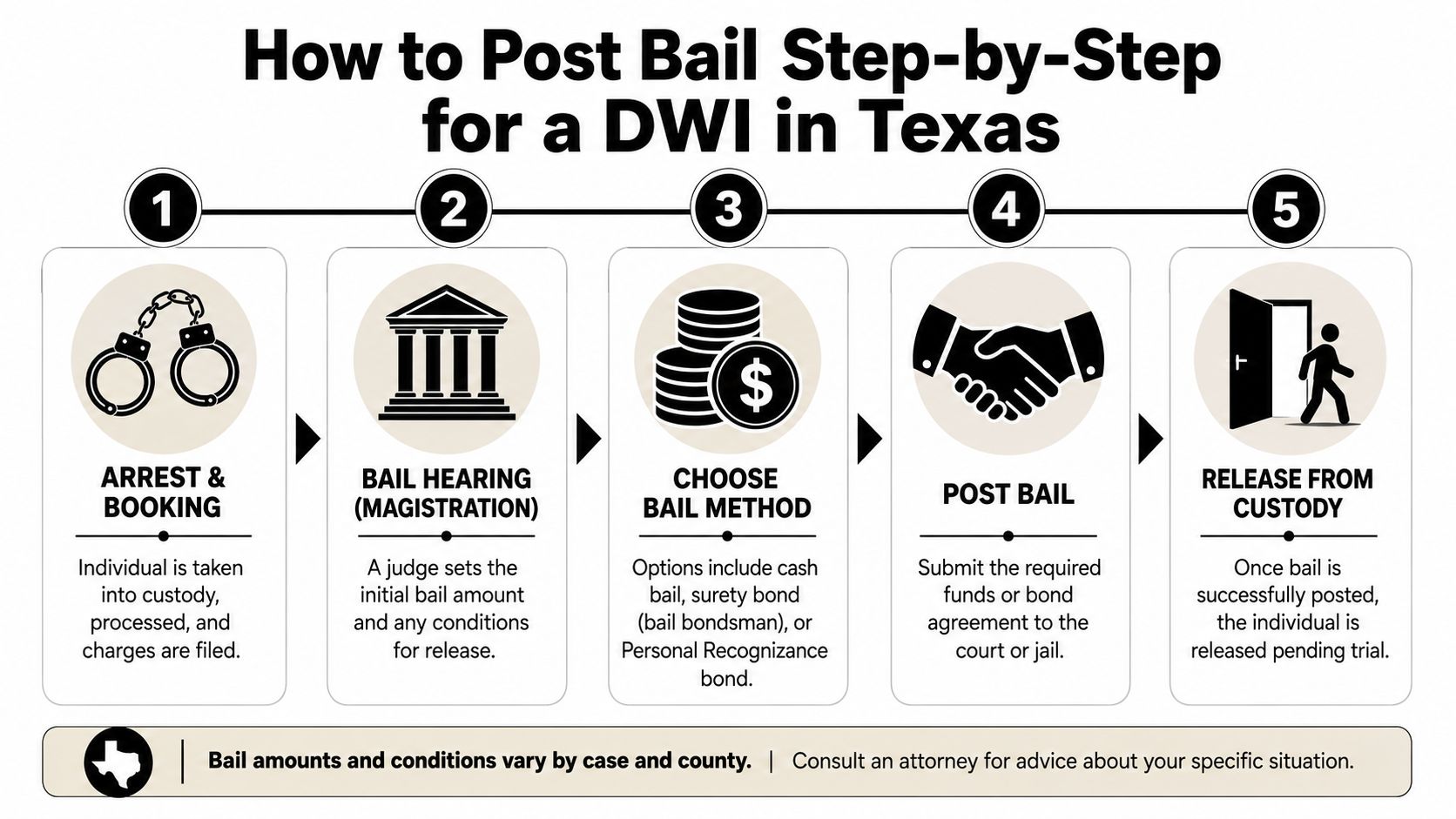
Step 1 and Step 2
Confirm where the person is being held
After arrest and booking, the person may still be waiting to see a magistrate. You need the jail location, booking information, and the exact charge.Wait for magistration and bail setting
This is when the judge or magistrate sets the bail amount and any conditions of release.
For a local option if you're comparing surety-bond logistics, this directory of bonding companies in Houston, Texas can help you identify the type of service families often use.
Step 3 through Step 5
A short video can make the sequence easier to follow before you start making calls.
Choose the release method
You may pay cash, use a surety bond, or ask counsel whether a PR bond request makes sense.Complete the paperwork
Every jail and bondsman process has forms. Expect to provide identifying information and sign agreements if a third party is involved.Get release instructions and court information
Once the bond is posted and accepted, release still takes processing time. Before anyone leaves, make sure the next court date and bond conditions are clear.
The common mistake families make
Individuals often focus only on getting someone out quickly. Speed matters, but so does the method.
A surety bond may solve the immediate custody problem. It may not be the cheapest path if a lawyer could have made a serious argument for reduced bail or a PR bond. That's why families should think about release and defense together, not as separate problems.
How a DWI Attorney Can Fight for a Lower Bail
The families I talk to after a DWI arrest usually have one urgent question: how do we get you out without making a bad financial decision that follows you for months.
A bail bondsman can arrange release. A DWI attorney can go after the amount, the conditions, and in the right case, the need for cash bail at all.

The lever many people overlook
The expensive part of a DWI release is not always the stated bond amount. It is the upfront cash required to get out. That is why the main question is often whether the court can be persuaded to lower bail or approve a Personal Recognizance bond, which allows release based on a promise to appear instead of a cash payment. Texas law allows release on personal bond in appropriate cases, and the judge looks at the person, the charge, and the risk of nonappearance or danger to the community. See the Texas Code of Criminal Procedure, Chapter 17 on bail and personal bond release: Texas Code of Criminal Procedure Chapter 17.
That is a legal argument, not a paperwork formality.
What a lawyer argues
A bond hearing is where the defense starts shaping the case. The judge must set bail high enough to give reasonable assurance that the person will appear, but not use bail as an instrument of oppression. Texas law also requires the court to consider the nature of the offense, the defendant's ability to make bail, and the future safety of the community. Those rules are set out in Article 17.15: Texas Code of Criminal Procedure Art. 17.15.
In practice, a strong request for lower bail or a PR bond usually focuses on facts like these:
- No prior criminal history or prior missed court dates
- Stable employment, especially if a jail hold threatens that job
- Strong local ties, such as family in the area and a fixed address
- Limited financial resources, shown with real details rather than vague claims
- Facts suggesting the case does not call for unusually restrictive conditions
- A workable release plan, including transportation, compliance with court orders, and reliable court appearance
Judges want specifics. General statements do not move the needle.
Strategy matters early
Timing matters here. If counsel gets involved early, the defense can present a cleaner picture of who you are and why standard money bail is higher than necessary. In some courts, that can mean a reduced bond. In others, it can support a request for personal bond or more manageable conditions.
That can save substantial money at the front end. It can also prevent a family from paying a nonrefundable bond fee when a better option may have been available.
Why this matters beyond release
A good bond argument does more than get someone out of jail. It gives the lawyer an early chance to frame the case, correct bad assumptions, and start protecting the client's job, driver's license, and ability to participate in the defense.
I treat bond as the first courtroom problem to solve, not a side errand. If handled correctly, it can reduce immediate cost and put the defense in a stronger position from day one.
If you or a family member has been arrested and you need practical answers now, request a free consultation with the Law Office of Bryan Fagan, PLLC. You can get guidance on bail, bond options, ALR hearings, first-time DWI defenses, and the steps to protect your license and your case from the start.