 Skip to content
TL;DR: In a civil injury case, lawyers usually take a 33% to 40% contingency fee from the settlement, and that fee is separate from case expenses such as filing fees and expert costs, as explained by Naqvi Law’s overview of settlement percentages. In a Texas DWI criminal case, the fee structure is different. You’re usually paying a flat fee or hourly rate, not giving the lawyer a cut of any “settlement.”
A DWI arrest can be overwhelming, especially if it happened after a crash. You may be worried about jail, your driver’s license, your job, your insurance, and whether someone involved in the accident is going to sue you. Then the money questions hit. How much is a lawyer going to cost, and how much do lawyers take from settlement?
That question has two different answers because you may be dealing with two different legal problems at the same time. One is the criminal DWI case brought by the State of Texas. The other can be a civil claim involving injuries, vehicle damage, or an insurance payout. If you mix those two together, the fee issue gets confusing fast.
Introduction A DWI Arrest Is Overwhelming We Can Help
Texas DWI cases move on more than one track. The criminal court focuses on whether you were driving while intoxicated. A civil claim focuses on money, meaning who pays for injuries, treatment, lost time, or property damage after a crash.
That distinction matters because the fee arrangement usually follows the type of case. A civil lawyer handling an injury claim may work for a percentage of a recovery. A Texas DUI attorney defending you in criminal court usually won’t, because there is no cash settlement to divide in a criminal case.
Two legal problems can exist at once
If your arrest involved an accident, you may face:
- A criminal prosecution: The state accuses you of DWI and seeks penalties.
- A license case: Texas can try to suspend your license through an administrative process.
- A civil demand or lawsuit: Another driver, passenger, or insurer may seek money.
Those are separate matters. They can overlap in facts, but they don’t work the same way and they aren’t billed the same way.
Practical rule: If money is being recovered in a civil case, contingency fees may apply. If you’re fighting a DWI charge, the legal fee is usually based on the work required to defend you.
Key Texas DWI terms you need to know
A lot of people hear legal terms right after arrest and don’t know what they mean. You should.
- Implied consent: Under Texas law, when you drive on public roads, you’ve already agreed to provide a breath or blood specimen if an officer lawfully requests it after a DWI arrest. Refusing can trigger a separate license consequence.
- BAC: This means blood alcohol concentration. It refers to the amount of alcohol measured in your breath or blood.
- Field sobriety test: These are roadside tests officers use to claim impairment, such as balance or eye movement testing.
- Administrative license suspension: This is the license action that can follow a failed or refused chemical test, separate from the criminal case itself.
What happens after a DWI arrest in Texas
The process usually unfolds in a predictable order, even if the facts are messy.
Arrest and booking
You’re stopped, investigated, and taken into custody.Bond and release
A judge or magistrate sets bond conditions, which may limit driving, alcohol use, or travel.License issue begins
If there was a failed or refused test, the state may seek a suspension through an ALR process. If you’re dealing with a DWI license suspension issue, timing matters.Criminal court dates start
Your lawyer evaluates the stop, the arrest, the test results, body cam footage, and police reports.Negotiation, motions, or trial
The case may end in dismissal, reduction, deferred resolution where available, or trial.
That’s why clear fee terms matter. You don’t need more uncertainty. You need to know what you’re paying for, what the fee covers, and whether anyone is taking a percentage of anything. In many Texas DWI matters, the answer to that last question is no.
Understanding the Contingency Fee for Civil Claims
A lot of DWI clients ask this question because there was also a crash, an injury claim, or a dispute with an insurance company. That is where people hear about a lawyer taking a percentage of a settlement. For the civil side of the matter, that fee structure is often a contingency fee. The lawyer gets paid from the recovery if the case produces money.
That is a very different arrangement from a criminal DWI defense fee. Your DWI case is usually billed as a flat fee or hourly fee, not as a cut of some future settlement. If you want a plain-English comparison, this guide to Texas DUI lawyer fee options explains how those two systems differ.
What a contingency fee is
The lawyer takes the risk of working the civil case first and getting paid later. If there is no recovery, there is usually no attorney fee under that contract.
Why does that structure exist? Because civil claims cost money to pursue. Records have to be collected. Insurance adjusters have to be pushed. Witnesses may need to be interviewed. If the claim turns into a lawsuit, the workload and the risk go up fast.
Why the percentage can change
A contingency percentage is often lower if the claim resolves early and higher if it moves into litigation. That makes sense. A pre-suit insurance claim and a lawsuit are not the same job.
Once suit is filed, the lawyer may have to draft pleadings, answer motions, conduct discovery, take depositions, prepare experts, and get the case ready for trial. More work. More expense. More risk. A staged fee can be perfectly reasonable if the contract spells it out clearly before you sign.
The right question is not just, “What percentage do you charge?” Ask these instead: When does the percentage increase? Does it change at filing, mediation, or trial? Are costs deducted before or after the fee is calculated?
The part clients miss
Attorney’s fees and case expenses are usually separate items in a civil claim.
Expenses can include filing fees, medical record charges, deposition costs, investigator fees, and expert witness bills. Those amounts are often reimbursed from the settlement under the fee agreement. If you do not read that language carefully, your net recovery can be lower than you expected.
A good fee contract is specific. It states the percentage, when that percentage changes, who advances costs, and how those costs are repaid.
That level of detail protects you. If a lawyer gives you a vague answer about fees, slow down. Clear fee terms at the start prevent ugly surprises when the case ends.
How a Settlement Is Divided The Path to Your Net Recovery
Most clients focus on the settlement headline number. That’s understandable, but it’s not the number that lands in your account. The number that matters is your net recovery, meaning what you receive after the required deductions are made.
Here is the basic flow.
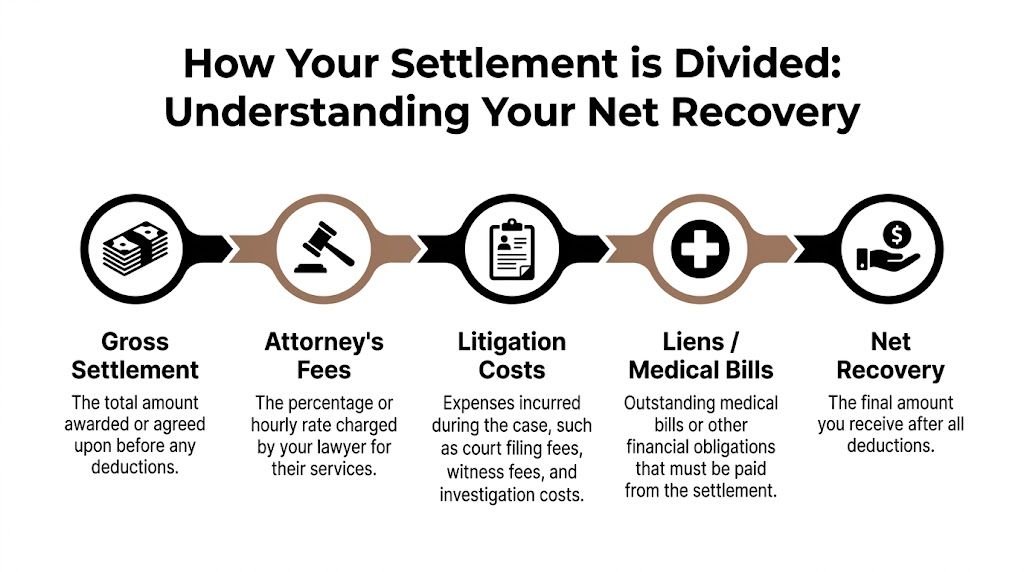
The five-part path from gross settlement to your check
Gross settlement
This is the full amount agreed to in the case before deductions.Attorney’s fee
The contingency percentage comes out according to the fee contract.Case expenses
Litigation costs or advanced case expenses are reimbursed.Liens and medical bills
Outstanding obligations tied to treatment may have to be paid.Net recovery
This is your final amount.
That sequence matters because clients often assume the attorney’s fee is the only deduction. It usually isn’t. If a lawyer doesn’t explain that clearly, the client gets surprised at the end. Surprise is bad practice.
Why hiring counsel can still leave you with more money
A lot of people hesitate when they hear a contingency percentage. They think, “Why give up part of the settlement?” That sounds sensible until you compare it to what unrepresented people often recover.
According to Bronx Law Firm’s explanation of attorney fees and outcomes, clients represented by skilled attorneys typically receive settlements that are approximately 3.5 times larger than those who handle the process themselves. The same source gives a clear example: a client with a $100,000 settlement could pay $33,000 in fees plus $5,000 in case costs and still net $62,000, while a self-represented person might recover only $40,000 with no fees.
That’s why I tell people to stop staring only at the percentage. Look at the likely net result.
Where clients lose money unnecessarily
Some losses are avoidable. Others are built into the process. The smart move is knowing which is which.
- Poor fee contracts: If the agreement is vague, disputes start later.
- Unmanaged expenses: Costs should be tracked and explained.
- Untested liens: Some obligations should be verified and challenged when appropriate.
- Weak negotiation: A bigger gross settlement can matter more than shaving a small amount off a fee.
The best lawyer is not the one who sounds cheapest at intake. It’s the one who protects your net recovery from every direction.
A simple way to think about settlement math
Use this checklist when you review any settlement statement:
| Step | What to check |
|---|---|
| Gross amount | Is this the full amount being paid? |
| Fee deduction | Does it match the signed contract? |
| Cost deduction | Are the listed expenses actual case costs? |
| Lien payment | Are all medical or reimbursement claims valid? |
| Final amount | Does the math produce the stated net recovery? |
That review takes a few minutes. It can save you a lot of frustration.
Real-World Examples of Settlement Calculations
Examples help. The exact numbers in your case will depend on your contract, expenses, and obligations, but the logic doesn’t change. The point is to see how the money moves.
One warning first. Because fee contracts differ, no sample table can replace the signed agreement. The right comparison is not “What did someone else pay?” It’s “What does my contract require, and what deductions are legitimate in my case?”
Sample settlement distribution scenarios
| Item | Scenario 1 Pre-Litigation Settlement | Scenario 2 Post-Litigation Settlement |
|---|---|---|
| Gross settlement | A civil claim resolves before suit is filed | A civil claim resolves after suit and major litigation work |
| Attorney fee structure | Lower contingency stage may apply under the contract | Higher contingency stage may apply under the contract |
| Case expenses | Usually more limited | Often more substantial because litigation is expensive |
| Medical liens and bills | May still reduce the final payout | Can significantly affect the final payout |
| Client net recovery | Depends on all deductions after the gross amount | Depends on all deductions after the gross amount |
Scenario one looks better on paper than in your pocket
Suppose a claim settles early. That’s usually good news because early resolution often means fewer expenses and a lower contingency stage under many contracts. Fewer moving parts often leave the client with a cleaner payout.
But even in an early settlement, you still need to ask hard questions. Were records costs advanced? Are there treatment balances? Did an insurer claim reimbursement? If no one explains those items, clients tend to overestimate what they’ll take home.
Scenario two can still be the better outcome
Now consider a case that requires litigation. The fee stage may be higher, and the expense load may be heavier. On the surface, that sounds worse.
It isn’t always worse. A litigated case can produce a much stronger gross recovery, and that can leave the client better off even after larger deductions. The right comparison is always net value, not just the percentage or the cost line by itself.
Some cases should settle early. Others shouldn’t. The right decision is the one that protects your final outcome, not the one that makes the fee line look smaller.
The lesson from both examples
Don’t evaluate a lawyer based only on what they “take.” Evaluate the whole financial picture:
- How the fee is calculated
- What costs are separate
- Whether liens are being addressed
- Whether the lawyer is improving the overall result
That mindset protects you in a civil case. It also keeps you from asking the wrong question in a criminal DWI case, where there usually isn’t any settlement fund to split in the first place.
The Critical Difference Fees for Your DWI Criminal Case
A lot of clients get tripped up right here. They read about lawyers taking a percentage of a settlement, then assume the same model applies after a DWI arrest. It does not.
In a Texas DWI criminal case, there is usually no settlement fund to divide. You are not hiring a lawyer to collect money for you. You are hiring a lawyer to protect your record, your license, your job options, and in some cases your freedom. That changes the fee structure from the start.

How Texas DWI lawyers usually charge
DWI defense is commonly billed as a flat fee or hourly fee. That approach fits the work. Criminal defense requires immediate analysis, court appearances, motion practice, negotiation, and sometimes trial preparation, whether or not there is any financial recovery at the end.
A flat fee often gives clients more predictability. You know the base cost up front, and you can ask what is included before you sign. Hourly billing can make sense in unusual or fast-changing cases, but it also creates more uncertainty if the case becomes contested.
If you want a side by side explanation of these pricing models, review this breakdown of DUI vs DWI legal fees in Texas.
What you are paying for in a criminal DWI case
The fee is tied to defense work, not to a percentage of money recovered. That work can include:
- Reviewing the stop and arrest for legal mistakes
- Examining video, reports, breath or blood records for weaknesses
- Filing motions to challenge the stop, statements, testing, or procedure
- Appearing in court for settings, hearings, and negotiations
- Handling license-related issues tied to the arrest
- Preparing for trial if the state does not offer a result worth taking
This is strategic work. Good DWI defense is built on pressure points in the evidence, timing, procedure, and officer conduct. That is why a low fee is not always a bargain. If the lawyer is not doing the work, the lower number does not help you.
Why contingency fees usually do not fit a DWI defense case
A contingency fee works in a civil claim because there may be a settlement or verdict to split. A DWI case does not work that way. The result you are paying for may be a dismissal, a reduction, a better plea position, a protected license, or a stronger record outcome.
Those results have real value. They just are not paid from a settlement check.
That distinction matters even more if your DWI arrest also involved a crash. You may end up dealing with two separate legal tracks at once. A civil injury claim related to the accident may use a contingency fee. The criminal DWI charge usually will not. If a lawyer does not explain that difference clearly, ask harder questions.
What clients should pin down before hiring a DWI lawyer
Do not stop at the total fee. Ask what the fee covers.
Some flat fees include routine court appearances but charge extra for trial. Some include license suspension work. Others bill that separately. You also need to know who is handling the case day to day, whether experts cost extra, and what happens if the charge is enhanced or the case becomes more complicated than expected.
If this is a first DWI in Texas, do not make the mistake of treating it like a minor hassle. First cases can still threaten your license, your insurance costs, your employment, and your future options. The right fee structure is the one that gives your lawyer room to attack the case early and thoroughly.
Key Questions to Ask Your Attorney About Fees
Most fee disputes happen because the client didn’t ask direct questions at the start. That’s avoidable. You don’t need to be shy about money. A good lawyer should welcome the conversation.
Start with the most basic point. Ask what kind of fee this is. Civil contingency, criminal flat fee, or hourly billing. If the answer isn’t clear in the first few minutes, keep asking.

Ask these questions before you sign anything
What type of fee am I being charged?
You need a direct answer. Contingency, flat, or hourly.If this is a civil case, when does the percentage change?
Some contracts increase the percentage if suit is filed or trial becomes necessary.What expenses are separate from the fee?
Costs and fees are not the same thing.If this is a DWI case, what does the flat fee include?
Ask whether it includes court settings, motion work, and license-related representation.Is the ALR hearing included or billed separately?
That issue matters in many DWI cases, especially where driving privileges are at risk.What happens if the case goes to trial?
Trial work changes the fee picture in many criminal matters.How will you update me about costs and billing?
You want predictable communication, not mystery invoices.
A deeper explanation of possible cost add-ons is in this guide to additional DUI attorney fees in Texas.
Don’t assume the cheapest quote is the best deal
Low quotes attract stressed clients. That doesn’t make them smart. Sometimes a low flat fee excludes important work. Sometimes an hourly arrangement sounds manageable until the case becomes contested.
The right question isn’t “Who is cheapest?” It’s “Who is giving me a clear fee structure that matches the seriousness of my case?”
Here’s a practical video that helps frame what to ask and why fee clarity matters before hiring counsel.
Questions specific to a Texas DWI defense
If you need to fight DWI Texas charges effectively, ask about the work that drives the case forward:
| Question | Why it matters |
|---|---|
| Will you review body cam and testing records? | That evidence often drives the defense |
| Do you handle license suspension issues? | The driving consequence is separate from court |
| Who appears in court for me? | You need to know who is actually handling the case |
| Is trial included? | Some flat fees stop before trial work begins |
| Do you discuss expunction options later? | Future record cleanup may matter if the case resolves favorably |
Ask for the fee agreement in writing. Then read it slowly. If you don’t understand a line, don’t sign until someone explains it in plain English.
If you’ve already started thinking about cleanup after the case, options related to expunctions and record relief may become important later, depending on the outcome.
Conclusion Protecting Your Rights and Your Recovery
The answer to how much do lawyers take from settlement depends on what kind of case you have. In a civil injury claim, the lawyer may take a contingency fee from money recovered. In a Texas DWI criminal case, the lawyer is usually charging a flat fee or hourly rate because there is no settlement fund to divide.
That distinction matters more than is commonly understood. It helps you ask better questions, compare lawyers more intelligently, and avoid fee surprises when you’re already under pressure.
Keep your focus on the outcome that matters
In a civil case, your goal is net recovery. In a criminal case, your goal is damage control and defense strength. Don’t mix those up.
Use this short checklist:
Separate the cases in your mind
Civil money claim and criminal DWI defense are not billed the same way.Read the contract before hiring anyone
Percentage, flat fee, hourly rate, and expenses all need to be clear.Ask whether license defense is included
A DWI license suspension problem can become urgent fast.Make sure the lawyer explains next steps
You should understand bond conditions, court settings, and the ALR timeline.
Know what you’re defending in a DWI case
A DWI charge can affect far more than one court date. It can affect your ability to drive, your job, your insurance costs, and your criminal record. Your lawyer should be prepared to challenge the stop, attack weak testing, question field sobriety evidence, and push for the best available resolution.
That includes understanding the practical side of your case. If the state is threatening your license, you need prompt attention to the administrative process. If the evidence is shaky, your defense should target suppression and reliability issues early. If a favorable outcome becomes available, you should also ask about future record-cleanup options.
You don’t need a lecture. You need clarity. The right fee agreement gives you that clarity, and the right defense strategy gives you a path forward.
If you’re facing a DWI charge or trying to sort out a related civil claim after an accident, Law Office of Bryan Fagan, PLLC can help you understand your options and what your legal fees may look like. Request a free consultation or case evaluation to get direct answers about your DWI arrest, license risk, defense strategy, and the financial side of moving forward in Texas.

