 Skip to content
A DWI arrest can be overwhelming — but you don’t have to face it alone. One of the first questions that likely comes to mind is, "How long will this follow me?"
Let's get straight to the point: a DWI conviction stays on your criminal record permanently in Texas. It doesn't "fall off" after a few years. While that sounds harsh, understanding this reality is the first step toward taking back control and building a strong defense to protect your future.
A Texas DWI Conviction Is a Permanent Mark—Unless You Take Action
The idea of a permanent stain on your record is a heavy burden. It can interfere with job prospects, housing applications, and even professional licenses. But here’s the critical part: “permanent” doesn’t mean you are out of options. The Texas legal system provides specific pathways to clear your name, but these remedies are not automatic. You must fight for them with a strategic legal defense.
A key first step is understanding that a DWI charge impacts you in two separate ways: on your criminal record and on your driving record. Each has different rules and timelines, and you must address both to truly move on. Our goal is to cut through the confusion and provide clear, actionable information so you can protect your rights.
Why Texas Law Takes DWI Records So Seriously
Texas law is tough on DWI offenses because the state views impaired driving as a major threat to public safety. The consequences are designed to be significant and long-lasting to deter individuals from getting behind the wheel after drinking. A DWI is not just a traffic violation; it's a serious criminal offense.
This strict approach varies from state to state. While many states use a 10-year look-back period, others are even tougher. For example, a DUI conviction in Florida can remain on a driving record for 75 years. You can discover more insights about DWI record durations on a national level, which highlights why a strong, immediate defense from a Houston DWI lawyer is so vital.
Different Records, Different Problems
It is absolutely critical to understand the difference between the two main records a DWI charge affects. Confusing them can lead to missed opportunities to clear your history.
Let's break down the two records and what they mean for you.
Texas DWI Record Types at a Glance
| Record Type | Duration of Impact (Without Legal Action) | Who Can See It |
|---|---|---|
| Criminal Record | Permanent | Employers, landlords, loan officers, licensing boards, and the general public during background checks. |
| Driving Record | Points and surcharges may expire after 3 years, but the offense notation can persist and impact insurance rates indefinitely. | Texas DPS, law enforcement, and insurance companies. |
This table shows why addressing both records is so important. One affects your legal standing and future opportunities, while the other impacts your daily life and wallet.
Let's dig a little deeper into what each of these records really entails.
- Your Criminal Record: This is the official story of your arrest and the court's final decision. If you are convicted, that DWI becomes a permanent part of your history, appearing on background checks for jobs, apartments, and loans.
- Your Driving Record: Managed by the Texas Department of Public Safety (DPS), this record tracks points, license suspensions, and surcharges. While some penalties on this record fade after a few years, the mark of the offense itself can stick around and keep your insurance premiums high.
A DWI conviction isn't just a mark on your record; it's a roadblock that can appear when you least expect it. The most effective strategy is to fight the charge from day one to prevent a conviction from ever happening.
Getting an experienced Houston DWI lawyer involved right away is your best chance at avoiding these lasting consequences. You have rights, and a skilled attorney's job is to ensure they're protected every step of the way.
Your Criminal Record vs. Your Driving Record
When you're arrested for a DWI in Texas, the consequences split into two distinct paths. You must deal with both your criminal record and your driving record. Understanding how these two are different is one of the most important first steps, because each one affects your life in a unique way and requires its own defense strategy.
Your criminal record is the permanent transcript that shows the arrest, the DWI charge, and what ultimately happened in court. A conviction here leaves a serious mark that’s visible to anyone running a background check—employers, landlords, and even banks.
Your driving record, on the other hand, is managed by the Texas Department of Public Safety (DPS). This record focuses on your behavior behind the wheel. It tracks items like traffic tickets, points, license suspensions, and DWI-related administrative penalties. Its main audience? Insurance companies, who use it to decide how much of a risk you are.
What Goes on Each Record
Because these records store different information, fighting a DWI charge is a two-front battle. You must challenge the criminal charge in court while simultaneously dealing with the administrative license process through the DPS.
- Your Criminal Record Contains: The official DWI charge, arrest details, court proceedings, and the final outcome—whether it was a conviction, dismissal, or acquittal.
- Your Driving Record Contains: Points from violations, driver’s license suspensions (like an Administrative License Revocation), and other alcohol-related offenses affecting your driving privileges.
Confusing the two can lead to costly mistakes. For example, winning your criminal case does not automatically protect your driver's license from being suspended. They are two entirely separate legal fights.
Why Both Records Matter for Your Future
The long-term damage tied to each of these records is exactly why you need a legal defense that covers all your bases. A DWI on your criminal record can close the door on job opportunities, prevent you from obtaining a professional license, or even stop you from volunteering at your child’s school.
Meanwhile, your driving record hits you directly in the wallet. A DWI notation will cause your car insurance premiums to soar, and those high rates can last for years. This financial burden often continues long after you’ve paid court fines and completed other court-ordered requirements.
Here’s the bottom line: a DWI creates a legal problem and a life problem. Your criminal record impacts your reputation and opportunities, while your driving record affects your mobility and finances. A smart defense must tackle both at the same time.
This dual-record system is also why you need different tools to clean up the aftermath. An expunction or an order of nondisclosure is a legal remedy designed to wipe clean or seal your criminal record. But the Administrative License Revocation (ALR) hearing is a civil process aimed squarely at stopping the DPS from taking away your driving privileges.
Ultimately, determining how long a DWI will follow you means looking at both of these records. A criminal conviction is forever unless you take legal action to clear it, while the administrative penalties on your driving record have their own long and painful sting. A skilled Texas DUI attorney will build a defense designed to protect both your freedom and your ability to drive.
How to Legally Clear a DWI from Your Record
When you're facing a DWI conviction, it can feel like a permanent stain. But Texas law provides real, powerful ways to get a second chance. This isn't wishful thinking; it's a practical roadmap within our legal system. You don't have to simply accept a mark on your record forever.
The two main paths forward are Expunctions and Orders of Nondisclosure. They may sound similar, but they work in completely different ways and apply to specific DWI case outcomes. Figuring out which one you might qualify for is the first step toward getting your future back on track.
Expunction: The Legal Eraser for Your Record
An expunction is the gold standard for clearing a DWI arrest. It acts as a legal eraser that wipes the slate clean, completely destroying all government records of the arrest. Once a judge grants an expunction, you can legally deny the arrest ever happened. It’s that powerful.
However, eligibility for an expunction is strict and almost always reserved for cases that did not end in a conviction. You may be eligible for an expunction if:
- The prosecutor dismissed your DWI case.
- A jury found you not guilty at trial.
- You successfully completed a pretrial diversion program.
There are also specific waiting periods you must follow before you can file, and these timelines depend on how your case was resolved. The rules are precise, making it critical to have an attorney confirm your eligibility and file the petition correctly.
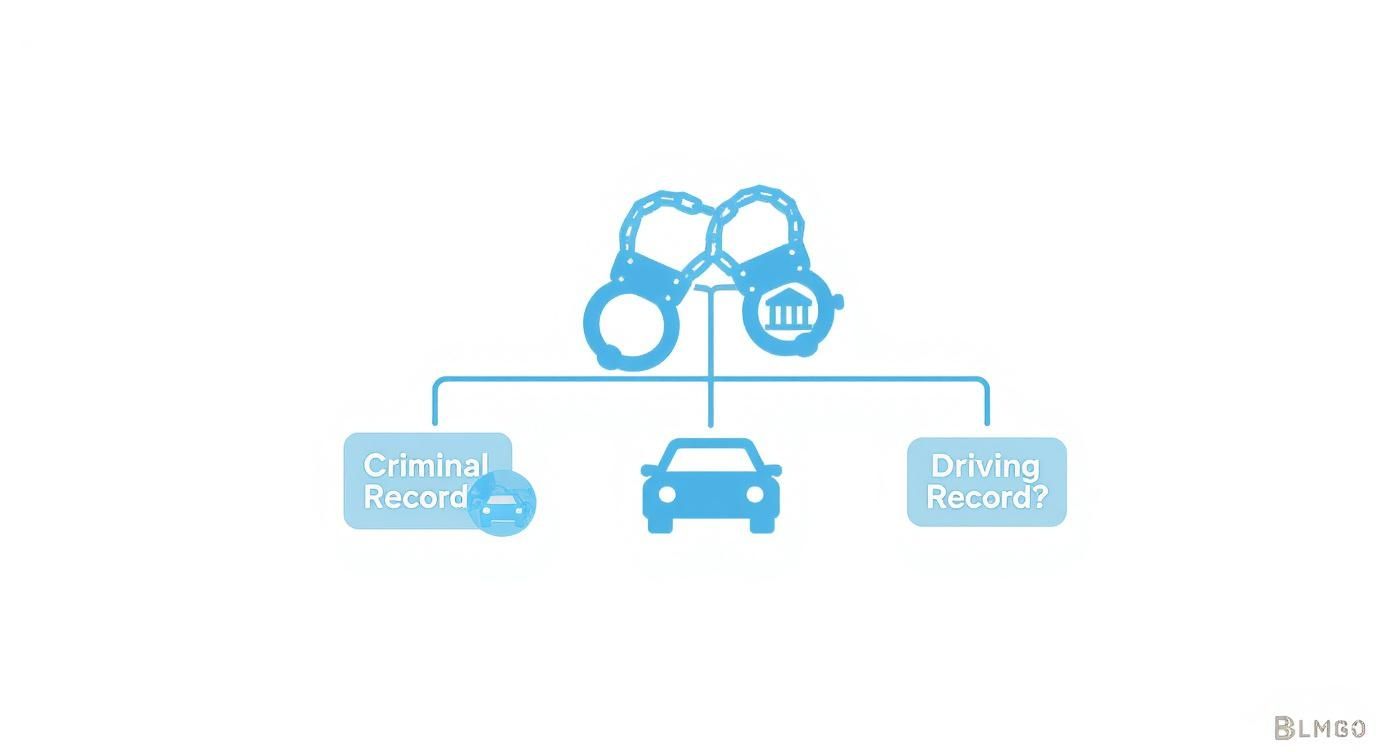
This diagram gets to the heart of the problem: a DWI creates two distinct headaches—one for your criminal history and another for your driving privileges. Each needs its own strategy.
Nondisclosure: Sealing Your Record from Public View
What if you were convicted? For some first-time DWI offenders, an Order of Nondisclosure offers a way forward. Unlike an expunction that destroys the record, a nondisclosure seals it from public view. This means private employers, landlords, and others won't see it during a background check.
An Order of Nondisclosure hides your past mistake from the very people who might hold it against you. It keeps the record confidential, accessible only to law enforcement and certain government agencies.
To qualify for a nondisclosure, you must meet several key criteria. It is generally an option for a first DWI in Texas if you:
- Did not have a blood alcohol concentration (BAC) of 0.15 or higher.
- Were not involved in an accident that injured someone else.
- Successfully completed your probation, including all required classes, fines, and community service.
Once probation is done, you still have to wait. For most first-time DWI offenses, the waiting period is two years. However, if you had an ignition interlock device on your vehicle for at least six months as part of your sentence, the waiting period might be shorter.
Expunction vs. Nondisclosure for a Texas DWI
It's easy to confuse these two remedies. This table breaks down the key differences to help you see which path might apply to your situation.
| Feature | Expunction (Record Destruction) | Order of Nondisclosure (Record Sealing) |
|---|---|---|
| Eligibility | Case was dismissed, acquitted (not guilty), or you completed a pretrial diversion. | Convicted of a first-time DWI (with specific limitations) and successfully completed probation. |
| What Happens | All records of the arrest and case are physically destroyed. | Records are sealed from the public but remain accessible to law enforcement and certain agencies. |
| Legal Status | You can legally deny the arrest ever happened. | You cannot deny the arrest or conviction if asked under oath, but it won't appear on public background checks. |
| Best For | Individuals whose cases ended favorably, without a conviction. | First-time offenders who were convicted but meet strict criteria (e.g., BAC below 0.15). |
Ultimately, an expunction offers a true clean slate, while a nondisclosure provides a crucial layer of privacy that lets you move on with your life.
Which Path Is Right for You?
The choice between an expunction and a nondisclosure depends entirely on the outcome of your DWI case. A smart legal strategy begins the moment you're arrested, aiming for an outcome—like a dismissal or an acquittal—that opens the door to an expunction.
Because the eligibility rules and waiting periods can be complex, determining your best path forward is something you should do with a skilled DWI lawyer. For a much deeper look at the process, you can learn more about whether a Texas DWI can be expunged in our complete guide. An experienced attorney can pull your records, explain your exact options, and walk you through every step of clearing your name.
The Real-World Consequences of a DWI Record
A DWI charge creates ripples that go far beyond a courtroom. While the immediate worries are fines and potential jail time, the long-term fallout from a conviction can quietly sabotage your life for years to come.
Understanding these hidden challenges shows why a proactive, strategic legal defense is so critical from day one. A DWI on your permanent criminal record is a major red flag that can turn routine parts of life into major hurdles. This isn't just about the past; it's about the doors that can close in your future.
Professional and Career Obstacles
For many Texans, a DWI conviction is a direct threat to their livelihood. A blemish on your record can create professional barriers that are incredibly tough to overcome.
- Professional Licenses: If you are a nurse, teacher, pilot, lawyer, or hold another state-issued professional license, a DWI conviction can trigger a review by your licensing board. This could lead to suspension, probation, or even revocation of the license you worked so hard to obtain.
- Employment Background Checks: The vast majority of employers now run background checks. A DWI conviction can disqualify you from jobs that involve driving, handling sensitive information, or working with vulnerable people. It can even prevent you from getting jobs that have nothing to do with driving.
- Commercial Driver's Licenses (CDL): For truck drivers and other commercial operators, a DWI is often a career-ender. A first offense triggers a one-year CDL disqualification. A second one? A lifetime ban.
These professional consequences can lock you out of your chosen career, forcing you to start over. It drives home the point that the effort to fight DWI Texas isn't just about avoiding jail—it's about protecting your ability to provide for yourself and your family.
Financial and Personal Burdens
The financial strain from a DWI record doesn't stop with court fines. The conviction kicks off a chain reaction of escalating costs and personal roadblocks that can create immense pressure.
One of the most painful financial hits comes from your auto insurance company. After a DWI, you can expect your premiums to skyrocket. Insurers will label you a high-risk driver, often forcing you to get a special, more expensive SR-22 insurance policy just to remain legal on the road. This financial penalty can last for three to five years, costing you thousands of extra dollars.
A DWI conviction is more than a legal problem; it’s a financial and logistical challenge. The costs pile up quickly, from inflated insurance rates to the fees for ignition interlock devices, creating a cycle of financial stress.
The consequences don't stop there. A DWI record can impact other major life decisions. Landlords and mortgage lenders often run background checks, and a conviction can lead to a denied rental application or a rejected home loan. Even international travel can become a problem; Canada, for example, considers a DWI a serious felony, and you will likely be turned away at the border.
These are not minor inconveniences. They are significant, long-lasting roadblocks that impact your freedom, finances, and future. A skilled Houston DWI lawyer can help you grasp the full scope of what’s at stake and build a defense designed to minimize these devastating real-world consequences.
Protecting Your Driver's License After an Arrest

When you're arrested for a DWI, your mind probably jumps straight to the criminal charges and potential penalties. But there's another, more immediate battle you need to fight—and it has nothing to do with the criminal court system.
This fight is a civil process run by the Texas Department of Public Safety (DPS) aimed at suspending your driver's license. It's called the Administrative License Revocation (ALR) process, and it moves at lightning speed.
From the moment of your arrest, a clock starts ticking. You have exactly 15 days to request an ALR hearing to challenge the state's attempt to take your license. If you miss this deadline, your license is automatically suspended. Acting fast isn't just a good idea; it's the only way to protect your right to drive.
The Power of Implied Consent
How can the state suspend your license before you are even convicted of a crime? It all comes down to a legal concept called “implied consent.” In Texas, the simple act of driving on a public road means you have automatically agreed to provide a breath or blood sample if an officer lawfully arrests you for DWI.
You still have the right to refuse the test, but that refusal comes with its own immediate consequences. The state views it as a breach of your "implied consent," which triggers an automatic license suspension, regardless of the outcome of your criminal case.
The same happens if you take the test and your blood alcohol concentration (BAC) is 0.08% or higher. The DPS will move to suspend your license in that situation as well. This is precisely why the ALR hearing is so critical—it's your first and often best chance to fight back against a DWI license suspension.
The ALR hearing is more than just a chance to save your license. It's a strategic opportunity. A skilled attorney can use this hearing to question the arresting officer under oath, exposing weaknesses in the state's case that can be used to your advantage in the criminal trial.
What Happens at an ALR Hearing
An ALR hearing is a mini-trial, though less formal than a criminal court proceeding. The burden is on the DPS to prove that the officer had reasonable suspicion for the traffic stop and probable cause for the arrest. They also must show you either refused the chemical test or failed it.
This is where a good defense attorney can make a significant impact. We have the chance to get the arresting officer on the record, challenge the reason for the stop, and question every step of the breath or blood testing procedure. Winning the ALR hearing not only prevents your license from being suspended but can also create major problems for the prosecutor in your criminal case.
Potential License Suspension Periods
The length of the suspension you face depends on whether you refused or failed the test and if you have any prior DWI offenses.
- Failed Test (BAC ≥ 0.08%): A first-time offense carries a 90-day suspension.
- Refused Test: Refusing the test for the first time results in a much stiffer penalty: a 180-day suspension.
These timeframes increase significantly for any subsequent offenses, making an immediate, strategic defense essential.
Securing an Occupational Driver’s License
Even if your license is suspended, you are not necessarily stranded. An experienced lawyer can petition the court for an Occupational Driver's License (ODL).
An ODL is an essential-needs license. It is not a full reinstatement, but it grants you limited driving privileges so you can get to and from work, take your children to school, or run essential household errands. While you can only drive during specific hours and in certain areas, an ODL is a lifeline that keeps your world from grinding to a halt while we continue to fight the criminal charges.
It’s Time to Take Back Your Future
A DWI arrest can throw your entire world off-balance, leaving you feeling lost and unsure of what comes next. It’s a stressful experience, but remember this: an arrest is not a conviction. You have rights and options, and you don’t have to figure this out on your own.
A DWI conviction in Texas stays on your criminal record forever—unless you fight back with the right legal strategy. We've discussed powerful tools like expunctions and orders of nondisclosure, which are the only ways to completely clear or seal your record. Achieving these outcomes depends on a strong defense built from day one. That’s why moving fast is your biggest asset, especially with that unforgiving 15-day deadline to request an ALR hearing to save your driver’s license.
Your Case Is Not Like Anyone Else’s
No two DWI arrests are the same. The details—the reason for the traffic stop, how field sobriety tests were administered, the officer's report—can change everything. Your case deserves a defense built specifically for you. The goal is to protect your rights and minimize the long-term damage before it starts.
You can move forward from this. The first step is getting a skilled legal advocate in your corner who knows the Texas DWI system inside and out. A sharp Houston DWI lawyer will analyze the evidence, challenge the prosecution’s case, and guide you toward the best possible outcome.
Don't let this one moment define the rest of your life. The actions you take right now can fundamentally change the outcome of your case and protect your future.
We invite you to contact The Law Office of Bryan Fagan, PLLC for a free, confidential consultation. Let's start building your defense and taking back control of your story.
Got Questions About Your DWI Record? We Have Answers.
When you're dealing with the fallout from a DWI arrest, the questions can feel endless. To help you find clarity, here are straightforward answers to the questions we hear most from Texans in your situation.
My DWI Case Was Dismissed. Is It Off My Record Automatically?
This is a major misconception. No, a dismissed DWI charge does not automatically disappear from your record in Texas. The arrest, mugshot, and charge will still appear on public background checks until you take legal action to remove them.
To truly wipe the slate clean, you must file a Petition for Expunction. An expunction is a court order to destroy all government records of the arrest, making it as if it never happened. This is a critical final step to reclaim your good name after a favorable outcome in court.
How Badly Does a DWI Mess Up a Commercial Driver's License?
For anyone with a Commercial Driver's License (CDL), a DWI is a career-ending threat. The penalties are dramatically harsher than for a standard driver's license.
- A first DWI conviction means a one-year disqualification of your CDL. If you were hauling hazardous materials, that period increases to three years.
- A second DWI conviction results in a lifetime disqualification. Your career as a commercial driver is over.
Because the stakes are this high, CDL holders must fight a DWI charge aggressively from the start. Retaining a skilled Texas DUI attorney immediately is non-negotiable.
A DWI conviction can be financially devastating for a professional driver. Protecting your CDL isn't just about protecting your license; it's about protecting your entire livelihood. A strategic legal defense is an absolute must.
Can I Still Travel to Canada with a DWI on My Record?
Many people are shocked to learn that a DWI conviction can get them barred from international travel. Our neighbor to the north, Canada, is particularly strict.
Under Canadian law, a DWI is considered a serious criminal offense, comparable to a felony. Because of this, you will most likely be deemed "criminally inadmissible" and turned away at the border. While you can apply for special permission through a Temporary Resident Permit or Criminal Rehabilitation, the process is difficult, expensive, and offers no guarantee of success. It’s one of the long-term consequences that shows how a DWI can limit your freedom for years after the case is closed.
A DWI arrest can feel like a heavy weight, but you have the power to fight for your future. The most important thing you can do is act fast and get an experienced legal advocate in your corner. At The Law Office of Bryan Fagan, PLLC, our team is here to defend your rights and work tirelessly to minimize the long-term damage of a DWI charge. We offer a free, confidential case evaluation to go over your situation and start building a defense. Contact us today and take that first step toward protecting your record and your future.

