
After a Texas DWI arrest, your first criminal court date is often 20 to 60 days later, while your deadline to protect your license is much faster: you have only 15 days to request an ALR hearing. That's why the right answer to how long after a DWI arrest is court in Texas is this: you're dealing with two separate clocks, and the license clock expires first.
A DWI arrest can be overwhelming, but you don't have to face it alone. Individuals often leave jail thinking the next big event is court. In Texas, that's usually wrong. The first deadline that can hurt you is often administrative, not criminal.
If you were arrested, released, and sent home with paperwork in your hand, you need to treat that paperwork like a legal timer. Your case may not reach criminal court for weeks, and felony cases can take even longer, but your chance to fight a DWI license suspension can disappear quickly. That's where strategy starts.
Your First Question After a DWI Arrest
You probably want one clean answer. “When is court?”
Texas doesn't make it that simple. After a DWI arrest, there usually isn't one timeline. There are two. One is for your driver's license. The other is for the criminal charge.
The two clocks that matter
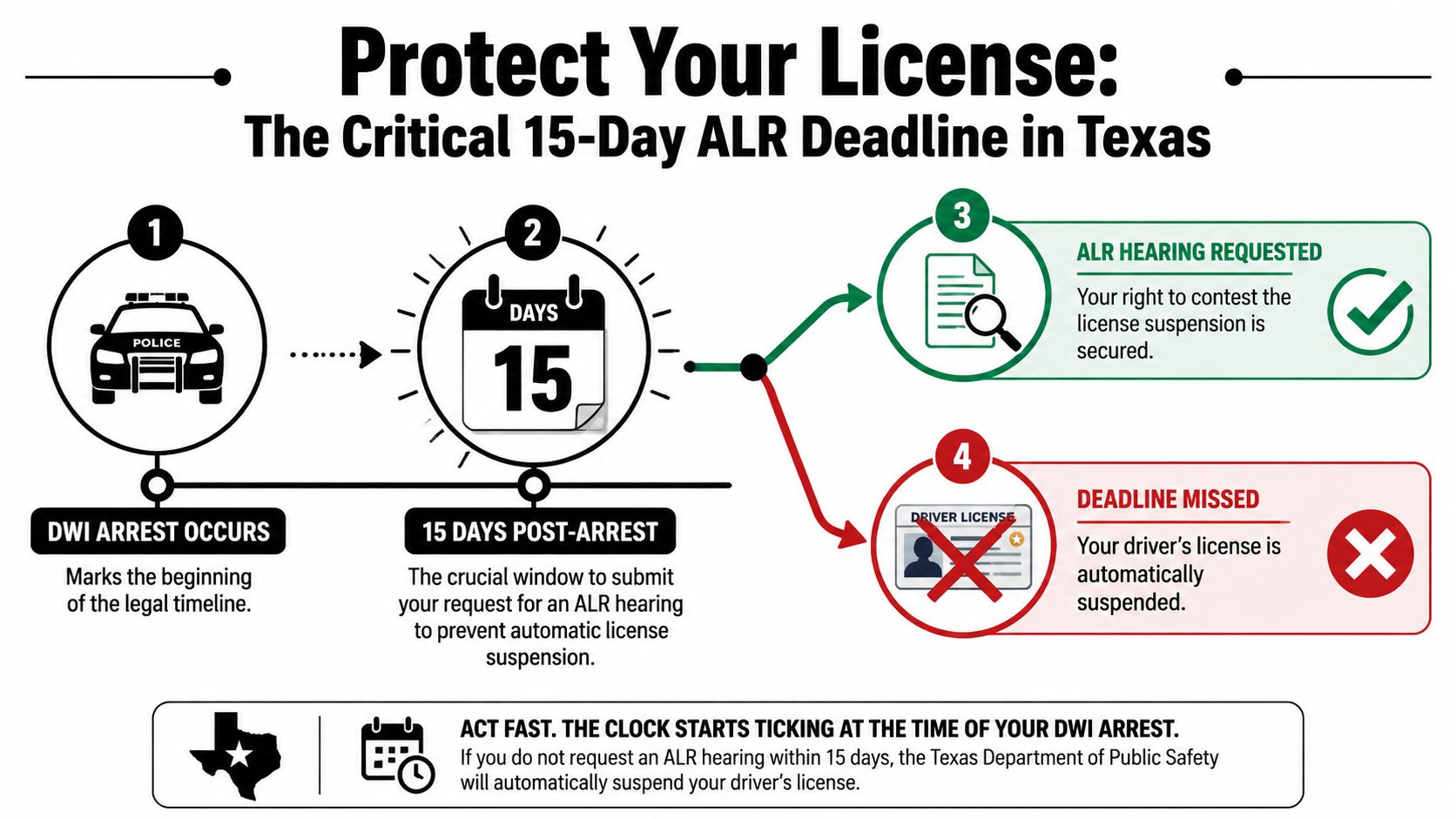
The first clock is the administrative license suspension process. This is the civil side of your case, often called the Administrative License Revocation, or ALR, process. If you want to fight the suspension of your license, you have only 15 days to request a hearing, as explained in this discussion of the Texas DWI court process.
The second clock is the criminal case. That court date usually comes later. For many misdemeanor cases, the first criminal appearance lands weeks after arrest, not the same day and not immediately.
Practical rule: Don't wait for the court notice before you act. By then, the most urgent deadline may already be gone.
That difference matters because people often relax once they get out of jail. They assume they'll deal with everything when court arrives. That's a mistake. If you miss the ALR deadline, your license problem can move forward even while the criminal case hasn't really started.
Key terms you should understand now
A few terms show up early in almost every Texas DWI case:
- BAC: Short for blood alcohol concentration. It refers to the amount of alcohol measured in your blood or breath.
- Implied consent: In Texas, by driving on public roads, you're considered to have agreed to provide a breath or blood specimen under the state's DWI laws in certain circumstances. Refusing can trigger license consequences.
- Field sobriety test: These are roadside balance and coordination exercises officers use during a DWI investigation.
- Administrative license suspension: This is the state's process for suspending your license apart from the criminal case.
If you keep those terms straight, the process gets less confusing fast. You don't need to know everything today. You do need to know which deadline comes first and why that changes what you should do next.
The First 48 Hours Magistration and Getting Out of Jail
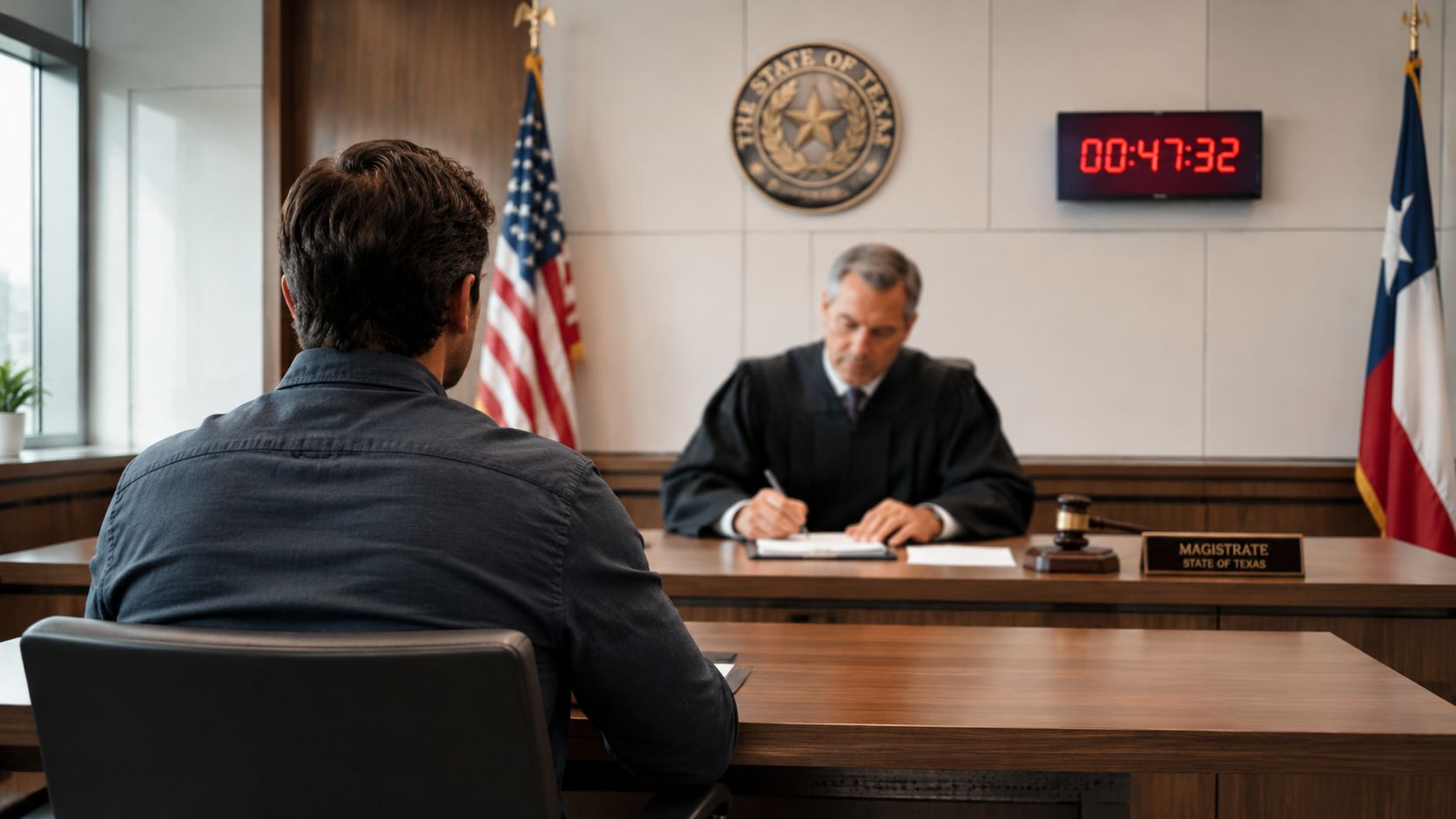
The first court-like event after a DWI arrest usually isn't your real DWI court date. It's magistration.
Under the Texas DWI timeline described in the verified material, a person arrested must be brought before a magistrate within 48 hours for bail and conditions. That appearance is about release, rights, and restrictions. It is not your trial date, and it is not the first setting where the case gets fully litigated.
What magistration actually does
At magistration, the magistrate generally handles a few basic things:
- Advises you of the charge: You're told what offense the State says you committed.
- Addresses your rights: That includes your right to a lawyer.
- Sets bail or bond conditions: This controls whether and how you get out of jail.
If you want a useful breakdown of that early stage, read about the first 24 hours after a DWI arrest in Texas.
Bail and bond in plain English
People use bail and bond like they mean the same thing. They're related, but not identical.
Bail is the amount or condition the court sets for your release. Bond is the mechanism used to secure that release. Sometimes that means cash. Sometimes it means a bond company. Sometimes there are added rules, such as not drinking, checking in, or avoiding new arrests.
What matters to you is simple. Getting released doesn't mean the case is moving fast. It just means you're no longer sitting in jail while the process starts.
Magistration is a holding point, not the main event. Don't confuse “I saw a judge” with “my DWI court date has happened.”
What you should do right after release
Once you're out, focus on control.
- Read every paper you were given. The Notice of Suspension can matter more than your court paperwork in the first days.
- Write down what happened. Traffic stop. Questions asked. Tests requested. Statements made. Small details fade quickly.
- Stop talking about the case casually. Friends, coworkers, and social media don't help your defense.
- Get legal advice early. The defense work starts before the first criminal setting.
That first 48-hour window is mostly procedural. But what you do immediately after release can shape both your license case and your criminal defense.
Your Most Critical Deadline The 15 Day ALR Hearing Request
If you remember only one thing from this article, remember this: the ALR deadline is not optional.
When police arrest someone for DWI in Texas, the license issue can start moving before the criminal case gets to court. To fight an automatic suspension, you must request an Administrative License Revocation hearing within 15 days of receiving the suspension notice, and if you miss that deadline, the suspension takes effect on the 40th day after arrest, even if the criminal case is still pending, according to this explanation of Texas ALR hearings.
What ALR means for your real life
The ALR case is separate from the criminal DWI prosecution. That's why people get blindsided. They think, “I haven't even been to court yet, so nothing major can happen.” Meanwhile, the State is already moving on the license side.
If you drive to work, take children to school, attend classes, or care for family members, this deadline has teeth. Missing it can create problems long before a prosecutor is ready to discuss the criminal charge.
What to do before the 15 days run out
Act in order:
- Find the Notice of Suspension: This is often the document that starts the ALR clock.
- Confirm the service date: The deadline runs from when you received the notice.
- Request the hearing quickly: Waiting until the last moment is sloppy lawyering and bad self-defense.
- Preserve every document: Keep the notice, bond paperwork, and any temporary driving paperwork together.
A more detailed look at how hearing decisions can turn on procedural issues appears here: ALR hearing officer discretion in Texas.
Here's a short explanation of the process that many drivers find helpful:
Why defense lawyers push this immediately
An ALR hearing isn't just about keeping you on the road. It can also give your lawyer an early chance to evaluate the stop, the arrest, and the officer's version of events. That makes it strategically important.
You should also know what implied consent means here. In Texas, driving on public roads comes with legal consequences tied to requests for breath or blood testing. Those consequences can affect your license even apart from what happens in criminal court.
The State doesn't wait for your anxiety to settle down. The deadline runs whether you feel ready or not.
If you're searching “how long after a DWI arrest is court Texas,” the practical answer is this: court may be later, but your first fight starts now. Protecting your license is often the first move in a serious defense plan.
The Criminal Court Timeline What to Expect and When
You can do everything right on the 15 day license deadline and still feel blindsided when the criminal court side moves slowly. That is normal in Texas DWI cases. The two clocks do not move together. The ALR clock starts fast. The criminal court clock usually takes longer to show itself.
For many misdemeanor DWI cases, the first criminal court setting does not happen immediately after arrest. Prosecutors often wait to review police reports, video, breath records, or blood evidence before pushing the case into regular court settings. If your case involved a blood draw, that wait can stretch because the State usually wants lab results before it decides how to proceed. A more detailed timeline of a DWI case in Texas from arrest to trial shows how that process usually unfolds.
Silence from the court does not mean the case disappeared.
Why the criminal case often feels slow
Clients expect a quick court date because the arrest felt immediate and aggressive. Court is different. The State works on its own schedule, and that schedule often turns on evidence review, filing decisions, and local court backlog.
In a misdemeanor case, the first appearance is often an arraignment or first setting. In a felony case, the path is usually slower because the case may need to go through indictment before regular district court settings begin. That slower pace feels frustrating, but it also gives your lawyer time to get ahead of the evidence instead of reacting at the last second.
What arraignment actually means
Arraignment is the formal start of the criminal court process. You are told the charge, the court confirms basic case information, and the case gets set on a path for pretrial hearings, motions, negotiations, or trial.
It is an important date. It is rarely the decisive one.
The real work usually happens before and after that first setting. A strong defense starts with early investigation, records requests, video review, witness review, and testing challenges. If your lawyer waits for arraignment to start digging, your lawyer is already behind.
Misdemeanor and felony DWI do not move at the same speed
| Event | Typical Misdemeanor DWI Timeline | Typical Felony DWI Timeline |
|---|---|---|
| First criminal appearance | Often weeks after arrest, once the case is reviewed and set | Often later, especially if indictment is required before settings begin |
| Main reason for delay | Evidence review, filing decisions, and lab results | Grand jury process, more extensive review, and higher-stakes charging decisions |
| Early case posture | Arraignment, then pretrial settings, motions, and negotiation | Indictment first in many cases, then district court settings and pretrial litigation |
| Overall case length | Often several months | Often many months, sometimes longer |
The waiting period is still part of your defense
A quiet docket can make people freeze. Do not make that mistake. The criminal court clock may be slower than the license clock, but it still demands action.
Your lawyer should be using this period to attack the case early:
- Review the stop: The officer needed a lawful reason to pull you over.
- Examine probable cause: An arrest still has to be supported by facts, not vague suspicion.
- Scrutinize the testing: Blood and breath cases rise or fall on procedure, machine records, chain of custody, and interpretation.
- Challenge field sobriety evidence: These tests are often subjective, and officers routinely overstate what they show.
Some cases get filed quickly. Some take much longer than clients expect. Either way, your strategy should stay the same. Handle the fast license clock first, then use the slower criminal court clock to build pressure on the State instead of sitting around worrying.
The State uses time to build its case. Your defense should use that same time to weaken it.
If you are waiting on a court date, stay reachable, keep every document, follow bond conditions exactly, and keep working with counsel. Fear makes people passive. Good results usually come from early, organized action.
Putting It All Together DWI Calendar Scenarios
Timelines make more sense when you see them as real life instead of legal jargon. These examples stay within the proven Texas timing ranges and show how the two clocks can unfold differently.
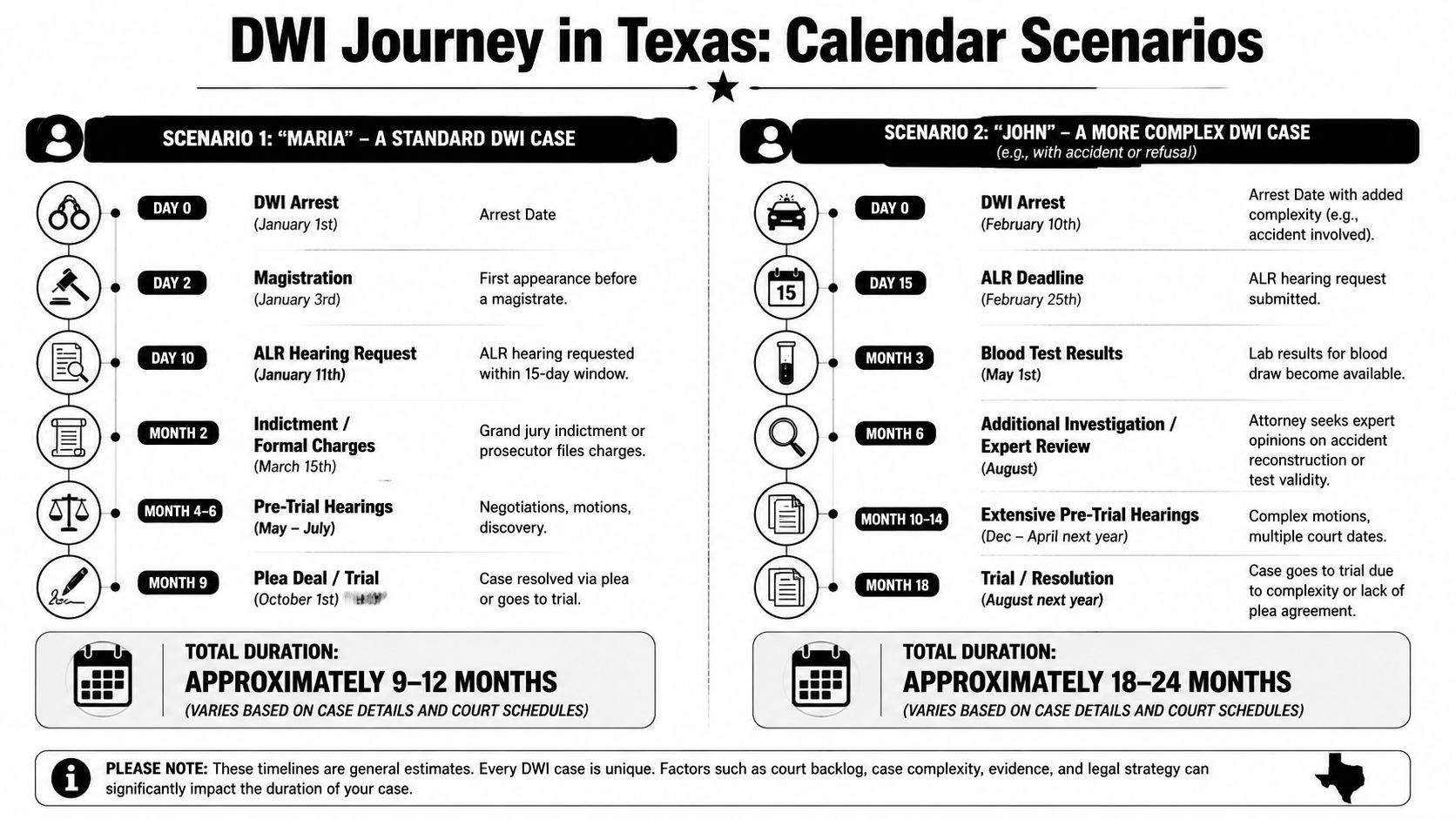
Scenario one Maria and the misdemeanor track
Maria is arrested for an alleged misdemeanor DWI and released shortly after the initial jail process. She gets home and sees a Notice of Suspension in her paperwork. She doesn't have a criminal court date yet.
Within the first 15 days, she requests the hearing needed to fight the license suspension. That protects her position on the administrative side while the criminal side is still catching up.
Her first criminal court setting arrives later, inside the common misdemeanor window described earlier. That feels slow to her, but it's normal. The prosecutor is still dealing with evidence review before pushing the case forward.
Maria's calendar looks something like this:
- Right after arrest: Release conditions, paperwork, and immediate confusion
- Within 15 days: ALR hearing request submitted
- Weeks later: First criminal court setting arrives
- Months after arrest: Pretrial work continues, including evidence review and negotiation
This is the most common pattern. Fast license pressure. Slower criminal scheduling.
Scenario two David and the felony track
David's case is more serious. The criminal side doesn't move on the misdemeanor schedule because felony DWI cases can take a few months before first court dates are issued, based on the verified Texas timeline material tied to indictment and filing procedures.
He still has the same early pressure on his license. That part doesn't wait just because the felony court process is slower.
The criminal case, however, can sit in review while the State waits on lab work, considers the charge level, and moves through the indictment process. David may spend a long stretch hearing very little, then suddenly receive notice that the case is moving.
The early silence in a felony DWI case often means procedure is still unfolding behind the scenes. It does not mean the danger passed.
What these examples should tell you
Both Maria and David face the same core truth. The first move isn't waiting for court. The first move is getting organized and defending the license side while preparing for the criminal case.
If you're trying to fight DWI Texas charges effectively, think like this:
- Handle the urgent deadline first.
- Preserve facts and paperwork while memories are fresh.
- Prepare for a criminal timeline that may be slower than you expected.
That approach gives you control. It also keeps you from making the most common mistake after a DWI arrest, which is doing nothing because the first criminal court date hasn't shown up yet.
Your Strategic Next Steps to Protect Your Future
You do not need to guess what happens next. You need a plan for both clocks.
The first clock is fast and unforgiving. It controls your license. The second clock is slower and often frustrating. It controls the criminal case. If you treat this like a one-date problem, you give up ground on both sides.
A good lawyer gets to work before the court process feels active. That means protecting the license deadline, securing police paperwork and video, checking whether the stop and arrest hold up, and stopping you from making mistakes that hand the State extra evidence. That is what a Houston DWI lawyer or Texas DUI attorney should be doing right away.
What to do today
Start with the steps that preserve control.
- Collect every document: Keep the notice you received after arrest, bond papers, towing paperwork, release forms, and any court paperwork in one place.
- Write down your facts now: Record where you were, what you drank, when you stopped drinking, when you were pulled over, what the officer said, and what tests were requested or refused.
- Stop talking about the case: Do not explain it to friends, coworkers, or on social media. Those statements can come back against you.
- Call a lawyer early: Early action gives your lawyer a better chance to protect your license and shape the defense before the file hardens against you.
Waiting creates problems that are hard to fix later. Video can disappear. Details fade. Deadlines pass. The State keeps building its case whether you feel ready or not.
The bigger point is simple. Silence from the court does not mean your case is gone. It means you still need to be ready for a filing decision, a court notice, license issues, work problems, and background concerns while the criminal side moves at its own pace.
If you are worried about a first DWI in Texas, trying to understand DWI license suspension, or looking for a serious Houston DWI lawyer, stop waiting for clarity to arrive on its own. Get a strategy for the 15-day license clock and the slower court clock now.
If you were arrested for DWI in Texas, the next smart step is to speak with Law Office of Bryan Fagan, PLLC for a free consultation or case evaluation. The firm helps Texans fight DWI charges, protect their licenses, challenge weak evidence, and build a defense from the first days after arrest through court.