
A DWI arrest can be overwhelming, but you don't have to face it alone.
You may be sitting at your kitchen table right now, staring at bond paperwork, replaying the traffic stop, and asking the same question every licensed professional asks after an arrest: Will I lose my job, my license, or both? That fear is real. If you're a nurse, teacher, lawyer, real estate agent, pilot, physician, or commercial driver, a DWI is more than a criminal case. It can become a threat to the career you spent years building.
The good news is that panic is not a strategy, and you still have options. In Texas, the smart move is to treat this as two problems at once. You need to defend the DWI itself, and you need to protect your professional standing before your licensing board, employer, or both. If you move quickly and make careful decisions, you can often put yourself in a much stronger position than you think.
Your Career, Your Future Navigating a DWI in Texas
The arrest usually happens fast. The consequences don't.
One minute you're driving home after dinner, a work event, or a late shift. Then come the lights, the roadside questions, maybe field sobriety testing, maybe a request for a breath or blood sample, and then the booking process. By the next morning, your criminal case has started, your driver's license may already be at risk, and your mind has jumped straight to your profession.

For most professionals, the first shock isn't jail. It's exposure. You worry about renewal forms, reporting rules, hospital privileges, district policies, firm management, client trust, and whether an arrest will show up the next time someone runs your record. If that's where your head is, read this guide on how a DWI can affect your background check in Texas.
Your case is bigger than the court date
A lot of people make the same mistake. They assume the DWI charge is the whole fight.
It isn't. If you hold a professional credential, your real problem may be the chain reaction that follows the arrest. The criminal court decides one set of issues. Your licensing board may review another. Your employer may make its own decision on top of that.
Practical rule: If your income depends on a license, don't make criminal-case decisions without thinking about board consequences.
You need a plan, not damage control
When people are scared, they tend to do one of two things. They either freeze and miss deadlines, or they over-explain to everyone around them and create new problems.
Neither helps.
A strategic response starts with a simple mindset:
- Protect the driving issue early: If your ability to commute matters, the license side of the case needs attention immediately.
- Protect the record: The criminal outcome often drives what happens next with your profession.
- Protect your disclosures: Saying too much, too soon, or to the wrong person can complicate a board review.
- Protect your credibility: Honest, careful, timely action matters. Sloppy reporting and inconsistent explanations hurt.
For how a DWI affects professional licenses Texas, a clear answer is frequently sought. Here it is. A DWI can threaten your license, but it doesn't automatically end your career. What matters is how fast you act, what your board requires, and whether your defense is built around both your freedom and your livelihood.
The Two Battles You Must Fight DWI and Your Professional License
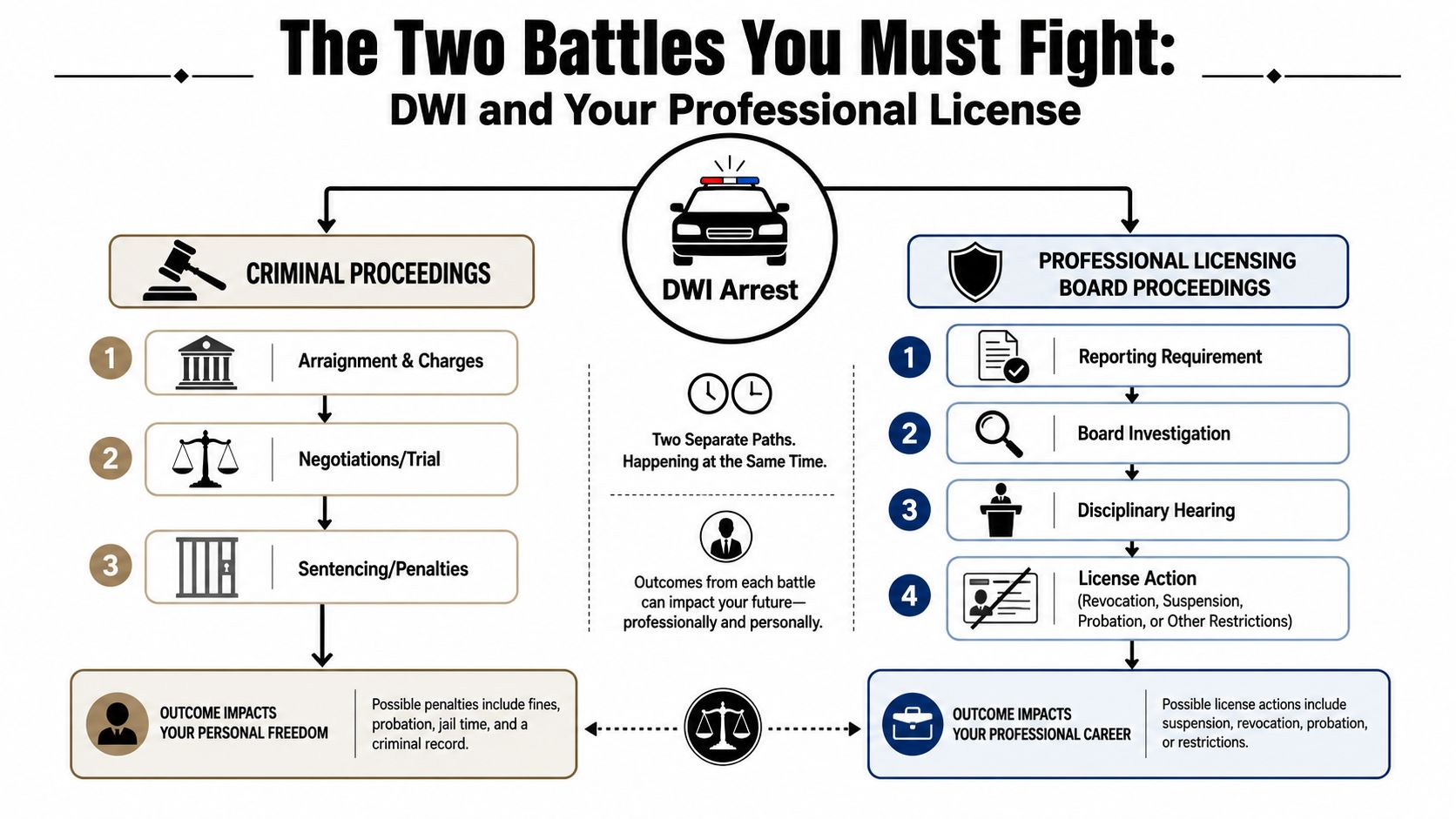
A Texas DWI often creates two separate legal fights running at the same time. If you don't understand that early, you can win ground in one case and still get blindsided in the other.
The criminal case and the license case are not the same
The first battle is the criminal DWI case. That's the prosecution in court. It deals with whether the state can prove intoxication, whether the stop was lawful, whether testing was reliable, and what the final outcome will be.
The second battle is the license review process. Part of that can involve your regular driver's license through the state's administrative process. Part of it can involve your professional board, which may review the arrest, charge, conviction, or underlying conduct depending on that board's rules.
Texas practitioner guidance notes that a DWI can trigger two separate licensing pathways with different technical standards: an administrative driver's-license action through DPS and ALR, and a professional-board review under Occupations Code §53.021. That same guidance explains that boards look beyond the label of the offense and examine whether it directly relates to the duties of the profession, how serious it was, and how much time has passed. It also notes that some medical professionals may seek a Criminal History Evaluation Letter from their board. You can read that summary in this discussion of how a Texas DWI can affect your professional license.
Key terms you need to understand fast
If you're overwhelmed, start here.
- BAC: This means blood alcohol concentration. It refers to the amount of alcohol measured in your breath or blood.
- Implied consent: In Texas, by driving on public roads, you're considered to have consented to a breath or blood test request after a lawful DWI arrest. Refusing testing can create separate consequences, especially for driving privileges.
- Field sobriety test: These are roadside tasks officers use to claim they observed impairment. They are not the same thing as a breath or blood test.
- Administrative license suspension or ALR: This is the separate process that can affect your driver's license after a DWI arrest. It is not the criminal trial.
What usually happens after arrest
Here is the practical sequence most professionals need to track:
Arrest and booking
You may be released on bond with conditions. Read those conditions carefully. Alcohol monitoring, travel limits, and check-ins can matter for work.ALR deadline starts running
If your driver's license is at risk, you may need to request a hearing quickly to challenge the suspension.Criminal case begins
Court dates start. Your attorney reviews the stop, police reports, video, testing, and possible defenses.Reporting question arises
You must determine whether your board, employer, or credentialing body requires disclosure of the arrest, the charge, or only a final conviction.Board review may begin now or later
Some boards act after a conviction. Others may investigate based on conduct, pending charges, or reporting failures.
The biggest mistake professionals make is assuming they can “deal with the license issue later.” Later is often too late.
One result does not control the other
You can beat the ALR case and still face board scrutiny. You can negotiate a criminal result and still have to explain it to your licensing authority. You can avoid immediate board action and still run into trouble at renewal if you answer disclosures carelessly.
That's why a smart Houston DWI lawyer or Texas DUI attorney doesn't look only at the criminal file. The defense has to line up with your reporting duties, your job duties, and your long-term record strategy if you want to fight DWI Texas in a way that protects your career.
How Texas Licensing Boards Evaluate a DWI Conviction
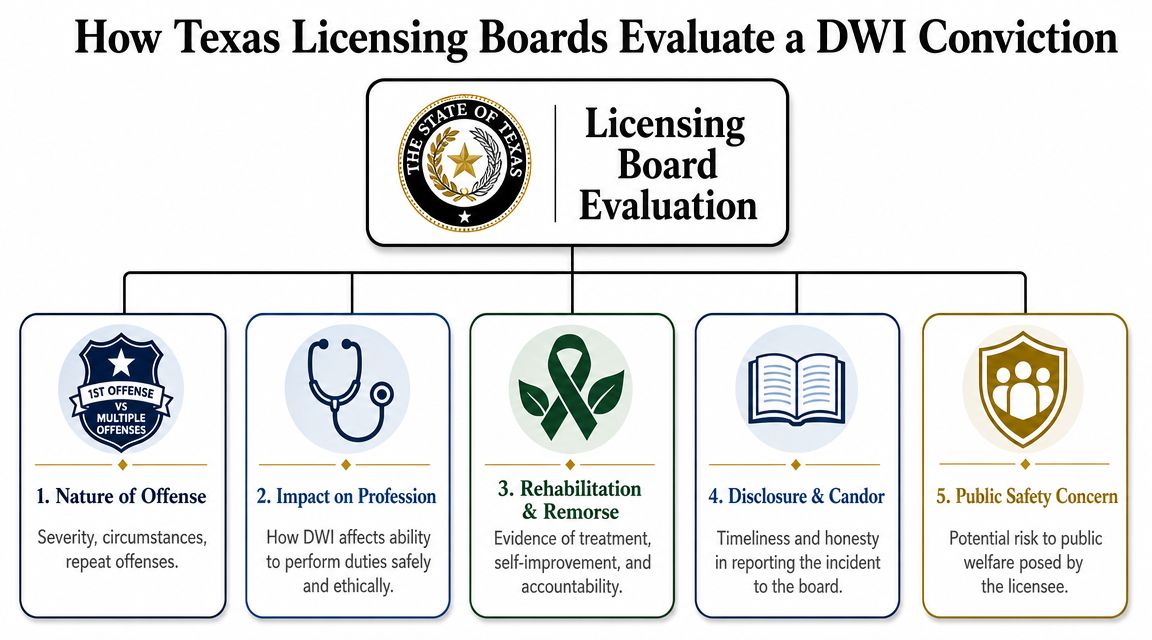
Texas boards usually don't treat a DWI as an automatic lifetime ban for non-CDL licenses. They use a review framework. That matters because a framework can be argued. It isn't random, and it isn't purely emotional.
The four factors that drive most reviews
The Texas Department of Licensing and Regulation says it weighs four core factors in a criminal-conviction review: the nature and seriousness of the crime, how closely the crime relates to the licensed occupation, whether the license would create an opportunity for similar criminal conduct, and the relationship between the crime and the applicant's fitness to perform the job. TDLR also explains that sanctions can include suspension, probation, public reprimand, or permanent revocation, and many boards require disclosure of convictions. Review the framework in TDLR's guidance on criminal conviction guidelines for licensing.
That framework is the black box you need to understand. Boards ask whether your DWI says something meaningful about your fitness, judgment, honesty, safety, or reliability in the specific role you hold.
What the direct-relation question really means
A board usually wants to know whether the conduct connects to the job.
For a desk-based profession with no patient contact, no public safety role, no controlled substances, and no driving duties, the connection may be weaker. For a nurse, physician, pilot, teacher, or anyone in a public-trust role, the board may see stronger relevance. If your work involves transportation, vulnerable people, medication access, or fiduciary duties, scrutiny often gets sharper.
That's why two people with the same DWI charge can face very different licensing consequences.
What boards care about: not just what happened, but what the incident suggests about your ability to do your work safely and ethically.
The board also studies your response
The underlying event matters. Your conduct after the event matters too.
Boards notice whether you disclosed when required, whether your explanation is consistent with the court record, whether you accepted appropriate responsibility, and whether you took reasonable steps to address any concern the incident raises. Silence can hurt. So can rushed over-disclosure that admits things the state hasn't proven.
If you need practical guidance on timing and wording, this guide on reporting a DUI to a Texas licensing board is a useful starting point.
Sanctions vary because facts vary
A lot of anxious professionals want a yes-or-no answer. Will the board suspend me or not?
That's not how these cases work. A board may decide on no action. It may issue a reprimand. It may place you on probation, impose restrictions, suspend your license, or seek revocation. The outcome often turns on three things:
- How closely the incident relates to your duties
- Whether there are aggravating facts
- How well your legal response is coordinated
If your defense lawyer treats the DWI like a standard traffic-adjacent misdemeanor and ignores the licensing angle, that's a problem. The board file should be shaped from the start, not cleaned up after the criminal case is over.
A Closer Look A DWI Impact on Specific Texas Professions
Different licenses carry different risk. That's why broad internet advice is often useless. A truck driver and a real estate agent don't face the same consequences. A nurse and an attorney don't answer to the same board. A teacher may have school-district reporting issues on top of certification issues.
Side-by-side comparison
| Profession / License | Governing Board | Typical Reporting Obligation | Potential Sanctions |
|---|---|---|---|
| Nurse or other healthcare professional | Profession-specific healthcare board | Often depends on charge status, conviction status, renewal questions, and board-specific rules | No action, monitoring, restrictions, probation, suspension, revocation |
| Attorney | State Bar disciplinary system | Review reporting rules carefully after any conviction | Reprimand, probation, conditions, suspension, other discipline |
| Teacher or educator | Educator certification authority and district policies | May involve board rules and separate employer disclosure duties | Reprimand, restrictions, suspension, revocation, employment action |
| Real estate agent or broker | Texas Real Estate Commission | Criminal-history disclosure issues often arise on application or renewal | Delay, conditions, discipline, reputational harm |
| CDL holder | DPS and commercial driving rules | Driving-related consequences are immediate and severe if there is a qualifying result | CDL disqualification, loss of work, employment consequences |
Healthcare professionals
If you work in healthcare, the board's concern is usually broader than driving. It may focus on judgment, patient safety, access to medication, reliability, and whether the facts suggest a substance-use problem.
A first-time misdemeanor DWI that happened off duty may not automatically end a medical career. But don't relax too soon. Healthcare boards often pay close attention to whether the facts connect to safe practice, and hospitals or employers may run separate reviews through credentialing or employment channels.
Lawyers
Lawyers often assume they can manage this alone because they know the legal system. That confidence can backfire.
A DWI can raise disciplinary reporting issues, reputation issues, and client-confidence issues. A significant trap for attorneys is casual self-management. If you're a licensed lawyer, you still need outside counsel who can look at your case without ego and without minimizing the professional fallout.
Teachers and educators
For educators, the problem is often split between certification and employment. Even if the board response is manageable, your district may have its own expectations about disclosure and conduct.
That means the practical question isn't only, “Will my certificate survive?” It's also, “Can I keep working while this is pending?” In many cases, the answer depends on district policy, the terms of your contract, your driving needs, and how you report the incident.
Real estate professionals
Real estate is a reputation business. Even where a single DWI may not automatically destroy the license itself, public trust matters.
Clients search names. Brokers watch risk. Renewals and applications can require disclosure. If you hold a real estate credential, you should read this guide on how a DWI can affect a Texas real estate license.
Commercial drivers
The law becomes brutally clear at this point.
For commercial drivers, a first DWI conviction in any vehicle can lead to a 1-year CDL disqualification, a second DWI conviction can result in lifetime disqualification, hauling hazardous materials raises the first-offense disqualification to 3 years, and refusing a breath or blood test also carries a 1-year disqualification, according to this explanation of how a DWI affects your career in Texas by profession.
If you drive for a living, a first DWI in Texas is not a bump in the road. It can shut down your income fast. That's why CDL defense has to be aggressive from day one. You are not just defending against a criminal record. You are defending your ability to work at all.
If you hold a CDL, avoiding a qualifying conviction is often the central career issue in the entire case.
Your Strategic Plan to Protect Your License After a DWI Arrest
At 6:30 Monday morning, you are staring at your phone, your court paperwork, and your board rules, trying to decide who you have to tell, whether you can still drive to work, and whether one bad night is about to wreck a career you spent years building.
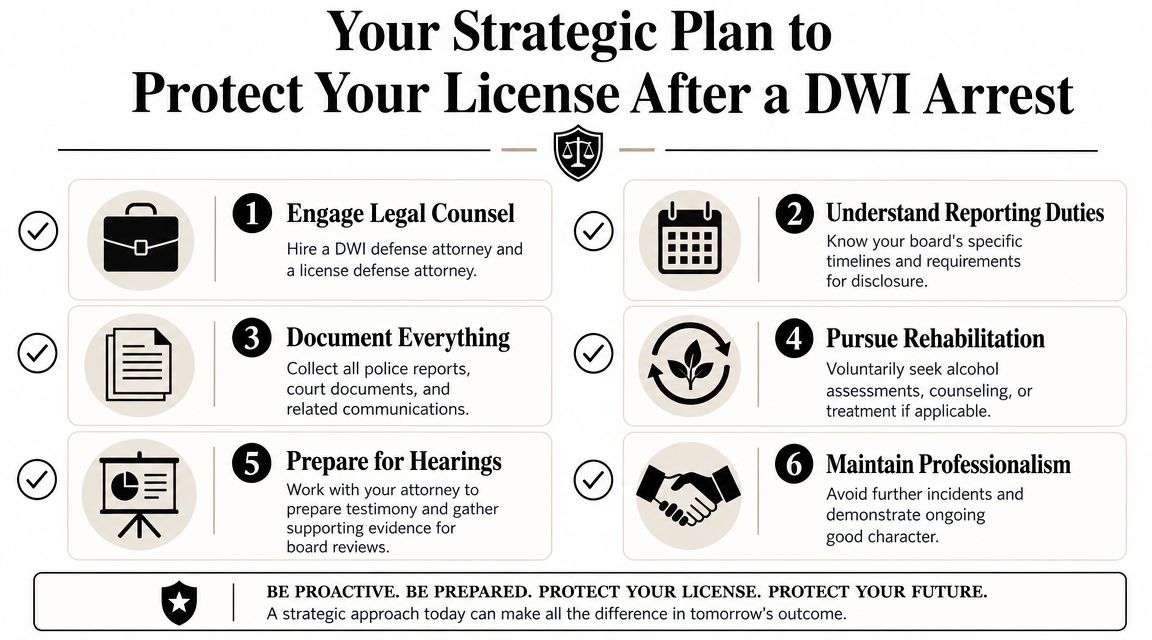
Start with this. An arrest is not a conviction. You can still protect your license, your job, and your ability to keep working if you act fast and stop making impulsive decisions.
Step one is immediate
The first deadline usually has nothing to do with your licensing board. It involves your driver's license.
You have a short deadline to request an ALR hearing after a DWI arrest. If you miss it, the suspension process gets harder to fight, and you lose an early chance to question the officer under oath. For many licensed professionals, that matters as much as the criminal case itself. If you cannot drive to the hospital, office, school, jobsite, client meeting, or home visit, your professional license may still be active but your income is already under pressure.
Treat the first week like damage control. Protect your driving status. Read your bond conditions. Find out exactly what your board requires you to report, and when.
Definitions that matter in the first week
Before the checklist, get these terms straight:
- Field sobriety test: roadside tasks officers use to claim they observed intoxication.
- Implied consent: Texas law ties driving on public roads to consent rules for post-arrest chemical testing.
- Administrative license suspension: the separate process that can affect your right to drive apart from the criminal case.
- BAC: the alcohol concentration measured in breath or blood testing.
This video gives a practical overview of DWI defense issues:
The checklist I'd give a client
Stop talking until you know your reporting duty
Do not email your supervisor, HR, compliance officer, or board investigator just because you feel panicked. Early disclosures done the wrong way create problems that did not have to exist.Read your bond conditions the same day
If the judge ordered no alcohol, testing, travel limits, ignition interlock, or regular check-ins, follow those terms exactly. Licensing boards care about judgment and compliance. A bond violation gives them fresh ammunition.Calendar every deadline in one place
Put your court date, ALR deadline, bond check-ins, renewal deadlines, employer reporting deadlines, and board reporting deadlines on one calendar today. Missed deadlines hurt good cases.Pull the actual rule for your profession
Do not rely on office gossip or a coworker's story. Read your board's rule and your employer's policy line by line. Many professionals get in trouble because they report too much, too soon, or to the wrong person. Others get in trouble because they assume an arrest never has to be disclosed.Get your documents organized
Keep the citation, notice of suspension, bond paperwork, towing paperwork, charging documents, and any work communication together. You need one accurate file, not fragments spread across your phone and inbox.Keep working, but do it carefully
If your license is still active and no rule bars you from practicing, keep doing your job. Do it professionally. Do not discuss the case with clients, patients, students, or coworkers unless your reporting duty or employer policy requires it.Build the criminal defense around the licensing risk
The easy court result is not always the best career result. You need a defense strategy that considers board reporting, renewal applications, background checks, and how the facts will read on paper months from now.
Some boards focus on convictions. Others look at the underlying conduct, dishonesty in reporting, noncompliance with court orders, or any sign that public safety is at risk. That is why your reporting decision cannot be based on guesswork.
That practical gap is described in this discussion of how a DWI affects a professional license in Texas. The point is straightforward. Many professionals can keep working while the case is pending, but only if they handle reporting, driving, and court compliance correctly from the start.
Use counsel that understands both tracks
You do not need a lawyer who only looks at the criminal charge. You need one who sees the full problem. That includes the ALR case, the court case, your board's reporting rules, and the practical question keeping you up at night. How do I keep working while this is unresolved?
One option is to consult a firm that handles Texas DWI defense across ALR hearings, court proceedings, and collateral consequences, such as the Law Office of Bryan Fagan, PLLC.
If your case ends well, ask about record-clearing options too. The arrest may still affect applications, renewals, credentialing, and job changes unless you deal with the record properly.
Taking the First Step to Defend Your Career and Future
A DWI can put your professional life under a microscope. That's true. It can also be managed.
The professionals who protect their careers usually do three things well. They act quickly. They stop guessing about reporting duties. They defend the criminal case with the licensing consequences in mind from the very beginning.
You do not need to assume the worst because you were arrested. An arrest is not the final word. In many cases, the smartest move is to slow down, stop making emotional disclosures, preserve your rights in the driver's-license process, and get a defense plan that matches your profession.
If you're searching for answers about DWI license suspension, board reporting, or how to keep working while your case is pending, you're already asking the right questions. Now you need case-specific answers.
Talk to a Houston DWI lawyer or Texas DUI attorney who understands that your license to practice may matter more to you than the criminal fine or standard court conditions. That's not unusual. It's reality for licensed professionals.
Frequently Asked Questions About DWIs and Texas Professional Licenses
Do I automatically lose my professional license after a DWI arrest in Texas
Usually, no. Most non-CDL professional licenses are not automatically revoked just because of a DWI arrest. The bigger issue is whether your board requires disclosure, whether the alleged conduct directly relates to your job, and how the criminal case ends.
Can I keep working while the DWI case is pending
Often, yes. But that answer depends on three practical issues: your bond conditions, your ability to drive, and your employer's or board's reporting rules. Some professionals keep working without interruption. Others run into immediate problems because they missed a reporting duty or lost regular driving privileges.
What if I haven't been convicted yet
That matters. Some boards focus more heavily on convictions than arrests. Others may review the underlying conduct, pending charges, or off-duty behavior. You cannot assume “no conviction yet” means “no risk,” but it can mean you have more room to protect the case and shape the outcome.
Should I report the arrest right away
Only after checking the exact rule that applies to your license and employment. Some boards require reporting of arrests. Others focus on charges, convictions, or renewal disclosures. Reporting too late can hurt you. Reporting carelessly can also hurt you. Accuracy matters more than speed alone.
What is implied consent in a Texas DWI case
Implied consent means Texas treats drivers on public roads as having agreed to provide a breath or blood sample after a lawful DWI arrest, subject to the state's testing rules. Refusing can create separate consequences for your driver's license and can be especially damaging if you hold a CDL.
What is an ALR hearing
An ALR hearing is an administrative hearing about your driver's license after a DWI arrest. It is separate from your criminal case. A win in one does not automatically mean a win in the other.
What is BAC
BAC stands for blood alcohol concentration. It is the measurement used in breath or blood testing to estimate the amount of alcohol in your system.
What are field sobriety tests
These are the roadside tasks officers use during a DWI investigation. They are meant to help officers claim impairment. They can be challenged, and they do not decide the case by themselves.
If my case is dismissed, am I safe with my board
A dismissal is better than a conviction, but don't assume it ends every licensing concern. Your board may still ask about the incident, the arrest, or prior disclosures depending on its rules. A favorable criminal result helps. It does not erase the need for careful follow-through.
What should I do today if I'm a licensed professional after a DWI arrest
Do these things first:
- Get the paperwork together: Bond documents, notice of suspension, citation, and any court date notice.
- Check your deadlines: Especially the driver's-license deadline and any board or employer reporting deadline.
- Stop informal explanations: Don't try to talk your way out of this with HR, a supervisor, or an investigator.
- Get legal advice that fits your license: Generic DWI advice is not enough if your livelihood depends on a credential.
If a DWI arrest has you worried about your license, your job, or your future, talk with the Law Office of Bryan Fagan, PLLC for a free and confidential consultation. Our team helps Texans address the criminal charge, the ALR process, and the professional fallout with a strategic defense built around real-world career risks. You don't have to sort this out alone.