 Skip to content
The tow truck is gone. Your car may be in impound. Your phone is full of missed calls. You’re replaying every word you said to the officer and wondering if one bad night is about to damage your license, your job, and your record.
That fear is normal. It’s also manageable.
A DWI arrest in Houston is serious, but it is not the same thing as a conviction. You still have rights. You still have defenses. And the decisions you make right now can protect far more than is commonly understood.
If you’re searching for a houston criminal defense lawyer, don’t treat this like shopping for a generic service. A DWI case moves fast, the license problem starts before the criminal case is over, and the wrong lawyer can lock you into damage-control mode before your defense ever gets off the ground. You need a strategy, not a sales pitch.
Texas DWI law is technical. The stop matters. The arrest decision matters. The officer’s report matters. The breath or blood procedure matters. The timing matters. So does the hearing that can affect your ability to drive.
Take a breath. Then take the next step the right way.
A DWI Arrest Can Be Overwhelming But You Have Options
Those arrested for DWI aren’t calm and organized the next morning. They’re embarrassed, angry, scared, and trying to figure out whether they should explain themselves to the court, call the officer back, or just wait and hope the case goes away.
Don’t do any of that.
You need to act, but you need to act in the right order. Start by accepting two things at once. First, the case is serious. Second, it can still be defended. Those ideas are not in conflict.
A lot of drivers make their biggest mistakes after release, not during the traffic stop. They apologize to investigators. They post about the arrest. They trust that if they “cooperate,” things will sort themselves out. That approach usually makes the defense harder.
Practical rule: Your first job is to protect your rights, not to explain yourself.
If this is your first DWI in Texas, you may be asking whether you’ll lose your license, whether you can keep your job, and whether the charge can be reduced or dismissed. Those are the right questions. The answer to each one depends on facts that need to be reviewed early, before deadlines pass and before evidence gets buried in paperwork.
If you hold a professional license, drive for work, or travel often, the stakes are even higher. A DWI doesn’t just raise a court problem. It can create an employment problem, a transportation problem, and a reputation problem all at once.
What matters most right now
The strongest early move is simple. Get organized.
Gather your bond papers, any notice about your license, the date of arrest, the location of the stop, and anything you remember about the encounter. Write it down while it’s fresh. Small details can become major defense issues later, especially in a case built on roadside observations, field sobriety testing, or chemical testing.
Here’s the reassuring part. A good defense isn’t built on panic. It’s built on timing, evidence review, and disciplined choices.
Your First 48 Hours Protecting Your Rights and Your License
The first two days matter more than many realize. You don’t need to solve the whole case in that window. You do need to stop yourself from making it worse.

Stay quiet and stop trying to explain
You have the right to remain silent. Use it.
That doesn’t mean being rude. It means not giving officers, prosecutors, or anyone else extra statements that can be used against you later. If law enforcement wants to “clear something up,” your answer should be that your lawyer will handle communication.
A DWI case often turns on details. What you drank, when you drank, whether you felt tired, whether you took medication, whether you were coming from dinner, whether you “only had a couple.” Drivers say these things thinking they sound harmless. They usually don’t.
Know the key terms right away
A few legal terms matter immediately.
| Term | What it means |
|---|---|
| BAC | Blood alcohol concentration. This is the measurement the state may use in a breath or blood test. |
| Implied consent | Under Texas law, driving on public roads means you’ve already agreed to chemical testing rules and related consequences when an officer lawfully requests a specimen. Refusing can trigger a separate license problem. |
| Field sobriety test | Roadside coordination exercises officers use to claim impairment. These are not the same as a breath test, and they can be challenged. |
| Administrative license suspension | A license action handled through the state’s administrative process, separate from the criminal court case. In Texas DWI cases, this is often discussed through the ALR process. |
That last one needs your attention now, not later.
The license deadline is not optional
After a DWI arrest, the license issue can start moving before your criminal charge is resolved. Post-2025 HB 3479 amendments tightened ALR timelines to 15 days for all drivers, and that deadline has caught many people off guard, especially out-of-state drivers, according to the Houston Lawyer Referral Service discussion of Houston criminal defense attorneys.
If you miss that deadline, you can face an automatic suspension. The same source notes that about 15% of Houston’s DWI arrests involve non-residents, which makes this especially dangerous for people who assume they can deal with the case after they get home.
Miss the ALR deadline and you may lose leverage before your defense has even started.
What to do in order
Use this checklist during the first 48 hours:
- Read every paper you were given. Look for any notice tied to your driver’s license, hearing rights, bond conditions, and court date.
- Write down the timeline. Include where you were stopped, what the officer said, whether tests were given, whether a breath or blood sample was requested, and whether your car was searched.
- Preserve evidence. Save rideshare receipts, bar receipts, text messages, names of witnesses, and any photos or videos from that evening.
- Follow bond conditions exactly. If the court imposed reporting, travel limits, ignition interlock requirements, or no-alcohol conditions, don’t test the rules.
- Request legal help immediately. A lawyer can move on the ALR hearing, gather records, and start reviewing the stop before the state locks in its version of events.
For a practical breakdown of what to gather and what to do next, review this Texas post-arrest DWI checklist.
Don’t confuse the criminal case with the driving case
This trips people up all the time. You can have a pending criminal DWI case and a separate fight over your license. Winning one doesn’t automatically win the other. Ignoring one can damage both.
That’s why quick action matters. The ALR hearing can be more than a license-saving step. It can also give your lawyer an early chance to examine the officer’s basis for the stop and arrest.
If you’re looking for a Houston DWI lawyer or Texas DUI attorney, ask one immediate question before anything else. What is your plan for the license hearing, and how fast can you act?
How to Evaluate a Houston Criminal Defense Lawyer
Houston gives you a lot of choices. That sounds good until you realize that too many choices create confusion, and confusion makes people hire the wrong lawyer.
The Houston market includes about 2,712 criminal defense attorneys, and only 1% of Texas-licensed attorneys achieve board certification in criminal law, according to the Avvo Houston criminal defense lawyer directory. That should tell you two things. First, you won’t struggle to find a lawyer. Second, finding the right one takes discipline.

Don’t hire a generalist for a technical DWI case
A DWI isn’t just “a criminal case.” It sits at the intersection of traffic law, evidence law, forensic testing, police procedure, and administrative license rules. A lawyer who handles “a little bit of everything” may know the courthouse, but that’s not enough.
You want someone who can talk intelligently about:
- The traffic stop itself. Was there a lawful basis to pull you over?
- Field sobriety testing. Were instructions clear? Were conditions fair?
- Breath or blood procedures. Was the request lawful? Was the process handled correctly?
- Administrative hearings. Can the lawyer pursue the license side while defending the court case?
- Harris County practice. Does the lawyer know how local prosecutors and courts handle DWI litigation?
That’s the difference between a true defense strategy and generic criminal representation.
Why jury trial experience matters even if your case never reaches trial
Many people assume trial experience only matters if they plan to “fight all the way.” That’s not how this works.
A lawyer with real jury trial experience evaluates evidence differently, negotiates differently, and prepares differently. Prosecutors can tell when defense counsel is capable of trying the case and when counsel is just angling for a fast plea. That alters the bargaining position.
Here’s my opinion. If a lawyer can’t explain how they prepare a DWI case for trial, they probably won’t negotiate from strength either.
The lawyer who is ready to try the case usually negotiates from a better position than the lawyer who just wants it off the desk.
Look for Harris County familiarity, not just a polished website
DWI defense is local in practice, even when the law is statewide. Courtroom habits, prosecutor expectations, scheduling realities, and evidentiary disputes all have local texture.
Ask whether the lawyer regularly handles DWI cases in Harris County. Ask whether they handle ALR matters in addition to the criminal charge. Ask who reviews the police report, body camera footage, and testing records. A polished consultation means very little if the actual work gets handed off without supervision.
A useful comparison looks like this:
| Weak sign | Strong sign |
|---|---|
| Talks mostly about price | Talks about evidence, deadlines, and defense themes |
| Gives broad promises | Gives a concrete process for reviewing reports, video, and testing |
| Treats DWI like a routine plea case | Treats DWI like a technical case with multiple pressure points |
| Avoids trial discussion | Explains what trial readiness changes in negotiation |
| Doesn’t mention license defense | Addresses the driving case early |
For a deeper guide, review how to choose a criminal defense attorney in Texas.
Specialization matters even more for high-risk drivers
Some drivers need a lawyer with a narrower skill set than others. If you drive for a living, hold a CDL, travel across state lines, or have a prior record, your case isn’t a generic first-offense file.
That means your lawyer should be able to identify consequences beyond the charge itself, including license exposure, job impact, and the practical value of motions attacking the stop, the arrest, or the chemical test. If they can’t spot those issues early, they can’t build around them.
A houston criminal defense lawyer worth hiring doesn’t just tell you they’ll “fight.” They tell you where the case can be attacked and why.
Critical Questions to Ask During Your Consultation
A consultation shouldn’t feel like an audition where you wait passively and hope someone picks you up as a client. You’re interviewing the lawyer. Act like it.
A good consultation should leave you calmer and better informed. If you finish the call with more slogans than answers, keep looking.

Ask questions that force a strategy answer
Start with questions that require the lawyer to think, not recite.
- What do you want to review first in my case? You want to hear about the stop, the report, the video, the testing, and any deadlines.
- How do you approach a DWI license suspension issue? This shows whether the lawyer treats the driving problem as urgent.
- What problems do you usually look for in field sobriety testing? A real DWI lawyer should have a direct answer.
- What’s your process for reviewing breath or blood evidence? The answer should sound methodical, not vague.
- If the state’s evidence is weak, how do you use that in negotiation? This reveals whether the lawyer sees the case as dynamic or predetermined.
You’re not asking for guarantees. You’re checking whether the lawyer thinks like a litigator.
Ask who will actually handle your file
This is one of the most important questions and one of the least asked.
Some firms market the consultation with one attorney and assign the day-to-day case to someone else. That isn’t automatically bad, but you deserve clarity. Ask who appears in court, who answers your questions, and who makes strategic calls.
Use plain language:
“If I hire your office, who is reviewing my evidence, who is going to court with me, and who do I call when something changes?”
If the answer is slippery, that’s a warning sign.
If you hold a CDL, ask this directly
For commercial drivers, generic DWI advice can be dangerous. A single DWI conviction can trigger a lifetime disqualification under 49 CFR Part 383, as noted in the Sharp criminal attorney discussion of affordable Houston lawyers.
That means a CDL holder should ask:
- Have you handled DWI cases involving commercial drivers?
- How do federal CDL rules change your defense strategy?
- What steps do you take to protect a commercial driver’s livelihood while the case is pending?
If the lawyer answers as if your case is the same as every other driver’s case, move on.
Ask about communication and fees without embarrassment
Clients often hesitate here. Don’t.
You need to know how updates are delivered, how quickly the office responds, and whether fees are flat, staged, or tied to trial work. A clear answer is a good sign. Confusion at intake usually turns into frustration later.
A short comparison helps:
| Question | Why it matters |
|---|---|
| Who handles my court appearances? | You need to know who is accountable |
| How often will I get updates? | Silence creates avoidable stress |
| What is included in the fee? | Hidden cost surprises poison trust |
| How do you prepare for contested hearings? | Preparation often decides leverage |
| What outcomes are realistically on the table? | Honest analysis beats easy promises |
For more ideas, review these questions to ask a criminal defense attorney before hiring.
Watch how the lawyer answers, not just what they say
A strong consultation usually sounds calm, specific, and grounded in process. The lawyer should be able to explain next steps in plain English. They should not need to scare you into signing.
You want someone who can say, in substance, “Here’s what we need to check first, here’s what can be challenged, here’s what happens next, and here’s what I can do now.”
That’s how confidence sounds.
Understanding the DWI Case Timeline and Likely Outcomes
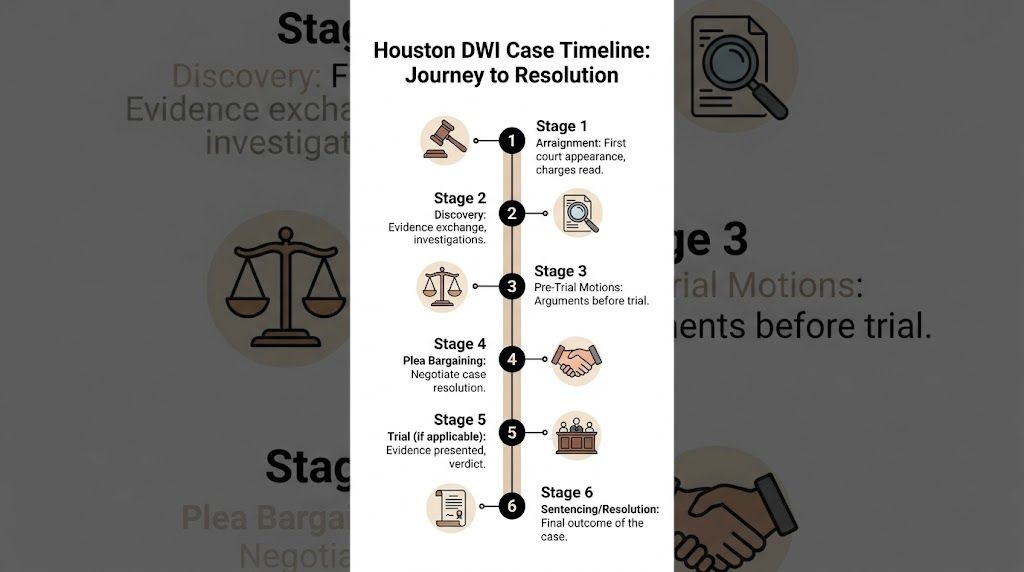
The legal process feels less intimidating once you know where the pressure points are. A DWI case doesn’t move in one dramatic leap from arrest to trial. It moves through stages, and each stage gives your lawyer chances to protect you.
The broad path is easier to understand when you see it laid out.
What usually happens after the arrest
Most DWI cases move through a sequence like this:
Initial court appearance
The charge is formally addressed and the court process begins.Discovery
During this phase, the defense seeks and reviews evidence such as reports, videos, testing records, and witness information.Pre-trial motions
Your lawyer may challenge the stop, the arrest, statements, or the admissibility of key evidence.Negotiation
When the case is properly developed, legal pressure can yield significant bargaining power.Trial, if needed
If the state won’t offer a fair resolution and the facts support a fight, the case can be tried.Sentencing or final resolution
This may involve dismissal, a negotiated resolution, or a result after trial.
None of those stages should be handled on autopilot.
Why negotiation matters so much in Houston
About 90% of Houston criminal cases settle before trial, according to Omar Saman’s discussion of why Houston criminal cases settle before trial. That reality should shape how you think about hiring counsel.
It doesn’t mean trial doesn’t matter. It means the lawyer’s negotiation skills, credibility, and preparation usually matter earlier than most clients expect. In other words, a strong result often comes from the work done before a jury is ever called.
In a settlement-heavy system, the attorney who can expose weaknesses in the evidence often has the most room to negotiate.
What common outcomes can look like
Not every DWI case ends the same way. Possible outcomes may include:
- Dismissal if the state’s evidence falls apart or key proof is excluded.
- Charge reduction if the defense creates enough pressure to reach a better resolution.
- Deferred adjudication or another negotiated outcome in situations where the law and facts allow a less damaging result.
- Trial verdict if the dispute can’t be resolved fairly.
The right result depends on your facts, your record, the evidence, and the quality of the defense work. No honest lawyer should promise a specific outcome at the first meeting.
What influences the result most
A DWI case often turns on a short list of issues:
| Case issue | Why it matters |
|---|---|
| Basis for the stop | An unlawful stop can undermine the entire case |
| Officer observations | These claims are often subjective and must be tested |
| Field sobriety testing | Poor instructions or bad conditions can weaken reliability |
| Breath or blood evidence | Technical issues can change the case dramatically |
| Timing and preparation | Early defense work creates leverage later |
That’s why people who want to fight DWI Texas cases effectively shouldn’t wait until the next court date to get serious. The outcome starts taking shape long before then.
How The Law Office of Bryan Fagan Defends Your Future
You do not protect your future by hiring the lawyer who plans to process your case quickly. You protect it by hiring counsel who treats your DWI like a case to be tested, challenged, and prepared for pressure points from day one.
That mindset matters in Houston. Many criminal cases resolve without a jury ever being seated. The lawyer who can prepare a case for trial usually has more power in every earlier conversation, from contested hearings to plea negotiations. A prosecutor can tell the difference between a file-handler and a trial lawyer.
Trial readiness changes the value of the defense
Jury trial experience is not a résumé detail. It affects how the case is built.
Lisa Strauss’s discussion of how to choose a Houston criminal defense lawyer points to a practical truth. Courts and prosecutors take prepared defense counsel more seriously, especially when that lawyer knows how to challenge police work, technical evidence, and witness testimony in front of a jury. In a system where so many cases settle, trial readiness gives the defense credibility before trial ever starts.
That is why bargain shopping is a mistake in a DWI case. Lower fees often mean less investigation, fewer motions, less time spent on video review, and weaker pressure on the State.
Choose preparation.
What a practical defense approach should include
A serious DWI defense requires work on several fronts at once. The file has to be reviewed closely. The stop has to be examined for legal defects. The roadside investigation has to be tested for poor instructions, bad conditions, or officer shortcuts. Any breath or blood evidence has to be scrutinized for gaps in procedure, maintenance, or chain of custody.
It also requires clear advice. You need to know what the weak spots are, what can be challenged, what likely outcomes make sense, and what decisions should wait until the evidence is fully reviewed.
The Law Office of Bryan Fagan, PLLC handles DWI defense matters including administrative license hearings, evidence review, motion practice, negotiated resolutions, and trial representation in Texas courts. That range matters because a DWI arrest can affect your license, your criminal record, your job, and your insurance at the same time.
Be blunt about fees, scope, and expectations
Ask direct questions and expect direct answers. Is the fee flat or hourly. Does it cover contested hearings. Is trial included or billed separately. Who handles the ALR matter. Who will appear with you in court. How often will you get updates.
If the answers are vague, keep looking.
The right lawyer will not sell you comfort. The right lawyer will tell you what must be investigated now, which deadlines can hurt you, where the State’s proof may be vulnerable, and what strategy gives you the strongest position to protect your record and license.
After a Houston DWI arrest, your next move should be deliberate and disciplined. Get counsel who prepares cases with trial in mind, because that preparation can shape everything that happens long before trial becomes necessary.

