
A DWI arrest can be overwhelming, but you don't have to face it alone.
If you're reading this after an airport stop, a call from law enforcement, or notice that your certificate could be reviewed, you're probably worried about more than a criminal charge. You may be thinking about your job, your medical, your reputation, and whether one accusation could end years of work in aviation.
That fear is understandable. A flying while intoxicated Texas case is different from a typical roadside DWI. You may be dealing with a county prosecutor on one side and FAA consequences on the other. Those are separate problems, and they don't always move on the same timeline.
An FWI Arrest Can Be Overwhelming But You Have Options
A pilot finishes a flight, starts handling post-flight tasks, and then gets approached by law enforcement. The questions may sound routine at first. Have you been drinking. How much. When was your last drink. Before long, the conversation turns into a criminal investigation.
That moment catches people off guard because it doesn't feel like a normal DWI stop. There may be no traffic stop, no patrol car lights on a highway, and no clear sense of what comes next. But the stakes are just as serious, and in some ways more serious, because your pilot credentials may be exposed to a second review outside criminal court.
Practical rule: In an FWI case, you're not just defending against a charge. You're protecting your freedom, your record, and your ability to keep flying.
The hardest part for many people is the split focus. Criminal court asks one set of questions. Aviation regulators may ask another. A result that sounds manageable in one setting can still create professional damage in the other.
That's why your response has to be organized early. You need to understand what officers were investigating, what evidence they collected, whether testing was handled properly, and whether anything you said can be challenged. You also need to think ahead about reporting duties, administrative hearings, and how your defense may affect your license.
Why pilots need a different defense strategy
A general criminal lawyer may focus only on the county case. That's not enough if you hold a pilot certificate. The legal strategy should account for both tracks at the same time.
A strong response often starts with these questions:
- What exactly happened during contact with police: The details matter, including where you were, what officers observed, and whether they had lawful grounds to proceed.
- What evidence exists: Breath, blood, statements, video, witness accounts, and timeline evidence can all shape the case.
- What professional consequences may follow: Even before a conviction, the accusation itself can affect your ability to fly.
- What deadlines apply right now: Missing an early hearing request can create avoidable damage.
If you're searching for a Houston DWI lawyer or a Texas DUI attorney after an aviation arrest, look for someone who understands that this is a two-front fight. That's the nuance many people miss at the start.
What Is Flying While Intoxicated in Texas
Texas law treats flying an aircraft while intoxicated as its own offense. Under Texas Penal Code §49.05, Flying While Intoxicated means operating an aircraft while intoxicated, and intoxication can be established at a BAC of 0.04% or greater, which is half the 0.08% limit used for driving a motor vehicle under Texas law, as explained in this overview of Flying While Intoxicated under Texas Penal Code §49.05 and this explanation of the Texas BAC limit for standard DWI.
That lower threshold is where many people get confused. They assume the same rule that applies to cars applies to aircraft. It doesn't. Texas holds pilots to a stricter alcohol limit.
The three parts prosecutors focus on
To prove this charge, the state generally has to show three things:
- You were operating
- An aircraft
- While intoxicated
“Operating” can become a contested issue. In some cases, the dispute isn't about alcohol alone. It's about whether the state can prove actual operation under the facts.
“Aircraft” sounds obvious, but legal cases often turn on precise definitions and the specific setting in which the allegation arose.
“Intoxicated” is where chemical testing and officer observations usually come into play. In plain English, BAC means blood alcohol concentration. It refers to the amount of alcohol measured in your body through a breath or blood test.
Why the lower BAC matters
Think of it this way. If the car-driving rule is one line, the pilot rule is another line set much lower. A pilot can face trouble at a level that would not trigger the same per se number for a standard driver.
That's one reason people arrested for FWI often feel blindsided. They may not have felt impaired. They may have assumed they were under the driving limit. But the aircraft standard is tighter, and prosecutors know that.
A charge can rest on a legal standard that's stricter than the one most Texans know from ordinary DWI cases.
If you want a useful comparison point, First-Offense DWI in Texas: Penalties and Defenses explains what a first DWI charge means and how it can be challenged. It's not the same offense as FWI, but it helps show why intoxication cases often turn on definitions, procedure, and proof, not just the accusation itself.
Texas FWI Criminal Penalties Explained
Once the state files the case, the penalty structure becomes critical. Texas increases punishment sharply for repeat allegations, and FWI doesn't get the same flexibility that some people expect from ordinary first-time DWI cases.
Penalties by offense level
Here is the basic framework for Texas Flying While Intoxicated penalties.
| Offense | Classification | Jail Time | Maximum Fine |
|---|---|---|---|
| First offense | Class B misdemeanor | 72 hours to 180 days | $2,000 |
| Second offense | Class A misdemeanor | 30 days to 12 months | $4,000 |
| Third offense | Third-Degree felony | 2 to 10 years | $10,000 |
A first-time FWI conviction is a Class B misdemeanor with a mandatory minimum of 72 hours, up to 180 days in county jail, and a fine of up to $2,000, and judges may not grant deferred adjudication in FWI cases, according to this summary of Texas Flying While Intoxicated law and penalties.
Repeat offenses get more severe. A second FWI offense is charged as a Class A misdemeanor with a mandatory minimum of 30 days in jail, and a third FWI offense, including certain prior intoxication-related convictions involving driving or boating, can become a felony punishable by 2 to 10 years in prison, as outlined in this discussion of repeat Flying While Intoxicated charges in Texas.
The deferred adjudication issue
This is one of the most important differences in an FWI case.
In many DWI conversations, people ask whether they can avoid a conviction through deferred adjudication. With FWI, Texas law removes that option for judges. That doesn't mean there are no defense strategies. It means the usual first-offense assumptions may not apply.
Probation may still be possible in some situations, but the no-deferred-adjudication rule changes how plea discussions and case strategy should be approached from day one.
Why repeat history matters so much
Prior intoxication-related history can affect charging decisions in ways people don't expect. A person may think, “My old case involved a different kind of vehicle.” That may not end the issue. Prosecutors look closely at whether prior offenses can enhance the current allegation.
The label on the old case matters less than people think. What matters is whether the law lets the prosecutor use it to increase punishment.
If the state is treating the matter as a felony-level intoxication offense, it can help to understand how Texas handles other serious intoxication allegations, including what intoxication assault means in Texas. The legal mechanics differ, but the lesson is the same. Once a case moves beyond a basic misdemeanor, the consequences expand quickly.
Terms people often hear in this stage
- Administrative license suspension: A separate process involving license consequences outside the criminal trial.
- Criminal record: The record created if the case ends in conviction or another qualifying result.
- First DWI in Texas: A common search phrase, but FWI follows its own rules and shouldn't be treated as a normal first-offense driving case.
- DWI license suspension: A broad term people use for the loss of driving privileges, often tied to the ALR process after arrest.
Your Pilot License The FAA Administrative Consequences
A pilot can walk out of a Texas criminal court with one problem under control and still face a second fight that threatens the license behind every logged hour. That is the part many people do not see at first. An FWI case is often a form of dual jeopardy in a practical sense. One case puts your freedom and record at risk. The other can put your certificate, medical status, and career in danger.
Federal aviation rules also apply here. Under 14 CFR §91.17, pilots must meet a stricter alcohol standard than drivers, and the FAA can review conduct through its own administrative process, as described in this summary of what happens when a pilot gets a DWI in Texas.
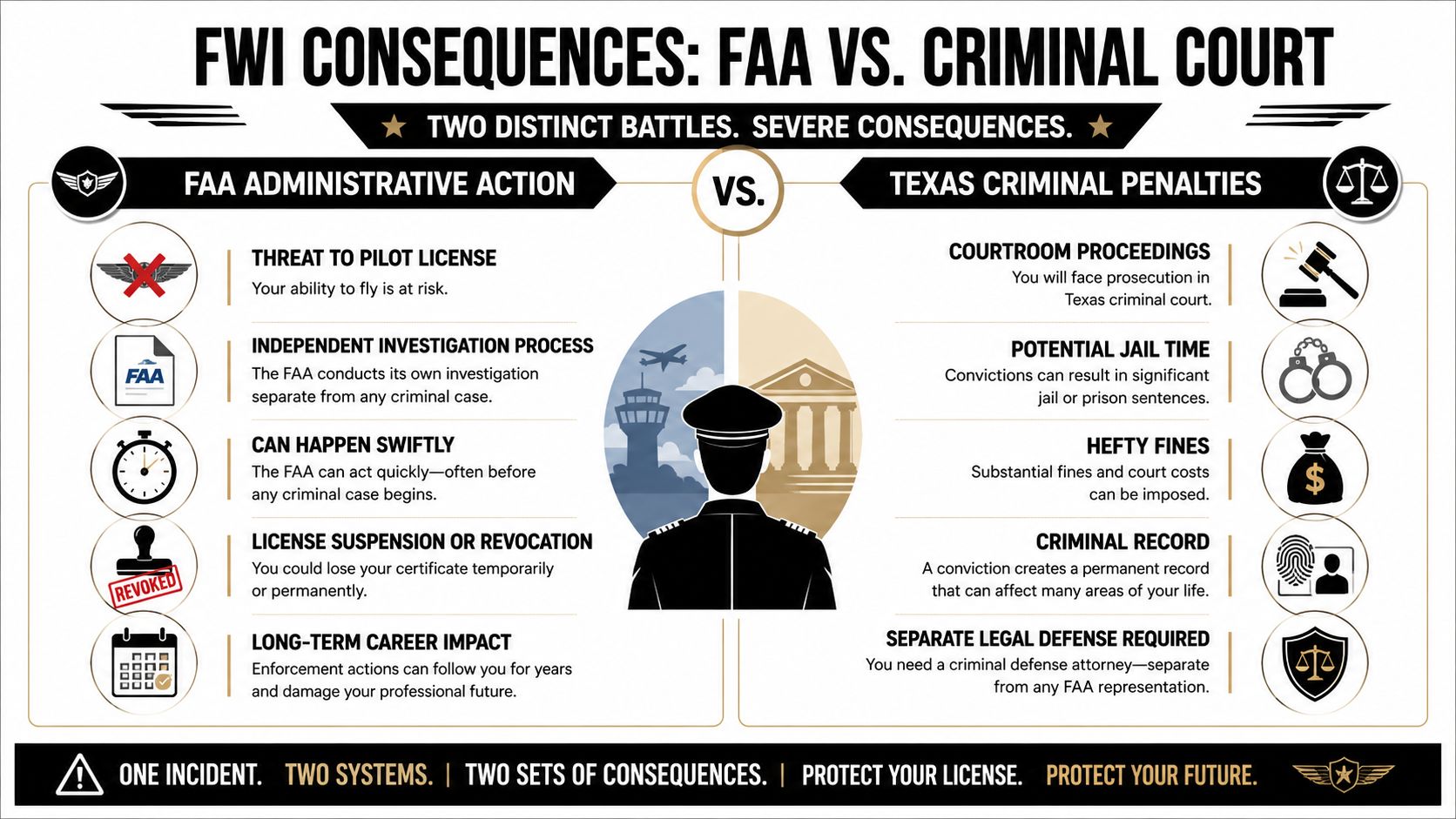
Two separate cases can grow out of one arrest
Texas prosecutors and the FAA are not asking the same question.
A prosecutor is focused on whether the state can prove a criminal offense under Texas law. The FAA is focused on whether your conduct, reporting, and overall compliance justify action against your certificate. Those tracks can overlap, but they do not rise or fall together.
That distinction matters more than many pilots expect. A result that sounds manageable in criminal court can still create serious trouble with the FAA. In plain English, winning one battle does not automatically win the other.
Why pilots need a different defense strategy
A general criminal defense approach may concentrate on fines, probation, or avoiding a conviction. For a pilot, that is only half the job. The defense also has to account for what gets reported, what appears in the record, and how statements made in one setting may echo in another.
The process works a lot like flying with two instrument panels in front of you. One panel is the Texas court system. The other is the FAA. If your lawyer watches only one, you can drift into danger on the other.
If you are trying to understand the professional stakes, this guide on whether pilots can keep their license after a DWI gives added context on how certificate issues can develop.
What often causes avoidable harm
Pilots are used to checklists, and that mindset helps here. Problems often grow from omissions and timing mistakes, not just from the arrest itself.
Common trouble spots include:
- statements made to explain the situation before the legal facts are fully reviewed
- plea decisions that appear minor in county court but create licensing consequences later
- missed or mishandled FAA reporting obligations
- a defense plan built only around the criminal charge, without protecting the certificate at the same time
A focused defense becomes critical in this situation. The legal goal is broader than staying out of jail or reducing a fine. It includes protecting the record the FAA may examine, limiting unnecessary admissions, and building a strategy that addresses both the Texas case and the threat to your license.
The FWI Investigation Process and Your Rights
Most FWI cases begin with observations, questions, and a decision by law enforcement that more investigation is needed. The setting may be different from a roadside stop, but the legal issues are familiar. Officers look for signs they believe support probable cause.

What officers are trying to establish
Probable cause means officers believe there are enough facts to support an arrest or further enforcement action. In practice, they may point to odor of alcohol, speech, balance, timing, witness reports, or your own statements.
If you want a closer look at how Texas officers build that argument, this article on what gives police probable cause for a DWI arrest in Texas explains the concept in plain terms.
Field sobriety tests and chemical testing
A field sobriety test is a set of roadside-style exercises officers use to claim a person has lost normal mental or physical faculties. In an aviation setting, those tests can be misleading. Fatigue, dehydration, stress, motion aftereffects, and uneven surfaces may affect performance even when alcohol is not the true cause.
Implied consent means that by driving in Texas, you're considered to have agreed to provide a breath or blood specimen if lawfully requested after an arrest for an intoxication offense. Refusing a test can trigger an administrative license suspension, often called an ALR process, which is separate from the criminal case.
The practical rights that matter
Your rights don't disappear because officers are investigating an aircraft-related offense.
- You have the right to remain silent: You don't have to explain your timeline, your drinks, or your guesses about your BAC.
- You can decline to answer investigative questions: Polite silence is often safer than trying to “clear things up.”
- You can request counsel quickly: Early legal advice can shape both the criminal and administrative response.
- You can challenge the evidence later: Arrest reports, testing methods, and officer conclusions are not automatically correct.
Even an allegation can set off temporary FAA action and serious professional risk, which is why early defense work matters before the case hardens into a record.
If you're worried about a DWI license suspension, don't assume that issue will wait until court. In Texas, the administrative side can start quickly, and your response window can be short.
How to Fight a Flying While Intoxicated Charge
An arrest is not a conviction. In many cases, the strongest defense comes from slowing the case down and examining each part of the state's proof instead of accepting the accusation at face value.
Where a defense lawyer starts looking
Some defenses challenge the stop or detention itself. If officers didn't have lawful grounds to investigate further, key evidence may be open to attack.
Other defenses focus on proof. In an FWI case, the state still has to connect the evidence to the legal elements. If “operation” is unclear, if witness observations conflict, or if the timeline doesn't hold together, the case may be weaker than it first appears.
Common defense themes in FWI cases
- Questioning the initial contact: If officers lacked a valid basis to proceed, the defense may seek to suppress later evidence.
- Attacking field sobriety testing: These tests are subjective, and pilot fatigue or post-flight physical effects can look like intoxication.
- Examining breath or blood procedures: Machine maintenance, sample handling, and chain-of-custody issues can all matter.
- Disputing operation: The prosecutor must prove more than suspicion. The facts have to show the legal element was met.
- Challenging statements: People often speak under stress. A defense lawyer reviews whether statements were voluntary, accurate, and lawfully obtained.
A good defense doesn't depend on one magic argument. It comes from finding the pressure points in the state's evidence and using them together.
Why the pilot angle changes the defense
A standard DWI plea strategy may not fit an aviator's case. Even a resolution that looks acceptable on paper may carry consequences for a pilot certificate, reporting obligations, or long-term employability.
That's why people searching how to fight DWI Texas charges need to think carefully when the allegation involves an aircraft. The defense should be built for both audiences. The prosecutor in court and the regulators reviewing your credentials.
If your case involves a first allegation, a repeat accusation, or concern about later record cleanup such as expunctions, the analysis should start with the facts of the arrest and the likely impact outside criminal court. For pilots, that second part is never optional.
Immediate Steps After an FWI Arrest in Texas
The first days matter. Small decisions can help or hurt both your criminal defense and your license position.
What to do right away
Stay silent about the facts of the case. Don't try to talk your way out of it after the arrest. Explanations made under stress often become evidence.
Write down everything you remember. Include where you were, who spoke to you, what was said, whether any tests were offered, and what happened before and after the flight.
Keep every document. Bond paperwork, notice forms, hearing paperwork, towing records, and testing paperwork can all matter later.
Request help fast. A lawyer can review the arrest, protect deadlines, and begin planning for both criminal court and administrative fallout.
Ask about the ALR deadline immediately. In many Texas intoxication cases, there is a short deadline to request an Administrative License Revocation hearing after notice of suspension. Missing that window can cost you advantage.
Why waiting is risky
A first-time FWI conviction carries a mandatory minimum jail term of 72 hours, up to 180 days in county jail, and a fine of up to $2,000, and Texas law does not allow judges to accept deferred adjudication pleas in FWI cases, as noted earlier in the legal standard for this offense.
That doesn't mean your case is hopeless. It means speed matters. Early action gives your attorney a better chance to preserve evidence, evaluate defenses, and protect your position before deadlines pass.
If this is your first DWI in Texas or your first intoxication-related allegation of any kind, don't assume the process will be simple because you've never been in trouble before. FWI is one of those charges where inexperience with the system can lead to avoidable mistakes very quickly.
If you're facing an FWI allegation, you don't have to sort through the criminal case and the FAA risk on your own. The Law Office of Bryan Fagan, PLLC helps Texans understand their rights, respond to ALR and court deadlines, and build a strategy aimed at protecting both their record and their future. Request a free consultation or case evaluation to discuss what happened, what deadlines apply, and what options may be available in your case.