
A DWI arrest can be overwhelming—but you don’t have to face it alone. Being charged with a first-time DWI in Texas is typically a Class B Misdemeanor, but it's critical to remember one thing: an arrest is not a conviction. If you act quickly, you have a real opportunity to challenge both the criminal charges and the automatic license suspension that comes with them. Your top priority right now is to understand your rights and the legal timelines you're up against.
You Have Rights and Options After a DWI Arrest

A DWI arrest is a disorienting and stressful experience. The flashing lights, the field sobriety tests, and the ride to the station leave most people with more questions than answers. It’s easy to feel like the situation is hopeless, but this is just the beginning of a legal process, not the end of the road.
You are not alone in this. DWI is a major legal issue across the state, with thousands of people facing these charges every year. To put it in perspective, recent data shows Harris County alone reported 12,255 DWI charges in a single year. That number highlights just how many people find themselves in a similar position.
Taking Control of Your Situation
The most important step you can take right now is to shift from feeling powerless to feeling empowered. An arrest does not mean you will be found guilty. The prosecution carries the burden of proving every single element of its case against you, and there are often many opportunities to challenge the evidence they present.
From the moment you were pulled over, your rights were on the line. The decisions you make in the hours and days following your arrest will have a massive impact on the outcome.
Here's what should be on your immediate to-do list:
- Protect Your Driving Privileges: You only have 15 days from the date of your arrest to request an Administrative License Revocation (ALR) hearing. If you miss this deadline, your license will be automatically suspended.
- Preserve Evidence: Write down every detail you can remember about the traffic stop. What did the officer say? What tests did they ask you to perform? What did you say? Every small detail can matter.
- Seek Legal Counsel Immediately: Consulting with an experienced Houston DWI lawyer ensures your rights are protected from day one and that you don't miss any critical deadlines.
Understanding these initial steps is vital. For example, knowing how to fight a DWI license suspension in Texas can be the difference between keeping your driving privileges and losing them while your criminal case is still pending. This guide will walk you through everything you need to know about facing a first-time DWI, giving you the knowledge to take back control.
Understanding How Texas Defines Intoxication
When you're facing a first time DWI in Texas, it's crucial to understand what "intoxicated" actually means under state law. It might sound simple, but legally, it's a broad term with three different definitions. A prosecutor doesn’t just have one way to prove you were intoxicated; they have three.
An arrest for DWI begins when the state believes it can prove—beyond a reasonable doubt—that you were operating a motor vehicle in a public place while intoxicated. The entire case hinges on that last word. Texas law says you're legally intoxicated if you've lost the normal use of your mental or physical faculties or if you have a blood alcohol concentration of 0.08% or more.
Three Ways to Define Intoxication
Understanding these three distinct definitions is the first step toward building a solid defense. The prosecution only needs to convince a jury of one of them to get a conviction. This means your defense strategy must be prepared to challenge the specific evidence they bring against you.
The state can argue you were intoxicated based on:
- Blood Alcohol Concentration (BAC) of 0.08% or Higher: This is the most straightforward, numbers-driven definition. If a chemical test—usually breath or blood—shows your BAC is at or above 0.08%, you are considered per se intoxicated. In other words, the law says you're intoxicated, period.
- Loss of Normal Mental Faculties: This definition is far more subjective. It means you could not think and reason the way an ordinary, sober person would under the same circumstances. An officer might point to things like slurred speech, confusion, or difficulty answering simple questions as evidence.
- Loss of Normal Physical Faculties: Similar to the mental faculties test, this is based on the officer's observations. It centers on your physical coordination—your balance, your ability to walk a straight line, or perform other basic motor skills. This is exactly what the field sobriety tests administered on the side of the road are designed to "measure."
You can be arrested and charged with DWI even if your BAC is under 0.08%. If an officer can build a case that you had lost the normal use of your mental or physical faculties due to alcohol or any other substance, the state can still pursue charges.
It’s a common myth that as long as you're "under the limit," you're safe. Texas law gives prosecutors the power to charge you based entirely on an officer's subjective opinion, making a BAC number just one piece of a much larger puzzle.
This table breaks down the three legal standards the prosecution can use to prove a DWI charge, helping you understand the basis of your case.
Three Ways Texas Defines Intoxication
| Method of Proof | What It Means for You | How It Is Measured |
|---|---|---|
| BAC ≥ 0.08% (Per Se) | This is the most straightforward standard. If your BAC is at or above this number, you are legally intoxicated, period. | Breathalyzer test, blood draw, or urine sample. |
| Loss of Mental Faculties | The state argues you couldn't think or make decisions like a sober person. | Officer testimony about slurred speech, confusion, or inability to follow directions. |
| Loss of Physical Faculties | Your physical coordination was impaired. You couldn't walk, stand, or move normally. | Officer observations and your performance on Standardized Field Sobriety Tests (SFSTs). |
Understanding which of these three definitions the prosecutor is relying on is absolutely critical for your defense.
What Is "Implied Consent"?
When you obtain your Texas driver's license, you enter into an agreement with the state. This agreement is known as the "implied consent" law. By accepting the privilege to drive on public roads, you automatically consent to provide a breath or blood sample if you are lawfully arrested for DWI.
Refusing the test does not get you out of trouble. A first-time refusal will trigger an automatic 180-day driver's license suspension. This is an administrative penalty that occurs in a separate civil proceeding, completely independent of your criminal case. While refusing might deny the prosecutor a key piece of scientific evidence (your BAC), it comes with an immediate consequence. You can learn more about the legal BAC limit in Texas and how it affects your case.
Special Rules for Younger Drivers
Texas has a strict zero-tolerance policy for any driver under the age of 21.
For younger drivers, any detectable amount of alcohol in their system is enough to lead to a charge of Driving Under the Influence (DUI), a Class C Misdemeanor. This tough legal stance is designed to send a clear message. For more on this, you can read the Texas Department of Transportation's safety report on efforts to reduce these offenses.
Knowing these definitions is your first line of defense. A knowledgeable Houston DWI lawyer will analyze the evidence—whether it’s a BAC reading from a poorly calibrated machine or an officer's subjective opinion—to protect your rights.
Navigating the Two Cases Against You: Criminal and Administrative
One of the biggest surprises for people arrested for a first DWI in Texas is discovering they aren’t just fighting one legal battle—they’re fighting two.
A single DWI arrest instantly triggers two separate cases that run on parallel tracks: one is criminal, and the other is administrative. Understanding this two-front process is the first step toward building an effective defense.
Your Criminal Case: The Fight for Your Freedom
This is the case most people think of when they hear "DWI." The criminal case is brought against you by the State of Texas and is handled in a criminal court. A prosecutor from the District Attorney's office will attempt to prove you are guilty beyond a reasonable doubt.
The stakes are high. A conviction can lead to jail time, steep fines, probation, and a permanent criminal record. The entire process—from your first court appearance to plea negotiations and a potential jury trial—is focused on one question: did you operate a motor vehicle in a public place while intoxicated?
This is where your Houston DWI lawyer works to challenge the traffic stop, fight the evidence, and protect you from a life-altering conviction.
The infographic below shows the three distinct ways the state can try to prove you were intoxicated.
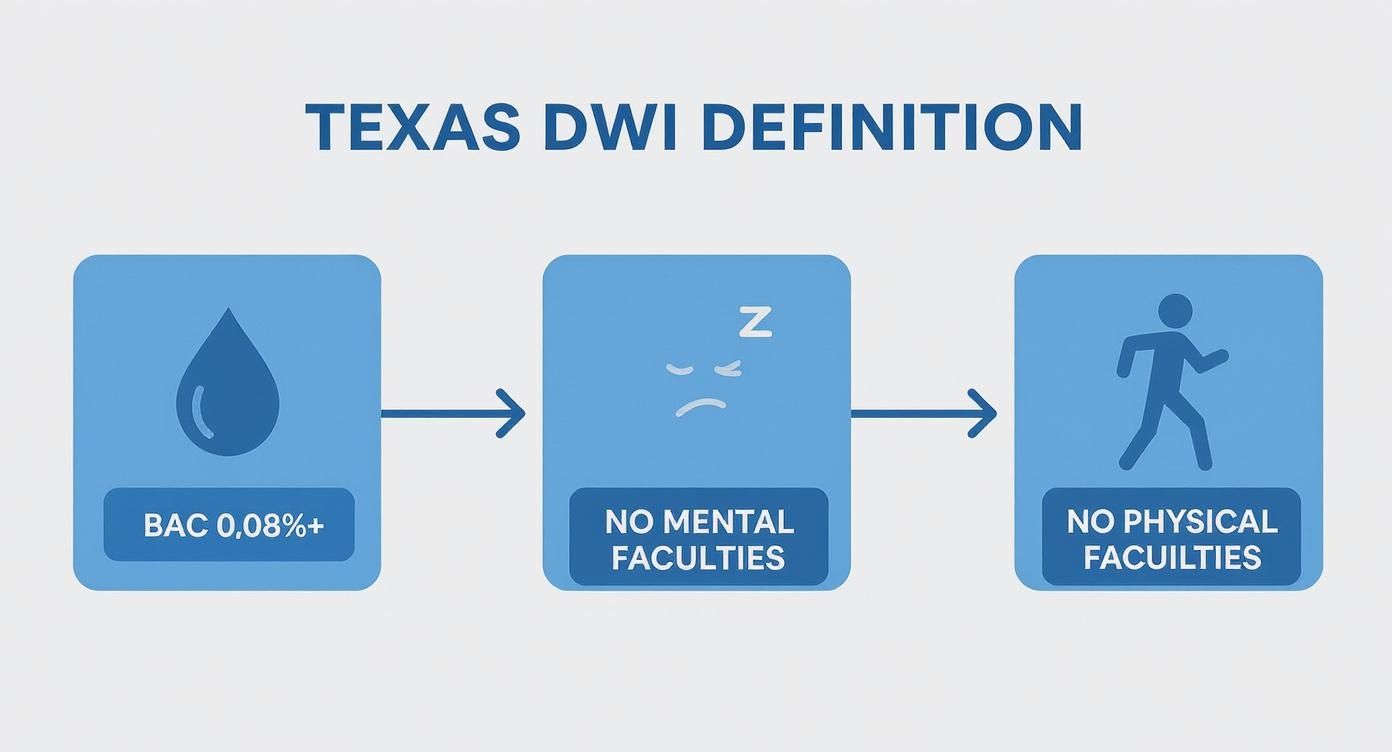
As you can see, a prosecutor doesn't have to rely solely on a breath or blood test. They can also use a police officer's subjective opinion about your "normal" faculties, which is why a strategic legal approach is so critical.
Your Administrative Case: The Fight for Your License
Running completely separate from the criminal proceedings is the civil case known as the Administrative License Revocation (ALR) process. This case has nothing to do with whether you are guilty or innocent of DWI. Its sole purpose is to determine whether your driver's license should be suspended.
This process is handled by the Texas Department of Public Safety (DPS), not the criminal courts. It is triggered if you either:
- Refuse to provide a breath or blood sample.
- Provide a sample that shows a Blood Alcohol Concentration (BAC) of 0.08% or higher.
The clock on this process starts ticking immediately.
You have only 15 days from the date of your arrest to formally request an ALR hearing. If you miss this deadline, your license will be suspended automatically.
This deadline is non-negotiable. It doesn’t matter if your criminal case is eventually dismissed. If you miss the 15-day window, you will lose your license. Requesting this hearing is your only opportunity to fight the automatic suspension and protect your driving privileges.
Why This Distinction Matters
Failing to understand the two-case system can have serious consequences. Many people assume that winning their criminal case automatically protects their license, but that is false. You can be found "not guilty" of DWI and still have your license suspended for months simply because you failed to request an ALR hearing in time.
Conversely, the ALR hearing offers a significant strategic advantage. It is the first chance for your attorney to question the arresting officer under oath about every detail of the stop. The testimony gathered from that hearing can be invaluable for developing a defense strategy for your criminal case. Think of it as a preview of the state's playbook.
Successfully navigating a first time DWI in Texas requires an aggressive, two-pronged defense. An experienced Texas DUI attorney will immediately request your ALR hearing to protect your license while simultaneously beginning the detailed work of dismantling the criminal case against you.
First Time DWI Texas Penalties Explained
https://www.youtube.com/embed/hki4ekS7qBc
Seeing the potential penalties for a first DWI in Texas can be intimidating. However, knowledge is power, and understanding what you are facing is the first step toward building a defense designed to minimize or avoid these consequences.
Remember, these are the maximum punishments allowed by law—they are not a guaranteed outcome.
A first-time DWI in Texas, assuming no aggravating factors like an accident or an extremely high BAC, is typically charged as a Class B Misdemeanor. While this is the lowest level for a DWI, the state still takes these cases seriously. An attorney's goal is to fight for a dismissal, a reduction in charges, or a sentence that protects your record and your future.
Criminal Penalties: Fines and Jail Time
For a Class B Misdemeanor conviction, a judge or jury can impose punishments that have a real impact on your life.
The primary penalties include:
- Jail Time: A conviction carries a potential sentence ranging from a mandatory minimum of 72 hours up to 180 days in county jail.
- Fines: The court can impose a fine of up to $2,000, not including court costs and other administrative fees.
These penalties get the most attention, but the financial and personal costs of a conviction don't stop there. A guilty verdict triggers a cascade of other requirements that can follow you for years. A strong legal defense is about challenging the state's case to prevent these penalties from ever being imposed.
Additional Court-Ordered Sanctions
On top of fines and potential jail time, a DWI conviction often comes with a list of court-ordered conditions you must complete. These are framed as educational and preventative but demand a significant commitment of your time and money.
These additional sanctions can include:
- Community Service: You could be ordered to complete anywhere from 24 to 100 hours of community service.
- DWI Education Program: You will almost certainly be required to attend and pass a 12-hour DWI education class.
- Ignition Interlock Device (IID): A judge might order you to install an IID on your vehicle, a device that requires a clean breath sample before your car will start.
- Probation: Instead of jail, a judge might place you on probation (also called "community supervision") for up to two years. Probation comes with strict rules like regular check-ins, random drug tests, and other demanding conditions.
The penalties for a first-time DWI conviction can be steep, but an experienced attorney's job is to argue for alternatives or fight for a result that avoids them altogether.
Potential Penalties for a First DWI Conviction (Class B Misdemeanor)
This is a summary of the statutory penalties you could face if convicted. An experienced attorney works to mitigate these outcomes.
| Penalty Type | Statutory Range | Important Notes |
|---|---|---|
| Jail Time | 72 hours to 180 days | A conviction requires a minimum of 3 days in county jail. |
| Fines | Up to $2,000 | This amount does not include court costs, which can add hundreds more. |
| Probation | Up to 2 years | Includes monthly reporting, fees, and strict conditions. |
| Community Service | 24 to 100 hours | This is often a mandatory condition of probation. |
| DWI Education | 12-hour class | Required for all DWI convictions in Texas. |
| License Suspension | 90 days to 1 year | This is the criminal suspension, separate from the ALR process. |
| DPS Surcharges | $1,000 to $2,000 per year for 3 years | These are administrative fees paid to DPS to keep your license valid. |
As you can see, the consequences add up quickly. A conviction isn't just a one-day event in court; it creates years of obligations and financial burdens.
The Financial Cost: Texas DPS Surcharges
One of the most painful and often overlooked consequences of a first DWI is the long-term financial impact. The court fine is just the beginning. A conviction also triggers massive annual fees, known as surcharges, imposed by the Texas Department of Public Safety (DPS).
A DWI conviction isn't a one-time financial hit; it's a multi-year burden. These DPS surcharges are a separate penalty from your court-ordered fines and can easily double the initial cost of a conviction.
If convicted, you will be required to pay these annual surcharges to DPS to keep your driver's license from being suspended again. For a first DWI, this fee is typically between $1,000 and $2,000 per year for three consecutive years. That’s an extra $3,000 to $6,000 on top of everything else.
These penalties underscore why it is so critical to fight your DWI charge from day one. An arrest is not a conviction, and a skilled defense attorney can challenge every piece of evidence to protect you from these severe and lasting consequences.
How to Fight a DWI Charge in Texas

An arrest for a first time DWI in Texas can make it feel like the case is already lost. But from a legal perspective, the arrest is just the prosecution's opening move. A skilled DWI lawyer knows every case is built on a foundation of evidence—and that foundation often has weaknesses.
Our job is to find those weaknesses and use them to your advantage. We never accept the police report at face value; we analyze it piece by piece. A strong defense isn't reactive. It's a proactive strategy designed to challenge the state’s narrative and protect your rights at every turn.
Challenging the Initial Traffic Stop
Every DWI case begins with the traffic stop. If the officer who pulled you over did not have a legally valid reason to do so, any evidence they collected afterward—field sobriety tests, breath samples, and statements—could be thrown out of court.
The law requires an officer to have reasonable suspicion to initiate a stop. This is more than a hunch; they must be able to point to specific, observable facts suggesting a traffic violation occurred.
Common reasons for a stop that we investigate include:
- Minor Traffic Violations: Did you really fail to signal, or was the officer mistaken? We scrutinize dashcam and bodycam footage to see if the state's claims hold up.
- Anonymous Tips: A call from an anonymous "concerned citizen" is usually not enough on its own to justify a stop. The officer must independently observe bad driving.
- Pretextual Stops: Was the officer using a minor traffic infraction as an excuse to pull you over and investigate for DWI?
If we can prove the stop was illegal, the case can be over before it truly begins.
How to Fight a Breath Test Result
A BAC result over 0.08% can feel like definitive proof, but scientific evidence is only as reliable as the people and machines that produce it. An experienced DWI attorney knows the potential points of failure that can render a breath or blood test result inadmissible in court.
We meticulously investigate the entire testing process:
- Breathalyzer Maintenance: We request the maintenance, calibration, and repair logs for the specific machine used in your case. If that machine was not functioning perfectly, its results are unreliable.
- Operator Error: The officer administering the test must be certified and follow a strict protocol. This includes a mandatory 15-minute observation period to ensure you do not do anything that could contaminate the sample, like burping or hiccupping.
- Chain of Custody: For blood tests, we track your sample from the moment it was drawn to the moment it was tested. Any gap or error in this chain of custody can compromise the sample's integrity.
Scrutinizing Field Sobriety Tests
The Standardized Field Sobriety Tests (SFSTs) are a cornerstone of most DWI investigations, but they are far from perfect. These are complex physical and mental exercises that must be administered under very specific, rigid guidelines.
Many factors can negatively affect performance on these tests that have nothing to do with alcohol:
- Improper Instructions: If the officer fails to explain or demonstrate the test correctly, the results are unreliable.
- Environmental Conditions: Poor lighting, an uneven road surface, or bad weather can make it nearly impossible for even a sober person to pass.
- Physical or Medical Issues: A bad knee, a back injury, or other physical conditions can dramatically impact your balance and coordination.
Our defense strategy includes a deep dive into how these tests were administered. We question whether the officer was properly trained and, more importantly, whether they followed standardized procedures to the letter. Any deviation can be used to challenge the validity of the results. You can learn more about defense strategies to beat a DWI charge in Texas in our comprehensive guide.
A Motion to Suppress is a powerful legal tool that asks a judge to exclude illegally obtained evidence from your case. If successful, the jury will never see it, which can cripple the prosecution's case.
Whether we are suppressing an illegally obtained breath sample or the results of a botched field sobriety test, this motion is one of the most effective tools in our arsenal. An arrest is just the beginning, and there are many avenues to build a winning defense.
Common Questions About a First DWI in Texas
After an arrest for a first-time DWI in Texas, your mind is likely racing with questions. Here, we provide clear, direct answers to some of the most common concerns to help you understand what you're facing and plan your next steps.
Will I Go to Jail for a First DWI in Texas?
The fear of going to jail is understandable, but it is not a foregone conclusion. While a Class B Misdemeanor carries a potential jail sentence of 72 hours to 180 days, many first-time cases are resolved without the defendant spending additional time in jail.
An experienced Houston DWI lawyer can often negotiate for probation, also known as community supervision. This allows you to serve your sentence in the community while complying with certain conditions, such as attending classes, performing community service, and reporting to a probation officer. The outcome depends on the specific facts of your case, but the primary goal of a strong defense is to fight for a complete dismissal or secure an agreement that keeps you out of jail.
Should I Have Refused the Breath Test?
This is a strategic question with no single "right" answer. Each choice has significant trade-offs.
Under Texas's implied consent law, refusing to provide a breath or blood sample automatically triggers a license suspension. For a first refusal, that suspension lasts for 180 days.
However, by refusing the test, you deny the prosecution its most powerful piece of evidence—a scientific number claiming you were over the legal limit. This forces the state to build its case on more subjective evidence, like the officer's observations and your performance on field sobriety tests, which is often easier to challenge in court.
While refusing the test leads to an administrative license suspension, it can significantly weaken the prosecutor's criminal case. A good lawyer can fight that suspension at an ALR hearing and build a strong defense around the lack of scientific BAC evidence.
The best choice depends on the unique circumstances of your stop.
Can a First-Time DWI Be Removed From My Record?
Yes, it is possible to clear a DWI arrest from your record in Texas, but only under specific circumstances. The ability to clear your record is one of the most powerful reasons to fight your DWI charge from the very beginning.
There are two main ways to clear a DWI from your record:
- Expunction: If your case is dismissed or you are found "not guilty" at trial, you can petition the court for an expunction. An expunction legally destroys all records of the arrest, as if it never happened.
- Order of Non-Disclosure: In some limited situations, a person who successfully completes a special type of probation may be able to seal their record. This does not destroy the record but hides it from public view. However, this option is not available for most standard DWI cases.
A standard DWI conviction will stay on your criminal record forever. It cannot be expunged or sealed. This is why it is critical to mount an aggressive defense from day one, with the ultimate goal of achieving a result that allows you to clear your name.
How Much Does a Houston DWI Lawyer Cost?
The cost of hiring a skilled DWI defense attorney varies depending on the complexity of your case, the lawyer's experience, and whether your case proceeds to a jury trial. Most reputable attorneys offer a free consultation to discuss your situation and provide a clear, transparent fee structure.
While legal fees are an investment, they must be weighed against the significant long-term costs of a DWI conviction.
Consider the financial fallout of a conviction:
- Court fines up to $2,000.
- Annual DPS surcharges of $1,000 to $2,000 per year for three years.
- Sharp increases in your car insurance premiums.
- The potential loss of employment or a professional license.
- Costs for probation, required classes, and ignition interlock devices.
When added up, the financial cost of a conviction can easily exceed $10,000 over just a few years. Hiring an experienced attorney is not just about defending your freedom; it’s about protecting your financial future from the devastating consequences of a DWI on your record.
An arrest for a first-time DWI in Texas is serious, but it is not the end of the road. You have rights, and there are powerful strategies available to defend your case. At the Law Office of Bryan Fagan, PLLC, we are dedicated to protecting your future and guiding you through this difficult time with confidence and skill.
Don't wait to get the answers and the help you need. Contact us today for a free, confidential case evaluation to discuss your options. Let our experienced team start building the strong defense you deserve.
Request a Free Consultation With Our Houston DWI Defense Team