
A DWI arrest can be overwhelming—but you don’t have to face it alone. Being charged with a first-time DWI in Texas is serious, typically a Class B Misdemeanor, and can follow you for years. But here’s the most important thing to remember: an arrest is not a conviction. With the right legal strategy, you can fight to protect your record, your freedom, and your future.
What to Do After a First Time DWI Arrest in Texas
A DWI arrest is often a blur. It's disorienting, stressful, and can leave you feeling powerless. However, the hours and days that follow are critical, and the decisions you make now will have a huge impact on the outcome of your case.
Your mind is probably racing with questions about jail time, massive fines, and losing your driver's license. The single best thing you can do for your case is take a deep breath and focus on a clear path forward.

The moment you are arrested for a first-time DWI, you are thrown into two separate legal battles at the same time. You have to address both, and you have to do it quickly.
- The Criminal Case: This is the formal charge brought against you by the State of Texas. It’s handled in criminal court and carries the penalties most people think of—fines, probation, and even jail time.
- The Civil Case (ALR): This is a separate, administrative action taken by the Texas Department of Public Safety (DPS) to suspend your driver's license. This process, known as an Administrative License Revocation (ALR), is automatic unless you fight back.
These two cases are completely independent. This means you could win your criminal case and get the charges dismissed but still lose your license in the ALR hearing, or vice versa. This is why you need a comprehensive defense strategy from day one.
Your Immediate Priorities and Next Steps
The legal clock starts ticking the second you're arrested. You have a very short window to act if you want to protect your rights, especially your ability to drive. Getting familiar with the proper Texas DWI arrest procedures is a great first step as you begin building your defense.
Your most urgent task is to challenge the automatic suspension of your license.
You have only 15 days from the date of your arrest to request an ALR hearing. If you miss this deadline, your license will be automatically suspended.
This hearing isn't just about your license; it's often your first—and best—opportunity to challenge the evidence against you. A skilled Houston DWI lawyer can represent you, question the arresting officer under oath, and gather critical information we can use to strengthen your defense in the criminal case.
The following checklist breaks down the most urgent steps you need to take right away.
Immediate Priorities After a Texas DWI Arrest
This checklist outlines the most urgent steps to take to protect your rights and driving privileges after being arrested for a DWI.
| Action Item | Why It's Critical | Timeline |
|---|---|---|
| Request an ALR Hearing | You have a strict 15-day deadline to prevent an automatic license suspension. This is your first chance to challenge the evidence. | Within 15 days of arrest |
| Contact a DWI Attorney | An experienced lawyer can handle the ALR request, preserve evidence, and start building your criminal defense strategy immediately. | As soon as possible |
| Write Down Everything | Document every detail you remember about the traffic stop, sobriety tests, and arrest. Memories fade quickly. | Within 24 hours of release |
| Do Not Discuss Your Case | Avoid talking about the details of your arrest with anyone except your attorney. Anything you say can be used against you. | Ongoing |
| Gather Your Paperwork | Collect all documents from your arrest, including the bond paperwork, ticket, and any notices from the DPS. | Immediately |
Acting quickly on these priorities can make a significant difference in the outcome of your case.
Fighting a first DWI in Texas demands a proactive, strategic defense. While the situation is stressful, a strong defense is absolutely possible. An experienced attorney will scrutinize every detail of your arrest—from the reason you were pulled over to how the sobriety tests were administered—to find weaknesses in the prosecution's case.
The goal is to move from a state of uncertainty to one of empowered action. Contacting a legal professional immediately ensures you won't miss any critical deadlines and that your rights are protected from the very beginning. Your future is far too important to leave to chance.
Understanding the DWI Charge in Texas
To effectively fight a DWI charge in Texas, you first have to understand what you're up against. What does the state actually have to prove? The term is "Driving While Intoxicated," but the legal definition is far more specific than most people realize. Remember, an arrest is just the start of the process—it's not a guilty verdict.
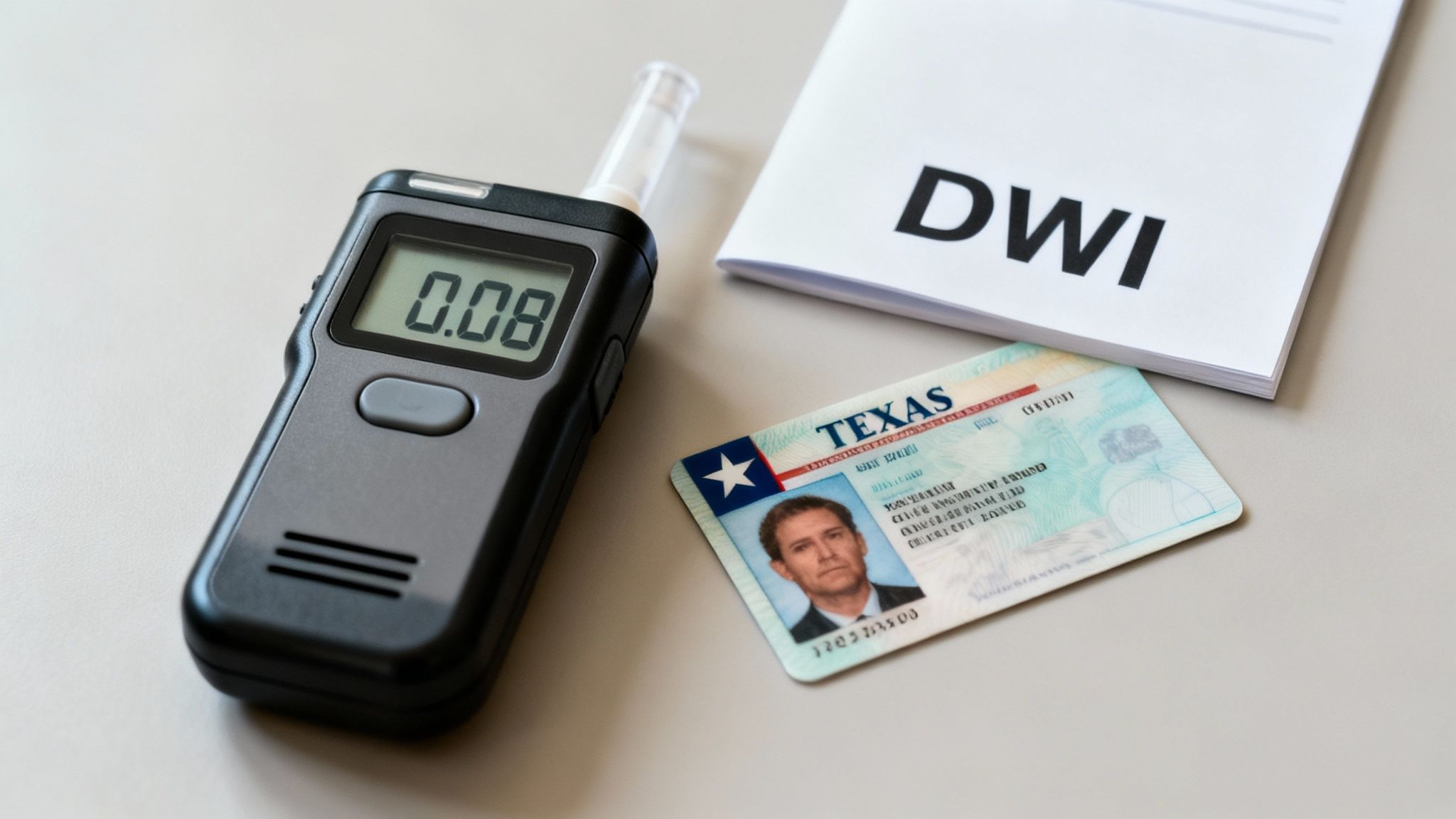
In Texas, the prosecutor has two different ways to prove you were intoxicated while operating a vehicle in a public place. They only need to convince a jury of one of these to secure a conviction.
The Two Paths to a DWI Conviction
The state can prove intoxication by demonstrating either of the following:
Per Se Intoxication: This is the most straightforward path for the prosecution. If they can show your Blood Alcohol Concentration (BAC) was 0.08% or higher at the time you were driving, you are considered intoxicated under the law. It doesn’t matter if you felt perfectly fine or passed every test—the number is all they need. This is why breath and blood test results are such powerful pieces of evidence for them.
Impairment of Faculties: This route is far more subjective. Here, the state tries to prove you lost the "normal use of your mental or physical faculties" because of alcohol or drugs. This is critical. It means you can still be convicted of DWI even if your BAC was below the legal limit of 0.08%, as long as a prosecutor can convince a jury your abilities were compromised.
To prove impairment, they will rely heavily on the officer's observations: your driving patterns, your appearance, how you spoke, and—most importantly—your performance on the Standardized Field Sobriety Tests (SFSTs). These tests are designed for one reason: to collect evidence of impairment that can be used against you.
How a Houston DWI Lawyer Builds Your Defense
Imagine the state's case as a table. A high BAC result is a very strong leg for that table to stand on. But what happens if that test result is flawed, thrown out, or never existed in the first place? Suddenly, the prosecutor has to rely entirely on the officer's subjective opinions to keep their case from collapsing.
An officer’s opinion that you failed a field sobriety test is just that—an opinion. A skilled Houston DWI lawyer knows exactly how to challenge the way these tests were administered and interpreted to create reasonable doubt in the prosecution's case.
This is where a real defense strategy comes into play. An experienced Texas DUI attorney will pick apart every piece of evidence. Was the breathalyzer machine calibrated correctly? Did the officer follow the strict national guidelines for administering the sobriety tests? Could a medical condition or even uneven pavement explain your performance? Asking these questions can dismantle the state’s argument, piece by piece.
DWI vs. DUI: What Is the Difference in Texas?
People often use the terms DWI and DUI interchangeably, but in Texas, they refer to completely different offenses. Knowing the distinction is key to understanding the charge you are actually facing.
DWI (Driving While Intoxicated): This is the charge for adults 21 and over who operate a motor vehicle while intoxicated, as defined by either a BAC of 0.08% or higher or by the loss of normal faculties.
DUI (Driving Under the Influence): In Texas, this charge is exclusively for minors under 21 who are caught driving with any detectable amount of alcohol in their system. It is a Class C Misdemeanor and has a different set of penalties than an adult DWI.
If you are reading this guide about a first DWI in Texas, you are facing a DWI charge, not a DUI. Knowing precisely what you are up against is the first step toward building a defense that protects your rights, your license, and your future.
Texas DWI Penalties Explained
If you’re facing a charge for a first-time DWI in Texas, it's natural to worry about the worst-case scenarios. Knowing the potential penalties is important, but remember: these are potential outcomes, not your destiny. A good DWI lawyer works to ensure they never become your reality.
A standard first-time DWI in Texas is charged as a Class B Misdemeanor. Even though it's the least severe DWI charge for adults, the state comes down hard. The penalties are designed to be a serious wake-up call, impacting your finances, your freedom, and your ability to live your daily life.
Standard Penalties for a First DWI in Texas
For a typical first-offense DWI—where your blood alcohol concentration (BAC) is under 0.15—the law outlines a specific range of punishments. This is the baseline of what a conviction could mean for you.
- Fines: You could face a fine of up to $3,000.
- Jail Time: A conviction comes with a mandatory minimum of 72 hours in jail, with a maximum sentence of up to 180 days.
- DWI License Suspension: Expect to lose your driving privileges for anywhere from 90 days to a full year.
- Annual Surcharges: After a conviction, you will have to pay an annual fee to the Texas Department of Public Safety (DPS) to keep your license. This surcharge can be up to $2,000 per year for three years, adding an additional $6,000 on top of your original fine.
These penalties show just how seriously Texas takes drunk driving. With over 90,000 DWI arrests and more than 1,000 drunk driving-related deaths each year in the state, the legal system is built to send a strong message. A conviction can ripple through your life, affecting your job and personal relationships. If you want to dig deeper into the numbers, you can find additional Texas DWI statistics here.
When a First DWI Becomes More Serious
Not all first-time DWIs are treated equally. Certain factors, known as aggravating circumstances, can instantly upgrade your charge from a Class B to a Class A Misdemeanor, bringing much harsher penalties. Prosecutors will use these facts to push for a more severe punishment.
A higher BAC or having a child in the car can dramatically change the game, even for a first offense. The goal of a strategic defense is to attack the very evidence that leads to these enhancements.
The two most common reasons for an enhanced charge are:
- High BAC Level: If your BAC test result is 0.15 or higher, the charge is automatically enhanced to a Class A Misdemeanor.
- Child Passenger: Driving while intoxicated with a passenger under the age of 15 is not a misdemeanor at all—it’s a State Jail Felony. The consequences are life-altering and require an immediate, aggressive legal defense.
To see how just one factor—a high BAC—can change everything, take a look at the table below.
Texas DWI Penalties at a Glance: First Offense
This table provides a clear side-by-side comparison of the penalties for a standard Class B Misdemeanor versus an enhanced Class A Misdemeanor for a first-time DWI.
| Penalty Type | Standard First DWI (Class B) | Enhanced First DWI (Class A) |
|---|---|---|
| Maximum Fine | Up to $3,000 | Up to $6,000 |
| Maximum Jail Time | Up to 180 Days | Up to One Year |
| License Suspension | 90 Days to 1 Year | Up to 2 Years |
| Ignition Interlock | Possible Requirement | Often Mandatory |
Seeing these maximums can be intimidating, but remember, the primary job of your defense attorney is to fight for a complete dismissal or, at a minimum, a significant reduction. An experienced Texas DWI lawyer will scrutinize every piece of evidence—from the traffic stop to the accuracy of the BAC test—and negotiate with prosecutors to protect your future. You do not have to accept these penalties as a foregone conclusion.
Navigating the Two Cases Against You
After a DWI arrest, it can feel like you are being attacked from all sides. One of the most confusing parts of the process is realizing you aren’t just fighting one battle—you’re fighting two separate legal cases at the same time.
This two-front war is a key reason you need a strategic defense right from the start. On one front, the State of Texas is pursuing a criminal charge against you in court. On the other, the Department of Public Safety (DPS) is launching its own civil action to take away your driver’s license.
These two cases run on parallel tracks, each with its own timelines, rules, and consequences. Winning one does not guarantee you will win the other, which makes a coordinated legal strategy essential to protect both your freedom and your driving privileges.
The Criminal Case: Your Day in Court
This is the case most people think of when they hear "DWI charge." The criminal case is handled in county or district court, where a prosecutor will try to prove you are guilty of Driving While Intoxicated beyond a reasonable doubt.
The stakes here are high, as this is where potential penalties like fines, probation, and jail time are decided. The process can feel long and overwhelming, involving several key stages:
- Arraignment: This is your first court appearance where the formal charges are read, and you enter a plea (typically "not guilty").
- Pre-Trial Motions: Your attorney files motions to challenge evidence, such as an illegal traffic stop or an improperly administered breath test.
- Plea Negotiations: Your lawyer may negotiate with the prosecutor for a potential dismissal or a reduction in charges.
- Trial: If no agreement is reached, your case will be presented to a judge or jury who will decide your guilt or innocence.
This is where a skilled DWI lawyer goes to work, dismantling the state’s arguments, questioning the evidence, and fighting to protect your record.
The Civil Case: The Fight for Your License
Completely separate from the criminal courts, the Texas DPS initiates an administrative case to suspend your driver's license. This is known as the Administrative License Revocation (ALR) process, and it’s triggered automatically if you refuse a breath or blood test, or if you provide a sample that shows a BAC of 0.08% or higher.
This process exists because of Texas's “implied consent” law. The law states that by driving on a public road, you have legally consented to provide a breath or blood sample if lawfully arrested for DWI. Refusing to do so comes with its own automatic penalty—a license suspension.
The single most critical thing to understand about the ALR process is its unforgiving deadline. You have exactly 15 days from the date of your arrest to formally request an ALR hearing. If you miss this deadline, your license will be suspended automatically. No exceptions.
This infographic shows the potential penalties you face in the criminal case, which run parallel to your license suspension fight.
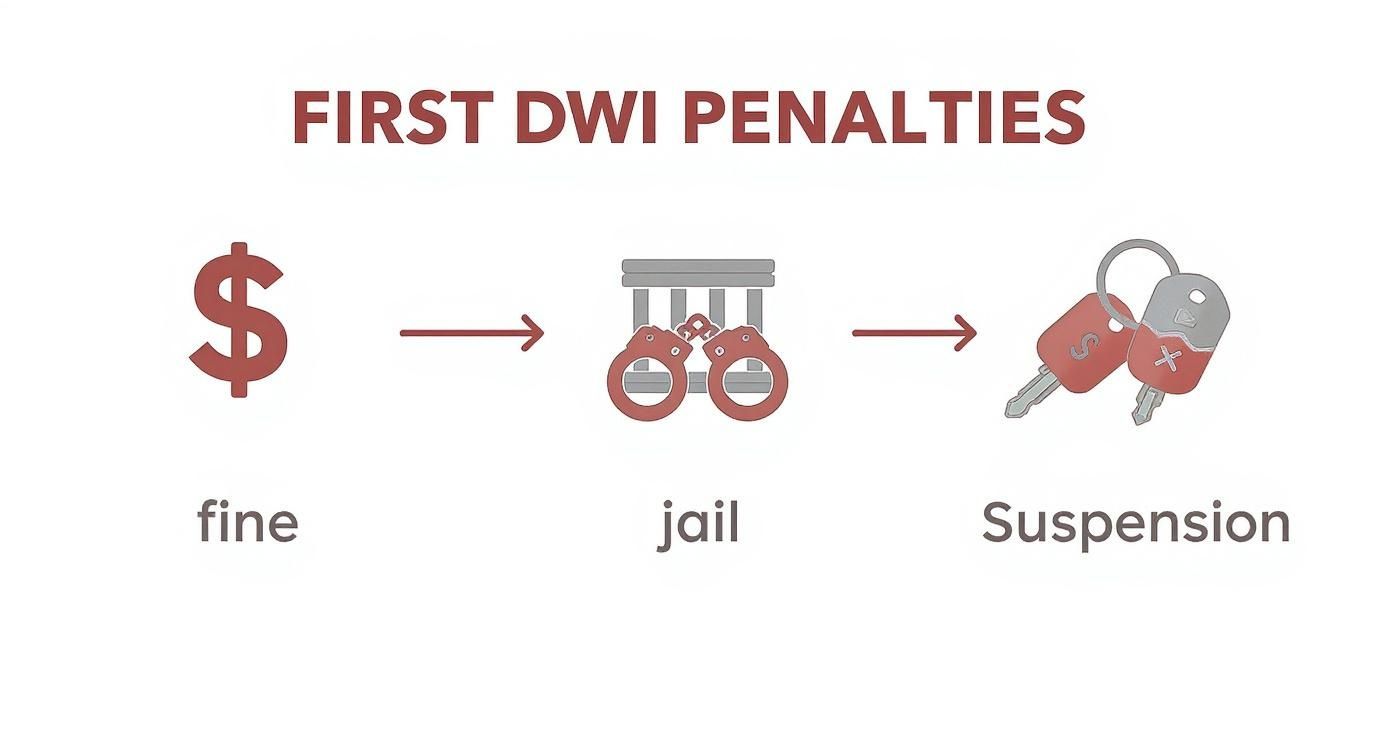
The penalties shown here are entirely separate from the administrative license suspension, highlighting the two-front battle you're facing.
Why the ALR Hearing Is Your First Line of Defense
Requesting an ALR hearing isn't just about trying to save your license—it is a powerful strategic tool. This hearing is often the first opportunity your attorney has to question the arresting officer under oath, long before the criminal trial even begins. You can learn more about how we approach this critical step by reading our detailed guide on the Administrative License Revocation process in Texas.
During the ALR hearing, your lawyer can gather invaluable information and start building your defense by:
- Challenging the Traffic Stop: They can question the officer about their reason for pulling you over in the first place.
- Examining Test Procedures: They will scrutinize how the field sobriety tests and chemical tests were administered.
- Uncovering Inconsistencies: This is the chance to lock the officer into sworn testimony that can be used to find weaknesses in their story later on.
Successfully managing both the criminal and civil cases requires an experienced attorney who understands how to make them work together. By acting fast to request your ALR hearing, you not only protect your right to drive but also gain a critical advantage in your fight to win the criminal case.
How to Fight a DWI Texas: Building a Strong Defense
Being arrested for a first-time DWI in Texas can feel like the end of the road. But it’s critical to remember that an arrest is just the beginning of a legal process—it is not a conviction. The state carries the entire burden of proving its case against you beyond a reasonable doubt. A skilled DWI defense attorney knows exactly how to make that an incredibly difficult job for them.
Building a strong defense is like an investigation. It means meticulously reviewing every detail, from the moment the police lights appeared in your rearview mirror to the final breath or blood test result. The goal is simple: find the procedural mistakes, faulty equipment, and moments of human error that create the reasonable doubt needed to win your case.

Questioning the Initial Traffic Stop
Every DWI case starts with a traffic stop. An officer cannot just pull you over on a hunch. They must have reasonable suspicion that you have violated a law. This is a foundational constitutional right. If the stop itself was unlawful, any evidence they gathered after that point—sobriety tests, statements, and BAC results—can be thrown out of court.
An experienced lawyer will analyze the officer’s report and dashcam video to challenge their reason for the stop. Was it a clear traffic violation, like speeding or running a stop sign? Or was it something vague and subjective, like "weaving within your lane," which can often be successfully disputed?
A powerful defense strategy often starts by attacking the very foundation of the state's case. If the traffic stop was illegal, the entire case against you can crumble before it even begins.
How to Fight a Breath Test Result
Breath and blood tests that measure Blood Alcohol Concentration (BAC) might seem like damning evidence, but they are also prone to significant errors. The machines used for breath tests need to be perfectly calibrated and regularly maintained. Likewise, the procedures for drawing and storing blood samples must be followed to the letter to prevent contamination.
Your attorney can file motions to obtain all records for the specific breathalyzer used in your test or the lab that handled your blood sample. Was the officer who administered the breath test properly certified? Was the blood sample stored at the correct temperature? Any failure to follow these strict legal protocols can make the BAC result inadmissible in court. Success here is a cornerstone of effective Texas DUI pretrial motions defense, as it can remove the prosecution's strongest piece of evidence.
Challenging Field Sobriety Test Results
Standardized Field Sobriety Tests (SFSTs) are the go-to tool for officers trying to build a case for impairment on the roadside. But these tests are nowhere near foolproof. They are essentially physical coordination drills that many sober people would struggle with under ideal conditions, let alone on the shoulder of a busy road with flashing lights in their eyes.
A strong defense shows a judge or jury exactly why these test results are unreliable. We do this by focusing on several key factors:
- Improper Administration: Officers must follow a strict, standardized script when giving these tests. Any deviation can render the results invalid.
- External Factors: Things like poor lighting, an uneven road surface, bad weather, or even the type of shoes you were wearing can seriously affect your performance.
- Medical Conditions: A host of health issues, old injuries, or even just being tired can mimic the signs of intoxication and cause a person to "fail" the tests.
By exposing how subjective these tests really are, an attorney can argue that the officer’s conclusion is just an opinion, not a scientific fact.
Ultimately, every piece of evidence the state plans to use against you can and should be questioned. An aggressive, detail-oriented defense is your best opportunity to protect your record and achieve a positive outcome, whether that's a dismissal, a reduction in charges, or a not-guilty verdict at trial.
Your Top Questions About a First-Time Texas DWI
When you're facing a DWI charge, your mind is likely racing with questions. The situation is confusing and urgent, and you need clear answers—fast. Here, we'll cut through the legal jargon and directly address the most common concerns people have after a first-time DWI arrest in Texas.
Can I Get a First-Time DWI in Texas Off My Record?
Yes, it is often possible to clear your record, but it all depends on the final outcome of your case. A clean record is always the ultimate goal, and Texas law provides two powerful tools to help you achieve it.
The best-case scenario is an expunction. If your case is dismissed or you are found not guilty at trial, you may be eligible for this. An expunction is a legal process that completely destroys all records of the arrest. It’s like it never happened.
The other path is an order of non-disclosure. You might qualify for this if you receive and successfully complete a specific type of probation. This order seals your record from the public, so it won’t appear on most background checks for jobs or housing. An experienced attorney can evaluate your case and fight for an outcome that makes one of these options attainable.
Should I Refuse the Breathalyzer Test in Texas?
This is one of the toughest decisions you can face in a high-stress moment, and there's no single right answer for everyone. Texas has an "implied consent" law, which means that by driving on public roads, you have already agreed to take a breath or blood test if lawfully asked. Refusing automatically triggers a driver's license suspension—usually for 180 days for a first refusal.
On the other hand, providing a breath sample gives the prosecutor what is often their strongest piece of evidence against you: a specific blood alcohol concentration (BAC) number. If you refuse, they are forced to build their case on more subjective evidence, like the officer's observations or your performance on field sobriety tests. That type of evidence is often much easier to challenge in court.
You are essentially weighing an immediate consequence (license suspension) against a long-term benefit (denying the state its best evidence). A skilled DWI lawyer can help you navigate the consequences, no matter what you decided to do in that moment.
What Is an Occupational Driver's License?
An Occupational Driver's License (ODL) is a critical lifeline if your regular license gets suspended. It is a special, restricted license granted by a judge that allows you to drive for court-approved, essential needs. It is a way to keep your life moving forward despite the suspension.
An ODL typically allows you to drive to and from places like:
- Your job or school
- Essential household duties, such as grocery shopping or picking up your children
- Medical appointments or court-ordered classes
To get one, your attorney must file a formal petition with the court. If the judge approves it, they will set strict limits on when and where you are allowed to drive. Often, a condition for obtaining an ODL is installing an ignition interlock device in your car. A lawyer can handle the entire petition process, ensuring all paperwork is filed correctly to get you back on the road legally and as quickly as possible.
How Much Does a Houston DWI Lawyer Cost?
The cost of hiring a top-notch Houston DWI lawyer can vary depending on the unique facts of your case, the attorney's experience level, and whether your case proceeds to a jury trial.
While it may seem like a significant expense, it’s crucial to view it as an investment in protecting your future. The long-term financial impact of a DWI conviction—thousands in fines, massive insurance premium hikes, and even potential job loss—can easily exceed the cost of a strong legal defense. Many of the best DWI firms, including ours, offer a free and confidential consultation. This gives you an opportunity to understand the charges you're facing, discuss potential defense strategies, and get a clear, transparent price without any obligation.
A DWI arrest can feel like it will define the rest of your life, but it absolutely does not have to. At The Law Office of Bryan Fagan, PLLC, our experienced DWI defense attorneys are here to protect your rights and fight for the best possible resolution for your case. We understand what is at stake, and we are ready to build the strategic, aggressive defense you deserve.
Don’t wait to get the help you need. Contact us today for a free, no-obligation case evaluation to discuss your options and take the first step toward protecting your future.