
A DWI arrest can be overwhelming—but you don’t have to face it alone. One minute you're driving, the next your world is spinning, and it has nothing to do with alcohol. It's a disorienting experience, but I want to be clear about something: an arrest is not a conviction.
Most first-time DWI offenses in Texas are classified as a Class B Misdemeanor. Before you even think about the courtroom, you need to understand the immediate next steps. What you do in the first few hours and days is critical for protecting your rights, your driver's license, and your future.
The legal process is more complex than most people realize. You are actually facing two separate legal battles, not one. A strategic defense starts the moment you see those flashing lights, and our goal is to guide you through it.
What Happens After a First DWI Arrest in Texas

The moments right after a DWI arrest are often a blur of confusion and anxiety. Knowing what to expect can give you back a sense of control and empower you to make the right moves for your case. The process moves fast, starting with the traffic stop and quickly escalating from there.
After pulling you over, the officer will likely ask you to perform Standardized Field Sobriety Tests (SFSTs). They may also request a chemical test—either a breath or blood sample—to measure your Blood Alcohol Concentration (BAC). If the officer believes they have probable cause, they will place you under arrest.
The Booking Process and Your Rights
From there, you'll be taken to a police station or county jail for booking. This is the administrative part of the arrest: they'll take your fingerprints, snap your mugshot, and record your personal information. It's during this time that you must remember your constitutional rights.
You have the right to remain silent. It is almost always in your best interest to politely exercise this right. Anything you say can and will be used against you in court, so it's far better to wait until you have spoken with a Houston DWI lawyer.
After booking, the next step is getting out of jail by posting a bond. A judge will set a bond amount, which is a financial promise that you’ll show up for all your future court dates. Posting bond allows you to return home while your case moves through the system.
Understanding the Two Separate Legal Battles
Here’s a common misconception that trips up many people: a DWI arrest isn't a single court case. You are now fighting two distinct legal challenges on parallel tracks, each with its own deadlines and consequences for your life.
- The Criminal Case: This is the one everyone thinks about. The State of Texas is prosecuting you for the crime of Driving While Intoxicated. The goal here is to fight the criminal charge to avoid penalties like hefty fines, jail time, and a permanent conviction on your record. This battle happens in a criminal court.
- The Civil (ALR) Case: This is the administrative fight for your driver's license. When you were arrested, the officer likely took your plastic license and handed you a piece of paper that serves as a temporary permit. This action kicks off the Administrative License Revocation (ALR) process.
It is absolutely critical to understand that you can win your criminal case but still lose your license in the ALR hearing, or vice versa. To truly protect yourself, you must address both challenges with a comprehensive strategy.
Taking swift, informed action is the very first step toward protecting your freedom and your driving privileges. That’s why we’ve outlined the most critical first steps below.
Immediate Actions After a Texas DWI Arrest
The clock starts ticking the moment you're arrested. Taking these steps immediately can safeguard your rights and lay the groundwork for a strong defense.
| Action Item | Why This Is Your First Priority |
|---|---|
| Contact a DWI Attorney | An experienced lawyer can advise you on your rights, guide you through the bond process, and immediately start working on both your criminal and ALR cases. |
| Request Your ALR Hearing | You have only 15 days from the date of your arrest to request this hearing. If you miss this deadline, your license will be automatically suspended. |
| Remain Silent | Do not discuss the details of your case with anyone but your lawyer. This includes law enforcement, cellmates, or even family and friends. |
| Document Everything You Remember | As soon as possible, write down every detail you can recall about the traffic stop, the arrest, and the tests you were asked to perform. Memories fade quickly. |
These initial actions can dramatically influence the outcome of your case. An experienced Texas DWI attorney will immediately tackle the time-sensitive ALR deadline and begin building a comprehensive defense strategy for both fronts.
What Am I Facing for a First DWI in Texas?
If you’ve been charged with your first DWI in Texas, the first thing you need to understand is what's really on the line. The state legally classifies a standard first-time DWI as a Class B Misdemeanor. That might sound like legal jargon, but it carries a specific set of potential penalties that can affect your freedom, your finances, and your future.
Our goal here isn't to scare you; it's to arm you with knowledge. When you know what the potential penalties are, you can work with an attorney to build the strongest possible defense. A proactive, strategic approach can make a significant difference in how these cases turn out.
The Standard Penalties for a First Offense
For a typical first DWI, the Texas Penal Code lays out a clear range of maximum punishments. It is important to remember that these are the worst-case scenarios, not a guaranteed outcome. A strong defense strategy is all about pushing back against these maximums every step of the way.
Here’s what the law allows a judge to impose:
- Fines: Up to $2,000 in court-ordered fines.
- Jail Time: Anywhere from 72 hours to 180 days behind bars.
- Community Service: Between 24 and 100 hours of mandatory service.
- License Suspension: Your driver’s license could be suspended for 90 days up to a full year.
- DWI Education Program: You'll likely have to complete a 12-hour DWI education course.
While the law sets these maximums, many cases resolve differently. For instance, a high percentage of first-time DWI cases result in probation rather than jail time. This statistic demonstrates that jail is far from a guarantee, and a skilled lawyer can work toward a more favorable outcome for you.
How "Aggravating Factors" Can Increase Penalties
Certain circumstances, which the law calls "aggravating factors," can elevate a first-time DWI from a Class B Misdemeanor to a more serious Class A Misdemeanor. If any of these apply to your case, the potential penalties become much steeper.
One of the most common aggravating factors is a high Blood Alcohol Concentration (BAC). If your BAC is measured at 0.15% or higher, the charge is automatically enhanced, even if it’s your very first offense.
A Class A Misdemeanor DWI comes with much harsher potential consequences:
- Fines: The maximum fine doubles to $4,000.
- Jail Time: The potential jail sentence increases to a full year.
Another common factor is having an open container of alcohol in your vehicle when you were arrested. This alone can add a minimum of six days in jail to any sentence you might receive. Understanding the full landscape of potential Texas DWI penalties and available defenses is the first step in protecting yourself. These are exactly the kinds of details a skilled Houston DWI lawyer will analyze to build a defense designed to get your charges reduced or dismissed entirely.
Protecting Your License The 15-Day ALR Deadline
When you're arrested for a DWI in Texas, most people assume the criminal charge is the biggest immediate problem. It's not. The most urgent threat is losing your driver's license, and it happens on a completely separate track from your criminal case—one that moves much, much faster.
This civil process is called the Administrative License Revocation, or ALR for short. Understanding how it works is absolutely critical if you want to keep driving.
Key Terms You Need to Know
- Implied Consent: When you get a Texas driver's license, you automatically agree to provide a breath or blood sample if law enforcement lawfully arrests you for DWI.
- Blood Alcohol Concentration (BAC): This is the percentage of alcohol in your bloodstream. In Texas, the legal limit for most drivers is 0.08%.
- Administrative License Suspension: This is a civil penalty separate from any criminal court sentence. It is handled by the Texas Department of Public Safety (DPS).
The ALR process is triggered by Texas's "implied consent" law. If you refuse a chemical test or provide a sample that shows a BAC of 0.08% or higher, the administrative suspension process begins immediately.
After your arrest, the officer likely took your plastic license and handed you a temporary driving permit. That piece of paper is more than just a temporary license; it's your official notice that a timer has started. You have exactly 15 days from the arrest date to request an ALR hearing.
If you miss that 15-day deadline, you automatically lose your right to challenge the suspension, and your license will be suspended on the 40th day after your arrest. There are no extensions or second chances.
This is why contacting a DWI attorney right away is so important. We can file the formal request for an ALR hearing on your behalf, which immediately pauses the automatic suspension until the hearing is held. This move not only buys you critical time but also gives us our first opportunity to challenge the state's case against you.
What Is the ALR Hearing?
The ALR hearing is not a criminal trial. It’s an administrative proceeding held before an administrative law judge. The focus is very narrow: the judge only wants to determine if the Texas Department of Public Safety (DPS) had the right to suspend your license.
To win, the DPS must prove three things:
- The officer had reasonable suspicion to pull you over.
- The officer had probable cause to arrest you for DWI.
- You either refused a chemical test or gave a sample showing a BAC of 0.08% or higher.
This infographic lays out the potential penalties you could face on the criminal side of your DWI case.
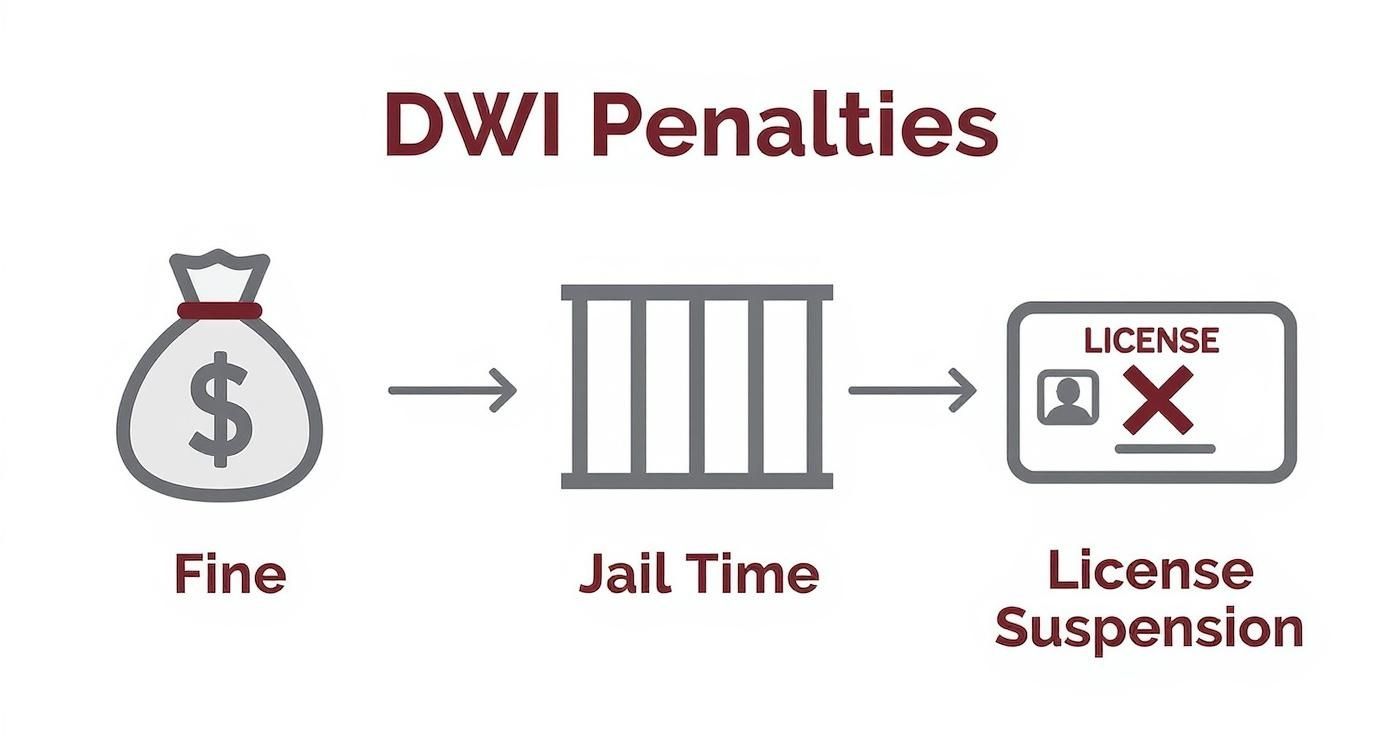
While license suspension is listed as a criminal penalty, remember that the ALR process is the first—and most immediate—battle you'll fight to keep your driving privileges.
A Critical Opportunity for Your Defense
The ALR hearing is much more than just a way to save your license. For an experienced DWI lawyer, it's a powerful strategic tool. This hearing is our chance to question the arresting officer under oath, long before your criminal trial ever begins.
Think of it as a preview of the main event.
We can lock the officer into their version of the story, find inconsistencies between their testimony and their police report, and gather crucial details about the traffic stop, field sobriety tests, and breath or blood testing procedures. Every weakness we uncover here becomes valuable evidence for your criminal defense. Often, what we learn in the ALR hearing can be the key to getting charges reduced or even dismissed entirely.
To get a better sense of what to expect, you can learn more about the complete Texas ALR hearing process in our detailed guide. It all starts with taking swift action within that critical 15-day window.
The True Cost of a First DWI Conviction
When you first see the potential fines for a first-offense DWI in Texas, it's easy to think that's the end of the story. A few thousand dollars, a headache, and it's over. But that couldn't be further from the truth.
The court-ordered fines are just the tip of the iceberg. A DWI conviction sets off a chain reaction of fees, surcharges, and long-term costs that can easily triple or quadruple the initial penalty, leaving a dent in your budget for years to come.
Understanding this total financial impact is critical. It shows that hiring an experienced DWI defense attorney isn't just another expense—it's a strategic investment to protect your financial future from a cascade of hidden costs.
Beyond the Courtroom Fines
The first wave of costs hits you right out of the gate, coming directly from the state and the court system. These are mandatory fees tacked onto any sentence, completely separate from whatever the judge orders you to pay.
For a standard Class B Misdemeanor first DWI, the fine can go up to $2,000. But if your Blood Alcohol Concentration (BAC) was 0.15% or higher, the charge is bumped up to a Class A Misdemeanor, and the maximum fine doubles to $4,000.
On top of that, the Texas Department of Public Safety (DPS) hits you with mandatory surcharges, adding another $3,000 to $6,000 that you’ll have to pay over three years. Right away, the real cost of a first DWI in Texas can climb past $5,000 before you’ve even thought about anything else. You can discover more insights about these penalties and how they are calculated in Texas law.
A DWI conviction is the gift that keeps on taking. The initial fines are just the down payment on a much larger financial commitment that includes state surcharges, class fees, and skyrocketing insurance rates.
And that's just the start. You'll also be on the hook for:
- Court Costs: These are the administrative fees every single person convicted of a crime has to pay.
- Probation Fees: If you get community supervision, you'll pay monthly fees directly to your probation officer.
- DWI Education Class: You'll be ordered to enroll in and pay for a state-approved alcohol education program.
- License Reinstatement Fees: After your suspension is over, you have to pay the DPS a fee to get your license back.
The Long-Term Financial Damage
Believe it or not, the most painful and lasting financial blow from a DWI conviction often comes from your own auto insurance company. A DWI on your record immediately flags you as a high-risk driver, and your premiums are going to go through the roof.
Many drivers see their annual rates double or even triple—an increase that can stick around for three to five years. It can feel like you’ve suddenly taken on another car payment, month after month, for years. Over time, these added insurance costs can easily add up to more than all the initial fines and court fees combined.
On top of everything else, a DWI conviction can impact your employment, especially if your job requires driving, a commercial license, or any kind of professional certification. The potential loss of income or career opportunities is a hidden cost that’s tough to put a number on, but it can be devastating.
When you add it all up—the direct costs and the indirect consequences—it becomes crystal clear that fighting to avoid a conviction is the most financially responsible decision you can make.
Building Your Strategic DWI Defense

Getting arrested for a DWI can make you feel powerless, as if the outcome is already decided. But this is the moment to stop reacting and start acting. An arrest is just an accusation—it is not a conviction.
The state has the heavy burden of proving every single element of its case against you beyond a reasonable doubt. A skilled DWI attorney knows that the prosecution's case is often built on a foundation with cracks in it, and our job is to find and expose them.
Building a powerful defense is like taking the prosecution's case apart, piece by piece. We meticulously review everything, from the instant the officer's lights flashed in your rearview mirror to the moment you were booked. Every detail matters, because every step of the process is an opportunity to challenge the state's narrative. This isn't about making excuses; it's about holding the system to the high legal standards required by Texas law.
Challenging the Initial Traffic Stop
The entire DWI case stands on one critical moment: the traffic stop. If the officer did not have a valid, legal reason to pull you over in the first place, then any evidence gathered after that—field sobriety tests, breath results, you name it—can be suppressed and thrown out of court.
This legal principle is often called the "fruit of the poisonous tree." The bad stop is the poisonous tree, and all the evidence that comes from it is the tainted fruit.
An officer needs what’s known as reasonable suspicion to pull you over. This means they must be able to point to specific, concrete facts suggesting you broke a traffic law. Vague excuses like "you were driving late at night" or "you looked lost" simply don't cut it.
We will dig into the officer’s report and, more importantly, the dashcam video to answer key questions:
- Did you actually commit the traffic violation the officer claims, like speeding or failing to signal?
- Does the video evidence match what the officer wrote in their report? Sometimes, it doesn't.
- Was the stop based on an anonymous 911 call that lacked enough detail to be reliable?
If we can prove the stop was unlawful, the case often falls apart before it ever gets started.
How to Fight a Field Sobriety Test Result
Field sobriety tests are standardized physical performance exercises used in nearly every DWI investigation, but they are far from perfect. Let's be honest: many completely sober people would struggle with these tests under ideal conditions. Now imagine trying to perform them on the side of a noisy road with police lights flashing in your eyes.
These tests must be administered and scored according to strict national guidelines. If the officer deviates from the protocol in any way, the results become unreliable and can be challenged in court.
An experienced defense attorney knows how to expose the flaws in these so-called "tests." We investigate whether the officer was properly trained to conduct them, if the instructions were given correctly, and if outside factors like uneven ground, bad lighting, or even your choice of footwear could have skewed your performance.
Furthermore, things like medical conditions, old injuries, fatigue, and simple nervousness can all mimic the signs of intoxication. We take a close look at your personal circumstances to find innocent, alternative explanations for why you might not have performed perfectly on these highly subjective exercises.
Attacking Chemical Test Evidence
At first glance, a breath or blood test result over the legal limit seems like game over. In reality, this "scientific" evidence is often the most fragile part of the prosecutor's entire case. These tests are governed by strict scientific and procedural rules, and any failure to follow them can render the results completely invalid.
A skilled attorney knows exactly where to look for weaknesses in the state's chemical evidence. This table highlights some of the common angles we investigate to build a strong defense.
| Area of Defense | Potential Issues an Attorney Will Challenge |
|---|---|
| Breath Tests | Was the machine recently and properly calibrated? Were maintenance logs kept? |
| Did the officer follow the mandatory 15-minute observation period before the test? | |
| Was the officer certified to operate the specific breathalyzer model used? | |
| Blood Tests | Can the prosecution prove the "chain of custody" was never broken? |
| Was the blood drawn by a qualified person in a sanitary environment? | |
| Did the lab follow proper scientific procedures, or was the sample contaminated? |
Every test has a margin of error, and we know how to use that to create reasonable doubt. Knowing exactly how to beat a DWI in Texas often comes down to this kind of deep dive into the science and procedures that the state relies on. It’s where a good defense can truly make all the difference.
Taking a Wider View: Texas DWI Enforcement
Being charged with a DWI can make you feel completely alone, as if the whole world is crashing down on you. But it can help to step back and see the bigger picture. The laws you’re facing today are the product of decades of tough-on-crime policies and aggressive prosecution strategies designed to get drunk drivers off the road.
Understanding this history helps explain why the system feels so unforgiving. It also brings a critical fact into focus: you are far from the only one going through this. Every year, thousands of Texans from every walk of life find themselves in the exact same spot, trying to navigate the complex legal maze you've just entered.
A Long History of Getting Tougher
The state’s attitude toward DWI has become more and more severe over the years. You can look back at historical data and see a clear trend. Even decades ago, there was a major push to crack down, with first-time DWI arrests actually dropping by about 10% between 1987 and 1990.
But despite these long-term efforts, DWI remains a major focus of law enforcement. In recent years, major counties like Harris, Dallas, and Tarrant have reported tens of thousands of DWI cases annually. These numbers prove that even with stricter penalties, arrests are as common as ever. You can dig into some of these historical DWI statistics in Texas to see the trends for yourself.
Knowing the history and scale of DWI enforcement in Texas underscores the importance of your defense. You are not just facing a single charge; you are up against a well-established system designed for vigorous prosecution.
This is precisely why having a skilled advocate in your corner is non-negotiable. A top-tier Houston DWI lawyer doesn’t just know the statutes as they’re written today. We understand the history, the public pressure, and the prosecutorial mindset that built this system.
That deep knowledge allows us to anticipate the state's arguments and build a proactive defense designed to protect your rights within this aggressive framework. Your case is unique, but the fight is one we know well.
Common Questions About a First Texas DWI
When you’re facing a first dwi offense in texas, it’s natural to have a million questions running through your mind. The uncertainty can be overwhelming, but getting clear, direct answers is the first step toward regaining control. Below, we’ve tackled some of the most common concerns we hear from clients just like you.
Can My First DWI Charge Be Dismissed in Texas?
Yes, a dismissal is absolutely a possible outcome—and it should be the primary goal of any strong defense strategy. An experienced Houston DWI lawyer doesn't just accept the state's story; they work to dismantle it, piece by piece, by meticulously challenging every part of the prosecution's evidence.
This isn't about finding a loophole. It's about holding law enforcement to the strict legal standards required of them. This often involves:
- Proving the initial traffic stop was unlawful and lacked reasonable suspicion.
- Showing critical errors in how the Standardized Field Sobriety Tests were administered or scored.
- Demonstrating that the breath or blood test results are unreliable due to machine malfunction, procedural mistakes, or sample contamination.
While no attorney can guarantee a specific outcome, a defense built to expose these weaknesses is designed to force a dismissal or put you in the best possible position for an acquittal at trial.
Am I Guaranteed to Go to Jail for a First DWI?
No, jail time is not a guarantee for a first DWI. It's a possibility, but far from a certainty. While a Class B Misdemeanor carries potential jail time of up to 180 days, many first-time offenders receive probation instead, especially with skilled legal representation fighting on their behalf.
A proactive Texas DUI attorney can negotiate for alternative sentences like community supervision, mandatory DWI education programs, and community service. The goal is to present you in the most favorable light to the court, highlighting reasons why jail time isn't necessary and helping you avoid being put behind bars.
How Long Will a First DWI Stay on My Record?
This is one of the most critical questions people ask, and for good reason. A DWI conviction in Texas stays on your criminal record permanently unless you can have it sealed through a legal process called an order of nondisclosure. This option is sometimes available for first-time offenders after they have successfully completed their sentence and satisfied a mandatory waiting period.
Protecting your permanent record is one of the most critical parts of a comprehensive DWI defense. The long-term consequences of a conviction can affect employment, housing, and professional licenses for years to come.
If your case is dismissed or you are found not guilty at trial, you may be eligible for an expunction. An expunction is even better than sealing, as it results in the complete destruction of all records related to your arrest. An attorney can advise you on the best path forward to keep your record clean and fight DWI Texas charges effectively.
A DWI charge can feel like a roadblock in your life, but it doesn't have to define your future. At the Law Office of Bryan Fagan, PLLC, our team is dedicated to building a strategic defense that protects your rights, your license, and your reputation. We have the local experience to guide you through this process with confidence. Don't wait to get the answers and the help you need. Contact us today for a free, confidential case evaluation to discuss your options. Visit us at https://texasduilawfirm.com.
