
A DWI arrest can be overwhelming—but you don’t have to face it alone. It can feel like a brand that follows you everywhere—job searches, apartment applications, and your general peace of mind. But a mistake in your past doesn't have to dictate your future. In Texas, a legal process called expungement offers a true clean slate by permanently destroying the records of an arrest.
Your Path to a Clean Slate After a Texas Arrest
A criminal record casts a long shadow, but it's critical to remember one thing: an arrest is not a conviction. For many Texans, there’s a clear way forward. The legal system gives you tools to move on from a past mistake, and understanding them is the first step toward getting your life back.
The most powerful of these tools is an expunction, which is a world away from a simple order of nondisclosure. While both provide relief, their results couldn't be more different.
- Expunction (or Expungement): This is the most complete remedy. It permanently erases the record of your arrest. We’re talking about the physical destruction of all files, from police reports to fingerprints. After an expunction, you can legally deny the arrest ever happened.
- Order of Nondisclosure: This is more like sealing the record. It hides it from public view, but it doesn't destroy it. Law enforcement and certain government agencies can still pull it up under specific circumstances.
Why Clearing Your Record is a Game-Changer
Getting a clean record is about more than just privacy; it's about opportunity. An expungement tears down the barriers that can hold you back both personally and professionally. Once your record is cleared, you can confidently chase your goals without that constant fear of a background check digging up a past mistake. This isn't just a legal filing—it's your second chance.
A DWI arrest can be completely overwhelming, but you don’t have to go through it alone. Taking action to clear your name is an achievable goal that opens doors and lets you move forward with confidence.
Taking That First Step
The journey to a clear record might seem complicated, but thousands of Texans successfully make it happen every single year. Between September 1, 2018, and early 2025, a total of 9,555 criminal records were expunged in Texas. In 2021 alone, that number peaked at 2,782 records cleared. These aren't just statistics; they represent a real commitment to rehabilitation and second chances. You can explore more data on Texas's commitment to clearing records yourself.
Our goal here is to give you immediate reassurance and a clear roadmap. With the right legal guidance from an experienced Houston DWI lawyer, you can figure out if you're eligible, navigate the paperwork, and confidently pursue a future that isn't burdened by a past arrest.
Confirming Your Eligibility for an Expunction in Texas
Before you can start the process of clearing your name, you must answer one critical question: are you legally eligible for an expunction in Texas? This is, without a doubt, the most important step. Texas law is incredibly specific about who qualifies for this powerful legal tool, and understanding the rules from the get-go will save you time and keep your expectations realistic.
An expunction is designed for situations where the justice system never found you guilty. Think of it as a way to completely erase the record when an arrest didn't stick and never led to a conviction. It’s a game-changer, but eligibility is strict, and not everyone can use it.
The Most Common Paths to Eligibility
So, who usually qualifies? Generally, you might be eligible for an expunction if your case ended in one of a few specific ways. These scenarios cover the vast majority of successful expunction petitions filed in Texas courts.
- You were arrested but never formally charged. Sometimes, after an arrest, the prosecutor’s office decides not to move forward. If the statute of limitations for that crime has passed, you can petition to have the arrest wiped from your record.
- Your case was dismissed. If the prosecutor filed charges but later dropped them for any reason—perhaps due to a faulty traffic stop or insufficient evidence—you are very likely eligible.
- You were acquitted at trial. This is the clearest path. If you went to trial and a judge or jury found you "not guilty," you have an absolute right to have the entire record of that arrest expunged.
- You successfully completed a pretrial diversion program. These programs are sometimes offered as an alternative to a formal court case. Once you complete all the terms, the case is dismissed, which opens the door for an expunction.
This chart breaks down the two main paths your record can take after a Texas arrest, leading to either a full expungement or a nondisclosure.
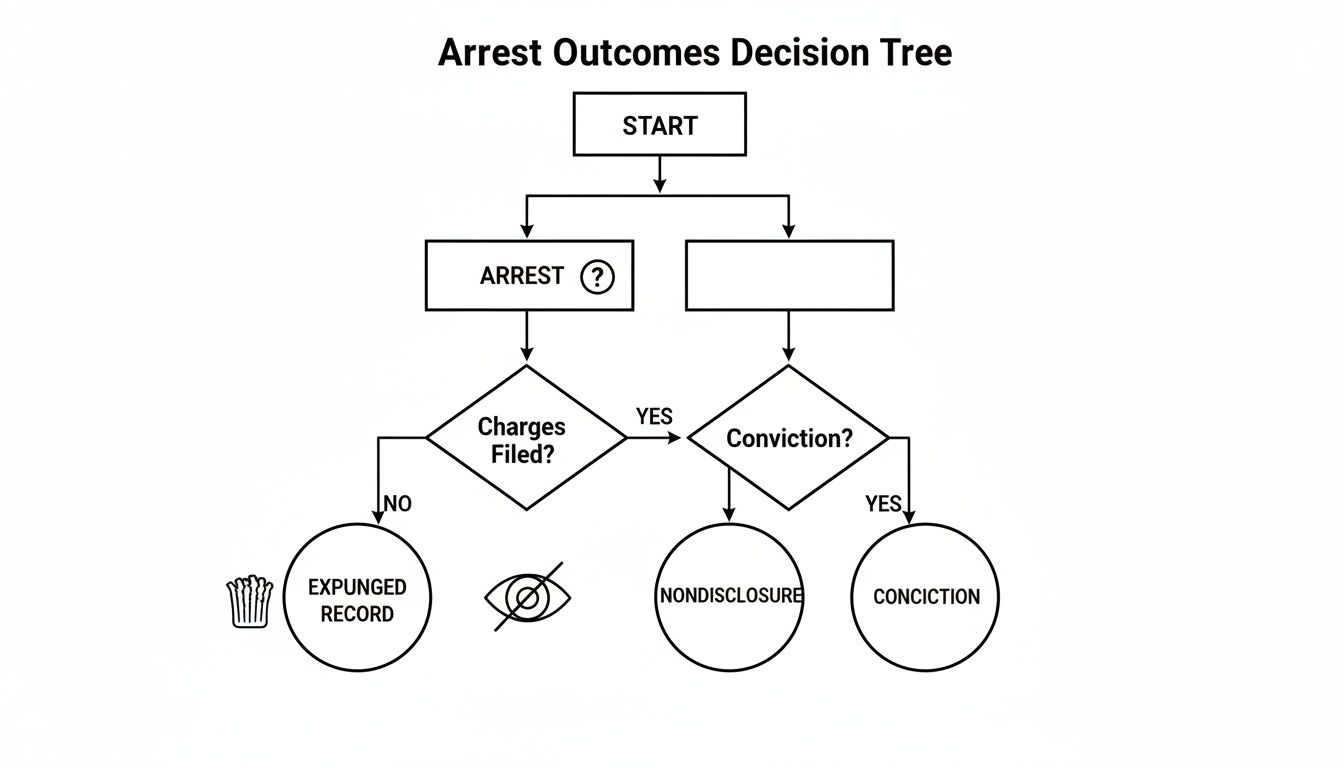
As you can see, an expunged record is completely destroyed, while a nondisclosure only seals it from public view. These are two very different legal outcomes.
Who Does Not Qualify for an Expunction
It's just as important to know who doesn't qualify. This clarity helps you avoid chasing a legal option that was never on the table for you in the first place.
In most cases, if you were convicted of the crime, you cannot get an expunction. This includes pleading guilty or no contest and serving a sentence.
A huge point of confusion for many people is deferred adjudication. If you received and successfully completed deferred adjudication for any offense other than a Class C misdemeanor, you are not eligible for an expunction. Instead, you may be able to get an Order of Nondisclosure, which seals your record but doesn't destroy it. Our guide on whether a DWI can be expunged in Texas dives into more detail on how this applies to drunk driving cases.
Expunction vs Nondisclosure: What's the Difference?
Understanding the difference between an expunction and a nondisclosure is crucial because it determines what happens to your criminal record. While both offer a fresh start, they are legally distinct remedies with very different outcomes. One destroys the record, while the other simply hides it.
This table breaks down the key distinctions to help you see which option might apply to your situation.
| Feature | Expunction (Expungement) | Order of Nondisclosure |
|---|---|---|
| What Happens to the Record? | The record is physically destroyed. All agencies must delete it. | The record is sealed from public view but not destroyed. |
| Who is Eligible? | Cases that were dismissed, acquitted, or never charged. | Typically for those who successfully completed deferred adjudication. |
| Public Access | The public cannot see the record because it no longer exists. | The public cannot access the record. |
| Law Enforcement Access | Law enforcement agencies cannot see the record. | Law enforcement and certain government agencies can still see the record. |
| Can You Deny It? | You can legally deny the arrest and charges ever happened. | You can deny the arrest and charges to the general public. |
Ultimately, an expunction is the gold standard for clearing your name, but an Order of Nondisclosure is still a powerful tool if you completed deferred adjudication.
Figuring out your eligibility requires a detailed legal analysis of your case's specific outcome and any waiting periods that might apply. An experienced Texas DUI attorney can review your records and confirm if an expunction is the right path forward for you.
Navigating the Texas Expungement Process
So, you've confirmed you're eligible for an expunction. Now comes the part where you actually engage with the legal system. That criminal record can feel like a heavy weight, but filing a Petition for Expunction is the first concrete step toward finally lifting it. This part of the process demands precision, attention to detail, and a solid grasp of legal procedures to make sure your fresh start becomes a reality.

This might sound intimidating, but it’s a structured legal action. An experienced Houston DWI lawyer can manage every technical detail, making a complex procedure feel much more straightforward. The goal is to file a petition that’s so thorough and accurate it sails through the court system with minimal resistance.
Gathering Your Essential Documents
Before a single legal document is drafted, you have to collect all the necessary paperwork related to your arrest. This is the foundation of your entire case. Even a small oversight at this stage can cause significant delays or, even worse, lead to a flat-out denial of your petition.
Think of it as building a case from the ground up. You need the complete, officially documented story of your arrest and how it was resolved.
Key documents you'll need include:
- Arrest Records: These are the official reports created by the police department when you were arrested.
- Charging Documents: If charges were filed, you need the formal complaint or indictment from the prosecutor’s office.
- Court Dispositions: This is arguably the most critical piece of paper. It officially states how your case ended—whether it was dismissed, you were acquitted, or another outcome was reached.
Hunting down these records can sometimes be a challenge, since different agencies hold different pieces of the puzzle. An attorney handles this crucial step by formally requesting records from all the right departments, ensuring nothing is missed.
Drafting the Petition for Expunction
With all the evidence in hand, the next step is to draft the Petition for Expunction. This isn't a simple form you fill out; it's a formal legal pleading that gets filed with the court. It must be drafted with absolute precision, citing the specific Texas statutes that make you eligible.
The petition must correctly identify all of the following:
- Your personal information
- The date and details of the arrest
- The specific offense you were arrested for
- The court and cause number of the original case
- The legal grounds for your expungement eligibility
This document is your formal request to the court, and it kicks the whole legal process into motion. Once drafted, it gets filed in the county court where the arrest originally happened.
A correctly filed Petition for Expunction is the key that unlocks the door to a clean slate. Any error, no matter how small, can bring the entire process to a halt, which is why professional legal preparation is so vital.
Notifying All Relevant Government Agencies
Here's one of the most commonly overlooked steps in the process of expunging a record in Texas: properly identifying and notifying every single government agency that might have a copy of your record. If you miss even one, that agency won't be legally required to destroy your records, which defeats the whole purpose of the expunction.
This list is often longer than people realize and can include:
- The arresting police department or sheriff’s office
- The county or district attorney’s office
- The county and district clerk’s offices
- The Texas Department of Public Safety (DPS)
- Any other state or federal agencies that may have received the information
An experienced attorney knows exactly which agencies to notify and how to serve them with legal notice properly. This diligence ensures that when the judge signs that final order, every trace of your arrest is wiped clean across all government databases.
What Happens After You File
After the petition is filed and all the agencies are notified, there's a waiting period. This gives the District Attorney’s office and other agencies a chance to review your petition and decide if they want to contest it. In most straightforward cases where eligibility is clear, no objections are raised.
If no one objects, the process moves smoothly toward a final hearing. Often, your attorney can attend this hearing on your behalf, so you may not even need to show up in court. The judge will review the petition, confirm you're eligible, and sign the Order of Expunction.
This final order is the legally binding document that commands all agencies to destroy your records. It's the culmination of the entire process—the final word that officially clears your name and lets you move forward without the burden of a past arrest.
What to Expect for Timelines and Costs
When you’re ready to finally put a criminal charge behind you, two questions always come up first: "How long is this going to take?" and "How much will it cost?" These are fair questions, and getting straight answers is key to managing your expectations. The journey to a clear record isn't instant; it involves legally required waiting periods and a multi-step court process, each with its own timeline and costs.
First, you can't file for an expunction the day after your case is resolved. Texas law has mandatory waiting periods, which are based on the statute of limitations for the crime you were arrested for. This is a non-negotiable step.
Mandatory Waiting Periods Before You Can File
The law requires a certain amount of time to pass after your arrest before you can ask the court for an expunction. This buffer gives the prosecutor’s office the full window of time they’re legally allowed to decide whether to file formal charges.
Here’s the general breakdown of those waiting periods:
- 180 days for Class C misdemeanors.
- One year for Class A or B misdemeanors.
- Three years for felonies.
It's critical to remember that this clock starts on the date you were arrested. If you try to file your petition even one day early, it will be automatically denied, and you'll have to start the entire process—and pay the fees—all over again.
This waiting period can feel like a frustrating delay when you're just trying to move on with your life. But it's a hard-and-fast rule designed to protect the integrity of the justice system, so patience here is essential.
The Expungement Process Timeline
Once that mandatory waiting period is over and your petition is filed, the actual expungement process kicks off. No two cases are exactly alike, but you can generally expect the process to span several months. After filing, all government agencies that have a record of your arrest must be notified, and they get a chance to respond. If no one objects, a judge will review the petition and sign the final Order of Expunction at a hearing.
From the day of filing to the day you have a signed order in hand, you should plan for about three to six months. For a more detailed look at what happens at each stage, check out our guide on the Texas DWI expungement timeline.
Recent legislative changes have actually helped speed things up. What used to be rigid waiting periods have been updated, and many courts are now using streamlined digital systems that have cut down on approval times.
A Transparent Look at the Costs
Think of an expungement not as a cost, but as an investment in your future. The total price tag is made up of a few different parts: court fees, service costs, and attorney fees.
- Court Filing Fees: Every county charges a fee just to file the petition. This usually runs between $300 to $500.
- Service Costs: We are legally required to serve a copy of the lawsuit on every single government agency that has your records. Depending on how many agencies were involved in your case, these costs can add up.
- Attorney Fees: This covers the legal expertise to get the job done right. An experienced attorney makes sure you’re truly eligible, drafts a flawless petition, ensures every agency is properly notified, and represents you in court.
While it's an upfront investment, you have to weigh it against the lifetime cost of having a criminal record. A successful expunction can open doors to better jobs, housing, and educational opportunities that might otherwise be closed to you. It’s one of the most powerful investments you can make in yourself.
What a Clear Record Means for Your Future
Getting a record expunged in Texas isn't just about winning a legal case—it's about getting your life back. A criminal record, even for an arrest that went nowhere, can put up invisible walls that block you from moving forward personally and professionally. A successful expunction knocks those walls down, giving you a legitimate fresh start.

The single most powerful benefit? You get the legal right to deny the arrest ever happened. Just think about it. When you're filling out a job application, a rental form for an apartment, or even a student loan request, you can confidently check "no" when asked about past arrests. An expunction gives you that power.
The Power of a Court Order
When a judge signs an Order of Expunction, it’s not a polite request. It’s a legally binding command. This order forces every single government agency that has a record of your arrest to physically destroy it. This isn't just sealing a file; it's a complete wipe.
This order goes out to:
- The police department that arrested you
- The district attorney's office
- The court clerk
- The Texas Department of Public Safety (DPS)
This destruction process means the record is gone for good. It becomes inaccessible to employers, background check companies, and the general public. That moment is effectively erased from your official history, giving you back your reputation and peace of mind.
Unlocking Your Full Potential
A clean slate opens doors that a past mistake may have slammed shut. Without the shadow of an arrest hanging over your head, you can chase after opportunities with real confidence.
- Career Advancement: You can compete for better jobs and promotions without the fear that a background check will ruin everything.
- Professional Licensing: Need a license for a career in nursing, real estate, or education? An arrest record won't be there to raise red flags.
- Housing and Loans: You can secure the apartment you want or apply for a home loan without a past charge creating unnecessary roadblocks.
The positive ripple effect is huge. We see it in community efforts like the Fresh Start program in Harris County, which shows just how much good this can do. At one event, they screened 300 participants, found about 75% were eligible, and helped 141 people get their records sealed in a single day. You can read more about this successful local initiative to see the impact.
A past arrest shouldn’t define your life. Expungement is the legal mechanism that allows you to move forward based on who you are today, not who you were on your worst day.
This is about more than just paperwork. It's about taking back control of your story and making sure one bad day doesn't dictate the rest of your life. An experienced Houston DWI lawyer can handle the complicated legal footwork needed to secure this freedom, letting you focus on building the future you deserve.
Why You Need an Experienced Attorney for Your Expungement
On paper, the steps to clear your record might look like a straightforward checklist. But in reality, the Texas expungement process is a legal minefield. It’s littered with procedural traps and strict deadlines where one tiny mistake can get your case thrown out, forcing you to start all over and pay the filing fees again.
This isn't just about filling out some paperwork. You're actually filing a formal lawsuit against the State of Texas, and you need to treat it with that level of seriousness.
Bringing The Law Office of Bryan Fagan onto your team isn't just for convenience—it's a strategic move to protect your rights. We’ve spent years defending Texans against DWI charges, which gives us an insider’s understanding of the criminal justice system from every angle. We know precisely what the courts and prosecutors are looking for in a petition, and we use that insight to build the strongest possible case for your fresh start.
How We Manage the Entire Legal Process
When you hire our firm, you can stop worrying about the legal complexities and focus on your future. We handle every single detail. We don't just fill out forms; we execute a precise legal strategy designed to secure your expunction as efficiently as possible.
Here’s what our hands-on approach looks like:
- Meticulous Eligibility Verification: First, we do a deep dive into your case history. We confirm you meet every single legal requirement before we file, which saves you from wasting time and money on a petition that’s doomed from the start.
- Flawless Document Preparation: We track down all the necessary arrest records and court documents. Then, we draft a legally airtight Petition for Expunction that leaves absolutely no room for technical errors or objections.
- Strategic Court Representation: Our attorneys appear for you at all court hearings. We’re prepared to professionally address any pushback from the District Attorney's office and advocate firmly for your right to a clean slate.
- Diligent Follow-Up: Our job isn't over when the judge signs the order. We meticulously follow up with every government agency to ensure they have fully complied and have actually destroyed your records as the law demands.
A past arrest shouldn’t define your future. Navigating the legal system alone is a risk you don’t have to take. We manage the complexities so you can move forward with confidence.
Having a knowledgeable attorney in your corner is often the single most important factor in a successful outcome. You can learn more about the specific advantages when you hire a lawyer for your DWI expungement and see how it strengthens your case.
An arrest record can feel like a heavy burden, but it's not one you have to carry by yourself. Let our team do the legal heavy lifting. Contact The Law Office of Bryan Fagan today for a free, confidential consultation to see how we can clear your record and help you reclaim your life.
Common Questions We Hear About Texas Expungements
When you’re trying to move past a criminal charge, the legal process can feel overwhelming. It’s only natural to have a lot of questions. Getting clear, straightforward answers is the first step toward feeling in control and ready to clear your name.
Below, we’ve tackled some of the most common questions our clients ask. Remember, while this gives you a good overview, every situation has its own unique details.
I Got Deferred Adjudication for My DWI. Can I Get It Expunged?
This is one of the biggest points of confusion, and the short answer is almost always no. In Texas, successfully completing deferred adjudication for a DWI does not make you eligible for an expungement. Legally, it's treated differently than a dismissal.
However, all is not lost. You might qualify for another powerful legal tool called an order of nondisclosure. A nondisclosure seals your record from public view, which can be just as effective for things like job applications and housing background checks. An experienced attorney can look at the specifics of your case to see which path is right for you.
How Long Does It Take for My Record to Be Completely Cleared?
Once a judge signs the final Order of Expunction, you've won the legal battle. But the administrative work is just getting started. That signed order must be sent to every relevant state and local agency—like the Texas DPS, the arresting police department, and the county clerk—with a direct command to destroy their records of your arrest.
This part of the process can take several months to be fully complete. And while private background check companies are legally supposed to update their databases, they don't always move quickly. A good attorney stays on top of this, following up to make sure every single agency has complied with the court's order.
It's crucial to be patient during this final stretch. The legal victory is immediate, but it takes time for all the different systems to catch up and fully wipe the slate clean.
Do I Actually Have to Show Up in Court for the Expungement Hearing?
In most cases, you won't need to be there in person. If the Petition for Expunction is drafted correctly, filed properly, and no government agency objects, the final hearing is often just a formality.
Your lawyer can typically handle that court appearance for you, presenting the final order to the judge for a signature. Your presence might be needed if the District Attorney’s office decides to contest your petition. If that happens, your attorney will let you know exactly what to expect and will be right there with you, prepared to protect your rights.
A past arrest shouldn't dictate your future. The team at The Law Office of Bryan Fagan, PLLC has the experience and strategic insight to guide you through the Texas expungement process. We are committed to helping Texans fight DWI charges and reclaim their lives. Contact us today for a free, confidential consultation to find out how we can help clear your record.