
A DWI arrest can be overwhelming—but you don’t have to face it alone. It can feel like a permanent black mark, a ghost that follows you for years. But for many, it's possible to legally and completely erase the arrest—as if it never even happened. The legal tool for this is called an expunction.
An expunction doesn't just hide your record. It orders government agencies to destroy it.
Your Path to a Truly Clean Slate After a DWI Arrest
That DWI arrest can be overwhelming, but you don’t have to let it define your future. Here’s a frustrating fact: even if your case was dismissed or you were found not guilty, the record of the arrest itself can linger. It can pop up on background checks, costing you job opportunities, housing, and peace of mind.
This is where getting the arrest expunged in Texas becomes so critical. It’s the single most powerful way to clear your name and get a genuine fresh start.

What an Expunction Actually Does for You
Imagine a future where you can honestly and legally answer "no" when an application for a job, apartment, or professional license asks if you’ve ever been arrested. An expunction makes that possible. It's a world apart from an order of nondisclosure, which just seals your record from public view. An expunction wipes the slate completely clean.
The benefits are life-changing. A successful expunction gives you total peace of mind. Here’s what it accomplishes:
- Complete Record Destruction: Every official record of your arrest held by government agencies—from the arresting police department to the district attorney’s office—is either physically destroyed or permanently deleted.
- Legal Right to Deny: You gain the legal right to deny the arrest ever occurred. This is your shield during job interviews, loan applications, and housing screenings.
- Restored Reputation: It removes the stigma of a DWI arrest, ensuring that one mistake or a wrongful accusation doesn't unfairly tarnish your personal and professional reputation.
- Career Protection: For professionals with licenses or those in sensitive fields, an expunction removes a huge barrier to career advancement and security.
Navigating Your Options with Confidence
This guide is built to give you a clear, straightforward overview of how to get a DWI arrest expunged in Texas. We’ll walk you through who qualifies, what the process really involves, and how the guidance of an experienced Houston DWI lawyer can help you navigate this complex legal path.
Your arrest doesn't have to be a life sentence. With the right legal strategy, you can turn the page for good and move forward without this chapter holding you back.
Facing the legal system alone is intimidating. At The Law Office of Bryan Fagan, PLLC, we believe in arming our clients with knowledge and providing a strong, strategic defense. We’re here to help you understand your rights and take the necessary steps to erase this mark from your record—permanently.
Understanding What Expunged Really Means in Texas
When you hear that a record has been "expunged in Texas," it's easy to misunderstand just how powerful that is. An expunction isn't about hiding or sweeping an arrest under the rug. It's about total and complete obliteration.
Think of your official criminal record like a detailed book about your life. Some legal remedies might glue a few pages together to hide an embarrassing chapter. An expunction, on the other hand, rips that entire chapter out, shreds it, and burns the pieces. By law, every government agency holding files related to your arrest must permanently delete or physically destroy them.
This isn't a small-scale cleanup. It includes records held by:
- The arresting police department or sheriff's office
- The county or district attorney’s office
- The court where the case was filed
- The Texas Department of Public Safety (DPS)
Once the expunction is granted, you can legally and honestly deny the arrest ever happened. That goes for job applications, housing forms, loan requests—pretty much everything. It’s as if it never occurred.
Expunction Is Not the Same as Nondisclosure
People often mix up expunction with an order of nondisclosure, but the two are fundamentally different legal tools. A nondisclosure order seals your record from the public's view. It's still there, though, and certain government and licensing agencies can still access it during background checks.
An expunged record is simply gone. For almost all intents and purposes, it no longer exists.
An expunction offers a true clean slate, not just a hidden one. It restores your legal standing to what it was before the arrest, providing a level of closure that sealing a record just can't match.
For many Texans, that distinction is life-changing. Imagine getting a DWI arrest dismissed after a skilled attorney proves there was no probable cause, but the record still haunts your job and housing searches years later. An arrest without a conviction shouldn't define someone's future.
How This Difference Impacts Your Future
The table below breaks down the critical differences between getting a record expunged versus having it sealed. Understanding this is the first step toward figuring out the right path for your situation.
Expunction vs Nondisclosure What Is the Difference
| Feature | Expunction (Record Destruction) | Order of Nondisclosure (Record Sealing) |
|---|---|---|
| Record Status | Permanently destroyed or deleted from all official government databases. | Hidden from the general public but still exists. |
| Agency Access | Inaccessible to virtually everyone, including law enforcement and government agencies for most purposes. | Accessible to certain government, law enforcement, and state licensing agencies. |
| Legal Denial | You can legally deny the arrest and any related proceedings ever occurred. | You can deny the arrest in most situations, but not all. |
| Eligibility | Typically requires a dismissal, acquittal, or that charges were never filed. | Often available after successfully completing deferred adjudication probation. |
As you can see, the requirements are miles apart, which makes it essential to determine which option you actually qualify for. While nondisclosure provides major benefits, only an expunction delivers that complete erasure. To learn more about whether sealing your record is a viable alternative for you, check out our guide on orders of nondisclosure in Texas.
An experienced attorney can review the specifics of your case and map out the best strategy to truly clear your name.
Figuring Out if You Qualify for a DWI Expunction
An arrest for DWI can throw your life into chaos, but a good outcome in court can open the door to a truly fresh start. The thing is, not every case qualifies for an expunction. Eligibility is the single most important hurdle, and in Texas, it all comes down to how your criminal case was ultimately resolved.
Understanding whether you have a path forward is the first—and most critical—step. Getting a DWI arrest expunged in Texas is a powerful legal remedy, but it’s reserved for situations where the justice system never found you guilty in the first place.
The Paths to Expunction Eligibility
The Texas Code of Criminal Procedure is very specific about who gets a clean slate. If your DWI case ended in one of the following ways, you're almost certainly on the right track to having that arrest record completely destroyed.
These are the most common ways to qualify:
- Acquittal: You went to trial and a judge or jury found you "not guilty." This is the clearest and most direct path to an expunction.
- Dismissal: The prosecutor decided to drop the charges against you. This can happen for a lot of reasons—maybe there wasn't enough evidence, your rights were violated, or your Houston DWI lawyer made a compelling argument to get the case thrown out.
- No Charges Filed: You were arrested, but the District Attorney's office never formally filed a case against you, and the time limit for them to do so (the statute of limitations) has run out.
One of the biggest myths out there is that if you finish probation for a DWI, you can get it expunged. That's just not true. A final conviction for DWI, even if you only got probation, permanently disqualifies you from ever wiping that specific arrest off your record.
Special Cases and Important Exceptions
On top of those main pathways, a few other scenarios might make you eligible. For instance, if you successfully completed a formal pretrial diversion program, your case was likely dismissed in a way that qualifies for expunction.
Another possibility involves deferred adjudication. While you can't get deferred adjudication for a DWI in Texas, if you were given deferred for a related Class C misdemeanor (like public intoxication), you might be able to get that specific charge expunged.
It’s crucial to remember that a final conviction for any DWI offense—whether it’s a first DWI in Texas or something more serious—makes that case ineligible for expunction. At that point, your only potential option might be an order of nondisclosure, which just seals the record from the public, but doesn't destroy it.
Navigating all these rules can feel like a maze. The specific details of your case—from the date of your arrest to the exact language used in the court's final order—all matter. A strategic Texas DUI attorney can dig into your case history, give you an honest assessment of whether you qualify, and map out the best way to move forward.
Navigating the Texas Expunction Process Step by Step
Filing to get your record expunged in Texas is a formal legal process, not just a matter of filling out some paperwork. It's a journey that requires precision and a close eye on the details, because one small mistake can lead to major delays or even get your case thrown out.
Think of it this way: the goal is to legally compel every single government agency holding a record of your arrest to destroy it. To do that, you have to follow the rulebook exactly. Understanding the road ahead is the best way to move forward with confidence and reclaim your clean slate.
Kicking Off Your Case with a Formal Petition
The first real step is filing a sworn legal document called a Petition for Expunction. Your attorney will draft this for you, and it serves as the foundation for your entire case. This isn't just a simple request; it's a comprehensive legal filing that must be submitted to the district court in the county where the arrest happened.
Getting this petition right is absolutely critical. It has to name every single government agency that could possibly have a record of your arrest. If you leave an agency off the list, they are not legally required to destroy their records, which defeats the whole purpose.
An experienced attorney knows exactly who to include, but the list usually covers agencies like:
- The arresting law enforcement agency (police department, sheriff's office, etc.)
- The District Attorney’s office that reviewed or prosecuted the case
- The county and district court clerks
- The Texas Department of Public Safety (DPS)
- Any other state or local agencies that might have received your arrest information
The infographic below shows the single most important factor in this process: how your original DWI case ended.
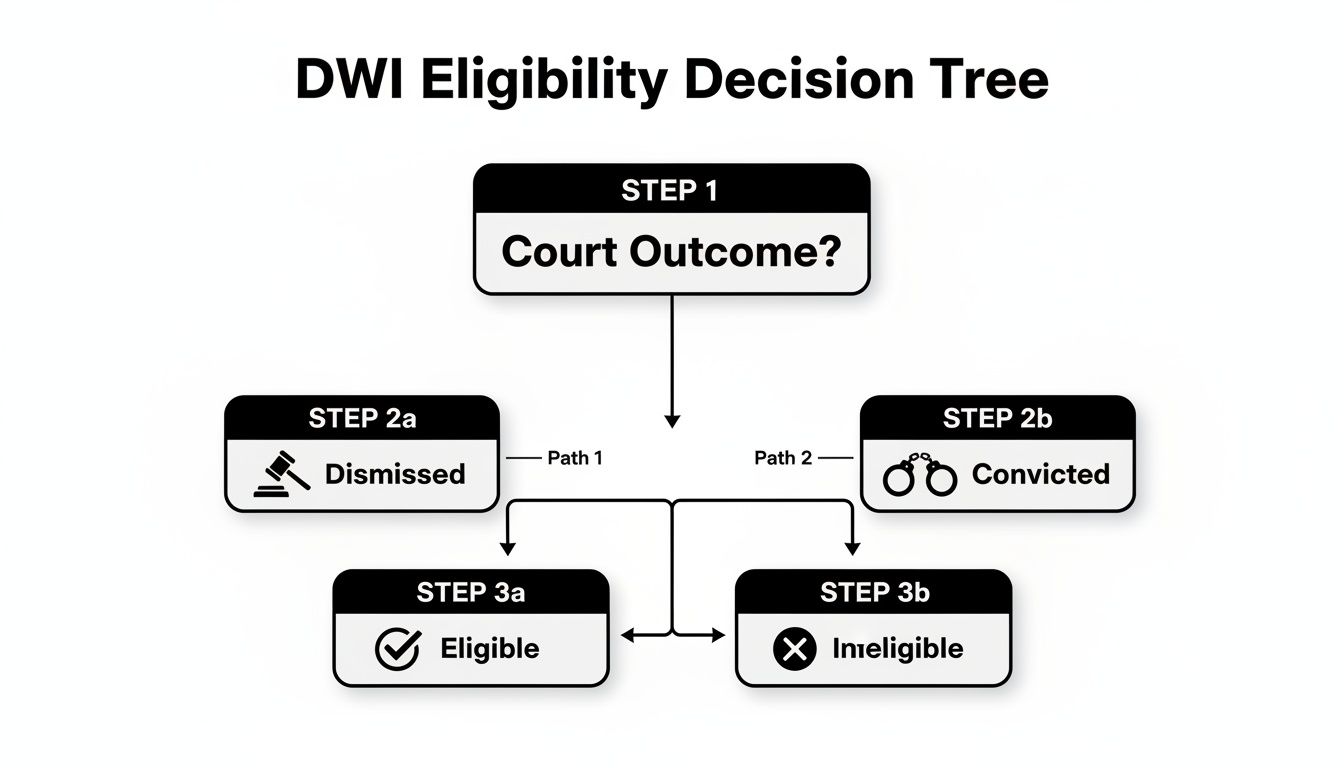
As you can see, a case that ends without a conviction—like a dismissal or an acquittal—is what opens the door to an expunction. A conviction, on the other hand, slams that door shut for good.
The Hearing and the Final Order
Once the petition is filed with the court, all the agencies you listed are formally served with a notice. They then have a specific amount of time, typically around 30 days, to respond or object. Honestly, in most straightforward cases where you are clearly eligible and the paperwork is perfect, no one objects.
If an agency does file an objection, or if the judge simply wants to review the facts, a hearing will be scheduled. This is a formal court proceeding where your attorney will stand up and argue why you meet all the legal requirements for an expunction under Texas law.
The most powerful moment in the entire process is when the judge signs the Order of Expunction. This legally binding document is the key that unlocks your fresh start, officially commanding all relevant agencies to destroy their records of your arrest.
After the judge signs it, the court clerk sends certified copies of that order to every single agency you listed in the petition. From that point on, those agencies have a legal duty to permanently erase your arrest from their files. The whole process usually takes a few months, but the result—a lifetime of freedom from a past mistake—is well worth the wait.
Common Roadblocks That Can Derail Your Petition
While an expunction offers a true clean slate, the legal journey to get there is lined with procedural traps. A simple clerical error or a missed deadline isn't just a minor hiccup—it can cause months of delays or even get your petition thrown out entirely. Knowing these potential pitfalls is the first step in building a solid strategy to sidestep them.
Getting a charge expunged in Texas is a game of precision. There’s almost no room for error, and you can bet that government agencies will object if anything is even slightly out of place. This is why a meticulous, proactive approach isn't just helpful; it's absolutely essential to your success.
Missing Critical Deadlines and Waiting Periods
One of the most common and frustrating mistakes we see is filing the petition too soon. Texas law is very clear about the specific waiting periods that must pass before you're even eligible to file. For an arrest like a DWI that was dismissed or never formally charged, you typically have to wait for the statute of limitations to run out.
This waiting period depends on how serious the offense was:
- Misdemeanors: The waiting period is generally two years from the date of the arrest.
- Felonies: The waiting period is longer, usually three years from the arrest date.
Filing your petition even a single day too early will trigger an automatic rejection. This forces you to start the whole process over from scratch, costing you valuable time and money. An experienced attorney’s first job is to verify these timelines down to the day, ensuring your petition is filed at the exact right moment.
Errors in the Petition Itself
Another frequent roadblock is a flawed Petition for Expunction. This legal document is the cornerstone of your entire case, and any inaccuracies can be fatal to your efforts. It needs to be perfect.
A single forgotten agency or a misspelled name can derail the entire process. The law requires you to notify every single government entity that might hold a record of your arrest, and the burden is on you to get that list right.
Some of the most common petition errors include:
- Failing to list all relevant agencies: This is by far the most critical mistake. If an agency isn't listed, it has no legal obligation to destroy its records of your arrest. A skilled lawyer knows the complex web of local, county, and state agencies that must be included.
- Incorrect case information: Simple clerical errors like a wrong case number, a typo in your name, or an incorrect date of arrest can give the District Attorney’s office an easy reason to object.
- Not meeting statutory requirements: Your petition has to clearly state the legal grounds that make you eligible, citing the correct sections of the Texas Code of Criminal Procedure.
Facing an Objection from the State
Even if your petition is drafted perfectly and filed on time, a government agency—usually the District Attorney's office—can still file a formal objection. This doesn't mean your case is lost, but it does mean you'll have to argue for your expunction in a court hearing.
An objection might be filed if the agency believes you aren't technically eligible, or sometimes if they simply feel there's a public interest in keeping the record. When this happens, having a strategic Houston DWI lawyer is your greatest asset. We anticipate these challenges, gather the evidence needed to counter their claims, and present a powerful, persuasive argument to the judge on your behalf. Our goal is always to manage these risks proactively, clearing the path so your case can move as smoothly as possible toward a successful outcome.
Why a Strategic Attorney Is Your Greatest Asset
After beating a DWI arrest, getting an expunction is the final step that truly wipes the slate clean. You've won the main battle, but this last part is just as critical. While the process might look like simple paperwork, trying to navigate it alone is a huge risk. The single most important decision you can make now is hiring a dedicated attorney who lives and breathes Texas expunction law.
Think of an experienced attorney as both your guide and your enforcer. They know every twist and turn of the procedural rules, how to track down every single government agency that holds a record of your arrest, and how to manage the unforgiving legal deadlines that can completely sink your case. This isn't just about filling out forms; it's about building an airtight legal strategy to prevent delays or pushback from the state.

Experience That Makes a Difference
At The Law Office of Bryan Fagan, PLLC, our years spent defending Texans against DWI charges give us a serious advantage. We’ve been in the trenches of local court systems all over the state, from Houston to Dallas-Fort Worth. We know the clerks, the judges, and the specific procedures they follow, which lets us spot potential problems long before they happen.
We get what’s on the line for you—your job, your reputation, and your ability to move on. Our entire approach is built around that reality.
- Flawless Petitions: We draft legally solid petitions that leave zero room for interpretation or error, making sure every single legal requirement is met.
- Ready to Fight: If a prosecutor or government agency tries to object to your expunction, we’re already prepared to step into court and make a powerful, evidence-based case for your right to a clean record.
- No-Nonsense Guidance: We give you clear, honest advice from the very beginning, so you’re never left guessing. You can find out more about the specific reasons why you should hire an attorney for your DWI expungement.
Your Future Is Worth Protecting
Getting your DWI arrest expunged in Texas is a detailed legal process where one small mistake can create a massive headache. You don’t have to face this alone. Our team is here to provide the strategic, confident, and reassuring guidance you need to finally put this chapter behind you for good.
You’ve already fought and won the DWI case itself. Let us handle this final, critical step to clear your name permanently. Your future is far too important to leave anything to chance.
If you’re ready to take back control and move forward without this arrest hanging over your head, we’re here to make it happen. Contact The Law Office of Bryan Fagan, PLLC today for a free, confidential consultation. Let's start the process of wiping your slate clean.
Your Top Questions About Texas DWI Expunctions, Answered
Going through the legal system after a DWI arrest can feel like navigating a maze. It leaves you with a lot of questions. For many, getting that arrest record expunged is the final, crucial step toward getting a truly clean slate, so it’s only natural to want to know exactly how it all works.
Here, we’re cutting through the legal jargon to give you direct, straightforward answers to the most common questions we hear from people looking to have a DWI arrest expunged in Texas. Our goal is to give you the confidence that comes with understanding your rights and options. A DWI arrest is overwhelming, but you don't have to figure out the aftermath alone.
How Long Does the Expunction Process Take in Texas?
This is a common question, and the answer is that it varies, but most cases wrap up within three to six months from the day the petition is filed. It’s not an overnight fix because the process involves several legal steps and requires coordination between different government agencies.
Once your attorney files the Petition for Expunction, every agency named in the document (like the prosecutor's office, the arresting agency, and the DPS) has a set amount of time, usually around 30 days, to respond or object. If no one contests your eligibility, things can move along pretty smoothly. However, if an agency objects and a hearing becomes necessary, it could add several weeks to the timeline.
Can I Get a DWI Conviction Expunged in Texas?
This is probably the most important question of all, and the answer is a firm no. Under current Texas law, a final conviction for a DWI offense is not eligible for expunction. This powerful legal tool is reserved only for cases that did not end with a guilty verdict.
You can typically pursue an expunction only if your DWI case ended in one of these specific ways:
- The prosecutor dismissed the charges.
- You went to trial and were acquitted (found "not guilty").
- You were arrested, but formal charges were never actually filed.
If you were convicted and served out your sentence, even if it was just probation, your record can't be destroyed through an expunction. Because court records can be complex, it's always a smart move to have a Houston DWI lawyer review your case's final disposition to confirm you're eligible.
What Happens After the Judge Signs My Expunction Order?
The moment a judge signs the final Order of Expunction is a huge win. That signature puts a legally binding record-destruction process into motion. From there, the court clerk is required to send certified copies of that order to every single government agency listed in your petition.
Those agencies are then legally required to destroy or permanently erase all their files—both physical and digital—related to your arrest. Once that's done, you can legally deny the arrest ever happened on applications for jobs, housing, loans, and even professional licenses. Your official record will be completely clear.
How Much Does It Cost to Get a DWI Record Expunged?
Think of the total cost of an expunction as an investment in your future. It's typically made up of a few different parts: court filing fees, the cost of formally serving notice to each agency, and the attorney's fees for handling the entire process from start to finish.
Filing fees can differ from county to county but usually land in the range of a few hundred dollars. The attorney's fees will depend on how complex your case is—for instance, how many agencies need to be notified or if the District Attorney's office decides to fight your petition.
While there are upfront costs, the long-term value of a clear record is immeasurable. It protects your earning potential, opens up career opportunities, and provides priceless peace of mind.
We believe in being upfront and transparent about costs. That's why we offer free consultations to give you a clear, detailed breakdown of what you can expect for your specific case.
Does an Expunction Clear My Driving Record Too?
Yes, it does. A successful expunction will also clear your official state driving record, which is maintained by the Texas Department of Public Safety (DPS). This is a critical piece of the puzzle to ensure the arrest is truly wiped from all major government databases.
For this to happen, the DPS must be specifically named as an agency to be notified in your Petition for Expunction. When the DPS gets that signed court order, they are legally obligated to remove any and all mention of the DWI arrest from your driving history. An experienced attorney makes sure this crucial step is never missed.
A DWI arrest doesn't have to define your future. At The Law Office of Bryan Fagan, PLLC, we provide the strategic and reassuring guidance you need to permanently clear your record. If you are ready to take the final step toward a clean slate, contact us today for a free and confidential case evaluation. Let our experienced Texas DWI attorneys help you move forward with confidence.