
A DWI arrest can be overwhelming, but you don't have to face it alone. A past arrest can feel like a heavy burden, casting a long shadow over your ability to secure a job, find housing, or even get a professional license. The stress and uncertainty of a public record can be overwhelming, but you're not powerless. Texas law provides powerful legal tools designed to help you move forward, unburdened by past mistakes. At The Law Office of Bryan Fagan, PLLC, we believe a single event should not define your entire future.
In Texas, you can clear certain criminal records through two main legal processes: expunction and nondisclosure. An expunction permanently destroys the records of an arrest, while a related process, called an order of nondisclosure, seals them from public view. Understanding which one applies to your specific case is the first critical step toward a fresh start.
Your Path to a Clean Slate in Texas Starts Here
Our goal is to demystify these legal options. We break down complex concepts like expunctions and orders of nondisclosure not as intimidating legal jargon, but as practical pathways toward reclaiming your life.
Understanding Your Options for a Clear Record
Think of an expunction as a complete and permanent erasure of your arrest record. Once a judge grants it, it’s as if the arrest never happened. You even get the legal right to deny it ever occurred.
An order of nondisclosure, on the other hand, acts like placing that record in a locked file—it's sealed from the general public but may still be accessible to certain government and law enforcement agencies.
Deciding which path is right for you depends entirely on how your case ended. Generally, expunctions are available for arrests that did not lead to a final conviction, such as:
- Cases that were dismissed outright.
- Situations where you were acquitted (found "not guilty") at trial.
- Instances where you were pardoned by the Governor.
Recent Changes in Texas Expunction Laws
The legal landscape for clearing records is always evolving. As of 2025, Texas has updated its laws to broaden eligibility and simplify the process for many people looking to clear their records.
These changes expanded eligibility to include certain first-time, non-violent misdemeanor convictions and reduced the waiting periods for nondisclosure petitions after completing programs like deferred adjudication. These updates are a big deal—they aim to remove barriers for countless Texans, paving the way for better employment and housing opportunities. To learn more about how these changes might affect you, you can read about navigating the new expunction rules in Texas.
Facing this journey alone can be daunting. A Houston DWI lawyer can evaluate your case, determine your eligibility, and guide you through every single step. You don't have to navigate this complex legal process by yourself; professional help is attainable and can make all the difference in securing the clean slate you deserve.
Understanding Expunction vs. Nondisclosure in Texas
If you’re looking to clear your record in Texas, you've probably encountered two legal terms that sound similar but are worlds apart: expunction and an order of nondisclosure. Both are designed to give you a fresh start, but they do it in fundamentally different ways. Understanding which one applies to your case is the first critical step.
Think of an expunction as hitting the delete button on your arrest record. It's the most complete remedy available. When a judge grants an expunction, all government agencies—from the arresting police department to the county court clerk—are ordered to physically destroy or permanently erase every file related to that arrest. From a legal standpoint, it’s as if it never happened. This gives you the powerful right to deny the arrest ever occurred, even under oath.
An order of nondisclosure, on the other hand, is more like putting your record in a locked vault. The record isn’t destroyed; it’s just sealed from public view. This means that for most purposes, like background checks for jobs or housing, it won't show up. However, law enforcement, prosecutors, and certain state licensing agencies can still access it if they have a legitimate reason.
This simple flowchart helps visualize how the outcome of your case points you down one of these two paths.
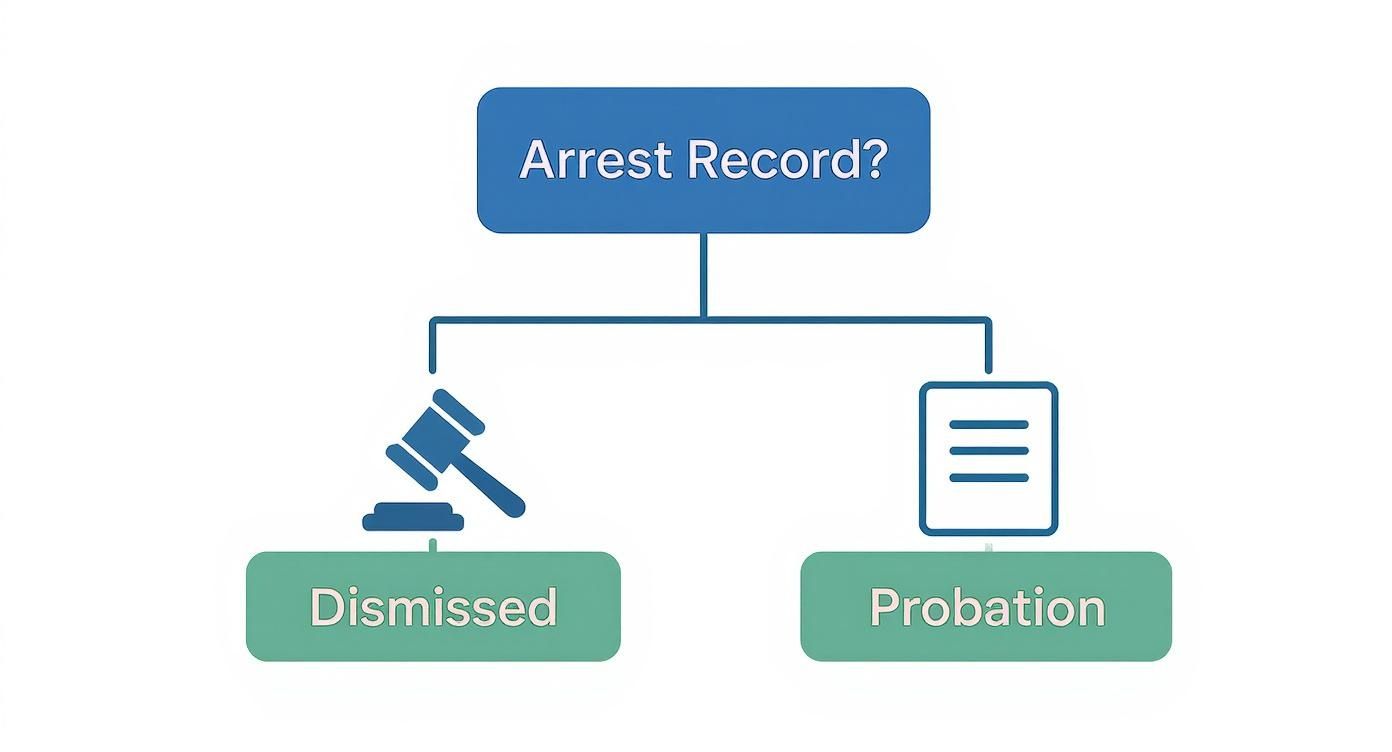
As you can see, what happened at the end of your case—whether it was dismissed outright or you completed a form of probation—is what truly determines which door might be open to you.
Who Qualifies for Each Path?
So, how do you know if you’re eligible for record destruction or just record sealing? It all comes down to the final disposition of your criminal case. This isn't a gray area; Texas law draws a very clear line.
An expunction is almost exclusively reserved for cases where the arrest did not end in a conviction or any form of community supervision. You’re likely on the path to an expunction if:
- The prosecutor dismissed your case.
- A judge or jury found you "not guilty" (acquitted you).
- You were pardoned by the Governor.
- You successfully finished a pretrial diversion program.
In contrast, an order of nondisclosure is the remedy for people who successfully completed a special kind of probation called deferred adjudication. When you complete deferred adjudication, the judge dismisses the case, and you avoid a final conviction. But the arrest record still exists and remains public until you take the next step to get it sealed.
To make this crystal clear, here’s a simple table breaking down the core differences.
Expunction vs. Nondisclosure at a Glance
This table breaks down the key differences between expunging and sealing a record in Texas to help you understand which option might apply to your case.
| Feature | Expunction (Record Destruction) | Order of Nondisclosure (Record Sealing) |
|---|---|---|
| What Happens to the Record? | The record is permanently destroyed or erased. | The record is sealed from public view. |
| Who is Eligible? | Cases that were dismissed, acquitted, pardoned, or completed pretrial diversion. | Cases where you successfully completed deferred adjudication probation. |
| Can You Deny the Arrest? | Yes. Legally, you can deny the arrest and the charge ever happened. | No. You cannot deny the arrest, but you don't have to disclose it on most applications. |
| Who Can See the Record? | No one. The records are gone. | Law enforcement and specific state agencies can still access it. |
| Common Outcome | The best possible outcome, providing a true clean slate. | A very good outcome that restores privacy for most practical purposes. |
Ultimately, expunction offers total erasure, while nondisclosure provides powerful concealment.
A Special Note on DWI Cases
When it comes to a DWI charge, the rules get even stricter. A DWI conviction in Texas can never be expunged. Period. However, if your DWI case was ultimately dismissed by the prosecutor or you were found not guilty at trial, the door to a full expunction may be wide open.
Nondisclosure has become an option for some first-time DWI offenses in recent years, but only under very specific circumstances that often involve a mandatory waiting period and the use of an ignition interlock device. The nuances are incredibly important, which is why our Texas DUI record sealing guide digs much deeper into this specific topic. The only way to know for sure where you stand is to have a Texas DUI attorney review the details of your case and map out the best path toward a clean slate.
Determining Your Eligibility to Clear a Record
So, can you actually clear your Texas criminal record? Answering that question is the single most important step in getting your life back on track. The final outcome of your case is what determines which legal tool you can use—an expunction or an order of nondisclosure.
Think of it like this: eligibility is a locked door, and the final disposition of your case is the key. Only the right key will open the door to a clean slate. Let's break down exactly what that means for you.
The Gold Standard Scenarios for Expunction
An expunction is the most powerful option out there. It doesn't just hide your record; it results in the complete destruction of all files related to your arrest. You're generally a strong candidate for an expunction if your case ended in one of these ways:
- Acquittal: You went to trial, and a judge or jury found you "not guilty." This is the cleanest and most direct path to an expunction.
- Pardon: You received a full pardon for the crime from the Governor of Texas.
- Dismissal: The prosecutor decided to drop the charges against you, and the time limit for that crime (the statute of limitations) has officially passed.
A dismissal is probably the most common way people become eligible. But here’s something most people don't realize: even when a case is dismissed, the arrest record stays public unless you take action. Millions of Texans are walking around with these damaging records, completely unaware they can wipe them away for good.
In fact, a recent analysis showed that over 4 million people in Texas currently qualify to have their records expunged, mostly because a judge dismissed their cases. That’s a massive number of people who could be free from the barriers that non-conviction records create for jobs and housing. You can explore the research on expunction eligibility in Texas to see just how big this opportunity is.
Understanding Nondisclosure Eligibility After Deferred Adjudication
What if your case didn't end in a dismissal or acquittal? If you successfully completed a program called deferred adjudication, you are likely a candidate for an order of nondisclosure, which seals your record from the public. Deferred adjudication is a special kind of probation where you avoid a final conviction by staying out of trouble and meeting the court's terms.
But here’s the catch: you can’t file for nondisclosure the day your probation ends. Texas law imposes mandatory waiting periods first.
Key Takeaway: The waiting period for a nondisclosure order depends on the type of offense. For most misdemeanors, you typically have to wait two years after the case is dismissed. For eligible felonies, the waiting period is usually five years.
During this waiting period, you absolutely cannot be convicted of or placed on deferred adjudication for any new crime (except for minor traffic tickets). Any new charge can reset the clock or even disqualify you completely, so staying on the right side of the law is critical.
The Strict Eligibility Rules for DWI Cases
When it comes to a DWI, Texas law is incredibly strict. It’s a common myth that any first-time DWI can just be wiped away. That's simply not true. A DWI conviction can never be expunged. Period.
However, you might be able to clear a DWI arrest record, but only under very specific circumstances:
- Your DWI case was dismissed by the prosecutor.
- You were acquitted (found not guilty) at trial.
In those two scenarios, you can go for a full expunction and have the arrest record destroyed. More recently, Texas law has opened a small door for nondisclosure (sealing) for some first-time DWI offenses, but the rules are extremely narrow. This option is typically only available for first-time offenders whose BAC was below 0.15 and who complete their sentence, pay all their fines, and satisfy a waiting period with an ignition interlock device installed on their car.
Because the rules are so precise, getting a professional evaluation is vital. You can learn more by reading our detailed guide that answers the question, "Can a DWI be expunged in Texas?" An experienced Houston DWI lawyer can analyze the unique facts of your case to determine if you're eligible and guide you toward the best possible outcome.
Navigating the Texas Expunction Filing Process
So, you’ve confirmed you’re eligible to clear your record. What now? The next phase is the formal legal process, which might sound intimidating, but it’s really just a roadmap with clearly defined steps. Following that map methodically is the key to getting your record wiped clean for good.
The journey to getting an expunction in Texas doesn't start in a dramatic courtroom scene. It begins with careful, quiet preparation. The entire process is built on precision, making sure every single agency that has a record of your arrest gets the memo and is legally ordered to destroy it. With the right approach, it’s a path you can absolutely navigate.
Step 1: Gathering All Your Case Information
Before a single legal document can be drafted, you need to pull together all the specific information about your case. Think of this as laying the foundation for your petition—if the foundation is weak, the whole thing can crumble.
You'll need to track down a few key details:
- Your Personal Information: This includes your full name, date of birth, driver’s license number, and social security number.
- The Arrest Details: The exact date of the arrest, the specific offense you were charged with, and the name of the arresting agency (like the Houston Police Department or Harris County Sheriff's Office).
- The Case Information: The court where your case was handled, the official case number, and what happened in the end (the disposition—was it dismissed, or were you acquitted?).
Most of this can be found in old court records or paperwork from your original case. Getting these details right is absolutely critical. Even a small error can cause major delays or, worse, get your petition denied.
Step 2: Drafting and Filing the Petition for Expunction
Once you have all your information lined up, it's time to draft the official "Petition for Expunction." This isn’t just a form you fill out; it's a formal legal document that gets filed with the district court in the county where the arrest happened.
The petition is your legal argument. It tells the judge the story of your case, lays out the facts, and explains exactly why the Texas Code of Criminal Procedure says you’re entitled to have the record destroyed. It also has to list every single government agency that could possibly have a record of your arrest.
Crucial Detail: This is where many people who try to file on their own run into trouble. If you forget to list even one agency that holds your records, you’ll end up with an incomplete expunction. Records can be hiding in places you wouldn’t expect, like the Texas Department of Public Safety (DPS) or the local prosecutor's office.
After the petition is drafted, it’s filed with the district clerk, which officially kicks off your case. You'll also need to pay a court filing fee, which usually runs between $300 and $500, depending on the county.
Step 3: The Hearing and the Final Order
After your petition is filed, it lands on the desk of the District Attorney's office for review. In a lot of straightforward cases where eligibility is clear and the petition is drafted perfectly, the DA won’t object. But if they do have an objection, or if the judge simply has questions, a court hearing will be scheduled.
At the hearing, your attorney will present your case and make the argument for why the expunction should be granted. The good news is that if you have a lawyer, you often don’t even need to show up for this hearing.
If the judge agrees with your petition, they will sign the "Order of Expunction." This is the golden ticket—the legally binding document that commands all those agencies to destroy every record of your arrest. The court clerk sends this order out, and the agencies typically have between 60 days to one year to comply. The whole process, from filing to final order, usually takes about three to six months.
What a Cleared Record Truly Means for Your Future
Getting an expunction or an order of nondisclosure is a huge victory. It’s more than just a legal win; it’s the moment you get to take back control of your own story. But what does that actually look like in your day-to-day life? The benefits are real, profound, and designed to give you back the opportunities you deserve.
When you successfully expunge records in Texas, the law gives you the right to deny the arrest ever happened. This isn't just a friendly suggestion—it’s a legal right. On job applications, housing forms, loan requests, and even in many sworn testimonies, you can truthfully and legally say that the event never occurred. It is a genuine clean slate.

How a Cleared Record Impacts Background Checks
One of the biggest anxieties after an arrest is the dreaded background check. An expunction order is a powerful directive sent to every single government agency holding a file on your arrest—from local police all the way up to the Texas Department of Public Safety. They are legally required to destroy all physical and digital records of the event. Period.
This means that when a potential employer runs a standard background check, that expunged arrest simply won't be there. It has been wiped from your official history, taking down a massive barrier to employment and professional growth.
An order of nondisclosure works a little differently. It seals your record from public view, meaning most private employers, landlords, and the general public won’t see it. However, certain government agencies and licensing boards can still access sealed records. It provides powerful privacy, just not the complete erasure of an expunction.
Restoring Your Rights and Opportunities
Clearing your record does more than just fix your reputation; it can restore fundamental rights and open doors that were slammed shut. This is where you feel the true, life-changing impact.
Common areas of concern that are positively affected include:
- Professional Licensing: Many state licensing boards for fields like nursing, real estate, or education can be incredibly strict about criminal records. A cleared record dramatically improves your chances of getting or keeping your professional license.
- Firearm Ownership: An expunction can help restore your right to purchase and own a firearm because the underlying arrest record is destroyed. The rules for nondisclosure can be more complicated here, making legal guidance essential.
- Peace of Mind: This might be the most significant benefit of all—the freedom from constant worry. You no longer have to live in fear of a past mistake surfacing at the worst possible moment.
The goal of clearing your record is simple: to ensure a past arrest doesn't unfairly limit your future. It's about giving you the ability to move forward with confidence, unburdened by an event that is no longer part of your public story.
The Future of Expungement in Texas
The process of clearing records is actually becoming more accessible. In a major policy shift, Texas is set to roll out an automated expungement system starting January 1, 2025. This system is designed to automatically identify and clear eligible records without forcing people to navigate the complex and costly petition process.
This forward-thinking legislation covers most misdemeanors and some felonies, streamlining what was once a lengthy procedure and removing barriers for countless Texans. To get a better handle on this change, you can learn more about the legislative efforts behind automatic expungements.
Whether you go through the traditional process or qualify for the new automated systems, the path to a clear record is more attainable than ever. The freedom and peace of mind that come with it are immeasurable.
Why an Experienced Attorney Is Your Greatest Asset
While the path to clear your record in Texas might seem like just a series of forms and deadlines, the reality is far more complex. The legal system is filled with procedural traps and dense statutes that can easily trip up anyone trying to go it alone.
A single mistake on your petition or a missed deadline can lead to an outright denial. That forces you to start all over, costing you valuable time, money, and emotional energy. Investing in professional legal guidance isn’t a luxury; it's the most effective strategy to secure the clean slate you deserve.
Avoiding Common and Costly Pitfalls
Many people who attempt to file on their own run into the same roadblocks. These aren't just minor clerical issues; they are errors that can completely derail your case and slam the door on your second chance.
Some of the most common pitfalls we see include:
- Misinterpreting Eligibility: The rules for expunction and nondisclosure, especially for DWI-related offenses, are extremely specific and full of nuances. A simple misunderstanding of waiting periods or the final outcome of your case can lead you to file for a remedy you don't even qualify for.
- Incomplete Petitions: Your petition must legally notify every single government agency that holds a copy of your record. Forgetting even one—like a local constable's office or a specific state department—results in an incomplete expunction, leaving a piece of your record exposed for anyone to find.
- Being Unprepared for a Hearing: If the District Attorney objects to your petition, a hearing is scheduled. This isn't a casual conversation; it's a formal court proceeding. An experienced attorney knows how to counter the state's arguments and effectively advocate for you before the judge.
The Strategic Advantage of Professional Counsel
At The Law Office of Bryan Fagan, PLLC, our entire role is to eliminate these risks. We manage every detail with the precision your future depends on.
From the moment you partner with us, we take control of the entire process. We will meticulously verify your eligibility, draft a flawless petition making sure every "i" is dotted, and file it correctly with the court.
Our goal is simple: to make the process as seamless and successful as possible for you. We handle the legal complexities so you can focus on moving forward with your life.
An attorney from our firm will represent you in court, often without you ever needing to appear. We ensure the final order is signed, distributed to all necessary agencies, and fully enforced. A Houston DWI lawyer is your greatest asset in the fight to expunge records in Texas, turning a complex legal challenge into a clear and manageable path toward your fresh start.
Common Questions About Expunging Texas Records
When you start looking into clearing your record, a lot of specific questions pop up. It's only natural. You're probably wondering about the timeline, the costs, and whether the rules are different for your specific type of case. Let’s tackle some of the most common questions we hear about how to expunge records in Texas.
Our goal here is to cut through the legal jargon and give you clear, straightforward answers. A past arrest doesn’t have to follow you forever, and getting the facts straight is the first step toward putting it behind you for good.
How Long Does the Expunction Process Take in Texas?
This is a big one. While it can vary a bit depending on the county and how complex your case is, you can generally expect the whole process to take three to six months. That's from the day the petition is filed to the moment a judge signs the final order.
But keep in mind, that's just the legal part. After the judge's order is granted, it can take several more months for all the different government agencies to actually get and destroy their copies of your records. An experienced attorney can keep things moving and make sure there are no unnecessary delays holding up your fresh start.
Can a First-Time DWI in Texas Be Expunged?
This is easily one of the most frequent questions we get, and the answer is tricky. Expunging a DWI arrest is tough, but it's possible in a few very specific situations. You might be eligible for a full expunction if your DWI case was:
- Dismissed outright by the prosecutor.
- Resulted in an acquittal (a "not guilty" verdict) after a trial.
- Pardoned by the Governor of Texas.
A DWI conviction, or even a case that ended in deferred adjudication, cannot be expunged. The good news? Texas law has changed, and now some first-time DWI convictions can be sealed with an order of nondisclosure, but only after you’ve met a mandatory waiting period and other strict requirements.
What Happens If My Petition for Expunction Is Denied?
If your petition gets denied, the arrest record unfortunately remains public. The reason for the denial is what really matters—it could be something as simple as a procedural mistake that can be fixed, or it could be a more fundamental problem with your eligibility.
If you aren’t legally eligible for an expunction in the first place, you might not get a second chance to refile. This is exactly why having a skilled Houston DWI lawyer handle your case from the very beginning is the surest way to avoid a denial and protect your one shot at clearing your name.
Do I Have to Attend the Court Hearing for My Expunction?
Most of the time, no. If the District Attorney's office agrees to the expunction and all the legal paperwork is filed perfectly, your attorney can almost always appear in court for you. You can go about your daily life while we handle all the legal legwork.
However, if the DA decides to object or the judge has specific questions about your case, your presence might be required. Your lawyer will keep you in the loop every step of the way and let you know if and when you need to be there.
A past mistake shouldn't dictate your future. At The Law Office of Bryan Fagan, PLLC, we are dedicated to helping Texans clear their records and move forward with confidence. If you're ready to explore your options for an expunction or nondisclosure, we invite you to request a free, no-obligation consultation to discuss your case. Let us help you secure the clean slate you deserve. Learn more and get started at https://texasduilawfirm.com.