
A DWI arrest can be overwhelming—but you don’t have to face it alone. You might be replaying the events, wondering if the police stop was fair or if you were unfairly targeted. It’s a common feeling, but while it may seem like the odds are stacked against you, Texas law provides powerful defenses, one of which is entrapment.
The idea that police can’t create a crime just to make an arrest is fundamental to our justice system. However, proving an entrapment defense requires a deep understanding of Texas DWI laws and a strategic legal approach. This article will break down what entrapment really means in the context of a DWI charge. We will provide clear examples of entrapment drawn from landmark cases and realistic Texas-specific scenarios.
Our goal is to empower you with knowledge, clarify your rights, and show you that a solid defense is attainable. We'll explore the critical difference between a legitimate police investigation and a situation where law enforcement crosses the line, inducing someone to commit an offense they otherwise would not have. Understanding these distinctions is the first step toward protecting your rights. A skilled Houston DWI lawyer can analyze the specifics of your arrest to determine if an entrapment defense is a viable strategy to fight your DWI in Texas.
1. Jacobson v. United States (1992) – The Inducement Standard
The U.S. Supreme Court case Jacobson v. United States set the modern federal standard for the entrapment defense. It established a critical principle: entrapment occurs when the government induces a person to commit a crime they were not already predisposed to commit. This landmark case provides a powerful framework for fighting charges where police tactics cross the line from investigation to persuasion. A DWI arrest can feel like a foregone conclusion, but understanding this standard is a key part of building a strong defense.
In Jacobson, federal agents spent over two years sending mail from fictitious organizations to a man who had previously ordered child pornography before it was illegal. They repeatedly encouraged him to break the new law. The Supreme Court found this was entrapment because the government couldn't prove Jacobson was predisposed to commit the crime before they began their aggressive, long-term campaign to persuade him.
How Jacobson Applies to Texas DWI Cases
While Jacobson was a federal case, its principles are highly influential and mirror the Texas entrapment defense outlined in Texas Penal Code § 8.06. In Texas, entrapment occurs if a law enforcement agent induces a person to commit an offense using persuasion or other means likely to cause a person to commit it, and the person was not ready and willing to commit the crime.
Consider this hypothetical scenario rooted in the Jacobson standard:
- The Situation: You are at a bar and have arranged for a rideshare to take you home. An undercover officer, posing as a friend, repeatedly insists on buying you drinks and goads you into driving, perhaps by challenging your pride or creating a false emergency that requires you to drive.
- The Arrest: Having had no prior intention of driving, you give in to the intense pressure and get behind the wheel. You are immediately pulled over and arrested for DWI by the officer's colleagues.
This scenario is one of the classic examples of entrapment because the crime only occurred due to the officer's persistent inducement. Your lack of predisposition to drive drunk is the cornerstone of the defense.
Actionable Steps for Your Defense
If you believe your DWI arrest involved police inducement, it is crucial to act quickly and strategically. You and your attorney can build a defense by focusing on the government's actions.
- Document Everything: Write down every detail you can remember about your interactions with law enforcement before the arrest. Who did you talk to? What did they say? How many times did they encourage you to do something you were hesitant about?
- Identify Witnesses: Were there other people who saw or heard the interaction? Their testimony could be vital to establishing that the police, not you, were the origin of the criminal idea.
- Preserve Digital Evidence: Save any text messages, social media communications, or call logs that show your original plans (e.g., ordering an Uber) or communications with the person who induced you.
Strategic Insight: The key is to shift the focus from your actions to the government's conduct. The prosecution must prove you were predisposed to commit the crime beyond a reasonable doubt. A skilled Texas DUI attorney can use evidence of inducement to create that doubt.
Facing a DWI can be overwhelming, but you don't have to navigate it alone. Understanding complex legal concepts like entrapment is a critical first step. Explore more about how these principles apply to building a robust case by reviewing various DWI defense strategies in Texas. An experienced Houston DWI lawyer can analyze the specifics of your arrest and determine if an entrapment defense is viable for you.
2. Texas Penal Code § 8.06 – State-Level Entrapment Defense
While federal cases like Jacobson are influential, Texas has its own specific law for the entrapment defense found in Texas Penal Code § 8.06. This statute provides a critical shield when police tactics go too far. It defines entrapment as occurring when a law enforcement agent uses persuasion or other means to induce a person to commit a crime, when that person was not otherwise ready and willing to do so. This is a powerful tool, as it shifts the legal focus onto the officer's conduct, not just your state of mind.
The Texas standard focuses on an objective test: would the police conduct have caused an ordinarily law-abiding person to commit the crime? This differs from the federal "subjective" test that zeroes in on the defendant's predisposition. For Texans facing a first DWI in Texas, this means the defense can succeed by showing the officer’s actions were so coercive that even a responsible person might have been pressured into making a terrible mistake.
How Texas Penal Code § 8.06 Applies to DWI Cases
The objective nature of the Texas entrapment law is crucial in DWI scenarios where police might use questionable tactics. The law provides a framework to challenge arrests that stem from aggressive or manipulative police behavior rather than a genuine intent to drive while intoxicated.
Consider these hypothetical examples of entrapment under the Texas statute:
- The Situation: You are pulled over for a minor traffic violation. The officer, without reasonable suspicion of intoxication, aggressively badgers you to perform field sobriety tests, creating a highly intimidating environment designed to produce a mistake.
- The Arrest: Flustered and confused by the pressure, you perform poorly on the tests. The officer uses this poor performance—a direct result of the coercive environment—as the sole basis for the DWI arrest, even though there was no initial probable cause.
This scenario highlights how police can create the conditions for an arrest. The defense would argue that the officer's intimidating inducement caused the "failure" that led to the arrest, a situation an ordinary person might also fall victim to.
Actionable Steps for Your Defense
If you feel your arrest was the result of police pressure or coercion, documenting the officer's conduct is paramount. Your attorney can use this evidence to build a powerful defense based on Texas's specific entrapment laws.
- Document Coercive Statements: Immediately write down any pressuring, threatening, or manipulative language the officer used. Did they threaten you with immediate jail time if you didn't comply with a non-mandatory test? Did they make false promises?
- Request All Footage: Your attorney should file a motion to obtain all dashcam and bodycam footage. This video evidence is often the strongest proof of an officer’s coercive tactics and can directly contradict their police report.
- File Discovery Motions: Seek all documents related to the traffic stop, including officer training materials. These can reveal if officers were following protocol or acting outside their authority.
Strategic Insight: In Texas, the focus is on the government's actions. Your defense isn't just about proving you weren't predisposed to drive drunk; it's about proving the police used methods likely to cause anyone to commit the offense. This is a subtle but powerful distinction that a skilled attorney will leverage.
A DWI arrest can feel like an impossible situation, but Texas law provides specific protections against improper police conduct. Understanding the various defenses for DWI cases in Texas is the first step toward protecting your rights. A Houston DWI lawyer can evaluate every detail of your stop and determine if an entrapment defense under § 8.06 is the right strategy for your case.
3. Sorrells v. United States (1932) – The Predisposition Test
The foundational U.S. Supreme Court case Sorrells v. United States is where the modern entrapment defense began. It established the "predisposition test" as the core of the analysis, asking a simple but powerful question: was the defendant an "unwary innocent" lured into crime by the government, or an "unwary criminal" who readily seized a criminal opportunity? This case underscores that law enforcement's job is to catch criminals, not create them. For anyone facing a DWI arrest in Texas, understanding this principle is vital.
In Sorrells, a federal prohibition agent, posing as a tourist and fellow war veteran, befriended the defendant. After multiple requests, the agent persuaded Sorrells to obtain illegal whiskey for him. The Supreme Court overturned the conviction, ruling that the agent's actions were entrapment because they implanted the criminal design in the mind of an individual who was not otherwise predisposed to commit the offense.
How Sorrells Applies to Texas DWI Cases
The principle from Sorrells is the bedrock of the Texas entrapment defense found in Penal Code § 8.06. The prosecution must prove you were "ready and willing" to commit the crime before law enforcement intervened. The focus is entirely on your state of mind and your past conduct, not just the officer's actions. Without proof of predisposition, the government's case for inducement can fall apart.
Here is a hypothetical scenario highlighting the Sorrells predisposition test:
- The Situation: You have a completely clean driving record and are at a quiet neighborhood gathering. An undercover officer, investigating an unrelated matter, begins pressuring you to drive to a nearby store to get more supplies, even offering to pay for them. You refuse several times, stating you have had a beer.
- The Arrest: The officer becomes insistent, fabricating a story about needing a specific item urgently for a medical reason. You reluctantly agree to the short drive, believing you are helping in an emergency. You are pulled over and arrested for DWI by a waiting patrol car.
This situation presents one of the clearest examples of entrapment because you showed a distinct lack of predisposition. Your initial and repeated refusals are powerful evidence that the criminal idea originated with the officer, not you.
Actionable Steps for Your Defense
If you were not predisposed to drive while intoxicated but were pressured into it by law enforcement, your defense must focus on proving your "unwary innocent" status. You and your Houston DWI lawyer can achieve this by gathering specific evidence.
- Establish a Clean Record: Provide your attorney with your complete driving history. A lack of prior DWI arrests, traffic violations, or alcohol-related incidents is crucial evidence of non-predisposition.
- Gather Character Witnesses: Identify friends, family, or colleagues who can testify about your responsible character and typical behavior regarding alcohol and driving. Their testimony can paint a picture of someone who would not normally commit this crime.
- Document Your Usual Habits: Write down your typical patterns of alcohol consumption and your usual transportation plans when you drink, such as always using a designated driver or rideshare service.
Strategic Insight: In an entrapment defense based on the Sorrells standard, your past is your greatest asset. The prosecution has the heavy burden of proving your predisposition beyond a reasonable doubt. A skilled attorney will use your history of law-abiding conduct to create a powerful contrast with the officer's inducement.
A DWI arrest can feel like your character is on trial, but you have the right to present a full defense. Exploring how to fight a first-time DWI charge in Texas can provide more context on building a case. An experienced Texas DUI attorney can effectively argue that you were a victim of improper police tactics, not a willing criminal.
4. DWI Checkpoint Entrapment Scenarios – Texas-Specific Application
While DWI checkpoints are technically illegal in Texas, police often use "no-refusal" initiatives and saturation patrols that function similarly, creating environments where entrapment can occur. Entrapment in this context happens when law enforcement's methods go beyond neutral investigation and actively induce or coerce a driver into committing a DWI they were not predisposed to commit. The line is crossed when officer conduct, checkpoint placement, or testing procedures are designed not just to catch impaired drivers, but to create them.
Unlike the direct persuasion seen in other entrapment cases, checkpoint-related inducement is often more subtle. It can involve misleading instructions, improperly administered field sobriety tests that are impossible to pass, or the strategic placement of a patrol to catch drivers leaving a specific establishment. The argument is that the police action created the conditions for the offense, rather than simply discovering an offense already in progress.
How Entrapment Applies to Texas Checkpoint & Saturation Patrols
Texas law enforcement cannot set up random DWI roadblocks, but they can and do use saturation patrols, which concentrate police presence in a specific area to stop drivers for minor traffic violations and then investigate for DWI. This is where the potential for inducement arises, as defined under Texas Penal Code § 8.06. The police must still have a reasonable suspicion for the initial stop.
Consider these scenarios that could qualify as examples of entrapment:
- The Situation: Officers set up a saturation patrol directly outside the only exit of a popular restaurant's parking lot late on a Saturday night. They pull over every single car for a minor, pretextual reason like a license plate light being out, with the sole purpose of initiating a DWI investigation on patrons they know have been dining.
- The Arrest: You had two glasses of wine with dinner over several hours and would not otherwise be considered impaired, but you are stopped. The officer immediately escalates to field sobriety tests, administering them on an uneven surface in poor lighting, making it nearly impossible for anyone to pass. You are arrested based on the "failure" of these improperly conducted tests.
Here, the defense would argue that the entire operation was not a legitimate traffic safety effort but a trap designed to generate DWI arrests by creating circumstances that guarantee failure and demonstrate impairment where none existed.
Actionable Steps for Your Defense
If you were arrested at a saturation patrol or similar operation, questioning the legitimacy of the police conduct is paramount. A DWI arrest can feel final, but you can fight DWI Texas charges by scrutinizing the officers' procedures.
- Document the Scene: Immediately write down or record everything you remember about the location of the stop. Note the road conditions, lighting, weather, and proximity to businesses.
- Request All Official Records: Your attorney should file motions to obtain the operational plan for the saturation patrol, all dashcam and bodycam footage from every officer involved, and any logs or data showing who was stopped and why.
- Challenge the Tests: Hire an expert witness who is certified in the administration of Standardized Field Sobriety Tests (SFSTs). This expert can review the video evidence and testify if the officers failed to follow the strict National Highway Traffic Safety Administration (NHTSA) protocols.
Strategic Insight: The focus of an entrapment defense in a checkpoint-style scenario is to prove the police operation was a pretext and that their methods were designed to produce a specific outcome, not to conduct a fair investigation. You are challenging the very foundation of the state's case against you.
A DWI arrest from a saturation patrol can be overwhelming, but understanding the complex rules police must follow is the first step toward building a powerful defense. For a deeper look into the legality of these operations, you can learn more about the legal standing of DWI roadblocks and checkpoints in Texas. An experienced Houston DWI lawyer can dissect the evidence and determine if the police crossed the line from enforcement into entrapment.
5. United States v. Russell (1973) – The Limits of Entrapment Defense
The U.S. Supreme Court case United States v. Russell significantly refined the entrapment defense, establishing a crucial boundary between permissible police investigation and impermissible inducement. This case clarified that law enforcement providing an opportunity or essential materials for a crime does not, by itself, constitute entrapment. The deciding factor remains the defendant's predisposition to commit the offense, a principle that directly impacts how Texas DWI cases are defended.
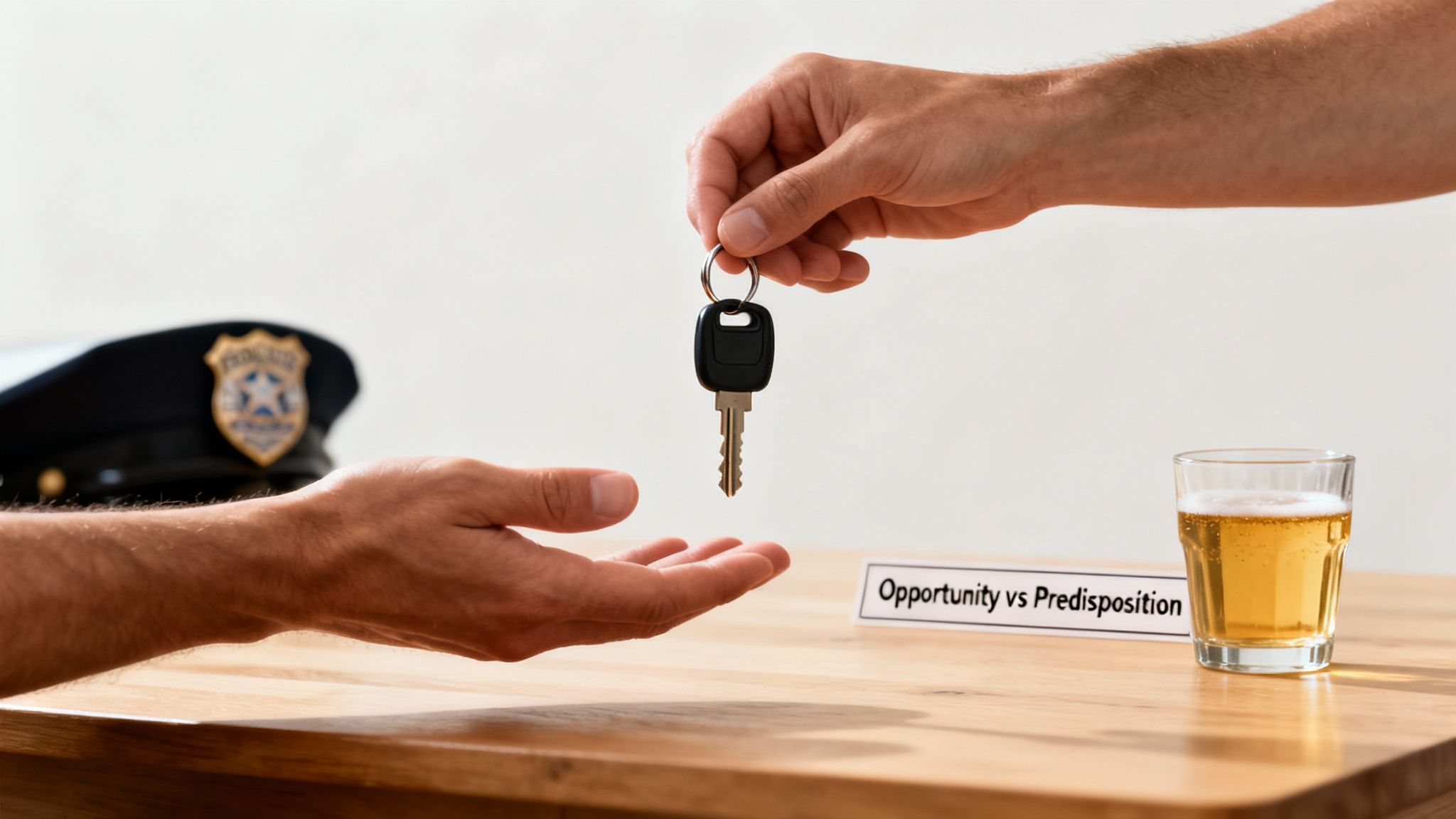
In Russell, an undercover agent supplied a legally obtainable but difficult-to-find chemical necessary for manufacturing methamphetamine. The Supreme Court ruled this was not entrapment because the defendant was already involved in the illegal drug operation and was predisposed to commit the crime. The government merely provided an opportunity; it did not implant the criminal design in the defendant’s mind.
How Russell Applies to Texas DWI Cases
The Russell decision reinforces a key aspect of Texas Penal Code § 8.06: the prosecution can defeat an entrapment defense by proving you were "ready and willing" to commit the crime. This means that simply showing the police created the situation for the DWI is not enough. You must also demonstrate you lacked the prior intent to drive while intoxicated.
Consider these hypothetical examples of entrapment scenarios through the lens of the Russell standard:
- The Situation: An officer, working a sting operation, directs you to move your car from a "no-parking" zone to a public street after you admit to having been drinking. You comply and are immediately arrested for DWI. Here, the officer provided the opportunity, but your prior act of drinking and getting behind the wheel shows predisposition.
- The Arrest: In another scenario, you have a prior DWI conviction and accept a ride from an undercover officer who then encourages you to drive the vehicle. The prior conviction would likely be used by the prosecution as powerful evidence of predisposition, making an entrapment defense very difficult to sustain.
In both examples, the officer's actions created the opportunity for the arrest, but your existing willingness to commit the crime is the pivotal element that undermines the entrapment claim.
Actionable Steps for Your Defense
If your DWI arrest involved police creating the opportunity, the defense must pivot from focusing solely on police conduct to proving your lack of predisposition. A DWI arrest can feel like the end of the road, but a strategic defense can make all the difference.
- Focus on Lack of Predisposition: Your defense should be built around evidence showing you had no intention of driving drunk. This includes plans for a rideshare, designated driver arrangements, or statements made before the police interaction.
- Compile Character Evidence: Gather evidence of your good character, clean driving record, and lack of prior alcohol-related offenses. Testimonials from friends, family, or employers can help establish that the offense was out of character and resulted from the unique situation created by law enforcement.
- Analyze Alternative Defenses: Because the predisposition standard is high, it's vital to explore other defense avenues. Your attorney should investigate if there was an improper traffic stop, insufficient probable cause for the arrest, or errors in the administration of field sobriety or chemical tests.
Strategic Insight: The Russell case teaches us that an entrapment defense is not just about what the police did, but about who you were before they did it. The prosecution's job is to prove you were already inclined to commit the crime; your defense must show that the criminal idea originated with them, not you.
Facing a DWI in Texas can be overwhelming, but understanding these legal precedents is the first step toward building a strong defense. An experienced Houston DWI lawyer can evaluate the facts of your case and determine if an entrapment defense is a viable option. For more information on fighting your charges, explore comprehensive DWI defense strategies in Texas.
6. Matthews v. State (Texas Court of Appeals) – Texas DWI Entrapment Application
The Texas Court of Appeals case Matthews v. State demonstrates how state courts apply entrapment principles directly to DWI arrests. This case is significant because it affirms that an entrapment defense is viable in Texas DWI prosecutions, but it hinges on clear, provable evidence of improper police conduct that goes beyond a standard investigation. It clarifies that the focus is on whether an officer's actions would induce an ordinarily law-abiding person to commit the offense. Facing a DWI charge can be disorienting, but understanding how Texas courts view police conduct is vital to building a defense.
In Matthews, the defendant was arrested during a saturation patrol. While the court ultimately found the evidence in that specific case was insufficient to prove entrapment, it acknowledged the defense's legitimacy. The ruling established that if an officer's actions are so persuasive or coercive that they cause a sober, law-abiding individual to drive while intoxicated, then an entrapment defense could succeed. This provides a crucial legal avenue for challenging arrests born from overzealous police tactics.
How Matthews Applies to Texas DWI Cases
The Matthews decision is a Texas-specific precedent that works hand-in-hand with Texas Penal Code § 8.06. It moves the theory of entrapment into the practical reality of a DWI stop. The core question becomes: did the officer simply provide an opportunity for someone to commit a crime, or did they actively manufacture the crime through inducement?
Consider these hypothetical examples of entrapment based on the principles discussed in Matthews:
- The Situation: During a sobriety checkpoint, an officer aggressively and repeatedly waves you, a hesitant driver, through, signaling you to proceed. When you comply and begin to drive away, the officer immediately pulls you over, alleging you were attempting to flee.
- The Arrest: The officer uses your compliance with their own confusing signals as a pretext for the stop and subsequent DWI arrest. You had no intention of evading the checkpoint but were induced into the action by the officer.
In this scenario, the officer’s actions created the criminal act. The defense would argue that an ordinary person would have been confused by the officer’s contradictory signals, and the act of driving forward was a direct result of police inducement, not a predisposition to flee or drive impaired.
Actionable Steps for Your Defense
If you suspect your DWI arrest resulted from manipulative police actions, documenting the officer's conduct is paramount. You and your DWI attorney can challenge the state's case by focusing on the specific behaviors that led to your arrest.
- Preserve All Video Evidence: Immediately request all bodycam and dashcam footage. This is the most powerful evidence to show exactly what the officer said and did.
- Document Improper Procedures: Hire an NHTSA-certified expert to analyze the field sobriety tests. If the officer administered them incorrectly or ignored results, it can demonstrate a biased, inducement-focused investigation rather than a fair one.
- Request Officer Records: File a discovery motion for the arresting officer’s training records and complaint history. A pattern of similar entrapment-like conduct in past arrests can be incredibly persuasive.
- Gather Character Witnesses: Provide your attorney with witnesses who can testify to your responsible character and lack of predisposition to drive drunk.
Strategic Insight: In a Matthews-style defense, the video footage is your best witness. The goal is to show a jury that the officer’s actions, not your own intentions, were the driving force behind the alleged crime. A skilled Houston DWI lawyer can dissect this footage to expose improper inducement.
A DWI arrest doesn't have to ruin your future. By understanding your rights and legal precedents like Matthews, you can challenge the circumstances of your arrest. If you believe you were a victim of police inducement, contact an experienced attorney who can evaluate the viability of an entrapment defense in your case.
Entrapment: 6-Example Comparative Overview
| Item | 🔄 Complexity | ⚡ Resources Required | ⭐📊 Expected Outcome | 💡 Ideal Use Cases | ⭐ Key Advantages |
|---|---|---|---|---|---|
| Jacobson v. United States (1992) – The Inducement Standard | High — two‑prong inquiry (predisposition + inducement); intensive factual analysis | High — expert witnesses, extensive discovery, officer testimony | ⭐⭐ — Strong constitutional protection if inducement proved; high evidentiary burden 📊 | Undercover stings or checkpoint tactics showing active government pressure | Shifts burden to prosecution; protects against manufactured crimes |
| Texas Penal Code § 8.06 – State‑Level Entrapment Defense | Moderate — objective "normal, law‑abiding person" test; jury‑factfinder role | Moderate — bodycam/dashcam, checkpoint authorizations, discovery motions | ⭐⭐⭐ — Easier to meet than federal test in many circumstances; jury‑dependent impact 📊 | Texas DWI with aggressive checkpoint procedures, coercive officer tactics | Focuses on police conduct; no need to prove defendant's lack of predisposition |
| Sorrells v. United States (1932) – The Predisposition Test | High — deep inquiry into defendant's state of mind and history | High — character witnesses, personal history evidence, expert testimony | ⭐⭐ — Constitutional protection exists but very difficult to establish in many DWI cases 📊 | Cases where government originated the criminal idea and defendant has little/no prior inclination | Shifts burden to prosecution after entrapment raised; strong constitutional basis |
| DWI Checkpoint Entrapment Scenarios – Texas‑Specific Application | Moderate — assesses procedural compliance, selective enforcement, FST administration | Moderate — checkpoint authorization docs, dashcam/bodycam footage, arrest statistics, FST experts | ⭐⭐⭐ — Procedural violations often yield suppression or stronger defenses when documented 📊 | Checkpoints, saturation patrols, selective stops, improperly administered field sobriety tests | Clear procedural standards and administrative rules; video evidence often available |
| United States v. Russell (1973) – The Limits of Entrapment Defense | Moderate — distinguishes mere opportunity from inducement; predisposition emphasis | Low–Moderate — focus on defendant history and prior conduct rather than proving officer misconduct | ⭐ — Defense narrowed; opportunity alone usually insufficient to win entrapment claims 📊 | Situations where police provided opportunity but defendant shows prior inclination or admissions | Clarifies limits of entrapment and sets realistic defense expectations |
| Matthews v. State (Texas Court of Appeals) – Texas DWI Entrapment Application | Moderate — applies §8.06 to DWI facts; requires clear record of officer misconduct | Moderate–High — NHTSA/FST experts, bodycam/dashcam, officer training and patrol records | ⭐⭐⭐ — Appellate precedent accepts entrapment when misconduct is clear; viable but fact‑sensitive 📊 | Saturation patrols, improper FSTs, selective enforcement in Texas counties | Provides state‑level precedent and practical guidance for Texas DWI defenses |
Take the Next Step: Secure Your Strategic DWI Defense Today
Navigating the aftermath of a DWI arrest can feel disorienting and overwhelming, but as we’ve explored through these detailed examples of entrapment, understanding your rights is the first step toward regaining control. From landmark Supreme Court cases like Jacobson v. United States to the specific applications within Texas law under Penal Code § 8.06, a clear pattern emerges: the government cannot create a crime where none would otherwise exist. Your defense hinges on the subtle but crucial distinction between providing an opportunity and improperly inducing a crime.
The examples discussed illustrate that a successful entrapment defense is not a simple claim; it is a complex legal argument built on a foundation of specific facts. It requires a deep analysis of law enforcement's conduct and, most importantly, your own predisposition. Were you an "unwary innocent," or did the police merely provide a chance for you to commit an act you were already prepared to do? Answering this question is at the heart of fighting your DWI charge with an entrapment defense.
Key Insights from These Entrapment Examples
The cases and scenarios we've analyzed offer critical takeaways for anyone facing a DWI charge in Texas:
- Inducement is Key: The police must have done more than simply ask you to do something. The pressure, persuasion, or inducement must be significant enough to overcome the hesitation of a law-abiding person.
- Predisposition Matters: Texas law, like federal law, focuses heavily on your state of mind. A lack of predisposition to commit the DWI is a cornerstone of a successful entrapment claim. Your defense must show you wouldn’t have driven while intoxicated without the officer’s improper influence.
- Evidence is Everything: Proving entrapment is impossible without concrete evidence. This includes dashcam and bodycam footage, audio recordings, witness statements, and any communication records that can demonstrate police overreach. Preserving this evidence immediately is non-negotiable.
- The Line is Thin: As seen in cases like United States v. Russell, the government is allowed to use deception and provide opportunities for a crime to occur. A skilled Houston DWI lawyer is essential to argue that law enforcement crossed the line from permissible investigation into illegal entrapment.
Building Your Proactive Defense Strategy
Understanding these examples of entrapment is valuable, but turning that knowledge into a powerful defense requires immediate, strategic action. You cannot afford to wait. The clock starts ticking the moment you are arrested, especially concerning your right to challenge a DWI license suspension through an Administrative License Revocation (ALR) hearing.
Your future, your career, and your freedom are on the line. The difference between a conviction and a dismissal often comes down to the thoroughness of the initial investigation and the strategic skill of your legal team. You don't have to face the complexities of the Texas legal system alone. An experienced attorney can meticulously review the details of your arrest, identify potential defenses like entrapment, and build a case designed to protect your rights and minimize the consequences.
Let this knowledge empower you, not intimidate you. A DWI charge is serious, but it is not the end of the story. With the right legal advocate by your side, you can confidently navigate the road ahead and fight for the best possible outcome.
Don't let a DWI charge define your future. The experienced attorneys at the Law Office of Bryan Fagan, PLLC specialize in dissecting the details of cases, including potential defenses like entrapment, to build a robust and strategic defense for Texans. Schedule your free and confidential case evaluation with the Law Office of Bryan Fagan, PLLC today to protect your rights and explore your legal options.