
A DWI arrest can be overwhelming—but you don’t have to face it alone. It’s crucial to remember one thing: an arrest is not a conviction. For the State of Texas to secure a conviction, the prosecutor must prove your guilt beyond a reasonable doubt—the highest legal standard in our justice system. This means the pressure is on them, not you. They carry the full burden of proof, and our role is to hold them to it.
What It Takes to Prove a DWI Charge in Texas
When you're arrested for a DWI in Texas, it's easy to feel like the fight is already lost. But from a legal standpoint, the battle has just begun. The State of Texas has to prove three specific elements to get a conviction. Your defense starts by understanding exactly what those are.
A strategic Houston DWI lawyer will pick apart the prosecutor's case, piece by piece. Their entire argument hinges on proving every single one of these points:
- You were "operating" a motor vehicle.
- You were in a "public place."
- You were legally "intoxicated" at the time.
The first two points might seem straightforward, but the details matter. Were you actually driving, or were you asleep in a legally parked car with the keys in your pocket? Was the location truly a "public place"? However, the real fight in most DWI cases happens over that third point: intoxication.
The Two Ways Texas Defines "Intoxicated"
This is where many DWI cases are won and lost. In Texas, the law gives prosecutors two distinct angles to argue that you were intoxicated. They only need to prove one of them.
-
Loss of Normal Faculties: The first way is subjective. The state can argue that you didn’t have the normal use of your mental or physical faculties because of alcohol or drugs. This is often based entirely on the arresting officer's opinion, your performance on field sobriety tests, and your appearance or speech.
-
"Per Se" Intoxication: The second, more common method is through chemical testing. If the state has a breath or blood test result showing you had a Blood Alcohol Concentration (BAC) of 0.08% or higher, they will argue you were intoxicated "per se"—meaning, by the letter of the law.
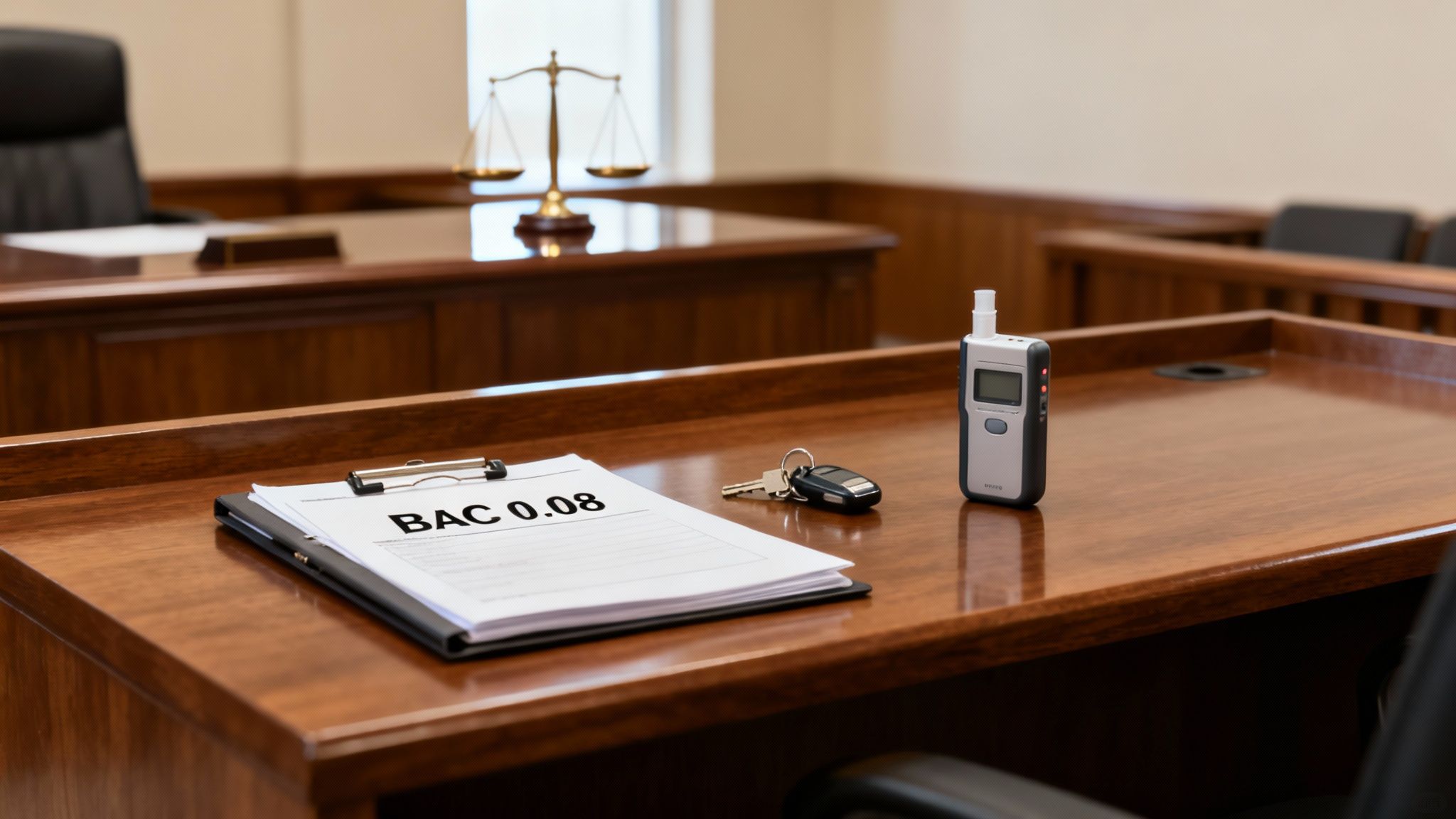
Even if a test result comes back over the limit, it’s far from a slam dunk for the prosecution. An experienced Texas DUI attorney knows exactly how to challenge the reliability of these tests. We question everything from the breathalyzer's calibration and maintenance records to the procedures used to draw and store a blood sample. To get a better handle on this critical number, you can learn more about what the legal limit means in Texas and how it's measured.
The heart of any solid DWI defense is creating reasonable doubt. By carefully scrutinizing every piece of evidence for each of these legal elements, we can find the weaknesses in the prosecutor's case and fight to protect your rights.
Remember, an arrest is just the start. The evidence police gather is not perfect. From the reason for the initial traffic stop all the way to the lab report, a skilled attorney will analyze every detail to dismantle the state's case against you.
Challenging the Arresting Officer’s Testimony
In most Texas DWI cases, the entire foundation of the prosecution's case is built on the testimony of one person: the arresting officer. Their police report often reads like a script, ticking off a familiar list of "symptoms"—bloodshot eyes, slurred speech, and the strong odor of alcohol.
These observations sound official, but at their core, they are nothing more than one person's subjective opinion, not concrete facts. An experienced Houston DWI lawyer knows this is often a weak link in the prosecutor's case. Our job is to show a judge or jury that an officer’s opinion is far from infallible.
Questioning Subjective Observations
The truth is, the supposed signs of intoxication are rarely exclusive to drinking. A good lawyer can—and should—present compelling alternative explanations for nearly every observation the officer makes. This is how we create the reasonable doubt needed to fight DWI Texas charges.
Consider these common examples:
- Bloodshot Eyes: Was it alcohol? Or was it allergies, a lack of sleep, irritation from contact lenses, or a long day staring at a computer screen? It’s hardly definitive proof of anything.
- Slurred Speech: People get nervous when pulled over by law enforcement. Fatigue, a medical condition, or even prescription medication can easily cause someone to mumble or slur their words.
- Unsteadiness on Feet: Many people don't have perfect balance to begin with. Add in uneven pavement, a physical injury, or poor footwear, and almost anyone could appear unsteady.
- Odor of Alcohol: The smell of a beer on someone's breath proves they had a beer. It says absolutely nothing about whether they were legally intoxicated or if their faculties were actually impaired.
By methodically presenting these perfectly plausible alternatives, we reframe the narrative. We show that the officer didn't consider other possibilities—they simply jumped to a conclusion. Their opinion is just that: an opinion.
Scrutinizing the Driving Pattern and Video Evidence
An officer’s report will always detail the so-called "erratic" driving that led to the traffic stop in the first place. They might claim you were swerving, straddling lanes, or driving too slowly. But in today's world of dashboard and body cameras, we have an objective witness that never lies.
Often, the video evidence tells a completely different story from the one in the officer's written report. The footage might show you driving perfectly within your lane, using your turn signal correctly, and pulling over smoothly. When an officer’s testimony clashes with the video, their credibility takes a massive hit.
This discrepancy is a powerful defensive tool. It gives us leverage to question not just their claims about your driving, but everything that came after—their observations about your physical appearance, your behavior, and your performance on field sobriety tests.
Law enforcement strategies have changed dramatically over the years. National DUI arrests, for example, skyrocketed by nearly 223% between 1970 and 1986, reflecting a major shift in policing. But even with today's technology, a DWI investigation still comes down to human observation, which is always vulnerable to error and bias.
Understanding how a Texas DWI investigation works from beginning to end reveals just how many opportunities there are for an officer to get it wrong. Your freedom shouldn't hang on one person's potentially flawed opinion, especially when objective video evidence is there to tell the real story.
How Field Sobriety Test Results Can Be Disputed
After an officer pulls you over, they'll often ask you to get out of your car and perform roadside exercises called Standardized Field Sobriety Tests (SFSTs). In Texas, these are presented as a scientific way to spot impairment, but the reality is much different.
These are highly subjective physical challenges that many perfectly sober people would struggle with even in the best conditions. You're nervous, on the side of a busy road, with police lights flashing. It's a recipe for failure.
It's critical to know that these tests are not mandatory. You have the absolute right to politely refuse them. Agreeing to perform them usually does little more than hand the prosecutor shaky, subjective evidence to build their case against you.
The Three Standardized Tests in Texas
The National Highway Traffic Safety Administration (NHTSA) has only validated three of these tests, and officers are trained to give them in a very specific, standardized way. Any deviation from these strict rules can make the results unreliable and invalid.
The three approved tests are:
- Horizontal Gaze Nystagmus (HGN): The officer holds up a pen or finger and asks you to follow it with your eyes. They are looking for an involuntary jerking of the eye, which their training links to intoxication.
- Walk-and-Turn: This is a "divided attention" test. You have to take nine heel-to-toe steps down a line (real or imaginary), turn around in a specific way, and take nine steps back. The officer watches for eight different "clues" of impairment, like stepping off the line or using your arms for balance.
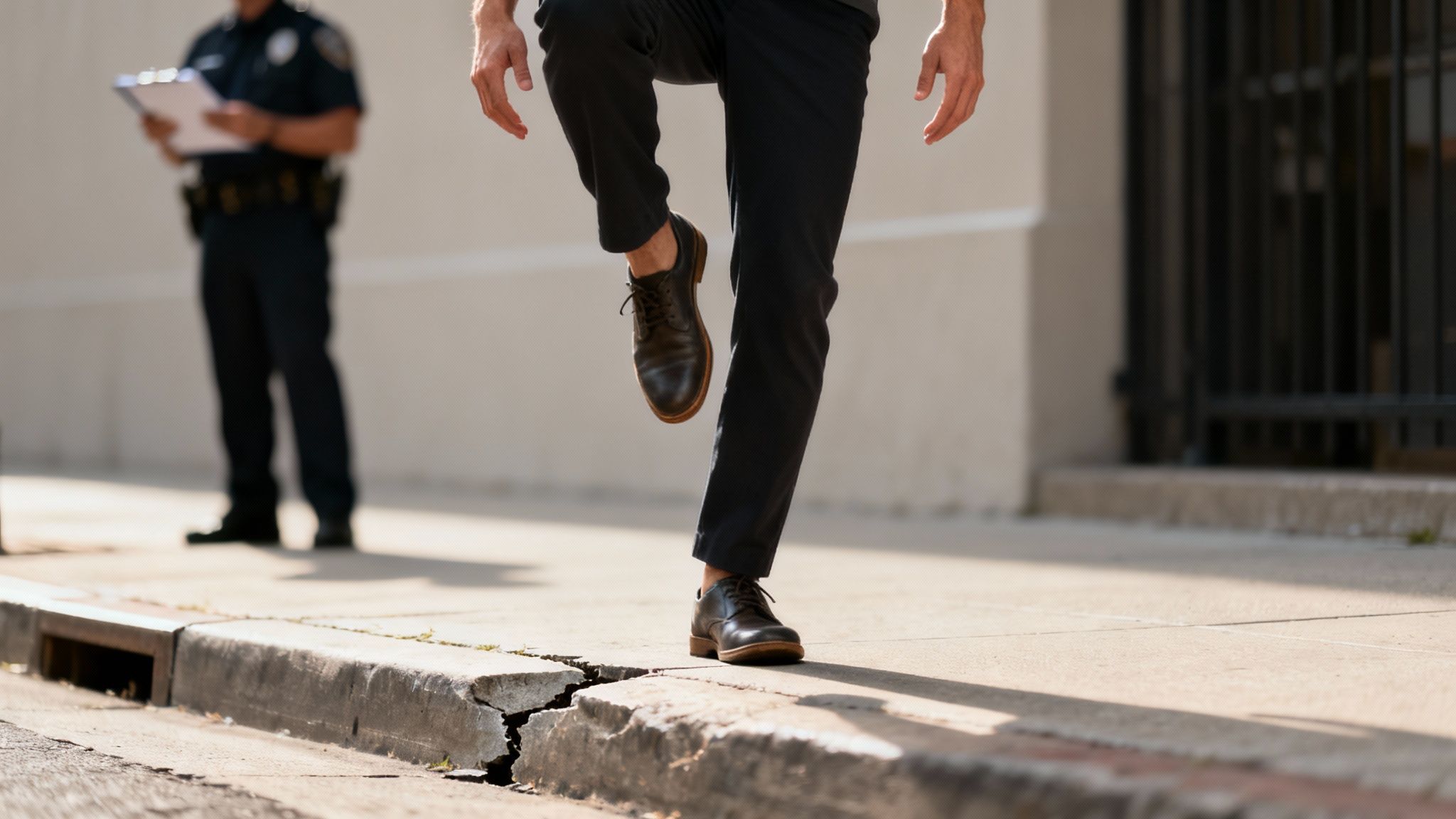
- One-Leg Stand: Here, you're told to raise one foot about six inches off the ground and count out loud for thirty seconds. The officer looks for four "clues," like swaying, hopping, or putting your foot down.
For a deeper dive, check out our in-depth Texas driver's guide to DUI and sobriety testing. It breaks down exactly what officers are looking for and why these tests are so tricky to begin with.
Common Weaknesses in SFST Evidence
These tests often feel like they're designed for you to fail. An experienced DWI attorney knows exactly where to find the errors that can get this so-called evidence thrown out of court. The prosecution will present these tests as objective science, but our job is to expose them for what they are: subjective judgments made under poor conditions.
Here are some common ways we challenge SFST results:
- Improper Instructions: If the officer mumbles, rushes through the directions, or gets them wrong, the test is invalid from the start. Dashcam video often catches this.
- Unsuitable Testing Environment: These tests are supposed to be done on a dry, flat, well-lit surface. Performing them on a sloped road shoulder, on gravel, or with flashing lights blinding you makes a fair test impossible.
- Failure to Inquire About Medical Conditions: Officers are required to ask if you have any injuries or health issues that could affect your performance. A bad back, problems with your inner ear, or an old knee injury can easily mimic the "clues" the officer blames on alcohol.
- Officer's Subjective Scoring: The officer isn't just the administrator; they're also the judge. Their interpretation of "clues" is completely subjective and ripe for confirmation bias—they're looking for proof to back up the suspicion they already had.
An officer's failure to follow NHTSA's strict, standardized procedures isn't just a minor slip-up—it undermines the entire validity of the test. An experienced attorney can use these mistakes to argue that the results should be suppressed and never seen by a jury.
By picking apart the administration and scoring of these tests, we can often dismantle a key piece of the evidence needed for a DUI conviction. This creates powerful reasonable doubt and dramatically strengthens your case for a dismissal, a reduced charge, or a "not guilty" verdict at trial.
Deconstructing Breath and Blood Test Evidence
When the prosecution has a number—a breath or blood test showing a Blood Alcohol Concentration (BAC) over the legal limit of 0.08—they often act like the case is closed. They present that chemical test result as hard, undeniable scientific proof of guilt.
But any experienced Texas DWI lawyer knows that number is just the beginning of the story, not the end.
This so-called “scientific evidence” is frequently flawed, unreliable, and wide open to powerful legal challenges. A number is only as trustworthy as the process used to get it. Any mistake along the way can make the result meaningless and inadmissible in court.
Uncovering Flaws in Breath Test Results
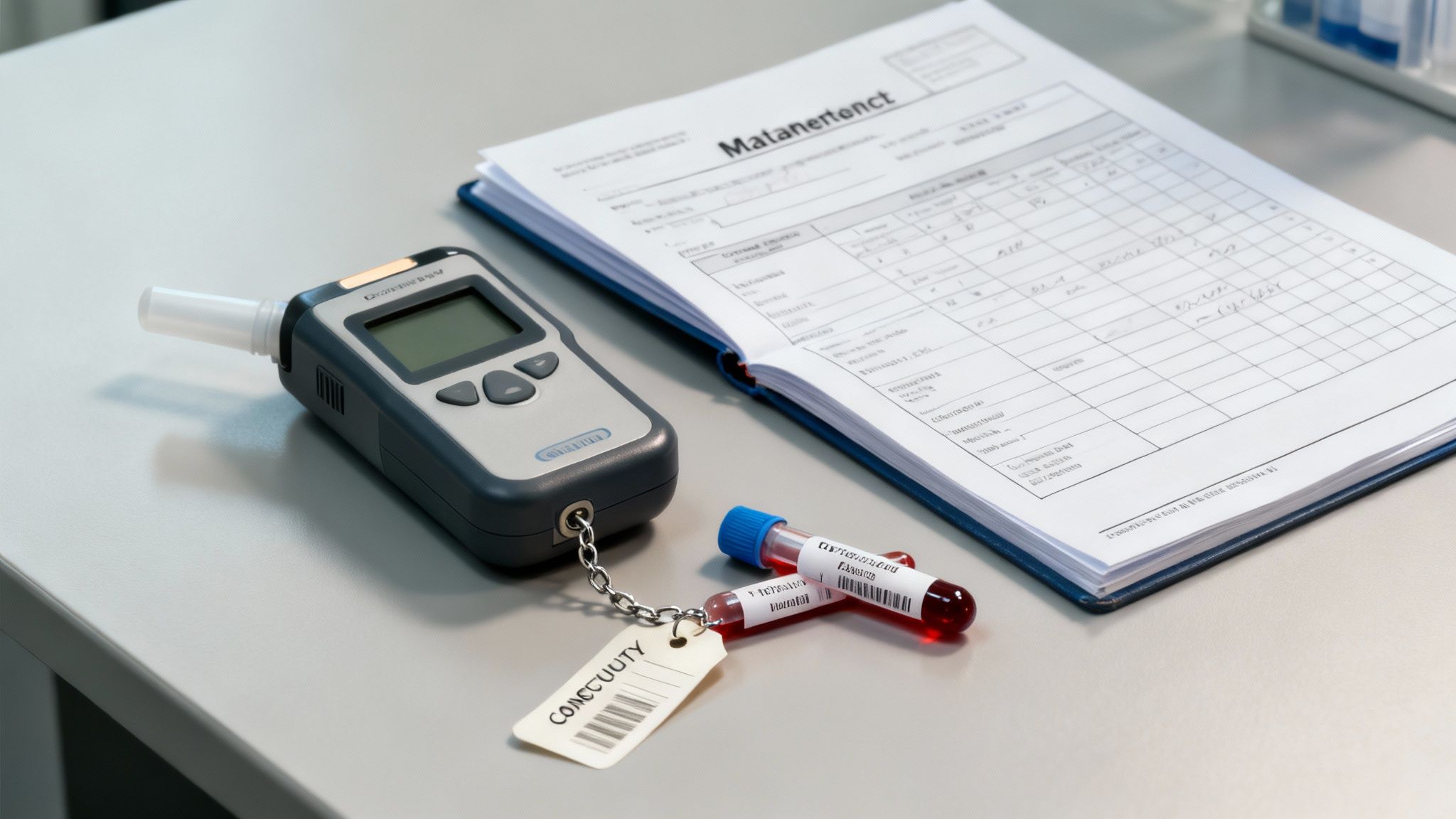
In Texas, the go-to breathalyzer device is the Intoxilyzer 9000. These are complex machines that demand strict, regular maintenance and calibration to produce an accurate reading. When police departments fail to follow these precise protocols, the results can be successfully torn apart.
An effective defense means doing a deep dive into the machine’s history and the officer’s own qualifications. We demand and scrutinize every document, hunting for critical errors like:
- Improper Calibration: Was the machine recently and correctly calibrated? We pull the maintenance logs to see if it was working properly on the day of your test.
- Lapsed Certifications: The officer who runs the test and the technical supervisor who maintains the machine are both required to hold valid, up-to-date certifications. If either one has expired, the results can be invalidated.
- Inadequate Observation Period: An officer is required to watch you continuously for 15 minutes before giving the test to ensure you don’t burp, hiccup, or regurgitate, as these actions can bring mouth alcohol to the surface and create a falsely high reading.
- Medical Conditions: Certain health issues, like GERD or acid reflux, can easily contaminate a breath sample. Even being on a low-carb diet can produce ketones that some machines mistake for alcohol.
A breath test reading isn't a fact; it's an allegation. By meticulously investigating the machine, the operator, and your own unique physical condition, we can expose the reasonable doubt hiding inside that number.
The accuracy of a BAC reading is crucial, which is why we fight so hard to ensure the state’s evidence is legitimate. For context, the World Health Organization (WHO) has found that reducing the BAC limit to 0.05 g/dL can decrease fatal and injury-related crashes by around 18%. These global public health findings on drink-driving underscore just how important it is that the number used against you is correct.
Challenging the Reliability of Blood Test Evidence
A blood test might sound more scientific than a breath test, but it comes with its own set of major vulnerabilities. For a blood test result to be considered valid evidence, the prosecutor has to prove an unbroken "chain of custody."
This means they must be able to account for every single person who handled your blood sample, from the moment it was drawn to the second it was tested at the lab. Any gap, undocumented step, or error in this chain can compromise the sample's integrity and get the evidence thrown out.
Common problems we investigate include:
- Improper Blood Draw: Was the person who drew your blood actually qualified? Did they use a non-alcoholic sterilizing agent on your skin? Using a standard alcohol swab is a classic way to contaminate the sample.
- Contamination or Fermentation: If the blood vial wasn't sealed correctly or didn't have the right amount of preservative, the sample could begin to ferment. When that happens, it literally creates its own alcohol, producing an artificially high BAC that has nothing to do with what was in your system.
- Improper Storage: Blood samples must be stored at a specific temperature. A vial left in a hot police car or not refrigerated correctly at the lab can undergo chemical changes that make the final test result completely unreliable.
The following table breaks down how we look at the prosecution's evidence and where we find opportunities to fight back.
Types of Evidence in a Texas DWI Case and How to Challenge Them
| Type of Evidence | What the Prosecution Argues | Common Defense Challenges |
|---|---|---|
| Breath Test Result | This number is scientific proof of intoxication above the 0.08 legal limit. | Machine wasn't calibrated, operator's certification lapsed, improper 15-minute observation, or medical conditions like GERD skewed the reading. |
| Blood Test Result | The lab analysis provides a precise and reliable measure of the driver's BAC. | Broken chain of custody, contamination from an alcohol swab, fermentation due to improper preservation/storage, or lab testing errors. |
| Field Sobriety Tests | The driver's poor performance on tests like the Walk-and-Turn proves physical and mental impairment. | Tests were administered on an uneven surface, driver had a medical condition or wore improper footwear, or the officer gave incorrect instructions. |
| Officer's Observations | The driver had slurred speech, red eyes, and smelled of alcohol, indicating intoxication. | These are subjective symptoms that can be caused by allergies, fatigue, illness, or nervousness—not just alcohol. |
| Driving Behavior | The driver was swerving, speeding, or committed another traffic violation, suggesting impairment. | The driving was a momentary distraction, a reaction to another vehicle, or a simple mistake unrelated to intoxication. |
| Driver's Statements | The driver admitted to "having a couple of beers," which is an admission of drinking. | Admitting to drinking is not an admission of being intoxicated. The statements may have been coerced or made before Miranda rights were read. |
Challenging breath and blood tests is a complex but essential part of defending against the evidence needed for a DUI conviction. By exposing these procedural errors and scientific flaws, a skilled Houston DWI lawyer can argue that the state’s most powerful piece of evidence should be thrown out of court, dramatically improving your chances of a successful outcome.
The Strategic Legal Fight to Suppress Evidence
Spotting weak links in the prosecution’s evidence—like a shaky field sobriety test or a questionable breathalyzer reading—is only the first move. The next is taking aggressive legal action to get that flawed evidence thrown out of court so a jury never sees it. This is where an experienced Houston DWI lawyer switches from playing defense to going on the offense.
A DWI case isn't one single battle; it’s a series of strategic legal skirmishes. We use powerful legal motions to attack every piece of the state’s evidence, arguing it was either gathered illegally or is simply too unreliable to be trusted. When we win these fights, the prosecutor's case can start to fall apart before a trial even begins.
Filing a Motion to Suppress Evidence
One of the most powerful weapons in a defense attorney's arsenal is the Motion to Suppress. This is a formal legal document we file with the court, arguing that specific evidence was collected in violation of your constitutional rights and must be excluded from the case.
The idea behind it is simple: if the police break the rules to get evidence, they shouldn't be allowed to use that ill-gotten evidence against you.
Common reasons we file a Motion to Suppress include:
- No Reasonable Suspicion for the Traffic Stop: The Fourth Amendment protects you from unreasonable searches and seizures. If an officer pulled you over without a legitimate, legally sound reason, then every single piece of evidence they gathered afterward—from observations to test results to your own statements—can potentially be suppressed.
- No Probable Cause for the Arrest: Before an officer can legally arrest you, they must have enough facts to form a reasonable belief that you were driving while intoxicated. If their "proof" was based on improperly administered field sobriety tests or their own biased observations, the arrest itself was illegal.
- Involuntary or Coerced Statements: If you were in custody and being interrogated without being read your Miranda rights, any incriminating statements you made can be thrown out.
When a Motion to Suppress is successful, it can be devastating to the prosecution's case. Without their key evidence, they may have no choice but to offer a much better plea deal, reduce the charge to a non-DWI offense, or dismiss the case entirely.
The ALR Hearing: Your First Chance to Fight
Long before you ever set foot in a criminal courtroom, you have another critical battle to fight—the Administrative License Revocation (ALR) hearing. This is a completely separate civil proceeding with the Texas Department of Public Safety (DPS) that decides the fate of your driver's license.
After a DWI arrest, you have only 15 days to request this hearing. If you miss this deadline, your license gets suspended automatically.
But the ALR hearing is so much more than just a fight to save your license. It’s an invaluable strategic opportunity. It’s our first chance to get the arresting officer under oath and question them, long before a criminal trial. We can lock them into their story, expose contradictions in their police report, and gather critical intelligence that we can use to dismantle their case later on. Winning this hearing is your first major victory against a DWI license suspension.
Data from jurisdictions worldwide highlights just how heavily prosecutors rely on blood alcohol evidence to secure convictions. For example, in Germany, over 80% of individuals arrested for DUI had BACs far exceeding typical legal limits, and Norwegian data shows nearly 30% of inmates had at least one DUI conviction. You can explore more about these statistical findings and their implications. This data shows why it's so vital to challenge the state's chemical evidence at every turn, and that fight starts at the ALR hearing.
Your Next Steps to Protect Your Future
After a DWI arrest, the clock starts ticking. What you do in the first few days is the single most important factor in protecting your rights, your driver’s license, and your future. It’s an overwhelming process, but you don't have to face it alone.
The most urgent deadline you’re up against involves your driver’s license. From the moment of your arrest, you have only 15 days to request an Administrative License Revocation (ALR) hearing with the Texas Department of Public Safety. If you let that window close, your license will be automatically suspended.
This hearing is often your first—and best—chance to challenge the state's case. It's a critical early step in building a strong, effective defense.
Take Control of Your Case Today
It’s absolutely essential that you avoid discussing the details of your case with anyone but your lawyer. Right now, the most powerful move you can make is to secure representation from a Houston DWI lawyer who knows exactly what evidence prosecutors need for a conviction and, more importantly, how to tear it apart.
The decision tree below shows how a single, well-argued legal challenge—like proving the initial traffic stop was illegal—can cause the entire case against you to fall apart.
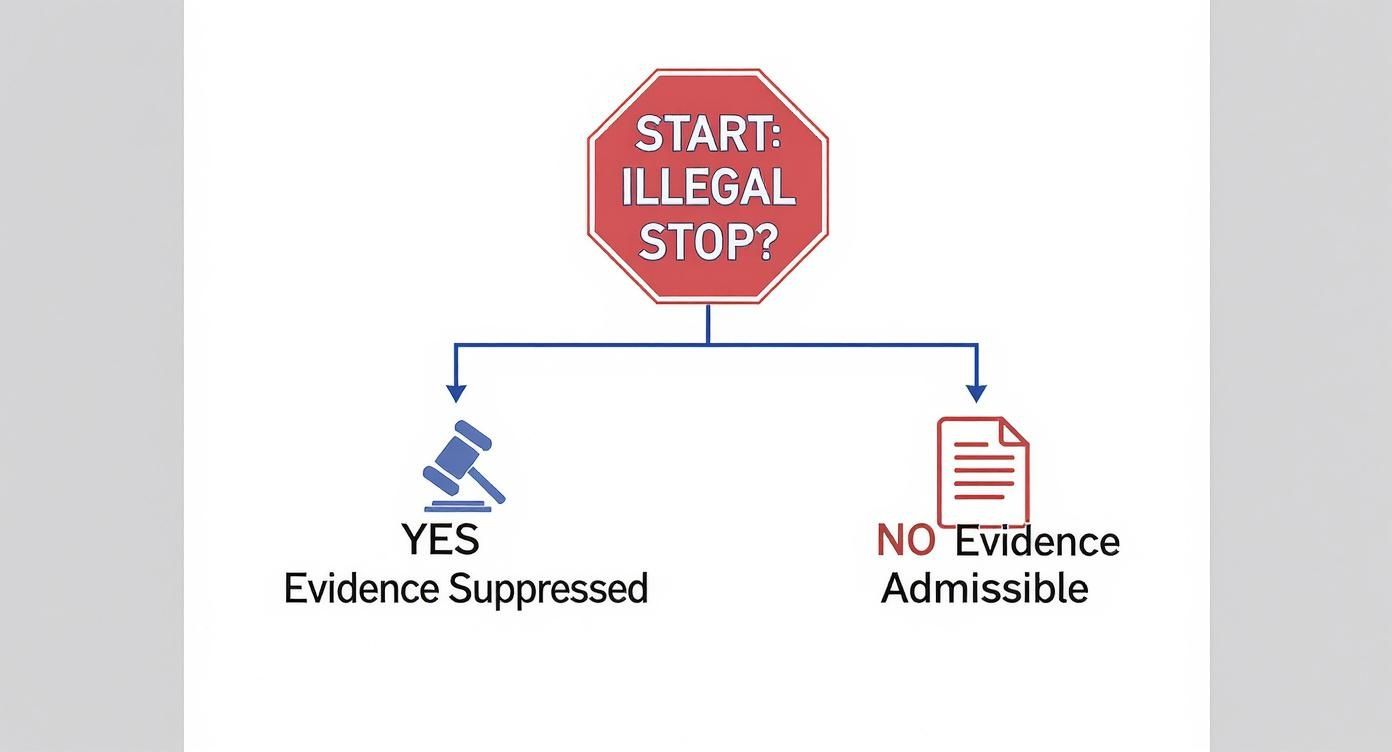
As you can see, a successful defense often starts by attacking the very beginning of the police encounter.
At The Law Office of Bryan Fagan, PLLC, we meticulously analyze every detail of your arrest to find the weak points in the prosecution's case. We're ready to protect your rights, your future, and your peace of mind.
Contact us immediately for a free, confidential case evaluation. Let's talk about what happened and start building the powerful defense strategy you deserve.
Still Have Questions About DWI Evidence in Texas?
A DWI charge throws your life into a tailspin, leaving you with a storm of questions and uncertainty. The first step toward taking back control is understanding exactly what you're up against. Here are some of the most common questions we hear from clients about the evidence needed for a DWI conviction in Texas.
Getting arrested is overwhelming, but you don't have to sort through it alone. Let's clear up these key points so you can see the road ahead.
Can I Be Convicted of DWI If I Refused the Breath Test?
Yes, it’s still possible, but you’ve just made the prosecutor's job much harder. Without a specific BAC number from a breath or blood test, the state is forced to build its case entirely on subjective evidence like officer testimony, your performance on field sobriety tests, and any video from the scene.
This means they have to prove you were intoxicated based on someone's opinion, not on science. A sharp Houston DWI lawyer can dismantle this kind of case by showing it doesn't meet the high standard of "proof beyond a reasonable doubt." While your refusal can be used against you in court, it takes away the prosecution's single most powerful piece of evidence.
What If the Police Video Contradicts the Officer's Report?
This is where cases are won. Video evidence is one of the most powerful tools in a DWI defense because it's an objective witness—it doesn't have an opinion or a bias. If the dashcam or bodycam shows you speaking clearly, walking without stumbling, or driving normally, it can completely shred the officer's written report and testimony.
The very first thing your attorney will do is demand every second of video and audio from your arrest. If the footage works in your favor, it becomes critical leverage to get the case dismissed or reduced.
When the officer's story doesn't match what the camera recorded, it casts serious doubt on the credibility of every other piece of evidence they gathered.
Can My DWI Charge Be Reduced to a Lesser Offense?
Absolutely. Negotiating a reduction to a non-DWI offense, like Obstruction of a Highway, is a common and often excellent outcome, especially for a first DWI in Texas. This usually happens when your defense attorney finds a critical weakness in the state's evidence.
For example, if we can show the breathalyzer machine was improperly calibrated or that the officer didn't have a legal reason to pull you over in the first place, the prosecutor might offer a deal to avoid losing the case at trial. Whether a reduction is possible depends entirely on the specific facts of your case and the strength of the defense we build for you.
The stakes are incredibly high after a DWI arrest, but a smart, strategic defense can protect your freedom and your future. The experienced attorneys at The Law Office of Bryan Fagan, PLLC are ready to scrutinize every piece of evidence and fight for the best possible outcome. Contact us today for a free, confidential case evaluation to get started. https://texasduilawfirm.com