 Skip to content
A DWI or traffic arrest can be overwhelming—but you don’t have to face it alone. The sight of flashing lights in your rearview mirror can send anyone into a panic. In that split second, a moment of fear can lead to a decision to drive away, and suddenly, you’re facing a serious criminal charge for evading arrest.
If you’re here, it’s probably because you’re feeling overwhelmed and looking for answers about the evading arrest Texas penal code. We get it. A charge is not a conviction, and you don’t have to figure this out on your own.
You Are Not Alone In This Fight
It happens faster than you can imagine. The wail of a siren, the red and blue lights flooding your rearview mirror—it’s enough to make your heart pound. For many, the instinct is to flee, even if it’s just for a few blocks. But that single decision can escalate a minor traffic ticket into a felony evading arrest charge. If the police suspected you of DWI, the stakes get even higher, and you may need a skilled Houston DWI lawyer to protect your rights.
At The Law Office of Bryan Fagan, we’ve seen how one moment of high stress can create a legal nightmare. We want you to know this: a charge for evading arrest does not have to ruin your life. We stand with Texans across Houston, Dallas-Fort Worth, and Austin, building a powerful defense against complex charges like these, especially when they’re tangled up with a DWI.
How We Can Help You Move Forward
Going up against the state can feel like an impossible fight, but it’s a fight that can be won. Our job is to show you exactly how. We do this by pulling apart the prosecution’s case, piece by piece, and giving you the knowledge you need to feel in control again.
This guide is your resource for understanding everything about your situation, including:
- What the Texas evading arrest law actually says.
- Your rights during and after a DWI or evading arrest.
- The first steps to building a defense strategy that works to fight a DWI in Texas.
Our goal is simple: to give you the confidence to challenge the charges against you. Whether that means finding inconsistencies in the police report or questioning if the officer even had a legal reason to stop you in the first place, we’re here to defend your rights. With an experienced Texas DUI attorney in your corner, you can start to take back control. We’ve helped countless clients in your exact position, and we’re ready to do the same for you.
Understanding Texas Penal Code 38.04
When you’re facing a charge for evading arrest, the entire case hinges on one specific law: Texas Penal Code § 38.04. Understanding what this statute actually says is the first step toward building a real defense. Put simply, the law states that a person commits this offense if they intentionally run from someone they know is a police officer trying to lawfully arrest or detain them.
But it's not that straightforward. For the prosecution to get a conviction, they have to prove two critical things beyond a reasonable doubt. It's like a referee blowing the whistle in a game—if you never heard the whistle or didn't realize it was for you, did you actually commit the foul? The same logic applies here.
The Two Pillars Of An Evading Arrest Charge
For the State of Texas to prove you're guilty of evading arrest, they have to establish both of the following elements:
- Intentional Fleeing: Your actions must have been deliberate. This means you made a conscious choice to get away. For example, continuing to drive because you genuinely didn't see the police car behind you is a world away from seeing the flashing lights and hitting the gas.
- Knowledge of the Officer: You must have known the person trying to stop you was a peace officer. An unmarked car with no lights or sirens on a dark road doesn't exactly scream "police." If you couldn't reasonably know it was an officer, the charge shouldn't stick.
If the prosecutor can’t prove both of these things, their case starts to fall apart. This is often where a skilled defense attorney goes to work—digging into the evidence to see if your actions truly meet the legal definition of the crime. For instance, did the officer even have a legal reason to stop you in the first place? You can learn more about what makes a stop legal in our guide on probable cause vs. reasonable suspicion.
Foot Pursuit Vs. Vehicle Evasion
The law also draws a huge distinction based on how you allegedly fled. This detail is absolutely critical because it drastically changes the potential punishment you're up against.
- Evading on Foot: Fleeing from an officer on foot is typically charged as a Class A Misdemeanor. While it’s still a serious charge, the penalties are far less severe than using a vehicle.
- Evading with a Vehicle: Using a car, truck, motorcycle, or any motor vehicle to flee automatically escalates the charge to a Third-Degree Felony.
Imagine getting pulled over after a night out, your heart pounding as the officer walks up to your window. What starts as a simple traffic stop can spiral into a life-altering felony if you panic and drive off. Suddenly, you're not just looking at a DWI, but a felony evading arrest charge under Texas Penal Code § 38.04.
This single decision can lead to two completely different futures, as this infographic shows.
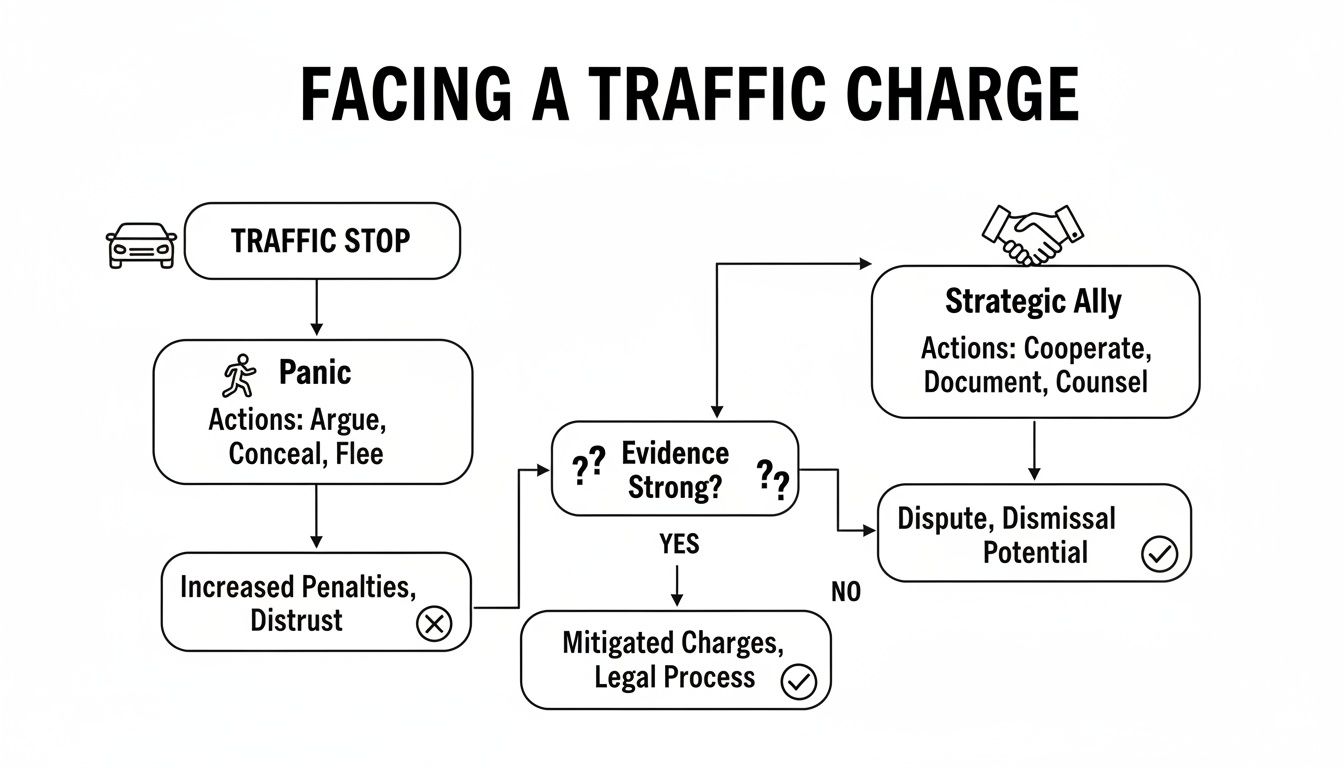
The key takeaway is that reacting out of fear almost always makes things worse. On the other hand, partnering with a strategic legal ally gives you a path to protect your rights and fight for a much better outcome.
Misdemeanor Vs. Felony: Texas DWI Penalties Explained
When you're facing an evading arrest charge, one of the first questions you’ll have is: how much trouble am I really in? The answer isn't a simple one, because the penalties can range from a serious misdemeanor to a life-altering felony. It all depends on the specifics of your case.
Our goal here isn’t to scare you, but to provide a clear, confident view of what you're up against. Understanding the potential consequences is the first step in building a defense to protect your future.
In Texas, the law makes a huge distinction based on one simple question: were you on foot, or were you in a car? That single detail dramatically changes everything.
Class A Misdemeanor Evading On Foot
If the police say you fled from them on foot, you’re looking at a Class A Misdemeanor. Don't let the word "misdemeanor" fool you into thinking it's minor. A Class A is the most serious type of misdemeanor in Texas, and a conviction carries heavy penalties:
- Jail Time: Up to 1 year in the county jail.
- Fines: A fine of up to $4,000.
- Criminal Record: A permanent conviction on your record that can complicate job applications, housing, and even professional licenses for years to come.
While these consequences are serious, they are significantly less severe than what happens the moment a vehicle gets involved.
Felony Evading With A Vehicle
Using a car, truck, or motorcycle to flee from law enforcement instantly elevates the charge to a felony. Depending on the facts, you could be facing a State Jail Felony or even a Third-Degree Felony. This is a critical jump, moving your case out of the county courts and into the felony system, where the possibility of prison time becomes very real.
When a vehicle is involved in an evading arrest case, prosecutors don't just see it as someone running from the police. They see it as an act that puts the public in danger. That perception is exactly why the penalties are so much harsher—and why having a powerful defense is absolutely critical.
Think about a common scenario: it's dusk on a busy Austin highway. You see flashing lights behind you after having a couple of drinks and panic, making a split-second decision to speed up instead of pulling over. Suddenly, you're not just facing a potential first DWI in Texas; you're now staring down Texas Penal Code § 38.04(b), a state jail felony.
This isn’t just a hypothetical. Texas crime statistics show a significant rise in evading arrest charges, particularly in counties with high DWI rates like Harris County (Houston). This trend highlights a strong link between DWI stops and evading charges, as many who flee are later found to be intoxicated. You can explore Texas crime statistics and reports to see these trends for yourself.
To put this into perspective, even a standard Class B Misdemeanor in Texas—a common charge for a first-time DWI—carries up to 180 days in jail. The penalties for evading quickly eclipse that.
To make the differences crystal clear, we've broken down the penalties in the table below.
Evading Arrest Penalties In Texas At A Glance
This table lays out the potential consequences you could be facing, depending on how you were charged.
| Type Of Offense | Criminal Classification | Potential Incarceration | Maximum Fine |
|---|---|---|---|
| Evading on Foot | Class A Misdemeanor | Up to 1 year in jail | $4,000 |
| Evading in Vehicle | State Jail Felony | 180 days to 2 years in state jail | $10,000 |
| Evading in Vehicle + Aggravating Factor | Third-Degree Felony | 2 to 10 years in prison | $10,000 |
As you can see, the stakes get incredibly high, especially when other factors come into play.
What Makes An Evading Charge Worse?
The prosecution will look for any reason to enhance the charges against you. These "aggravating factors" can turn a bad situation into a catastrophic one, bumping a state jail felony up to a third-degree or even second-degree felony.
Your charge can be enhanced if the state alleges:
- You have a previous conviction for evading arrest.
- Someone suffered serious bodily injury as a direct result of the chase.
- You used a tire deflation device against the pursuing officers.
- Someone was killed as a result of your attempt to flee, which can lead to a Second-Degree Felony charge, punishable by up to 20 years in prison.
These enhancements completely change the legal fight. A felony conviction can strip you of your right to vote, own a firearm, and hold many professional licenses. It follows you forever. This is why a proactive, aggressive defense is not just an option—it's essential.
How An Attorney Defends Against Evading Arrest Charges

When you're facing an evading arrest charge, it’s easy to feel like the evidence is stacked against you. But a skilled defense attorney knows that every case has weak points. The prosecution carries the entire burden of proving every single element of their case beyond a reasonable doubt, and our job is to find the holes in their story. We never just accept the police report at face value—we challenge it.
At The Law Office of Bryan Fagan, PLLC, our approach is methodical and built on experience. We start by asking the tough questions that police and prosecutors often hope no one will ask. This process means we do a deep dive into every piece of evidence, from dashcam and bodycam footage to the officer's own testimony, searching for the inconsistencies and legal missteps that can build a powerful defense for you.
Challenging The Element Of Intent
One of the most powerful defense strategies we use revolves around intent. To get a conviction under the evading arrest Texas penal code, the prosecutor has to prove you intentionally fled. But what if you didn’t? Life is rarely that simple.
Imagine you're driving home at night with the music turned up. It’s entirely possible you wouldn't see the faint reflection of police lights in your mirror or hear a distant siren over the traffic noise. Your failure to stop right away wasn't a deliberate act of defiance; it was an honest mistake.
This is a common scenario, and we use it to build a strong defense by arguing you never formed the specific intent to flee. We scrutinize the evidence to show that your actions were misinterpreted. For example, we might argue:
- You were simply looking for a safe, well-lit place to pull over.
- You were having a medical emergency that affected your awareness.
- The officer’s vehicle was unmarked, or their lights and siren weren't activated properly.
By presenting a logical and believable alternative to the prosecution’s narrative, we can create the reasonable doubt needed to win a case.
Questioning The Lawful Detention
Another cornerstone of a strong defense is attacking the legality of the initial stop itself. A police officer can't just stop you for any reason they feel like; they must have reasonable suspicion that you've actually committed a crime. If that initial stop was unlawful, any evidence they gathered from that point forward—including the evading charge—can be thrown out completely.
This is especially relevant in cases where an evading charge is tacked onto a DWI stop. Did the officer truly have a valid reason to pull you over in the first place, or were they on a fishing expedition? We meticulously comb through the police report and video evidence to see if the officer’s stated reason for the stop actually holds up.
If the foundation of the case—the lawful stop—is weak, the entire structure can collapse. A successful challenge to the initial stop can lead to the suppression of critical evidence, often resulting in a full dismissal of the charges.
Our attorneys are experts at filing and arguing a Motion to Suppress Evidence. You can find out more about how we use this powerful legal tool in our detailed guide on what a motion to suppress evidence is. This motion asks the judge to exclude illegally obtained evidence, which can absolutely cripple the prosecutor’s ability to move forward.
Arguing Lack Of Knowledge
The law also requires the state to prove you knew the person trying to stop you was a peace officer. This might sound obvious, but there are plenty of situations where it's not clear at all. An officer in an unmarked car without clear police markings or functioning emergency equipment could easily be mistaken for an aggressive driver or something far more sinister.
In those cases, your decision to keep driving wasn't an attempt to flee from the law but a reasonable action to protect your own safety. We work to prove that from your perspective, you had no idea you were being pursued by police. By putting the judge or jury in your shoes, we can effectively dismantle this key element of the state's case.
The Dangerous Link Between DWI and Evading Arrest

A DWI stop is stressful enough. But when you add an evading arrest charge on top of it, the situation spirals into something far more serious, with stakes that get dangerously high. From a prosecutor’s point of view, this combination tells a damning story: not only did you potentially risk lives by driving while intoxicated, but you actively chose to endanger the public even more by fleeing from law enforcement.
This is one of the most serious one-two punches a person can face in the Texas criminal justice system. We see it happen all the time—a moment of pure panic during a traffic stop leads to a split-second decision to drive away, instantly adding a felony to a misdemeanor. Why? Because prosecutors will argue that fleeing shows a “consciousness of guilt.” In other words, you ran because you knew you were guilty of DWI.
How Prosecutors Stack Penalties
When you’re charged with both DWI and evading arrest with a vehicle, you aren’t just facing one set of consequences. The state will push for convictions on both offenses, and the penalties are designed to stack on top of each other. This is how what might have been a misdemeanor DWI can explode into a multi-felony nightmare, carrying years of potential prison time and a future crippled by a permanent criminal record.
Here’s how quickly the charges compound:
- A first-time DWI is typically a Class B Misdemeanor.
- Evading arrest with a vehicle is, at a minimum, a State Jail Felony.
- A DWI with a child passenger is also a State Jail Felony.
If you’re facing a DWI and an evading charge, the prosecutor can—and will—pursue both. If you're convicted of each, a judge could order you to serve your sentences consecutively, meaning you finish the time for one offense before you even start the time for the next. Suddenly, one bad night could cost you years of your life.
Why This Combination Is a Prosecutor’s Priority
In the Dallas-Fort Worth area and across the state, the link between these two crimes is a major focus for law enforcement. Evading arrest under Texas Penal Code § 38.04 can turn a routine DWI stop into a high-speed chase that puts everyone on the road at risk. In fact, Texas DPS data reveals a high number of vehicle evasion incidents that start as high-risk DWI encounters, a trend that has only gotten more attention with recent legislative changes. You can find more on Texas justice data and trends in recent reports.
When you face both a DWI and an evading charge, you are not just fighting two cases; you are fighting the state’s narrative that you are a danger to the community. This perception is what makes a strategic, dual-pronged defense absolutely essential.
At The Law Office of Bryan Fagan, PLLC, we know just how grave these combined charges are because we specialize in dismantling these exact high-stakes scenarios. Our approach isn’t to defend one charge and just hope for the best on the other. We build a coordinated strategy to fight both at the same time.
A Dual-Pronged Defense Strategy Is Key
You can’t successfully defend against stacked DWI and evading charges with a piecemeal approach. You need an aggressive, comprehensive defense that attacks both cases from every possible angle. Our team gets to work immediately to deconstruct the prosecution's entire narrative.
For the DWI Charge, We Investigate:
- The legality of the traffic stop itself—did the officer have a valid reason to pull you over?
- The administration and reliability of any Field Sobriety Tests.
- The calibration records and results of the breathalyzer or blood test.
For the Evading Arrest Charge, We Challenge:
- Whether you intentionally fled from the officer, or if you were simply confused or looking for a safe place to stop.
- If you even knew you were being pursued by a peace officer in the first place.
- Any inconsistencies between the police report, officer testimony, and the dashcam footage.
By fighting on both fronts simultaneously, we create pressure points in the prosecutor’s case. If we find a problem with the DWI evidence, it can weaken their argument that you had a motive to flee. Likewise, a strong defense against the evading charge can completely change the context of the entire incident. It’s this integrated defense that gives you the best possible chance at protecting your freedom and your future. You don’t have to face this overwhelming situation alone—our experience is your advantage.
Take Control Of Your Case With A Strategic Defense
Getting hit with an evading arrest charge—especially when it’s piled on top of a DWI—can feel like your world is caving in. The threat of a felony, potential prison time, and a criminal record that follows you forever is overwhelming. It’s a scary and lonely place to be.
But you have to remember this: an arrest is just an accusation. The prosecution has a story they want to tell, but it’s not the only story. Their case might look solid on paper, but it can almost always be challenged. An arrest does not have to be the final word on your future.
You Have The Right To A Strong Defense
Here’s the most important thing you need to know: an evading arrest charge might be serious, but it is absolutely defensible. There are countless ways to build a powerful defense, whether the issue was a simple misunderstanding, an illegal traffic stop, or a case of mistaken identity. You don’t have to—and shouldn’t—try to figure this out alone.
At The Law Office of Bryan Fagan, PLLC, we’ve built our entire practice around helping Texans navigate charges exactly like these. We know what’s at stake when your freedom, your job, and your future are all on the line. Our job is to provide the steady, confident guidance you need to fight back and regain control.
A single moment of panic shouldn't be allowed to ruin the rest of your life. The decisions you make right now matter more than ever. A skilled criminal defense attorney can be the shield between you and the prosecution, fighting for your rights every step of the way.
Don’t give the prosecution a head start. The time to build your defense is now, not weeks or months from now.
We invite you to request a free, 100% confidential case evaluation to go over the details of your case. We will listen to your side of the story, break down your legal options in plain English, and show you exactly how we can start protecting you today.
Don't let this charge define your future. Call us 24/7 or fill out our online form to speak with an experienced Texas DWI attorney now. We are ready to stand up for your rights and fight for the best possible outcome for you and your family.
Common Questions About Evading Arrest Charges
When you’re staring down a serious charge like evading arrest, your mind is probably racing with questions. It’s a stressful and confusing time. We get it. Let’s walk through some of the most common questions our clients ask, so you can get clear, direct answers and start to see a path forward.
Can an Evading Arrest Charge Be Dropped or Reduced?
Yes, absolutely. It's often possible to get an evading arrest charge reduced or even dismissed entirely. A lot depends on the specific facts of your case, and that’s where an experienced Houston DWI lawyer comes in. We dig into every detail to find weak spots in the prosecutor's story.
For example, was the initial stop even legal? If we can show the officer had no valid reason to pull you over in the first place, the whole case can fall apart. Or maybe we can prove you didn’t actually intend to flee. Sometimes, confusion or panic isn’t the same as a deliberate attempt to escape.
In many cases, negotiation is key. We can work with the prosecutor to get a felony evading charge knocked down to a lesser offense, like a misdemeanor. For first-time offenders, a deferred adjudication is often a great goal—it lets you complete a term of probation and avoid a final conviction on your record.
What’s the Difference Between Evading and Resisting Arrest?
People mix these up all the time, but in the eyes of the law, they are two completely different things. The evading arrest Texas penal code draws a clear line between them.
Evading Arrest (Texas Penal Code § 38.04): This is all about fleeing. If an officer is trying to legally arrest or detain you and you take off—either on foot or in a car—that’s evading. The key action here is flight.
Resisting Arrest (Texas Penal Code § 38.03): This charge involves using force against the officer. It means you are physically preventing them from making an arrest, search, or transport. Think pulling away, stiffening your arms so they can't be cuffed, or actively fighting back.
While both are serious, the penalties show just how different they are. Evading arrest with a vehicle is an automatic felony. Resisting arrest, on the other hand, is usually a Class A Misdemeanor, unless a weapon is involved.
Will I Lose My Driver’s License for Evading Arrest?
This is a tricky one. A conviction for evading arrest itself doesn't automatically trigger a driver's license suspension from the criminal court. However, if the evading charge happened alongside a DWI arrest, your license is in immediate danger because of the DWI.
The moment you're arrested for DWI, Texas’s “implied consent” law means an automatic process begins. The officer will probably take your license and hand you a suspension notice. From that day, a clock starts ticking. You have only 15 days to request an Administrative License Revocation (ALR) hearing to challenge the suspension.
If you miss that deadline, an automatic DWI license suspension kicks in. This is called an administrative license suspension and happens separately from the criminal court case. It is absolutely critical to act fast to protect your ability to drive while we fight the criminal charges.
An arrest can make you feel like your world is caving in, but you don't have to face this alone. The experienced attorneys at The Law Office of Bryan Fagan, PLLC are ready to build a strategic defense designed to protect your rights and your future. We offer free, confidential consultations to help you understand your options and figure out the next best step. Contact us 24/7 by calling our office or filling out the form on our website at https://texasduilawfirm.com.

