
A DWI arrest can be overwhelming, but you don't have to face it alone. If you were already on probation when the officer pulled you over, your case just split into two fights at once, and that matters more than many realize. One case is the new DWI. The other is the probation violation. You need a strategy for both, or you can get buried by the one you ignored.
What Happens When You Face a DWI While on Probation in Texas
You were probably trying to get home, thinking one mistake couldn't turn into two court battles. Then the stop happened, the officer started asking questions, and now you're dealing with a new arrest on top of an existing probation term.
That's the hard part of dwi while on probation texas consequences. Texas doesn't treat this like a single event. It treats it like a new offense plus a possible violation of an old court order. A Texas DWI lawyer has to look at both tracks immediately, because the damage can stack fast if you wait.
The first thing to understand is that your probation does not protect you from a new criminal case. It also doesn't stop the judge who placed you on probation from reviewing whether you broke the terms of supervision. In Texas, that older case can carry its own punishment exposure if the judge decides revocation is justified.
Practical rule: Don't assume a dismissal in the new DWI case automatically fixes the probation problem. It usually doesn't.
If you're in this position, calm action beats panic. Your lawyer needs the arrest details, the probation paperwork, and the timeline from the stop, because timing drives the defense. A Houston DWI lawyer or any local Texas DUI attorney who understands probation law can start building a defense before the court starts moving against you.
Two Separate Legal Tracks You Need to Understand
The most important thing to understand is that you do not have one case. You have two. One is the new criminal DWI charge. The other is the probation-revocation case, often called a motion to revoke.
The new DWI case
The new case is handled like a normal criminal prosecution. The state has to prove the intoxication offense beyond a reasonable doubt. That means the prosecutor must carry the full criminal burden, whether the case is in county court or, if the charge escalates, another court with jurisdiction over the offense.
The revocation case
The probation case works differently. The judge who placed you on probation usually hears the violation side, and the state's burden is lower. A DWI arrest while on Texas probation creates two separate proceedings, and on the revocation side the state only has to show a violation by a preponderance of the evidence, which means more likely than not. That standard is materially easier than proving a new crime beyond a reasonable doubt. See the Texas DWI Defense Lawyer listing for defense under Texas Penal Code 49.04, Texas DWI Defense Lawyer.
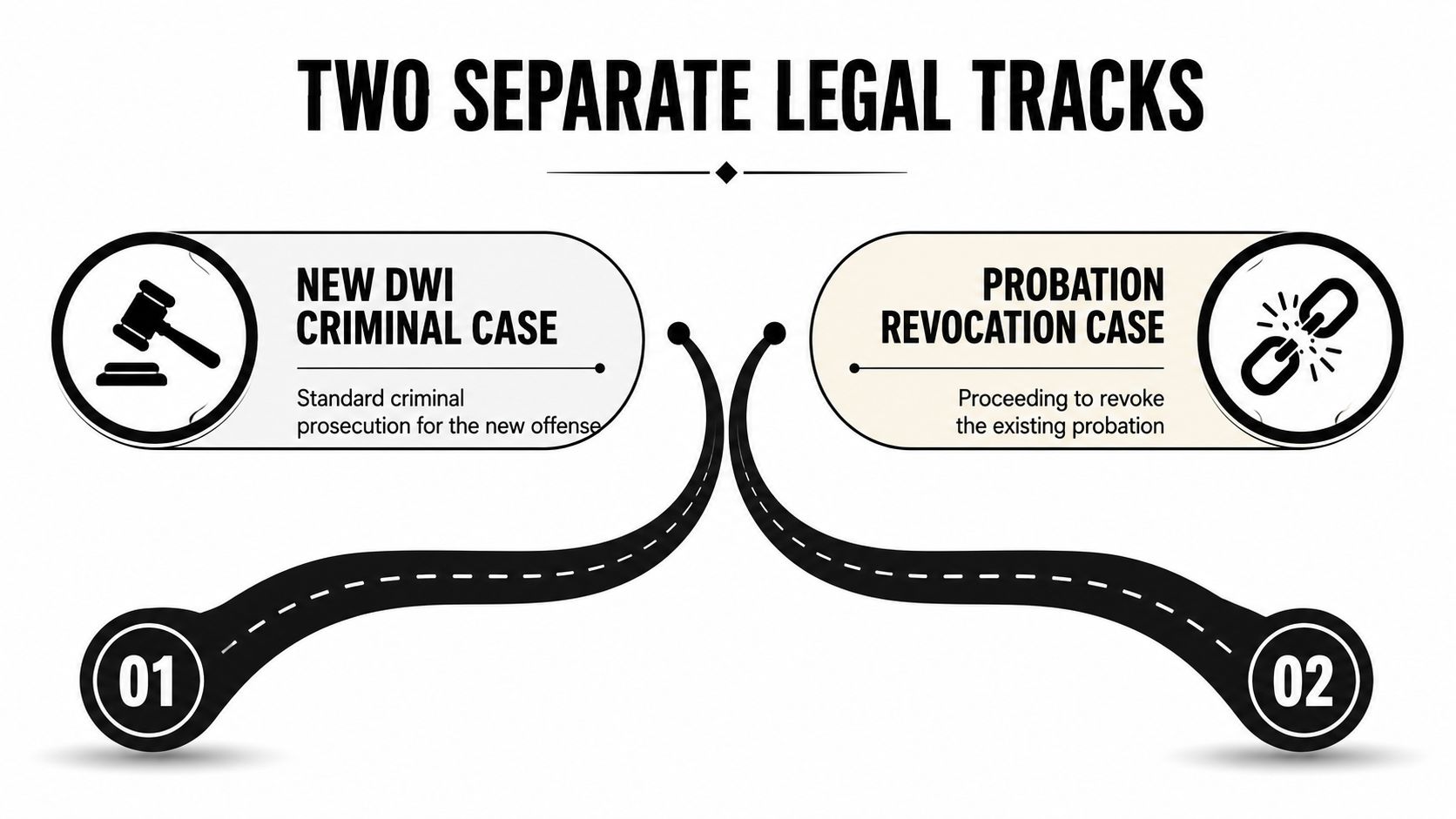
That split changes everything. A lawyer may win part of the case and still have to fight the other part separately. Sometimes the criminal case drags on while the revocation hearing moves first. Sometimes the reverse happens. You can't assume the court will wait for the other track to finish.
The cleanest way to think about it is this. The new DWI case asks whether the state can prove you committed a new offense. The revocation case asks whether the court believes you violated the rules of probation. Those are related, but they are not the same question.
Texas DWI Penalties That Apply to the New Charge
A new DWI while you are on probation creates an immediate problem. Texas will prosecute the new case on its own, and if your prior supervision already involved alcohol or driving conduct, the new charge can move into harsher territory fast.
Penalty ranges that matter
Texas DPS lists first-offense DWI penalties of up to 180 days in jail, with at least 3 mandatory days, and a license loss of up to 1 year. A second-offense DWI rises to 1 month to 1 year in jail and up to a 2-year license loss. A third offense can bring 2 to 10 years in prison plus up to a $10,000 fine. Texas also lists state alcohol-related fines of $3,000, $4,500, or $6,000 depending on the offense stage Texas DPS impaired driving penalties.
| Texas DWI Penalty Ranges by Offense Level | Maximum Jail or Prison | Maximum Fine | License Loss | State Surcharge |
|---|---|---|---|---|
| First offense | Up to 180 days in jail, with at least 3 mandatory days | Varies by jurisdiction and enhancement | Up to 1 year | $3,000 |
| Second offense | 1 month to 1 year in jail | Varies by jurisdiction and enhancement | Up to 2 years | $4,500 |
| Third offense | 2 to 10 years in prison | Up to $10,000 | Varies by jurisdiction and enhancement | $6,000 |
A repeat offense changes the courtroom dynamic immediately. Prosecutors see someone on probation as a person who already had a warning and is now accused of ignoring it. Judges see that too. That does not make the case unwinnable. It means the defense has to attack the stop, the test results, and the State's ability to prove the new charge cleanly.
Texas-focused legal guidance also reports that first-offense DWI probation usually runs from 6 months to 2 years, while more serious cases can extend up to 10 years Texas DWI probation guidance. A longer supervision period gives the State more time to catch a new arrest and use it against you. If you are already on supervision, the old file is still active, and the new case can trigger both prosecution and revocation pressure at the same time.
A repeat DWI is where many people make their first serious mistake. They fixate on the criminal charge and ignore the probation file that is already open. The better move is to defend both tracks together from day one, and a Texas DWI probation violation defense has to account for both the new case and the motion to revoke.
How Probation Revocation Works in Texas
A new DWI on probation creates two separate fights. The criminal case addresses the new arrest. The revocation case asks whether you violated the probation terms already on the books, and that second case can be the one that puts you in custody faster.
What the judge can do
If the state files a motion to revoke, the judge can continue probation, tighten the conditions, or revoke supervision altogether. If the judge revokes, the court can impose the original sentence that was suspended, including jail or prison time, fines, community service, additional treatment, or a longer driver's license suspension probation revocation consequences. The judge can also refuse bond or set a higher bond after the violation, which can keep you in jail until the next hearing.
That is why the revocation side often carries more immediate danger than the new DWI charge itself. The state does not have to prove the new offense the way it would in a criminal trial. It only has to persuade the judge that a probation condition was violated under the lower civil standard mentioned earlier. That can happen even if the new DWI case later gets dismissed or reduced.
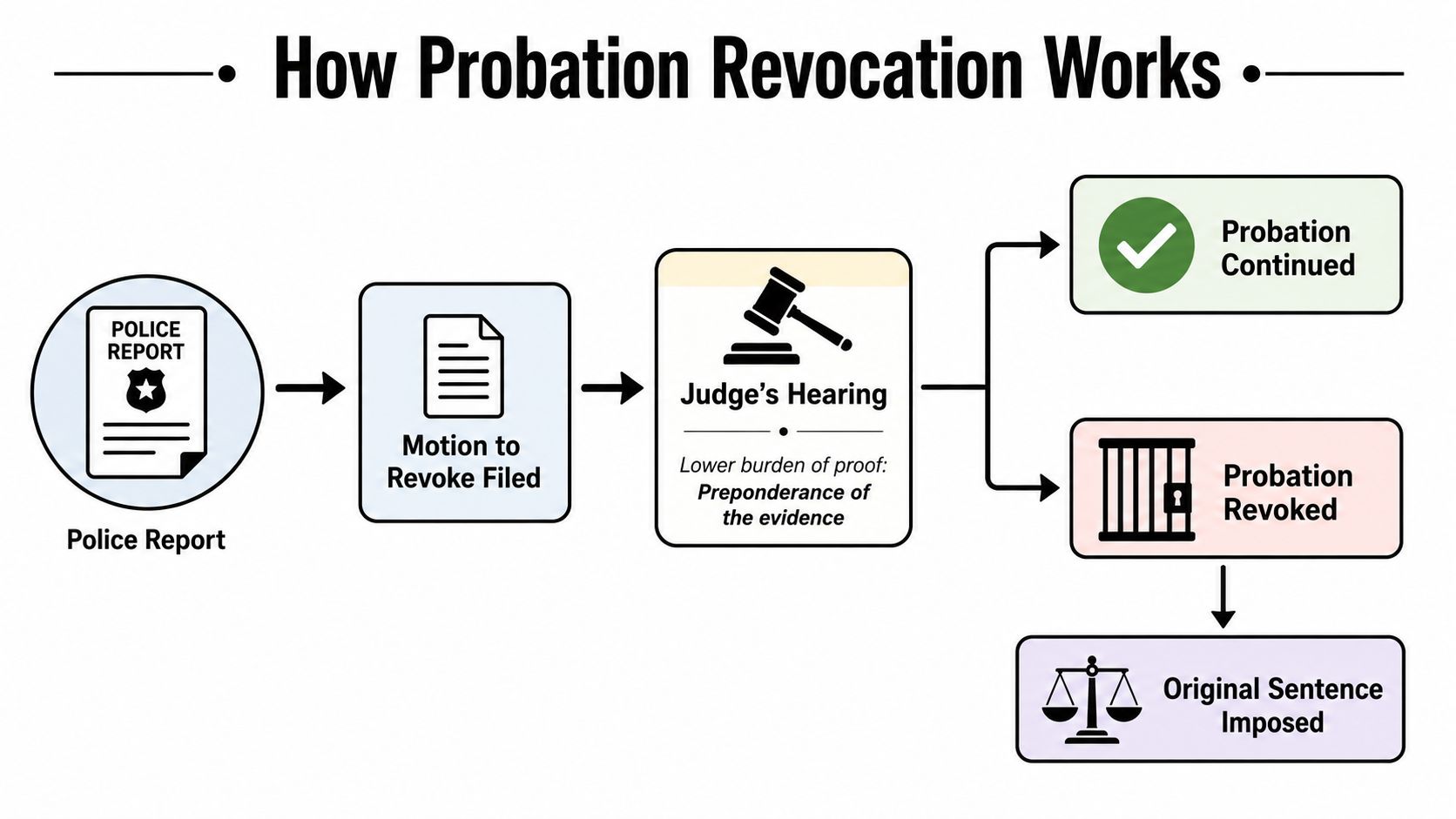
A violation hearing is not about whether the police had a bad night or whether the stop looked messy. It is about whether the judge believes you broke probation. That is a narrower fight, but it can carry harsher consequences than people expect.
For more on the court process, review the probation violation defense resource.
License Consequences and the ALR Hearing
Your driver's license sits in a separate fight. The criminal case and the probation revocation case do not decide it, and people lose ground fast when they treat it like a side issue.
Implied consent and administrative suspension
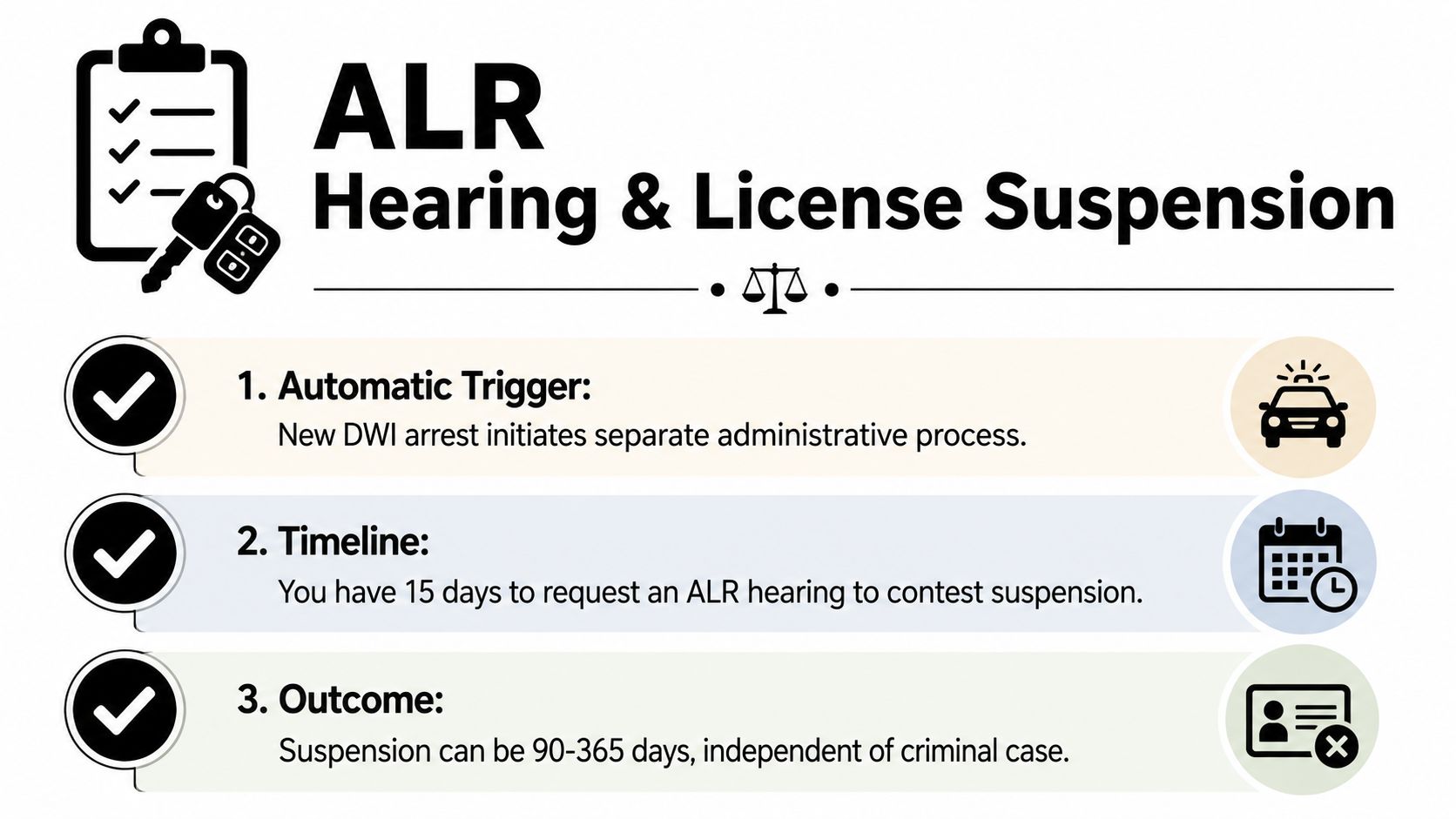
Texas implied consent law means that by driving on Texas roads, you agree to chemical testing after a lawful arrest in the situations the law covers. If you refuse or fail a breath or blood test, the state can start an administrative license suspension, and that process is separate from the criminal case. The Texas Department of Public Safety handles that side, and the arrest starts the clock.
The ALR hearing is your chance to challenge the suspension. The request deadline is strict, typically 15 days from the date of arrest. Miss that deadline, and you give up a real chance to fight for your driving privileges. Review the Texas ALR hearing process guide right away if that deadline is already close.
What to do with the hearing
At the hearing, DPS still has to justify the suspension. If the officer made mistakes, if the stop was weak, or if the test result has reliability problems, your lawyer can push back. In some cases, a probated license with an ignition interlock device can help keep you driving legally while the case is pending, depending on the facts and the court's orders.
Bottom line: The license deadline is one of the first deadlines that can hurt you if you miss it.
Under-21 drivers face a one-year suspension on a conviction, with subsequent offenses carrying an 18-month suspension Texas DPS impaired driving penalties. That is why the ALR deadline matters so much, because Texas treats driving privileges in alcohol-related cases as something it will take away quickly if you do not act.
Immediate Steps to Take After a DWI Arrest on Probation
The first 72 hours matter. Don't improvise. Don't assume the probation officer will be flexible. Don't wait to see if the case “works itself out.”
Your first moves
- Call a DWI defense lawyer first. Your lawyer should hear the facts before you start explaining things to probation staff or court personnel.
- Request the ALR hearing immediately. The deadline is short, and the license fight disappears fast if you miss it.
- Pull every probation document. That includes the judgment, special conditions, reporting rules, and any prior modifications.
- Write down the stop while it's fresh. Save the time, location, officer statements, field sobriety details, and whether you took a breath or blood test.
- Do not treat the cases as one file. The new DWI and the revocation case need separate defense planning.
The record from your original probation case matters because the court will look back at the exact conditions you were ordered to follow. Texas law does not allow early termination of DWI probation under Texas Code of Criminal Procedure 42A.701, so if the judge set a fixed term, you're generally expected to finish it Texas DWI probation guidance. That makes protecting the existing term critical.
If you're worried about saying the wrong thing, that's normal. What matters is that you stop talking to the wrong people and start documenting the facts for your lawyer. The more organized you are early, the more options your defense team has later.
Defense Strategies That Protect Both Cases at Once
A new DWI on probation is two fights at the same time. Your lawyer has to defend the criminal charge and keep the revocation case from turning into a fast trip back to jail.
What to attack on the DWI side
On the criminal case, the stop comes first. Your attorney should examine probable cause, the legality of the field sobriety tests, and whether the breath or blood evidence can be challenged. A field sobriety test is the roadside coordination exercises officers use to look for signs of impairment. A BAC, or blood alcohol concentration, is the number the state uses to measure alcohol in your body. If the stop was weak or the testing process was flawed, the state has a harder time proving the new DWI charge.
What to press on the revocation side
The probation case has its own rules and its own pressure points. Your lawyer may push for continued probation, a modification of conditions, or a lesser sanction instead of full revocation. That can mean treatment, an interlock device, or tighter supervision. The goal is simple. Keep the judge from jumping straight to the harshest result.
Defense strategy planning basics matter because the order of operations can change the outcome. McConathy Law notes that a new DWI while on probation is handled as two separate problems, and that split is exactly why counsel has to sequence the defense carefully new DWI and probation violation split. Sometimes the smarter move is to press the criminal case first, since a better result there can weaken the revocation case. Other times the revocation hearing comes first, and your lawyer has to protect your custody status before anything else.
You need a lawyer who can manage both tracks without making one case worse while trying to save the other. In Texas, that is the job.
Take the Next Step With a Texas DWI Defense Team
A DWI on probation is not one problem, it's two. The new charge has its own penalties, and the revocation case can pull the original sentence back into play if you don't fight it correctly. That's why you need a defense team that knows how to handle the criminal case, the ALR hearing, and the probation violation together.
The Law Office of Bryan Fagan, PLLC handles Texas DWI defense across Houston, Dallas–Fort Worth, Austin, and San Antonio, with free consultations and 24/7 support. If you're facing a DWI license suspension, a revocation motion, or a first DWI in Texas while already on supervision, get legal help now and don't give the court a head start.
If you're dealing with a DWI while on probation in Texas, the Law Office of Bryan Fagan, PLLC can review the arrest, the probation terms, and the license deadlines so you know exactly where you stand. Visit Law Office of Bryan Fagan, PLLC to request a free consultation and get a defense plan built around your case.