 Skip to content
A DWI arrest can be overwhelming—but you don’t have to face it alone. When you're pulled over and charged with drunk driving in Texas, the legal jargon can be confusing. You might hear the terms "DWI" and "DUI" used, and it's easy to assume they mean the same thing. In Texas, they don’t. The core difference between a DWI and a DUI comes down to a single factor: age.
A DWI (Driving While Intoxicated) charge is for adults aged 21 and over. In contrast, a DUI (Driving Under the Influence) is a zero-tolerance charge aimed specifically at minors under 21 who have any detectable amount of alcohol in their system. Understanding which charge applies to your case is the first critical step in building your defense.
Understanding the Difference Between DWI and DUI
Facing a DWI arrest is an overwhelming experience, and you shouldn't have to navigate the complex legal system by yourself. While many people use "DWI" and "DUI" interchangeably, Texas law draws a very clear line between them. This distinction is crucial because it changes the legal standard, the potential penalties, and the defense strategies we can use to protect your rights.
The main takeaway is that your age at the time of the arrest dictates the charge. This decision tree breaks down the straightforward path Texas law follows.
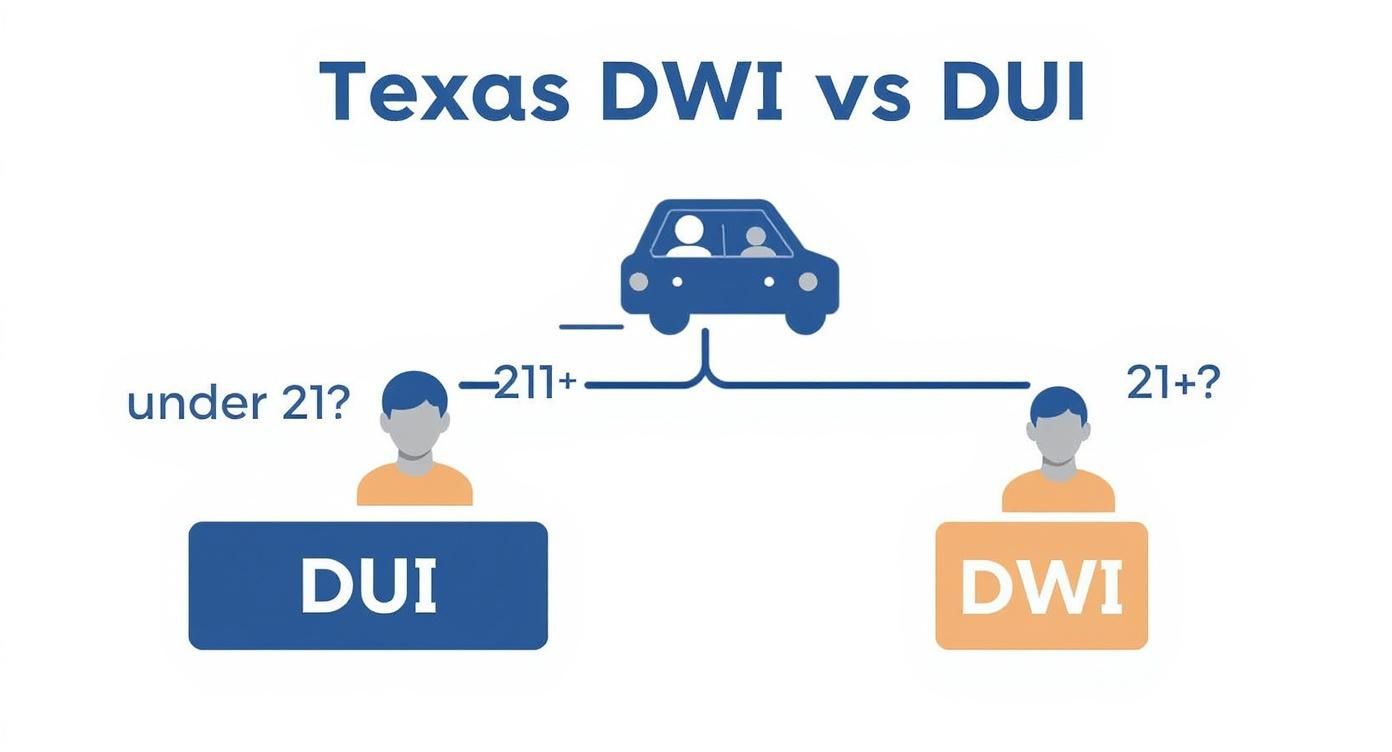
As you can see, the split is simple: if you're 21 or over, it's a DWI. If you're under 21, it's a DUI. Understanding this legal separation is essential for grasping the specific challenges of your case and how to best fight the charges.
Historically, DWI became the standard term in Texas for intoxicated driving. This was heavily influenced by advocacy groups that pushed for a uniform Blood Alcohol Concentration (BAC) limit of 0.08% nationwide. This history explains why DWI is the primary charge for adults today, while DUI was created to address underage drinking and driving under a stricter "zero tolerance" policy.
Texas DWI vs DUI at a Glance
To make these differences crystal clear, let's break them down side-by-side. Knowing these details is vital for your defense, and you can get more information by reading our detailed guide on DWI vs. DUI differences.
This table offers a quick snapshot of how the two charges compare under Texas law.
| Factor | DWI (Driving While Intoxicated) | DUI (Driving Under the Influence) |
|---|---|---|
| Applicable Age | Adults 21 years or older | Minors under 21 years old |
| BAC Standard | 0.08% or higher OR loss of normal faculties | Any detectable amount of alcohol |
| Common Charge | Class B Misdemeanor for a first offense | Class C Misdemeanor for a first offense |
| Primary Proof | Chemical test results or evidence of impairment | Evidence of any alcohol consumption |
Essentially, for an adult DWI conviction, the prosecution must prove you were legally intoxicated, either through a BAC test or by showing a loss of your physical or mental abilities. For a minor facing a DUI, however, the simple presence of alcohol is enough for a conviction, creating a much lower bar for the state to clear.
Understanding a DWI Charge for Adults

A DWI arrest can feel like your world is crashing down, but your first move isn't to panic—it's to understand the charges you face. Knowing what the state must prove is the foundation of a strong defense. For anyone 21 or older in Texas, the charge is Driving While Intoxicated (DWI). This is not the same as a DUI for minors; for an adult DWI, the prosecutor must prove you were legally intoxicated.
Under Texas law, the state has two ways to do this. The most common path is proving your Blood Alcohol Concentration (BAC) was 0.08% or higher while you were operating a vehicle. This is typically done with a breath or blood test.
But what if you are under the legal limit? You can still be convicted. The second method of proving intoxication is subjective: showing you lost the "normal use of your mental or physical faculties" due to alcohol, drugs, or a combination of both.
How the State Proves Impairment
When there is no BAC number—or the number is below 0.08%—the prosecution’s case relies on a collection of observations and subjective tests. They will build their argument using:
- Officer Testimony: The arresting officer will describe your driving, appearance (e.g., slurred speech, red eyes), and overall behavior. This testimony is often the centerpiece of their case.
- Field Sobriety Tests (FSTs): Your performance on tests like the walk-and-turn or the one-leg stand will be presented as evidence of your impairment. These tests are notoriously subjective and difficult even for sober individuals.
- Dashcam and Bodycam Footage: Video recordings can either support the officer's report or contradict it, making this footage an incredibly valuable piece of evidence for your defense.
This "loss of faculties" standard means you can be charged with a first DWI in Texas even if your BAC is below 0.08%. A strategic Houston DWI lawyer will meticulously analyze this evidence, questioning the officer's conclusions and the reliability of the field sobriety tests administered.
Implied Consent and Your Rights
Here is something many drivers don't realize: when you obtain your Texas driver's license, you legally agree to the state’s implied consent law. This means you have consented to provide a breath or blood sample if an officer has probable cause to suspect you are intoxicated.
Refusing a chemical test doesn't automatically mean you avoid charges. While it denies the prosecution a key piece of evidence, it triggers an immediate consequence: an automatic DWI license suspension. This is a separate civil process known as an Administrative License Revocation (ALR).
You have the right to refuse, but it's a difficult decision. Refusing the test may make the criminal case harder for the state to prove, but it forces you into a separate legal battle to keep your driving privileges.
Finally, remember that the limits are stricter for some. For commercial drivers (CDL holders), the BAC limit is just 0.04%. For any driver, a BAC of 0.15% or higher leads to enhanced penalties, elevating a first-offense DWI from a Class B to a more serious Class A misdemeanor.
Navigating a DUI Charge for Minors
For parents and young drivers, seeing flashing police lights in the rearview mirror can be terrifying. When the driver is under 21, that fear intensifies. Texas has a strict zero-tolerance policy for underage drinking and driving, and it’s here that the difference between a DWI and a DUI becomes critical.
Unlike an adult DWI, a Driving Under the Influence (DUI) charge is exclusively for minors. The legal standard isn't about being "drunk" or hitting a specific BAC. It's about the presence of any detectable amount of alcohol in their system. This incredibly low threshold makes it far easier for the state to secure a conviction, putting a young person’s future at risk.
A DUI arrest can throw a family into chaos, but you don’t have to go through it alone. The first step is to understand what you’re up against and develop a smart defense to protect your child's future.
The Zero-Tolerance Standard Explained
The zero-tolerance law means a minor doesn't have to feel "drunk" to be charged. A single beer or a sip of wine hours before driving can be enough to trigger a positive test and a DUI charge. This is a world away from the adult standard, where prosecutors must prove intoxication through a 0.08% BAC or a clear loss of faculties.
For a first-offense DUI, which is a Class C misdemeanor, the penalties are meant to be educational but are still serious. They often include:
- A fine of up to $500
- Driver’s license suspension for 60 days
- 20 to 40 hours of mandatory community service
- Completion of a state-approved alcohol awareness program
These penalties are more than just a slap on the wrist. They can disrupt a young person’s life, making it difficult to get to school, work, or other commitments.
A critical point for parents: a minor can still be charged with an adult-level DWI. If an underage driver's BAC is 0.08% or higher, prosecutors can—and often will—charge them with DWI. This brings much harsher penalties, including the potential for jail time.
Protecting Your Child’s Future
While DUI penalties may seem minor compared to a DWI, the long-term impact of a criminal record is significant. A conviction can create roadblocks for college admissions, scholarship applications, and future job opportunities. That is why it is essential to fight the charge from day one.
An experienced Texas DUI attorney knows how to challenge the state's evidence. We can question everything from the reason for the traffic stop to the administration of the chemical test. The goal is always to minimize the damage and protect your child's clean slate. With the right legal strategy, it is often possible to get the charge dismissed or reduced, which can make all the difference for their future.
DWI vs. DUI: Comparing the Penalties
An arrest for DWI or DUI is a deeply unsettling experience. The uncertainty can be overwhelming, but understanding the potential consequences is the first step toward building a smart, strategic defense. A DWI for an adult and a DUI for a minor are entirely different charges, but both can seriously impact your freedom, finances, and future.
It's crucial to know that any impaired driving arrest in Texas initiates two separate legal battles. First, you have the criminal case that proceeds through the court system. Second, there's the civil administrative process to suspend your driver's license. You must fight both, and you must act fast.
Penalties for a First-Time DWI (Adults)
For anyone 21 or older, a first-offense DWI is a major legal challenge. It's typically charged as a Class B Misdemeanor, and the potential penalties are significant:
- Jail Time: A conviction carries a minimum of 72 hours and up to 180 days in county jail.
- Fines: You could face up to $2,000 in criminal fines, not including additional court costs and fees.
- License Suspension: Your driver's license can be suspended for 90 days to one year.
Penalties become more severe if aggravating factors are involved. For example, if your BAC was 0.15% or higher, the charge is enhanced to a Class A Misdemeanor with harsher consequences. To see the full picture, you can review the Texas guide to substance penalties.
Penalties for a First-Time DUI (Minors)
Texas has a strict zero-tolerance policy for underage drinking and driving. A first-offense DUI for a minor is a Class C Misdemeanor. While the penalties may seem lighter, they are designed to leave a lasting impression:
- Fines: Up to $500.
- License Suspension: Up to 60 days.
- Community Service: 20 to 40 hours of mandatory service.
- Alcohol Awareness Course: You must complete an approved educational program.
Don’t underestimate a DUI charge. While it is a lesser offense than a DWI, a conviction still goes on your permanent criminal record. That mark can create unexpected roadblocks for college applications, scholarships, and future jobs, which is why a strong defense is absolutely critical.
The Administrative License Revocation (ALR) Process
This is the part that catches most people by surprise. The Administrative License Revocation (ALR) process begins the moment you are arrested, separate from your criminal court case. If you refuse a breath or blood test or provide a sample over the legal limit, the officer will take your license.
You will receive a temporary driving permit, but you have only 15 days from the arrest date to request an ALR hearing and challenge the automatic suspension of your license.
If you miss that deadline, your license is suspended—no questions asked. This occurs regardless of whether your criminal case is eventually dismissed. A skilled Houston DWI lawyer can represent you at the ALR hearing to fight for your driving privileges, which is often the first battle in your overall defense.
Texas DWI vs DUI Potential Penalties
To make the differences clear, here is a side-by-side look at the potential consequences for a first offense.
| Penalty Type | First Offense DWI (Adult) | First Offense DUI (Minor) |
|---|---|---|
| Criminal Charge | Class B Misdemeanor | Class C Misdemeanor |
| Jail Time | 72 hours to 180 days | No jail time |
| Fines | Up to $2,000 | Up to $500 |
| License Suspension | 90 days to 1 year | Up to 60 days |
| Mandatory Courses | DWI Education Program | Alcohol Awareness Course |
| Community Service | Possible | 20 to 40 hours |
This table highlights the significant legal gap between the two charges. While a DUI focuses on education and community service, a DWI conviction comes with the real possibility of jail time and substantial financial penalties. No matter the charge, the stakes are high.
Building an Effective DWI and DUI Defense
An arrest is not a conviction. Whether you are an adult facing a DWI or your child is dealing with a DUI, now is the time to remember your rights and start building a proactive, strategic defense. The state carries the entire burden of proof, and a skilled attorney’s job is to analyze every piece of evidence they plan to use against you.
Every DWI or DUI case begins with the traffic stop. An officer must have a legitimate reason—what the law calls reasonable suspicion—to pull you over. If they cannot justify the stop—for example, if dashcam footage shows you weren't swerving as claimed—then any evidence gathered after that point could be thrown out. This is often a powerful angle to fight DWI Texas charges.
From there, we examine the investigation itself. This includes challenging how the field sobriety tests (FSTs) were administered and questioning their scientific reliability. These tests are notoriously subjective and are difficult for anyone to perform perfectly, even when completely sober.
Questioning the State's Evidence
A strong defense means digging into every procedure and piece of equipment law enforcement used. We can challenge the core elements of the prosecution's case, including:
- Breathalyzer Accuracy: We scrutinize the maintenance logs, calibration records, and operational history of the breathalyzer machine used in your arrest. An improperly maintained device can produce faulty BAC readings.
- Administration of Tests: Officers must follow strict protocols when administering both field sobriety and chemical tests. Any deviation from these rules can be grounds for challenging the results.
- Police Questioning: For minors facing a DUI, their rights during police questioning are critical. We ensure their constitutional protections were respected at every step.
An arrest is just the beginning of the legal process. There are numerous opportunities to challenge the state's case, protect your rights, and pursue a favorable outcome, whether that is a dismissal, a reduced charge, or an acquittal.
The high stakes of these charges are underscored by sobering statistics. Drunk driving remains a serious problem in Texas, which in 2022 ranked as the third-worst state for drunk driving fatalities despite some progress. Insights about drunk driving statistics in Texas show that alcohol-related crashes claim three lives every day.
Ultimately, building a powerful defense requires a thorough investigation into the specifics of your arrest. A seasoned Houston DWI lawyer will conduct this deep dive to find weaknesses in the prosecutor’s argument. There are many steps you can take, and you can learn how to boost your DWI defense with our detailed guide. Protecting your future starts now.
What to Do After a DWI or DUI Arrest

A DWI or DUI arrest is disorienting and frightening. But you don't have to face it alone. The steps you take in the next few hours and days are critical for protecting your rights and your future. Feeling lost is normal, but a smart, strategic response can make all the difference.
Your first and most important move is to exercise your constitutional rights. Politely but firmly tell the officer that you are invoking your right to remain silent and your right to an attorney. Avoid the temptation to explain yourself or answer questions—anything you say can and will be used against you.
Act Fast—Your License Is on the Line
One of the most urgent deadlines you face has nothing to do with the criminal court. After an arrest, Texas law gives you only 15 days to request an Administrative License Revocation (ALR) hearing. This is a civil proceeding, separate from your criminal case, and it's your only chance to fight the automatic suspension of your driver’s license.
If you miss this 15-day window, your license will be suspended. It doesn’t matter what happens with your criminal charges later. This deadline is absolute.
The moments after a DWI arrest are pivotal. By immediately contacting an experienced DWI defense lawyer, you empower yourself with a professional advocate who can manage critical deadlines, such as the ALR hearing request, while you focus on moving forward.
A qualified Houston DWI lawyer can file the ALR hearing request on your behalf, ensuring it's done correctly and on time. This is the very first step to fight DWI Texas consequences and work toward keeping your driving privileges.
The road ahead may seem complicated, but a clear plan and the right legal support can bring much-needed confidence and reassurance. The single most important decision you can make right now is to secure experienced legal representation. Contact our office for a free, confidential case evaluation and let's start building your defense today.
Frequently Asked Questions
When you're facing a DWI or DUI arrest in Texas, questions pile up fast. It's a confusing and stressful time, and getting straight answers is the first step toward regaining control. Here are some of the most common questions we hear from our clients.
Can I Get a DWI in Texas if My BAC Is Below 0.08 Percent?
Yes, you absolutely can. While a Blood Alcohol Concentration (BAC) of 0.08% is the legal limit, it is not the only way the state can charge you with a DWI.
Texas law allows for a DWI conviction if the prosecution can prove you lost the normal use of your mental or physical faculties due to alcohol or any other substance. This means evidence from field sobriety tests, the officer's testimony about your driving, and your appearance can all be used to build a case against you—even if a chemical test shows you were under the legal limit.
What Happens if I Refuse a Breathalyzer Test?
Refusing a breath or blood test is not a get-out-of-jail-free card. Due to Texas's implied consent law, refusing has immediate and automatic consequences for your driver's license.
The moment you refuse, the state begins an Administrative License Revocation (ALR) process. For a first-time refusal, this means an automatic 180-day license suspension. This is a civil penalty separate from your criminal case. It is critical to remember you only have 15 days from the date of your arrest to request an ALR hearing to fight this suspension.
Can a DWI Charge Be Removed From My Record?
In some situations, yes, but it is not guaranteed. If your case is dismissed or you are found not guilty at trial, you may be eligible for an expunction. An expunction is the best-case scenario—it completely erases the arrest and charge from your public record as if it never happened.
For some first-time offenders who successfully complete deferred adjudication probation, another option may be a petition for non-disclosure, which seals the record from public view. An experienced Texas DUI attorney can review the specific facts of your case to determine if you qualify for an expunction or non-disclosure.
A DWI arrest can feel like a massive weight on your shoulders, but you don’t have to carry it alone. At The Law Office of Bryan Fagan, PLLC, we build the strategic, assertive defense you need to protect your rights, your freedom, and your future. We are dedicated to defending Texans against DWI/DUI charges with experience and confidence.
Contact us today for a free and confidential case evaluation to understand your options and take the next step toward your legal defense. You can learn more by visiting us at The Law Office of Bryan Fagan, PLLC.

