 Skip to content
In Texas, the primary charge for adults is DWI (Driving While Intoxicated), while DUI is used mainly for drivers under 21 with any detectable amount of alcohol. For adults, the key legal benchmark is often 0.08% BAC, but the core issue is whether the state can prove intoxication.
If you were arrested, you're probably dealing with two kinds of confusion at once. The first is emotional. You may be worried about your license, your job, your family, or what happens in court. The second is legal. You may have searched for the DWI vs DUI meaning and found national articles that blur the terms together without telling you how Texas handles them.
That gap matters. A person arrested in California may see DUI as the standard term, while an adult driver in Texas will usually see DWI instead. Texas also treats underage alcohol-related driving offenses differently, which is where many people get tripped up. The label on the charge matters, but it isn't the whole story. Your age, the facts of the stop, the officer's observations, the testing process, and the evidence the prosecutor can use often matter more.
A DWI Arrest Is Overwhelming But You Are Not Alone
A DWI arrest can feel like your life narrowed overnight. One traffic stop turns into handcuffs, paperwork, questions, a bond process, and a flood of uncertainty. Individuals in that position aren't thinking like lawyers. They're thinking, "What did they charge me with?" and "What happens now?"
If you've been searching for the DWI vs DUI meaning, the first thing to understand is simple. These terms are not standardized across states. In Texas, adults are usually charged with DWI, while DUI is mainly used for drivers under 21, as noted by MADD's explanation of DWI vs. DUI.
Why people get confused
Part of the confusion comes from everyday language. People say "DUI" in casual conversation even when Texas law would call the charge something else. That doesn't mean you're misunderstanding your case. It means national shorthand often doesn't match state law.
Another problem is that many articles stop at definitions. They tell you what the letters stand for, but not what they mean for your defense. In real life, your strategy doesn't turn on acronyms alone. It turns on what the officer claims to have seen, what tests were given, whether the stop was lawful, and whether the state can prove its case.
Practical rule: In Texas, start by identifying your age and the exact charge listed on your paperwork. That tells you much more than a generic internet definition.
What you need to focus on first
Right now, the goal isn't to memorize legal vocabulary. The goal is to get oriented. For most adult readers in Texas, that means understanding a DWI case, the risk of a DWI license suspension, and the immediate steps that protect your position.
A calm way to look at this is to separate the problem into three questions:
- What was I charged with: Adult Texans usually face DWI, not DUI.
- What does the state have to prove: The prosecutor must show intoxication under Texas law.
- What can be done next: Early legal action can challenge the stop, the testing, and the license consequences.
That path is manageable. You don't have to solve everything in one night.
The Texas Reality DWI for Adults DUI for Minors
Texas uses terms in a way that catches many drivers off guard. Across the country, DWI and DUI can mean different things depending on the state. Some states use one label. Some use both. In most states, the adult impaired-driving benchmark is 0.08% BAC, and Utah is a major exception at 0.05%, while some underage laws treat even 0.01% BAC as illegal, according to AutoInsurance.com's guide to DUI vs. DWI. Texas fits into that larger picture, but Texas law has its own practical labels.

Texas DWI vs DUI At a Glance
| Criteria | Driving While Intoxicated (DWI) | Driving Under the Influence (DUI) |
|---|---|---|
| Who usually faces it | Adult drivers | Drivers under 21 |
| Core issue | Whether the state can prove intoxication | Whether an underage driver had any detectable alcohol |
| Alcohol benchmark often discussed | 0.08% BAC for adults in most states | Zero-tolerance style enforcement for minors |
| How people often misunderstand it | Many adults call it DUI by habit | Many assume DUI applies to all drunk driving cases |
For adult drivers in Texas
If you're an adult, the charge you usually need to understand is DWI. That's the term that typically appears in Texas adult impaired-driving cases. This is why a search for a "Texas DUI attorney" often leads to DWI information. People use the terms loosely, but the legal paperwork usually does not.
A DWI case is not just about alcohol. Texas impaired-driving cases can involve alcohol, drugs, prescription medication, or a mix of substances. The state's job is to prove intoxication under the law, not merely to show that you had a drink at some point earlier in the day or night.
For drivers under 21
For minors, Texas uses DUI in a narrower way. The underage issue is often tied to any detectable amount of alcohol rather than the adult standard generally considered. If you're dealing with a younger driver's case, Underage DWI and DUI in Texas addresses how Texas handles alcohol-related driving offenses for drivers under 21.
You can also read the firm's detailed overview on underage DWI issues in Texas if the case involves a minor driver and you're trying to sort out the terminology.
The most useful way to think about the DWI vs DUI meaning in Texas is this. Adults usually face DWI. Minors may face DUI. The evidence and the legal standard still decide the case.
What a DWI Charge Means for You
For an adult driver, a DWI charge means the state believes it can prove intoxication while you were operating a motor vehicle in a public place. That sounds technical, but it becomes clearer when you break it into the pieces police and prosecutors employ.
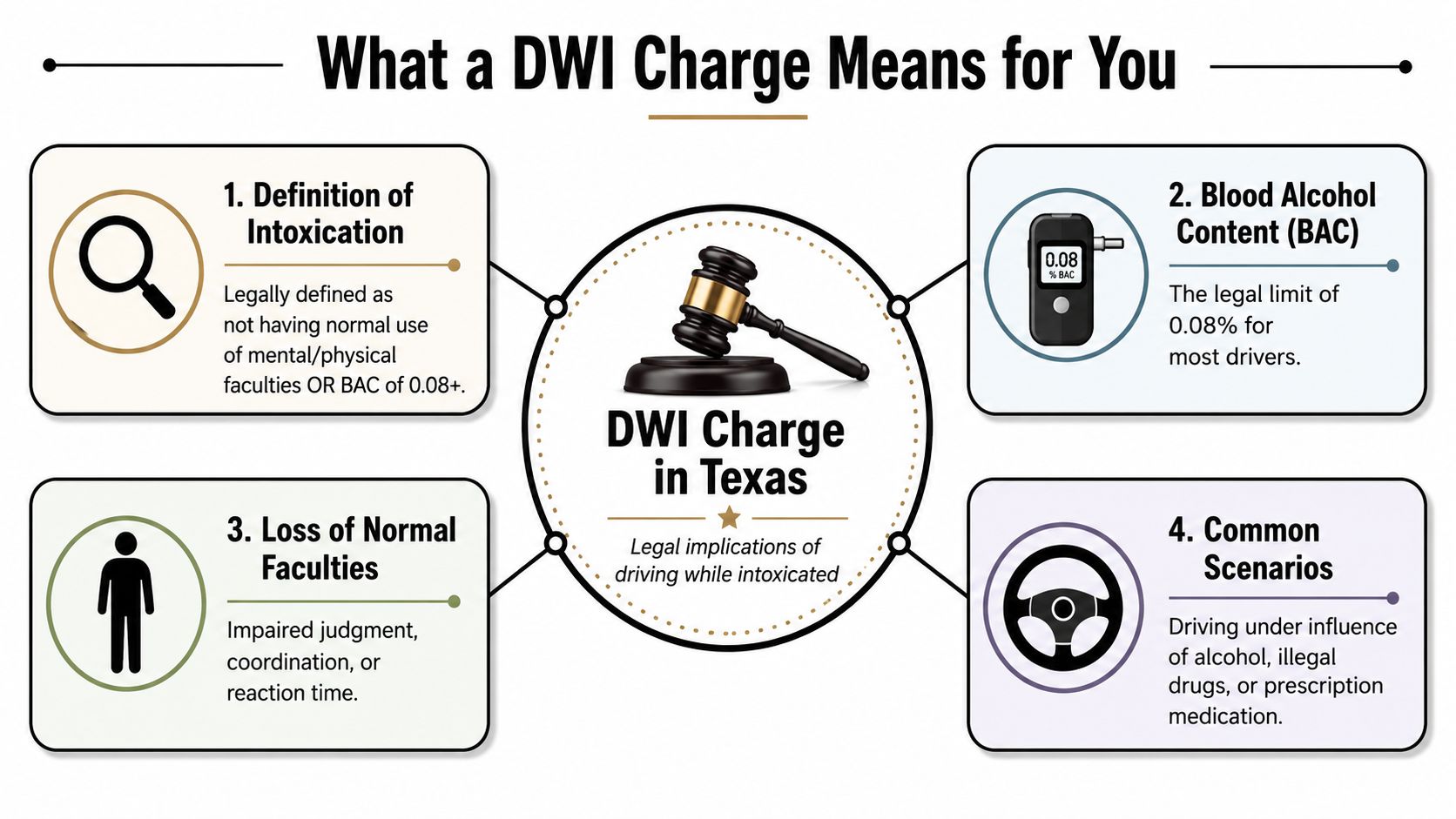
BAC in plain language
BAC means blood alcohol concentration. It's the measurement people usually hear about first. In most states, the adult legal threshold tied to impaired driving is 0.08% BAC. That number matters, but it doesn't tell the whole story.
A BAC result is only one form of evidence. The state still has to rely on the stop, the officer's observations, the testing process, and whether the evidence was gathered and handled correctly. A machine result doesn't speak for itself. People do. Officers administer tests. Technicians maintain equipment. Analysts interpret results. Lawyers challenge weak links.
Loss of normal use
Texas DWI allegations also focus on whether a person lost the normal use of mental or physical faculties. In everyday terms, that means the officer may claim your judgment, balance, coordination, speech, reactions, or ability to drive safely appeared impaired.
Many cases become more contestable than people expect, as officers often rely on observations that can have other explanations, including fatigue, anxiety, illness, weather conditions, footwear, road conditions, or a driver's natural mannerisms.
Common evidence the state may use
A prosecutor may try to build a DWI case from several kinds of evidence:
- The traffic stop: Why were you pulled over in the first place, and was the stop lawful?
- Field sobriety tests: These are roadside exercises used to assess signs of impairment. They are not the same as a breath test.
- Breath or blood testing: These are chemical tests used to measure alcohol concentration or detect substances.
- Officer observations: This can include driving pattern, speech, odor, balance, and statements made during the stop.
A field sobriety test is not a pass-fail school exam. It's an officer-administered tool, and the way it was explained, demonstrated, and scored can matter a great deal.
Key terms that often confuse drivers
Here are the terms clients ask about most often:
- Field sobriety test: A set of roadside tasks officers use to look for signs of impairment.
- BAC: Blood alcohol concentration.
- Chemical test: A breath or blood test used after a stop or arrest.
- Administrative license suspension: A license consequence handled separately from the criminal court case.
If you're trying to fight DWI Texas charges, the defense starts here. Your lawyer looks at each stage and asks whether the officer followed the law, whether the evidence is reliable, and whether the state can prove intoxication beyond a reasonable doubt.
Understanding Texas DWI Penalties and Consequences
Once the terminology is clear, the next concern is usually practical. People want to know what they're facing. That's reasonable. You need a straight answer, but you also need context. Potential penalties are not the same as inevitable outcomes.
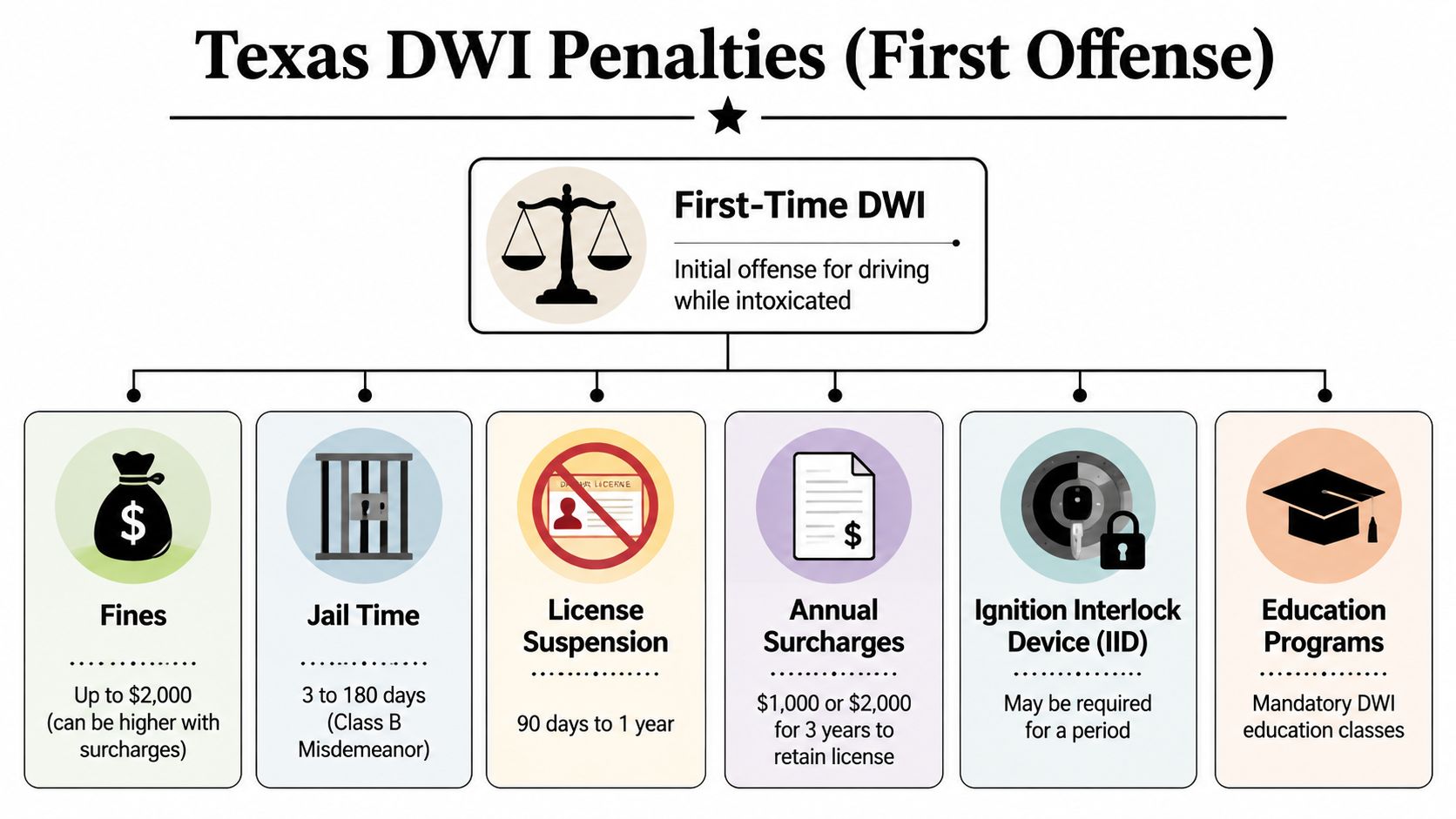
First DWI in Texas
A first DWI in Texas is commonly treated as a Class B misdemeanor. In broad terms, that means the court can impose jail time, fines, license consequences, court requirements, and conditions that affect daily life. Judges may also order education programs, supervision terms, and restrictions tied to driving privileges.
For many people, the biggest immediate concern isn't jail. It's the ripple effect. A pending charge can affect work schedules, transportation, professional licenses, insurance, and family responsibilities. That's one reason early defense work matters. Reducing disruption often starts long before trial.
Penalties are only part of the picture
The legal system looks at more than the label "first offense." The facts around the arrest can shape how the state approaches the case. Cases may be treated more seriously if prosecutors believe aggravating details exist, or if the evidence appears strong. On the other hand, weak evidence, procedural mistakes, and constitutional issues can change the direction of the case dramatically.
Here are the categories one should keep in mind:
- Criminal penalties: These can include jail exposure, fines, and a permanent record if there is a conviction.
- License consequences: Your ability to drive may be threatened through a separate administrative process.
- Court conditions: These may include classes, supervision terms, and monitoring requirements.
- Collateral impact: Employers, schools, and licensing boards may react to the charge or result.
Potential punishment sets the ceiling. Defense strategy focuses on lowering exposure, challenging the evidence, and protecting your record where possible.
Why the details of the arrest matter
No attorney can evaluate a case by charge name alone. Two people may both be accused of DWI, yet one case may hinge on a questionable traffic stop while another may center on a contested test result. The police report, video, witness accounts, body camera footage, and maintenance records for testing equipment can all matter.
That is why broad internet summaries often leave people unnecessarily discouraged. They list consequences in the abstract but don't explain how cases are defended in practice. A strategic review asks different questions. Was the officer justified in stopping you? Did the officer have enough to expand the encounter? Were roadside tests given correctly? Was a breath or blood result vulnerable to challenge? Did any statement come from improper questioning?
Practical next steps
After an arrest, focus on preserving options rather than assuming the worst.
- Keep your paperwork: Bond documents, notice forms, and court dates matter.
- Write down what happened: Your memory is strongest early. Note where you were, what you consumed, what the officer said, and what tests were requested.
- Avoid casual statements about the case: Conversations with friends, coworkers, or on social media can create problems later.
- Get legal advice quickly: Early review helps identify deadlines and defense issues before they harden into bigger problems.
For many drivers, the better question isn't "What is the maximum?" It's "What can be challenged, and what can still be protected?" That's the question a Houston DWI lawyer or Texas DUI attorney should be helping you answer.
What Happens After a DWI Arrest A Step by Step Guide
Uncertainty gets worse when you don't know the process. A DWI case is easier to handle when you can see the sequence clearly. In Texas, you are often dealing with two tracks at once. One involves your driver's license. The other is the criminal case in court.
Early in the process, this overview of what happens after a DWI arrest in Texas can help you compare your own timeline to the usual pattern.
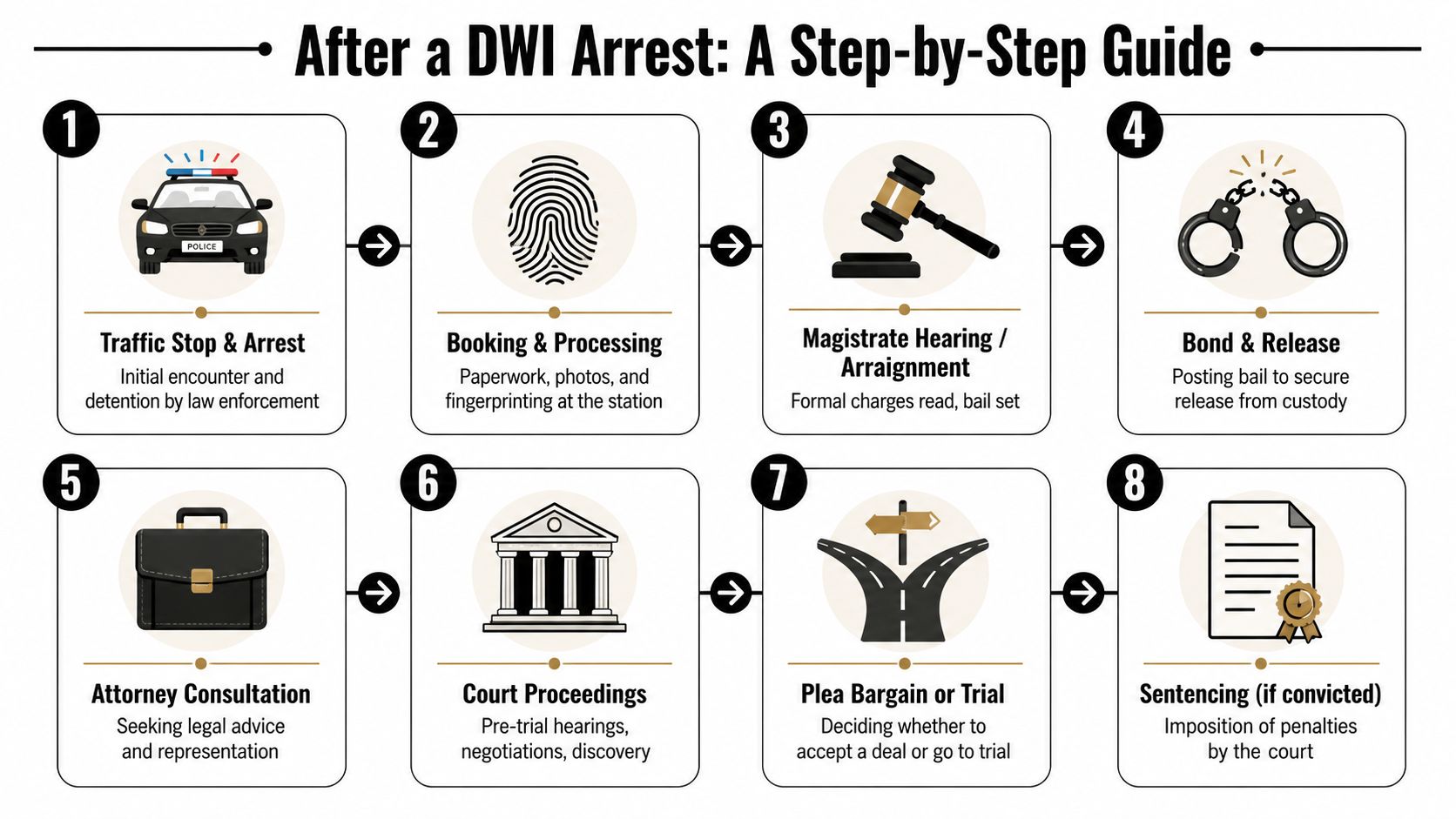
Step 1 through Step 3
Traffic stop and arrest
An officer stops the vehicle, asks questions, and may begin a DWI investigation. This can include observations, field sobriety testing, and requests for breath or blood testing.Booking and processing
After arrest, you may be taken to jail or another facility for fingerprinting, photographs, paperwork, and detention until release becomes possible.Bond and release conditions
A magistrate or court may set bond terms. Release conditions can include reporting requirements, travel limits, alcohol restrictions, or device requirements depending on the case.
A useful visual explanation appears below.
The license issue moves fast
One of the most important parts of the process is the threat to your license. Texas uses an administrative system separate from the criminal court case. In this administrative system, many people hear the phrase administrative license suspension.
You may also hear the term implied consent. In plain language, implied consent means that by driving, a person is treated as having agreed to chemical testing rules set by law. A refusal or certain test-related events can trigger a separate license action.
That administrative case is often called an ALR hearing, short for Administrative License Revocation hearing. It can be a very important early opportunity because your attorney may be able to examine the state's basis for the stop and arrest, question the officer under oath, and gather testimony that later helps the criminal defense.
The criminal case follows its own path
The court case usually unfolds in stages rather than all at once:
- First court appearance: The court addresses the charge and scheduling.
- Discovery and review: The defense obtains reports, video, lab materials, and other evidence.
- Motions and hearings: Your attorney may challenge the stop, the arrest, statements, or testing evidence.
- Negotiation or trial: Some cases resolve through reduction or agreement. Others need courtroom litigation.
The license case and the criminal case are related, but they are not the same proceeding. A person can make a mistake by focusing on one and ignoring the other.
Why early action helps
The first days after arrest often shape the rest of the case. Witness memories are fresher. Video can be located. Paperwork can be reviewed before deadlines pass. Conditions of release can be explained before accidental violations happen.
You don't need to know every rule by heart. You do need a plan. That usually means identifying deadlines, preserving evidence, staying compliant with bond conditions, and preparing for both the administrative and court sides of the case.
How to Fight a DWI Charge in Texas
A DWI arrest can make the case feel decided before you ever step into a courtroom. In Texas, it is not decided at arrest. For an adult driver, the state still has to prove a DWI charge with lawful police work and reliable evidence.

That is where a defense begins. It starts with a careful review of each step the officer took, each statement recorded, and each test the state plans to use. A case that sounds straightforward in a police report can look very different once video, timing, and procedure are examined side by side.
The basic question is simple. Can the prosecutor prove, under Texas law, that an adult was operating a vehicle while intoxicated? If the answer depends on shaky observations, poorly administered tests, missing video, or a questionable stop, the defense may have room to challenge the charge.
A practical case review often focuses on several pressure points:
- The traffic stop: Was there a lawful reason to pull the vehicle over?
- The officer's observations: Are the claimed signs of intoxication clear, specific, and consistent with the video?
- Field sobriety testing: Were the instructions clear, and were the conditions fair enough for the results to mean much?
- Statements made during the encounter: Can the state use them, and were they obtained properly?
- Breath or blood evidence: Were collection and testing procedures followed closely enough for the result to be trusted?
- The paperwork and recordings: Do the report, video, and charging documents match, or do they conflict?
A defense review works like checking a chain link by link. The state needs the whole chain to hold. One weak link may not end the case by itself, but it can change negotiations, hearings, and trial strategy.
Law Office of Bryan Fagan, PLLC handles Texas DWI matters, including license hearings, first-offense cases, and trial-level defense.
Strong defense work is methodical. It comes from records, timelines, procedures, and a close examination of the state's evidence.

