
A second DWI arrest can be overwhelming—but you don’t have to face it alone. If you're reading this, you are likely feeling that same sense of dread from the first time, only amplified. The fear for your freedom, your job, and your family can be paralyzing. Let’s be clear: a DWI Texas 2nd offense is a serious Class A Misdemeanor, and the penalties are far more severe than what you faced before, including mandatory jail time and fines up to $6,500.
But here's the most important thing to remember right now: an arrest is not a conviction. This guide is here to help you understand your rights, explain Texas DWI laws in clear terms, and help you take the next step toward a powerful legal defense.
What a Second DWI Charge Means for You

A second DWI charge feels like a nightmare you’ve already lived through, but this time the stakes are dramatically higher. The legal system, which might have shown some grace for a first offense, now sees you as a repeat offender. Prosecutors will pursue your case with more aggression, and judges have their hands tied with much stricter sentencing guidelines.
Think of this guide as your roadmap. We're going to walk you through exactly what a DWI Texas 2nd offense involves, breaking down the penalties, the court process, and the critical deadlines you absolutely cannot afford to miss. Understanding the fight ahead is the first step in taking back control.
The Clock Is Ticking: Your First Move After a DWI Arrest
Your most urgent priority has nothing to do with the criminal court. You have just 15 days from the date of your arrest to request an Administrative License Revocation (ALR) hearing to protect your driver's license.
This is a separate, civil process, but it is your one and only opportunity to challenge an automatic license suspension. If you miss this deadline, your license will be suspended, no questions asked. Taking immediate action gives your Houston DWI lawyer a chance to challenge the evidence and the traffic stop from the very beginning.
To see just how much the penalties increase, look at this direct comparison.
Texas DWI Penalties Explained: First vs. Second Offense
| Penalty | First DWI Offense (Class B Misdemeanor) | Second DWI Offense (Class A Misdemeanor) |
|---|---|---|
| Jail Time | 3 to 180 days | 30 days to 1 year (Mandatory) |
| Fine | Up to $3,000 | Up to $6,500 |
| License Suspension | 90 days to 1 year | 180 days to 2 years |
| Ignition Interlock | Possible | Mandatory |
The table makes it obvious: Texas law is designed to punish a second offense significantly more harshly.
A second DWI charge does not have to define your future. It is a serious legal battle, and it requires a serious, strategic defense. The choices you make in the first few days can lay the groundwork for a much better outcome.
This guide will help you get a handle on:
- The tougher penalties for a Class A Misdemeanor DWI.
- The critical ALR hearing process and why it’s your first line of defense.
- How a skilled defense attorney can pick apart the prosecution's case.
- Potential outcomes and what to expect as your case moves through the system.
Right now, your number one job is to understand your rights and the legal landscape you're facing. The consequences are severe, but remember, the state still has the burden of proof. Every single piece of their case—from the reason they pulled you over to the chemical test results—can be scrutinized and challenged by an experienced Texas DUI attorney. Your future is worth the fight.
Critical First Steps After Your Arrest
After a second DWI arrest, your head is probably spinning. The confusion and anxiety can be overwhelming, but what you do in the next two weeks will set the stage for your entire case. Right now, you’re not just fighting one battle; you're fighting two. One is the criminal charge that threatens your freedom, and the other is a civil action that could take away your driver's license.
This isn’t a time for waiting to see what happens. There’s a critical deadline looming, and missing it means automatically losing your right to drive. You must act fast.
Secure Your Right to an ALR Hearing
The single most urgent task on your plate is requesting an Administrative License Revocation (ALR) hearing. The moment you were arrested, a timer started.
You have only 15 days from the date of your arrest to formally request this hearing with the Texas Department of Public Safety (DPS). If you miss this deadline, your license will be suspended automatically. No second chances.
Think of the ALR hearing as your first opportunity to fight back. It's a civil process, completely separate from your criminal DWI case, but it's incredibly important. It's the first chance for your lawyer to question the arresting officer under oath about the stop, the field sobriety tests, and why they arrested you. We can often uncover weaknesses in the state’s case here that become powerful tools in your criminal defense later.
Understanding Key Terms: Implied Consent, BAC, and More
During your arrest, the officer almost certainly asked you for a breath or blood sample. This is where a legal concept called implied consent kicks in. Simply by driving on a public road in Texas, you have legally—or "implicitly"—agreed to provide a sample if an officer has probable cause to believe you’re intoxicated.
Your choice in that moment—to take the test or refuse it—sets off two different paths for your license suspension.
- Failing the Test: If you provided a sample and your Blood Alcohol Concentration (BAC) was 0.08% or higher, your license will be suspended for at least 90 days. A BAC of 0.15% or higher leads to even harsher penalties.
- Refusing the Test: If you refused to provide a sample, you face a much longer automatic suspension: 180 days.
While refusing the test leads to a longer potential suspension, it also means the prosecutor doesn't have that key piece of BAC evidence for your criminal trial. There are strategic pros and cons to both situations, and a skilled DWI lawyer can walk you through how it applies to your specific case.
Start Building Your Defense Immediately
While the ALR hearing is the first legal deadline, there are other things you need to do right now to help your attorney build the strongest defense possible. You can get started on these even before your first court date. To help, we’ve put together a detailed guide you can follow. Read more about what to do in our comprehensive DUI post-arrest checklist for Texas.
Here are the most important actions to take immediately:
- Write Down Everything You Remember: Your memory is evidence. As soon as you can, write down every single detail you can recall about the 24 hours leading up to the arrest. Where were you? What did you eat? What did the officer say when they pulled you over? How did they conduct the sobriety tests? No detail is too small.
- Preserve All Related Evidence: Keep every piece of paper the police or jail gave you—your notice of suspension, bond paperwork, citations, everything. If you have receipts from dinner or the bar, save them. This documentation helps build a timeline and can back up your version of events.
- Contact a DWI Defense Attorney: Don't wait. The sooner you hire an experienced attorney, the sooner they can file for your ALR hearing, start their own investigation, and guide you through the next steps.
Facing a DWI Texas 2nd offense is a serious challenge, but taking these first steps puts you back in a position of control. By acting quickly, you're not just protecting your license—you're laying the groundwork for a powerful defense.
Understanding the Harsher Penalties You Face
If this is your second time facing a DWI charge in Texas, you need to know one thing: the game has completely changed. The state no longer sees this as a one-off mistake. A DWI Texas 2nd offense is automatically upgraded from a Class B to a Class A Misdemeanor, and the penalties are designed to be seriously punishing.
You can be sure the prosecutor will approach your case with a level of aggression you didn’t see the first time around. This isn't meant to scare you—it's meant to prepare you. Knowing exactly what's on the line is the first step toward building a defense that can stand up to that pressure.
Mandatory Jail Time and Skyrocketing Fines
The single biggest shift for a second DWI is the mandatory jail sentence. With a first offense, it’s often possible to avoid jail entirely. Not this time. Even if a judge grants you probation, Texas law demands you serve time behind bars.
Once a DWI is classified as a second offense, the stakes are immediately raised. The charge becomes a Class A Misdemeanor, which carries a mandatory minimum of 30 days in county jail and a maximum of up to one year. The fines also jump to as high as $6,500, and that’s before you even factor in court costs and other state-imposed fees that can easily double that number.
On top of that, you’re looking at a driver's license suspension that can last anywhere from 180 days to two full years. These consequences are severe and reflect the state's goal of preventing repeat offenses. You can get more details on what to expect after a 2nd DWI in Texas.
A second DWI conviction brings consequences that are not just tougher but also mandatory. The law removes much of the judge's discretion, making it absolutely essential to fight the conviction itself with a strategic legal defense.
The Endless Memory of Texas Law
One of the toughest parts of Texas DWI law is that it has a lifetime "lookback period." Think of it this way: your driving record has a permanent memory. Unlike in other states where an old DWI might fade away for sentencing purposes after a certain number of years, in Texas, it’s there forever.
That means a DWI from five, ten, or even twenty years ago is still on the books and will be used to enhance your current charge to a DWI Texas 2nd offense. This policy shows just how unforgiving the state is toward repeat offenders, making it critical to challenge every piece of evidence in the new case.
The Ignition Interlock Device Mandate
With a first offense, a judge has some discretion on whether you need an Ignition Interlock Device (IID). For a second offense, that choice is gone. It's mandatory.
An IID is a breathalyzer that gets wired into your car’s ignition. You have to blow into it and provide an alcohol-free breath sample just to start the engine. It will also demand random "rolling retests" while you're on the road to ensure you haven’t been drinking. If you're charged with a second DWI, a judge must order you to install an IID on any vehicle you drive, both as a condition of your bond and likely as part of any probation.
The chart below lays out the immediate steps you have to take after an arrest. Time is not on your side.
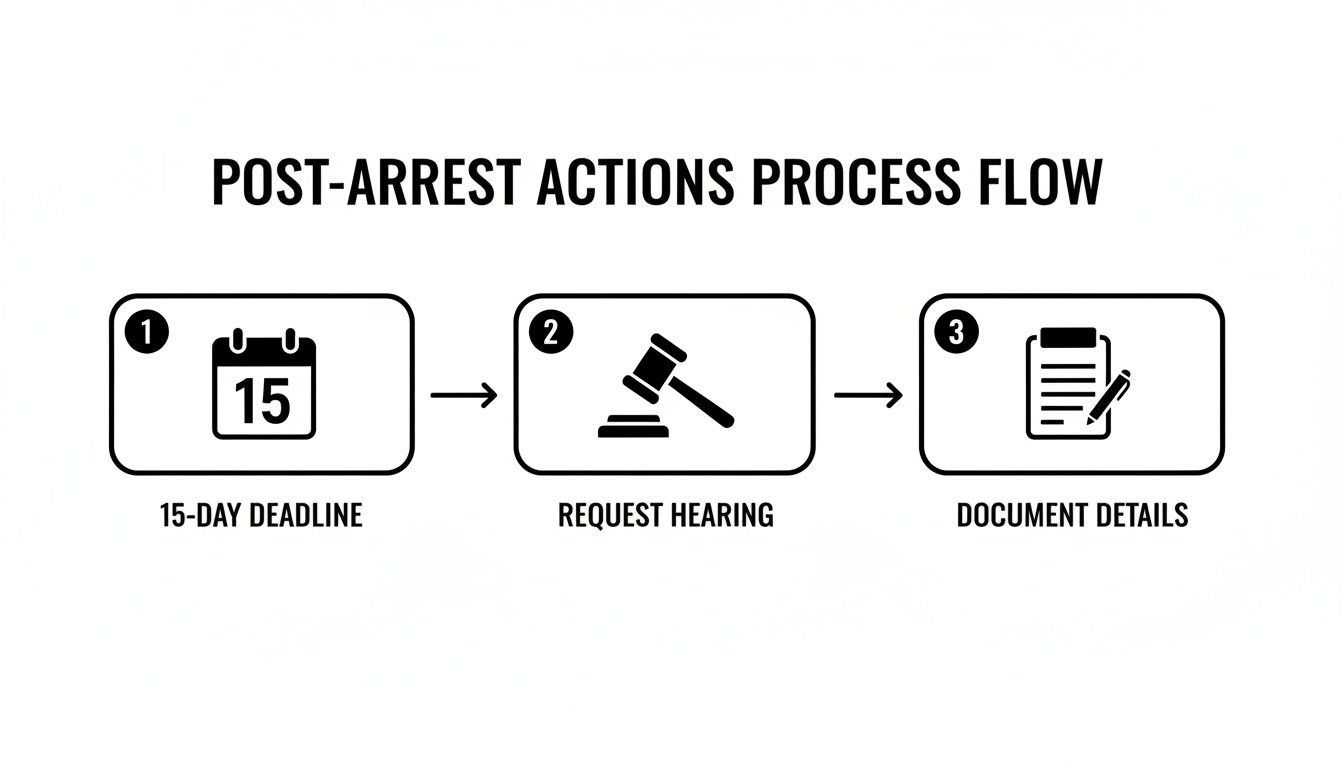
As you can see, you face a critical 15-day deadline to request an ALR hearing to even have a chance at saving your license from automatic suspension.
Other significant penalties that come into play include:
- Mandatory Community Service: A judge can order you to complete between 80 and 200 hours of service.
- DWI Education Program: You will be required to finish a 12-hour, state-approved DWI education class.
- License Suspension: Your driver's license can be taken away for up to two years—a much harsher and longer suspension than for a first offense.
These are serious penalties, but remember, an arrest is not a conviction. It’s just the start of a long legal fight. An experienced DWI lawyer can scrutinize every detail of your case—from why you were pulled over to how the chemical tests were handled—to find the weaknesses needed to build a powerful defense.
Building a Winning Defense Strategy
Getting arrested for a DWI Texas 2nd offense is a gut-wrenching experience. It’s easy to feel like the system has already branded you as guilty and that a conviction is inevitable. But it's critical to remember that an arrest is just an accusation. The state has the entire burden of proving its case, and their evidence is often full of holes.
A winning defense isn't about making excuses—it's about holding the prosecution to its own standards. A skilled Houston DWI lawyer doesn't just accept the police report as the final word. Instead, we treat it like a puzzle, taking it apart piece by piece to find the procedural errors, constitutional violations, and factual weaknesses that can turn a case in your favor.
How to Fight a DWI: Challenging the Traffic Stop and Arrest
The first domino in any DWI case is the traffic stop. If the officer didn't have a legal reason—known as reasonable suspicion—to pull you over in the first place, the entire case can fall apart.
An experienced attorney will dig into the officer's justification for the stop. Was it a legitimate traffic violation, or was it just a hunch? We start asking the tough questions:
- Did the stop come from a vague or anonymous tip that wasn't properly verified?
- Did the officer actually have a clear view of the so-called traffic mistake?
- Could other factors like bad weather, road construction, or another driver's actions explain your driving pattern?
If we can show the stop was unlawful, everything that came after it—the sobriety tests, the breath or blood sample—can be thrown out of court. In many cases, this leaves the prosecution with nothing, forcing a dismissal.
How to Fight a DWI: Deconstructing Field Sobriety Tests
You’ve seen them on TV: the walk-and-turn, the one-leg stand, and the eye test. These Field Sobriety Tests (FSTs) are what officers use to gather evidence they believe shows impairment. The reality is that they're notoriously subjective and are practically designed for failure, even for a completely sober person.
Think about all the things that can affect your performance that have nothing to do with alcohol:
- The sheer anxiety and nervousness of being on the side of the road with police lights flashing.
- Physical limitations, like a past injury, medical condition, or just being overweight.
- The officer failing to give instructions exactly as the standardized protocol demands.
- Bad lighting, an uneven road surface, or passing traffic creating distractions.
We meticulously review every second of dashcam and bodycam footage. Were the instructions mumbled? Was the scoring biased? If the tests weren't done by the book, we can argue the results are unreliable and should be excluded as evidence.
How to Fight a Breath Test Result
The prosecution’s "silver bullet" is usually the Blood Alcohol Concentration (BAC) number from a breath or blood test. They'll present it like it's undeniable proof. But these scientific tests are far from perfect. They are vulnerable to a host of errors, both from the machine and the humans operating it.
For a breath test, a sharp defense lawyer will investigate:
- Machine Calibration: Was that breathalyzer machine properly maintained and calibrated? We pull the service records to find out.
- Officer Certification: Was the officer who administered the test even certified to use that specific device?
- The 15-Minute Observation Period: The officer must watch you for 15 continuous minutes before the test to ensure you don’t do anything to contaminate the sample, like burping or hiccuping. Did they actually do it, or were they distracted?
When it comes to blood tests, the potential for error is even higher. We challenge the results by digging into:
- The Chain of Custody: Who handled your blood sample from the draw to the lab? Any undocumented gap or break in this chain can render the result inadmissible.
- Lab Procedures: Was the equipment sterile? Was the sample stored at the right temperature? Did the lab technician follow every single scientific protocol?
Remember, a number on a lab report doesn't automatically equal guilt. By questioning the science and procedure behind the BAC result, a defense attorney can create the reasonable doubt necessary to win your case or force the prosecutor to offer a reduced charge.
Every single step of a DWI investigation is an opportunity to build a strong defense. To effectively fight DWI Texas charges, your attorney has to be willing to question everything. A successful strategy can get evidence thrown out, which often leads to a full dismissal or a much more favorable plea deal, protecting both your freedom and your future.
Navigating the Texas Court System
Walking into a Texas courthouse for a DWI Texas 2nd offense can feel like you’ve been dropped into a foreign country without a map. The rules are unfamiliar, the language is confusing, and the stakes couldn't be higher. But understanding the legal road ahead is the first step toward taking back control. You don’t have to face this alone—a skilled defense lawyer is your guide for every step of this journey.
The process kicks off right after your arrest with the step-by-step guidance we've outlined, starting with the all-important request for your ALR hearing. Your first formal court date is the arraignment. This is where the judge will officially read the charge against you—a Class A Misdemeanor—and you will enter a plea of "not guilty." Pleading not guilty is standard practice; it’s what allows your attorney to get to work fighting for you.
Who's Who in the Courtroom
It helps to think of the courtroom as having assigned players, each with a specific job. The prosecutor works for the State of Texas, and their only goal is to get a conviction. They will use every piece of evidence they have—the police report, your test results, and the officer’s testimony—to build their case against you.
On your side, you have your defense lawyer. Our job is to be both your shield and your sword. We’re there to challenge the prosecutor's case, protect your constitutional rights from being violated, and make sure your side of the story gets told. We are your advocate, your strategist, and your guide through this intimidating system.
The Path to a Resolution
After the arraignment, your case moves into a critical pre-trial phase filled with motions and negotiations. This is where your attorney can file motions to suppress evidence—for instance, arguing the police had no legal reason to pull you over in the first place or that the breathalyzer results are scientifically unreliable. A strong defense can often pick apart the state's case piece by piece, long before a jury ever hears it.
At the same time, your lawyer will be negotiating with the prosecutor. The aim here is to find a way out, whether that’s a complete dismissal, a reduction of the charge to something less serious, or another outcome that protects your future. However, there’s one option that is completely off the table.
A crucial reality of a second DWI charge is that you are no longer eligible for deferred adjudication in Texas. That "second chance" option, which lets first-timers earn a dismissal after probation, is gone for good.
Community Supervision as an Alternative to Jail
Just because deferred adjudication isn't an option doesn't mean a long jail sentence is a certainty. One potential outcome is community supervision, which most people know as probation. With a strong negotiation, a judge can sentence you to probation instead of locking you up for the maximum time.
Be warned, though: for a DWI Texas 2nd offense, the law requires a mandatory minimum of 30 days in jail, even as a condition of probation. An experienced attorney’s goal is to negotiate for the most manageable probation terms possible, which often include:
- An Ignition Interlock Device (IID) installed on your vehicle.
- Completing a state-mandated DWI education program.
- A substance abuse evaluation and any recommended follow-up treatment.
- Regular meetings with a probation officer.
It’s important to know that DWI outcomes are not the same across Texas. The state sees roughly 90,000 DWI arrests each year, and the results can look very different from one county to the next. In major counties like Harris, Dallas, and Travis, a surprising number of cases are resolved without a final conviction for people who mount a smart defense. You can see how the numbers break down by reviewing an in-depth analysis of Texas DWI statistics.
This is exactly why having a Houston DWI lawyer who knows the local courts is so critical—they understand the prosecutors, the judges, and the unwritten rules of the courthouse where your freedom is on the line.
Protecting Your Career and Livelihood

A conviction for a DWI Texas 2nd offense does more than just put you in legal trouble. It sends shockwaves through every part of your life, especially the career you’ve worked so hard to build. For many Texans, the professional fallout can be devastating.
This is particularly true for anyone holding a state-issued professional license. A second DWI conviction is a massive red flag that can trigger an immediate review by your licensing board. Your ability to work as a nurse, doctor, pilot, or lawyer could be on the line.
The list of affected professions is long:
- Nurse
- Doctor
- Pilot
- Lawyer
- Real estate agent
- Teacher
The stakes are even higher for Commercial Driver's License (CDL) holders. A second DWI conviction means a lifetime disqualification from holding a CDL. It's not a suspension; it's the end of a professional driving career.
Keeping You on the Road and at Your Job
Even if your professional license isn't directly threatened, a long driver's license suspension can make it nearly impossible to keep your life moving. How do you get to work, take care of your family, or run basic errands? We understand. Life doesn't just stop because of a DWI charge.
That’s why a core piece of our defense strategy is petitioning the court for an Occupational Driver's License (ODL). Think of it as a lifeline. An ODL is a special, restricted license that lets you drive to and from work, school, and other essential places during your suspension. Securing this for you is a critical first step to minimize the disruption and help you keep your job while we attack the criminal charges.
Background Checks and Your Professional Future
In today’s world, almost any serious job application comes with a background check. A second DWI conviction is a permanent mark on your record—in Texas, it is not eligible for expunction or an order of non-disclosure. This creates a massive hurdle when you’re trying to find a new job or earn a promotion.
The professional challenges are real and complex. You can learn more in our detailed guide on how Texas DWI penalties affect job seekers.
A DWI charge does not have to be the final word on your career. By taking swift, strategic action, we can work to protect your livelihood and minimize the long-term professional fallout.
Facing a second DWI is a defining moment, but it doesn't have to define your future. The road ahead might seem impossible, but you have the power to fight back. It all starts with getting experienced legal help on your side. We invite you to contact us for a free, confidential consultation. Together, we can start building your defense and moving forward.
Frequently Asked Questions About Second DWI Charges
When you’re facing a second DWI charge in Texas, the questions come fast and furious. The uncertainty can be overwhelming. We understand. Let's provide clear, direct answers to the questions we hear most often from people in your exact situation.
Can I get probation for a second DWI in Texas?
Yes, probation (which Texas law calls "community supervision") is a possible outcome. But here’s the reality you need to be prepared for: Texas law is unyielding on one point. Even if you get probation, there is a mandatory minimum of 30 days jail time that must be served as a condition of that probation.
An experienced lawyer can fight for the best possible terms, but that initial jail time is a required component for a second DWI conviction that results in probation. There’s no negotiating that part away.
Is a second DWI in Texas a felony?
Not automatically. A standard second DWI is a Class A Misdemeanor, which is a serious charge but not a felony.
However, the charge can be escalated to a felony if specific aggravating factors are involved. The most common one is having a child passenger under 15 in the vehicle at the time of the offense. It's also critical to know that if this ever happens again, a third DWI is always charged as a felony in Texas.
A DWI conviction stays on your criminal record in Texas permanently. A second DWI conviction is not eligible for expunction or an order of non-disclosure. This is why it is so critical to fight the charge itself to avoid a conviction.
How long does a DWI stay on my record?
Forever. That’s the blunt, honest answer. In Texas, a DWI conviction is a permanent mark on your criminal record. The state has a lifetime "lookback period," meaning a conviction for a DWI Texas 2nd offense can never be sealed or expunged.
This permanent record will appear on background checks for jobs, apartments, and professional licenses for the rest of your life. The only way to prevent this from happening is to get the charge dismissed, be found not guilty at trial, or have the charge reduced to a non-DWI offense that might be eligible for record clearing down the road.
The answers to these questions make one thing clear: a second DWI charge is incredibly serious. But they also show why a strategic, aggressive defense is so important. At The Law Office of Bryan Fagan, PLLC, we believe that your future is worth fighting for. We're here to listen, protect your rights, and build the strongest defense possible for your case.
Don't face this alone. Contact us today for a free, confidential case evaluation. Let’s talk about your options and start building your defense.