
A DWI arrest can be overwhelming—but you don’t have to face it alone. The moments after an arrest are confusing, and it's easy to feel like the world is crashing down around you. But it's critical to remember one thing: an arrest is not a conviction. The penalties you might face depend entirely on the specifics of your case, and they can range from a Class B Misdemeanor for a first-time offense to a serious felony charge carrying heavy prison time. The first step toward building a solid defense is understanding exactly what you're up against.
Texas DWI Penalties Explained
After a DWI arrest, you are suddenly facing two separate legal battles at once: a criminal case that will decide your guilt or innocence, and an administrative case that will determine the fate of your driver's license.
The potential consequences are serious, and they get worse with each subsequent offense. A conviction can bring:
- Jail or Prison Time: This can mean anything from a few days in county jail for a first offense to several years in a state prison for a felony DWI.
- Significant Fines: The financial hit can be staggering, with fines reaching up to $10,000 for felony convictions—and that doesn't even include court costs and other mandatory fees.
- DWI License Suspension: A DWI charge almost always triggers a license suspension, which can last anywhere from 90 days to two years.
- A Lasting Criminal Record: A conviction can follow you for life, creating major hurdles for employment, housing applications, and professional licenses.
This visual gives you a clear picture of how DWI charges escalate from a simple arrest to misdemeanor and felony convictions, with the stakes getting higher at every level.
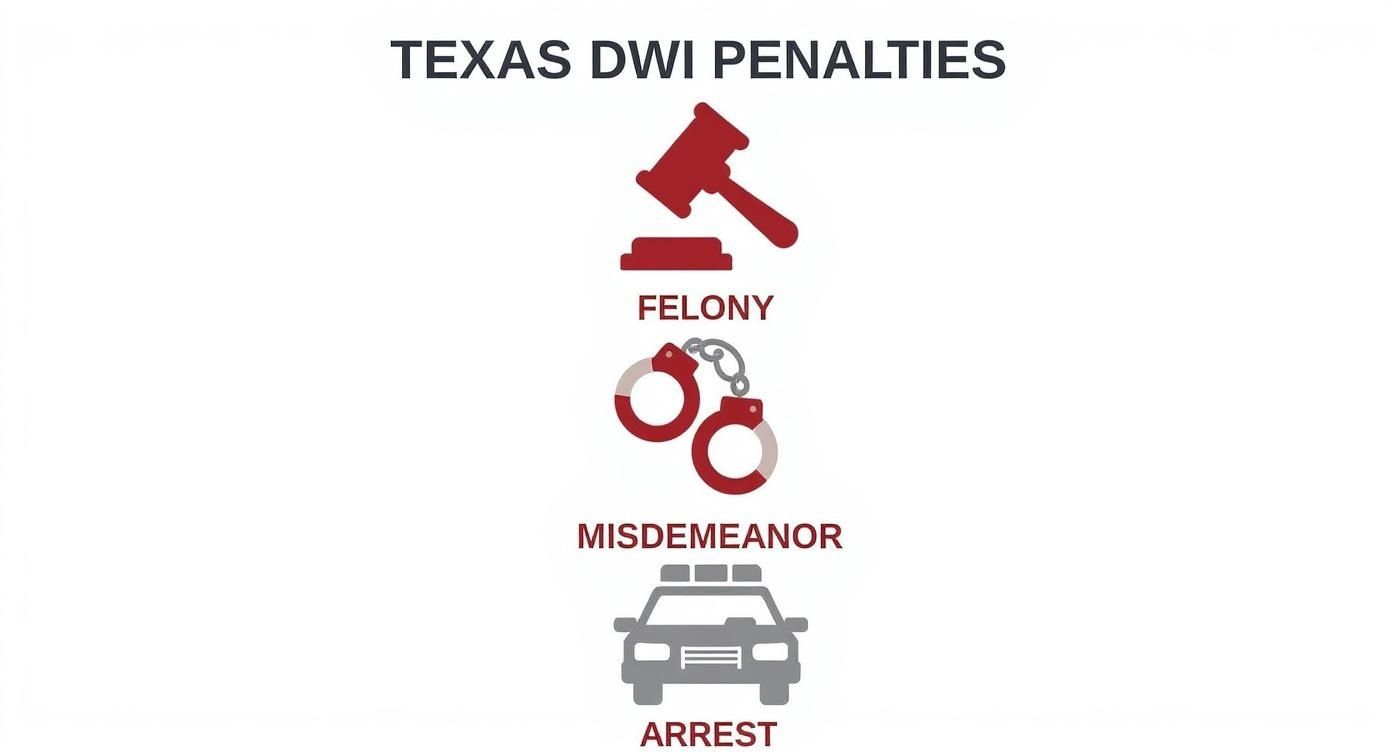
As you can see, each step up brings much harsher consequences. This is why having a strong legal defense from the very beginning is so important to protect your rights and minimize the consequences.
The Two Fronts of a DWI Case: Criminal and Administrative
Right after an arrest, you have to prepare to fight on two different fronts. The first is the criminal charge itself, where the prosecutor has to prove your guilt beyond a reasonable doubt.
The second—and more urgent—battle is the Administrative License Revocation (ALR) hearing.
You have only 15 days from the date of your arrest to request an ALR hearing to challenge the automatic suspension of your driver's license. If you miss this deadline, your license is automatically suspended.
This civil process, known as an administrative license suspension, is completely separate from your criminal case and moves much more quickly. Successfully navigating the Texas ALR hearing process is a crucial first move, as it’s often the first chance to challenge the evidence the state has against you. An experienced Houston DWI lawyer can represent you in both proceedings, fighting to protect your rights every step of the way and working to minimize the impact on your life.
Texas DWI Penalties At a Glance
To give you a clearer idea of what's at stake, here’s a breakdown of the standard penalties for DWI offenses in Texas. Keep in mind that these are general guidelines; the specific consequences you face can vary based on the unique details of your case, like your BAC (Blood Alcohol Concentration) level or if there was an accident.
| DWI Offense | Classification | Potential Jail Time | Maximum Fine | License Suspension |
|---|---|---|---|---|
| First DWI | Class B Misdemeanor | 72 hours to 180 days | Up to $2,000 | 90 days to 1 year |
| Second DWI | Class A Misdemeanor | 30 days to 1 year | Up to $4,000 | 180 days to 2 years |
| Third DWI or More | Third-Degree Felony | 2 to 10 years in prison | Up to $10,000 | 180 days to 2 years |
| DWI with Child Passenger | State Jail Felony | 180 days to 2 years | Up to $10,000 | 180 days |
| Intoxication Assault | Third-Degree Felony | 2 to 10 years in prison | Up to $10,000 | 90 days to 1 year |
| Intoxication Manslaughter | Second-Degree Felony | 2 to 20 years in prison | Up to $10,000 | 180 days to 2 years |
This table shows just how quickly the penalties can escalate. A single mistake can have life-altering consequences, which is why it's so important to understand the charges and build the strongest defense possible.
Navigating Your First DWI Offense
For most people, a first DWI in Texas is their first real, and deeply unsettling, encounter with the criminal justice system. The experience can feel like a blur—confusing, overwhelming, and scary. But understanding the specific penalties you’re up against is the first step toward regaining control of your situation.
Remember, an arrest is just the start of a legal fight. It’s not the final word.
Typically, a first DWI offense is charged as a Class B Misdemeanor. This legal classification comes with a set range of penalties designed to impact your freedom, your finances, and your daily life. A smart defense strategy is absolutely critical to minimizing these consequences.
Standard Penalties for a First DWI
When you’re facing a first DWI, you need to know what’s on the table. Texas law lays out clear minimums and maximums for a Class B Misdemeanor, giving the court a framework to work within.
The standard penalties include:
- Jail Time: A conviction comes with a mandatory minimum of 72 hours in county jail, but the sentence can go all the way up to 180 days.
- Fines: You could be hit with a fine of up to $2,000. That doesn't even include the court costs and other administrative fees that always seem to pile up.
- Driver's License Suspension: Your license can be suspended anywhere from 90 days to one full year.
These are the baseline penalties for a standard first-time conviction. However, the unique facts of your case will have a huge say in the final sentence. For a more detailed breakdown, check out our guide on navigating a first DWI offense in Texas. An experienced Houston DWI lawyer can work to get these penalties reduced or even fight for a complete dismissal.
How a High BAC Changes Everything
One of the most powerful pieces of evidence in any DWI case is your Blood Alcohol Concentration (BAC). This number—a simple measurement of the alcohol in your system—can change everything. In Texas, a BAC of 0.08% or higher makes you legally intoxicated.
But what happens if that number is much higher? The penalties get much, much worse.
If your BAC comes back at 0.15% or higher, the charge is automatically enhanced from a Class B Misdemeanor to a Class A Misdemeanor. This single factor effectively doubles the potential punishment across the board.
A Class A Misdemeanor brings much tougher consequences:
- Jail Time: The potential jail sentence skyrockets to a maximum of one year.
- Fines: The maximum fine doubles to $4,000.
Think about that. One number from a breath or blood test can completely alter the course of your life for the next year. That's precisely why challenging the accuracy and legality of BAC testing is a cornerstone of any strong DWI defense.
Additional Consequences to Consider
Beyond the threat of jail time and hefty fines, a first DWI conviction brings a whole host of other court-ordered requirements. These aren't optional—they are mandatory conditions of probation or your sentence that will impact your daily life for months, sometimes even years.
Other potential requirements include:
- DWI Education Program: You will almost certainly be ordered to complete a 12-hour DWI education course.
- Community Service: The court can order you to perform between 24 and 100 hours of community service.
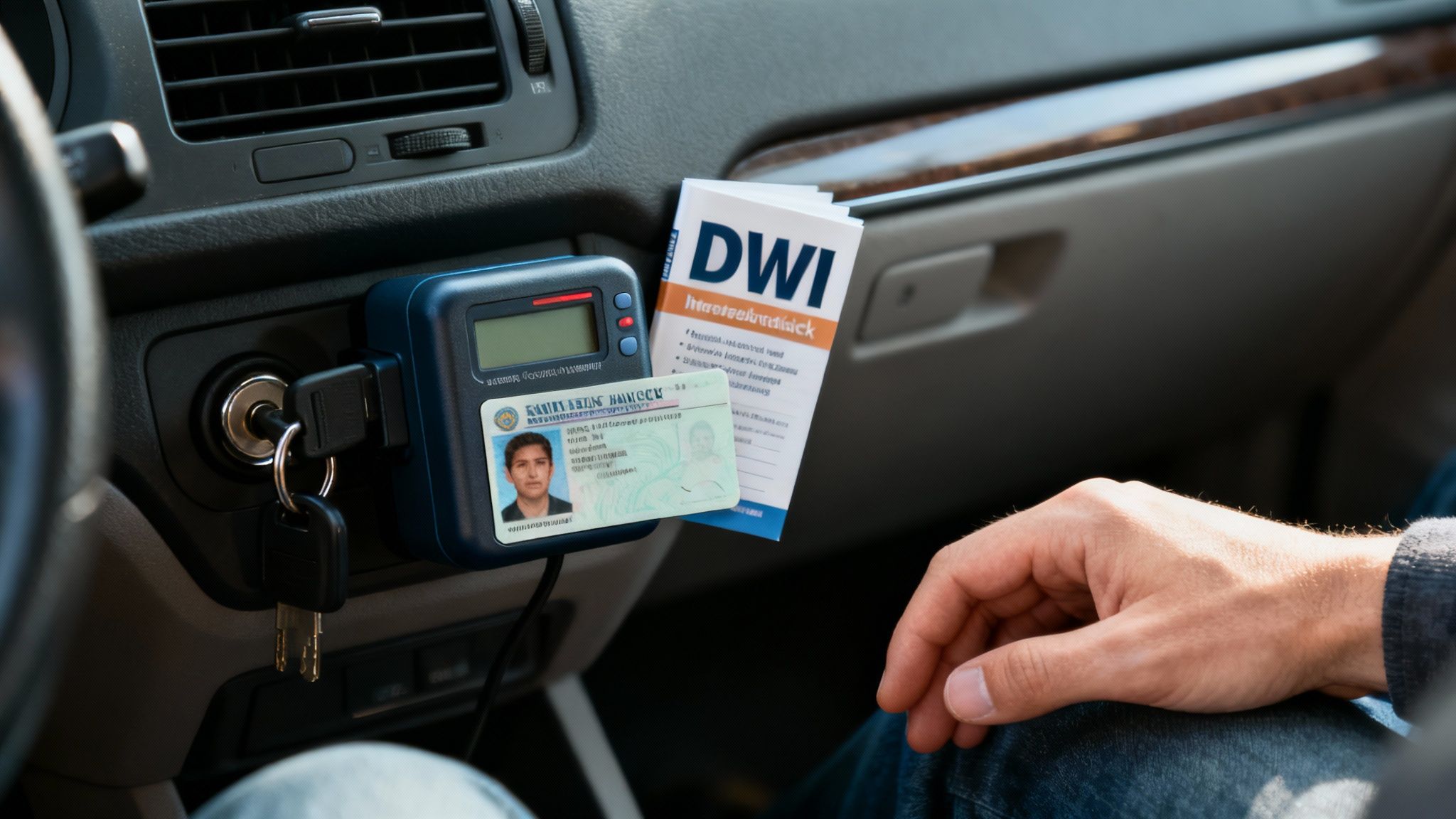
- Ignition Interlock Device (IID): This is the "car breathalyzer." An IID is installed in your vehicle and requires you to provide a clean breath sample before the car will start. It may be ordered as a condition of your bond or probation, adding a significant daily hassle and expense.
Facing this laundry list of potential penalties alone is a truly daunting prospect. A skilled attorney won't just represent you in court; they will help you understand all your options and fight for the best possible outcome for your future.
Escalating Penalties for Repeat DWI Charges
If a first DWI is a serious wake-up call, a second or subsequent charge brings the full weight of the Texas justice system down on you. The state doesn't see repeat offenses as a series of isolated mistakes; it sees a clear pattern of dangerous behavior. And the penalties escalate sharply to match.
Facing a second or third DWI raises the stakes to a whole new level. A strategic, aggressive defense isn't just an option—it's an absolute necessity.
A second DWI charge jumps from a Class B to a Class A Misdemeanor. This isn't just a bureaucratic label. It's a major leap in consequences that can threaten your freedom, your finances, and your future.
The Consequences of a Second DWI Conviction
When you're facing a second DWI, the court has far less wiggle room than it does for a first-timer. The penalties are harsher across the board, and the mandatory minimums are much stricter. You're no longer viewed as someone who made a one-time error in judgment; you're seen as someone with a history of driving intoxicated.
For a second DWI, the potential penalties include:
- Mandatory Jail Time: A conviction means a jail sentence anywhere from 30 days to one full year. Unlike a first offense where probation might help you avoid significant time behind bars, a second offense often comes with a mandatory stretch in county jail.
- Increased Fines: The maximum fine doubles to $4,000. And that’s before court costs and state fees pile on, which can easily add thousands more to your financial burden.
- Lengthy License Suspension: Your driver's license can be taken away for 180 days up to two full years, making it incredibly difficult to get to work, school, or handle family responsibilities.
One of the most significant changes is the mandatory installation of an Ignition Interlock Device (IID). While a judge might have discretion on an IID for a first offense, it's almost always required after a second DWI conviction. This device, installed in your vehicle at your own expense, demands a clean breath sample before the engine will even start—a constant, inconvenient reminder of the conviction.
Facing a Third DWI: A Life-Altering Felony
A third DWI arrest is a critical turning point. The charge is automatically filed as a third-degree felony. This moves your case out of the misdemeanor courts and into a system designed to handle the most serious crimes.
A felony conviction isn't something you can just move on from. It leaves a permanent mark that can alter the entire course of your life.
A felony DWI conviction means you could be labeled a "convicted felon" for life. This status can legally bar you from owning a firearm, voting (while serving your sentence), and obtaining certain professional licenses, fundamentally changing your civil rights and career opportunities.
The penalties for a third-degree felony DWI are severe, reflecting the state's zero-tolerance policy for habitual offenders. A conviction can result in:
- State Prison Time: You're no longer looking at county jail. You face 2 to 10 years in a Texas state prison.
- Crippling Fines: The maximum fine skyrockets to a staggering $10,000.
- Extended License Suspension: You can lose your driving privileges for up to two years.
Even with prior convictions, an arrest is not the end of the road. A skilled Houston DWI lawyer can meticulously review every piece of evidence—from your past cases and your current one—to build the strongest possible defense. The goal is to fight the felony charge, protect your freedom, and minimize the devastating long-term impact on your life.
When a DWI Becomes a Felony Charge
Most first-time DWIs are considered misdemeanors, but that's not always the case. Certain situations, known as aggravating factors, can instantly elevate the charge to a felony, even if you have a spotless record. This is where the legal battle becomes incredibly serious.
When you're facing a felony DWI, the stakes are sky-high. We're talking about the potential for years in state prison and the permanent, life-altering label of a "convicted felon." This isn't just a mark on your record; it can strip you of fundamental rights like owning a firearm or voting and slam the door shut on future jobs and housing opportunities. An experienced Texas DUI attorney is absolutely essential to navigate these high-stakes charges.
DWI with a Child Passenger
One of the quickest ways a DWI becomes a felony is by having a child in the car. Texas law is crystal clear on this: if you're arrested for DWI with a passenger under the age of 15, the charge is automatically bumped up to a state jail felony.
This law is all about protecting children from incredibly dangerous scenarios, and the penalties are severe to match that priority.
- Jail Time: You're looking at 180 days to two years in a state jail facility.
- Fines: The court can impose a fine of up to $10,000.
- License Suspension: Your driver's license can be suspended for a minimum of 180 days.
It makes no difference if the child was unharmed or if your driving seemed perfectly fine. Just having a young passenger in the vehicle is enough to trigger these felony-level DWI penalties in Texas.
Intoxication Assault (Serious Bodily Injury)
When a drunk driving accident leads to someone else suffering a serious injury, the charge skyrockets to Intoxication Assault. This is a third-degree felony, and the consequences are devastating, going far beyond a standard DWI.
So, what does "serious bodily injury" mean? Legally, it's an injury that creates a substantial risk of death or causes serious permanent disfigurement or long-term impairment of an organ or limb.
Think of it this way: if an accident you cause leads to an injury that fundamentally changes someone's life—like a severe burn, paralysis, or a traumatic brain injury—you will likely face this charge. The outcome of your case could mean a decade of your own life spent in prison.
The penalties for this third-degree felony are harsh:
- Prison Time: A conviction can land you in the Texas Department of Criminal Justice for 2 to 10 years.
- Maximum Fine: You could also face a fine of up to $10,000.
Intoxication Manslaughter (Causing a Fatality)
The gravest DWI-related offense is Intoxication Manslaughter. If an intoxicated driver causes an accident that results in someone's death, they will be charged with this second-degree felony. The penalties are designed to reflect the ultimate tragedy of a life lost.
A conviction for Intoxication Manslaughter is a catastrophic event, carrying some of the heaviest penalties in the Texas criminal justice system.
- Prison Time: The potential prison sentence ranges from 2 to 20 years.
- Maximum Fine: A fine of up to $10,000 can also be imposed.
When you’re facing any felony charge, especially one as serious as Intoxication Assault or Manslaughter, you need a powerful legal advocate in your corner immediately. The prosecution will throw significant resources at securing a conviction. To fight a DWI in Texas at this level, your defense must be just as robust, meticulous, and strategic.
Protecting Your Driving Privileges After an Arrest
After a DWI arrest, it’s easy to focus only on the criminal charges. But while that case slowly moves through the courts, another battle is already underway—one that directly threatens your driver’s license.
This is the Administrative License Revocation (ALR) process, a separate civil action that moves much faster than your criminal case. If you want to keep driving, the fight starts the moment you're arrested.

This entire process is triggered by a legal concept called "implied consent." In Texas, the act of having a driver's license means you’ve already legally agreed to provide a breath or blood sample if lawfully arrested for DWI. Refusing that test—or failing it with a BAC of 0.08% or higher—triggers an automatic license suspension.
The Critical 15-Day Deadline
If there's one thing you must know about the ALR process, it's the deadline. You have only 15 days from the date of your arrest to formally request an ALR hearing with the Texas Department of Public Safety (DPS).
If you miss this 15-day window, your license will be automatically suspended. No hearing, no appeal, no second chances. There are no exceptions and no extensions.
Acting fast isn’t just a good idea; it's essential. This hearing is your only opportunity to challenge the administrative suspension. It’s also often the first chance for your attorney to question the arresting officer and find weaknesses in the evidence against you. A skilled DWI lawyer will file this request for you, ensuring this crucial deadline isn't missed.
Understanding the ALR Hearing Process
The ALR hearing is an administrative proceeding, not a criminal trial. An administrative law judge only decides if the DPS has enough reason to suspend your license. The state just needs to prove a few key points:
- The officer had reasonable suspicion to stop you.
- They had probable cause to arrest you for DWI.
- You either refused a chemical test or gave a sample that was over the legal limit.
The BAC limit of 0.08% is the clear, measurable line used to enforce DWI laws and impose serious consequences. This standard shows how focused the state is on using chemical test results in these cases.
Even if you lose the ALR hearing and your license gets suspended, you still have options. An experienced attorney can help you apply for a special restricted license. If you need to drive for work, school, or other essential duties, learning about obtaining a DWI occupational license in Texas can be your pathway back onto the road legally. A strong defense means fighting on all fronts, and protecting your ability to drive is always a top priority.
How a Strategic DWI Defense Can Help Your Case
Getting arrested for DWI can make you feel like the fight is already lost, but nothing could be further from the truth. It's critical to remember one thing: an arrest is not a conviction.
The state has the heavy burden of proving its case against you beyond a reasonable doubt. A strategic defense is your single most powerful tool for protecting your rights and your future, because the evidence the prosecution presents is rarely as airtight as it seems.
An experienced Houston DWI lawyer knows that a powerful defense starts with a meticulous investigation. We don't just take the police report at face value. Instead, we pull apart every detail of the process—from the reason you were pulled over to the chemical test results—hunting for procedural mistakes and weaknesses we can use to your advantage.
How to Fight a Breath Test Result and Other Evidence
A successful defense often starts by questioning the very first moment of the encounter: the traffic stop. Was it even legal? An officer must have reasonable suspicion to pull you over in the first place. If they can’t point to a specific, valid reason for the stop, any evidence they gathered afterward could be thrown right out of court.
We also dig deep into the administration and results of any tests they asked you to perform. This includes:
- Challenging Field Sobriety Tests: A field sobriety test is notoriously subjective and often administered incorrectly. Things like medical conditions, bad weather, fatigue, or even the officer’s confusing instructions can easily lead to a false sign of impairment.
- Questioning Breathalyzer and Blood Tests: We immediately investigate the maintenance logs and calibration records of the breathalyzer machine used in your case. For blood tests, we scrutinize the chain of custody and lab procedures to make sure the sample was handled correctly and the results are actually accurate.
Exposing Weaknesses in the Prosecution's Case
Our job is to hold the prosecution to its high standard of proof. A skilled Texas DUI attorney will meticulously review every piece of evidence—police reports, dashcam footage, and equipment maintenance logs—searching for inconsistencies or violations of your rights. This comprehensive approach is essential for building a defense designed to achieve a dismissal, a charge reduction, or a not-guilty verdict at trial.
An arrest feels like the end of the road, but for your legal defense, it’s just the beginning. Every piece of evidence can be challenged, and every procedure can be questioned. Your defense is built by finding the weaknesses in the state’s case.
The state takes DWI charges incredibly seriously, and public safety data shows why. From 2014 to 2023, impaired driving was a factor in approximately 37% of all traffic fatalities in Texas. You can review the full report on Texas traffic safety to explore this data further. This statistic explains why prosecutors are so aggressive, but it doesn't change your fundamental right to a powerful defense. If you're ready to fight the charges against you, we are here to help.
Common Questions We Hear After a Texas DWI Arrest
Getting arrested for a DWI in Texas opens the floodgates to a hundred different questions. The uncertainty is overwhelming—what happens to my job? My license? My future?
Here are some direct, honest answers to the questions we hear most often from people who are right where you are now.
Can I Actually Get a DWI Charge Dismissed in Texas?
Yes, absolutely. But let’s be clear: a DWI dismissal isn’t a matter of luck. It’s earned by finding and exploiting the weaknesses in the prosecution’s case against you.
An experienced DWI lawyer fights for a dismissal by digging into the details:
- Was the traffic stop even legal? If the officer didn’t have a valid reason—what’s known as reasonable suspicion—to pull you over in the first place, any evidence they gathered afterward could be thrown out.
- How were the sobriety tests handled? We can often show that field sobriety tests were administered incorrectly. Sometimes, a person’s medical conditions or even just the road conditions can make the results completely unreliable.
- Is the BAC evidence trustworthy? We don’t take the numbers from a breathalyzer or blood test at face value. We scrutinize everything from the machine’s maintenance logs to the lab’s procedures, looking for errors that make the results questionable.
While no lawyer can ever guarantee a specific outcome, a deep-dive investigation into your arrest can uncover the leverage needed to argue for a full dismissal or at least a reduction to a less serious charge.
What Is an Occupational Driver's License?
Think of an occupational driver's license (ODL) as a temporary, restricted license that lets you drive for essential, pre-approved reasons while your main license is suspended. It’s not a get-out-of-jail-free card for driving, but it's a critical tool that lets you keep your life together.
With an ODL, you can legally drive to work, to school, and for essential household tasks like doctor’s visits or grocery shopping. Getting one requires petitioning the court and proving that you have an essential need to be on the road. A judge will then lay out the specific hours and locations you’re allowed to drive.
A Texas DUI attorney can handle this entire process, managing all the paperwork and court requirements to get you back behind the wheel legally and without hassle.
Will a DWI in Texas Get Me Fired?
It certainly can. A DWI conviction can put your job in serious jeopardy, particularly if you drive for a living (like a commercial truck driver), hold a professional license (like a nurse, pilot, or teacher), or need a security clearance.
Most employers run background checks these days, and a DWI on your record is a major red flag that can threaten your current job and slam the door on future opportunities. This is exactly why it’s so important to fight a DWI in Texas—the goal is to prevent a conviction from ever hitting your record.
If your case qualifies, an attorney can also help you pursue an expunction or an order of non-disclosure down the road. These legal tools can clear the DWI from your public record, protecting your career for the long haul.
How Much Is a DWI Lawyer in Houston Going to Cost Me?
The cost of a Houston DWI lawyer really depends on the specifics of your case. A straightforward first offense will cost less than a complex felony case that’s headed for a jury trial. The good news is that most experienced DWI firms work on a flat-fee basis.
This means you’ll know the total cost right from the start, with no surprises or scary hourly bills piling up. That single fee covers everything—from the initial investigation and fighting your license suspension at the ALR hearing to every single court appearance.
Hiring a skilled lawyer is an investment, there’s no doubt about it. But when you stack it up against the long-term costs of a conviction—fines, court fees, insane insurance hikes, and damage to your career—the cost of a strong defense is almost always the smarter financial choice.
A DWI arrest can feel like the end of the world, but it doesn't have to define your future. At The Law Office of Bryan Fagan, PLLC, our experienced Houston DWI attorneys build the strategic, aggressive defense you need to protect what matters most. Don't go through this alone. Request a free, confidential case evaluation today and let us help you take the next step toward legal defense.