
A DWI arrest can be overwhelming, but you don't have to face it alone.
If you were stopped in Houston, taken to jail, handed paperwork you barely had time to read, and then sent home with a court date, you're probably running on fear and confusion right now. That's normal. You may be worried about your license, your job, your family, and whether one bad night is about to define your future.
Here's the truth. An arrest is not a conviction. It is the start of a process, and that process can be challenged. A strong defense starts early, often before you ever walk into a courtroom. If you want to fight DWI Texas cases the right way, you need a plan, not panic.
A DWI Arrest Is Overwhelming But You Have Options
The worst mistake people make after a DWI arrest is freezing up. They wait. They hope the case will somehow work itself out. It won't. Texas DWI cases move on two tracks, and your rights can slip away fast if nobody steps in.
You need to think strategically from day one. That means protecting your driver's license, preserving evidence, reviewing the basis for the stop, and preparing for court before the prosecutor has framed the story against you. A Houston DWI lawyer isn't just there to stand beside you in court. Your lawyer should guide every move from the start, including what to request, what to challenge, and what not to say.
A lot of people charged with first DWI in Texas assume the case is open and shut because they were arrested. That's not how this works. Officers can make mistakes. Testing can be questioned. Reports can leave out important details. Procedure matters.
You are not powerless after a DWI arrest. You are on a deadline, and deadlines can be managed if you act quickly.
Texas law is strict, but it's also technical. That matters in your favor. The same rules that give the state power also impose limits on police conduct, chemical testing, and license suspensions. If you want a clear starting point on how Texas changed and clarified DWI law, review this guide on new Texas DWI law.
What you should focus on right now
- Protect your license: Your right to drive may be at risk before your criminal case is even resolved.
- Protect your words: Don't try to explain the case away to police, friends, or on social media.
- Protect the evidence: Dashcam video, bodycam footage, dispatch records, and test records can matter.
- Protect your future: A DWI charge can affect work, insurance, and professional standing even before any conviction.
You don't need to know every statute tonight. You do need to start making smart decisions.
The First 24 Hours After a Houston DWI Arrest
You get out of jail, look at the paperwork in your hand, and realize the case already started without you. That first day matters because evidence can disappear, deadlines start running, and one bad conversation can make your defense harder.
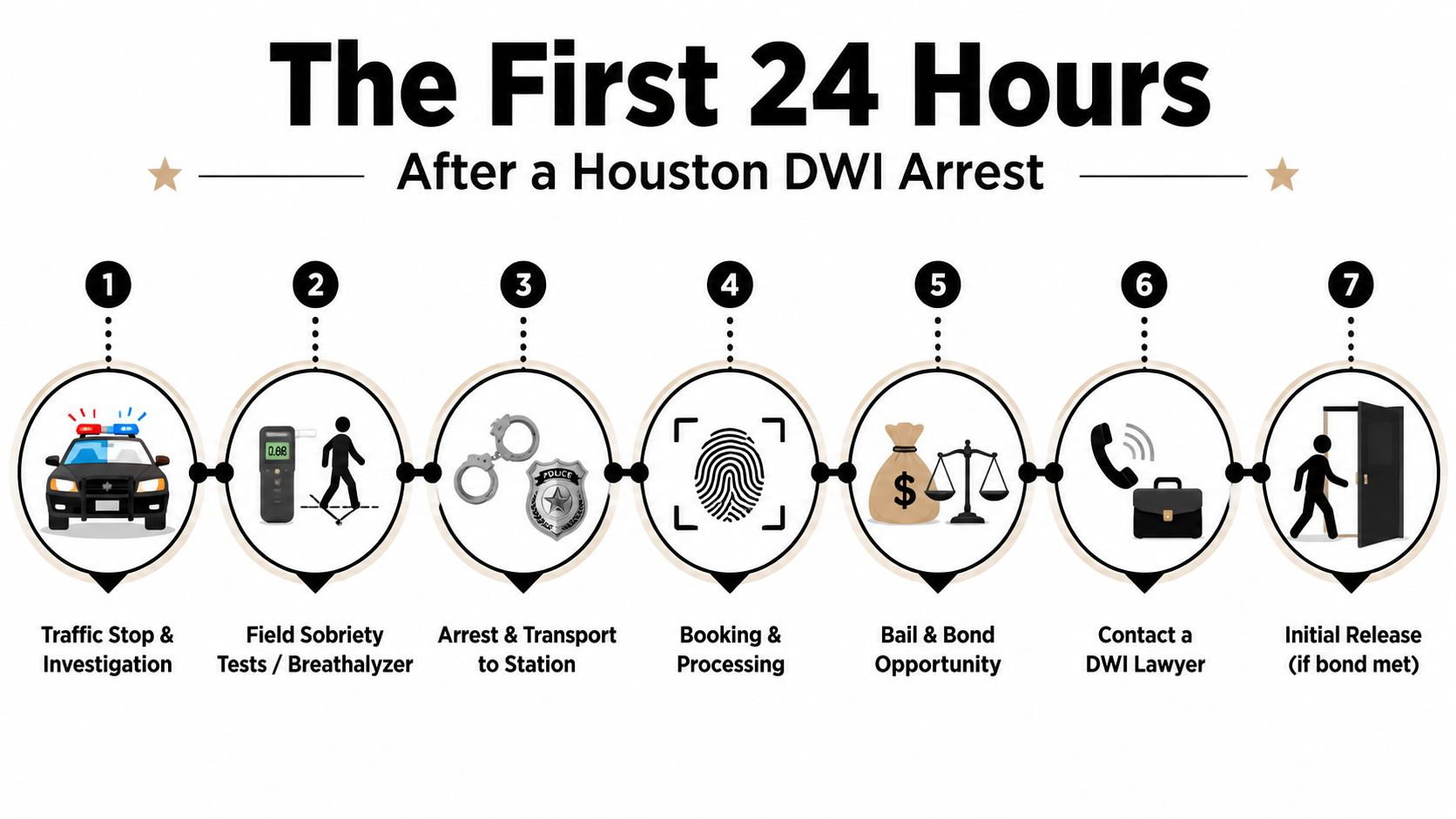
Start with control. Save every document you received at release. Write down the timeline while it is still fresh. Do not post about the arrest, do not text your version of events to friends, and do not call the officer or the court to explain anything. Your job in the first 24 hours is simple. Preserve facts and avoid giving the state extra evidence.
What usually happens from the stop to release
A Houston DWI case often begins with a routine traffic stop. The officer claims a traffic violation, then shifts into a DWI investigation by watching your speech, balance, eyes, and answers. That roadside encounter becomes a major part of the case later, especially if the video does not match the report.
You may be asked to perform a field sobriety test. These roadside exercises are subjective. They can be affected by anxiety, fatigue, injury, uneven pavement, bad lighting, or the shoes you were wearing. A poor performance does not end your case, and a lawyer should examine how the officer instructed, scored, and documented each test.
You may also be asked for a breath or blood sample. Under implied consent, Texas can seek license consequences if you refuse a lawful test request after arrest. That is why the license issue starts fast. If you need a clear explanation of the deadlines and process, review this Houston ALR hearing lawyer guide.
BAC means blood alcohol concentration. Texas uses different legal thresholds depending on the driver and the type of license, as explained by Texas BAC limits for adults, CDL holders, and minors.
What to do in the first 24 hours
After arrest, you will usually be booked, photographed, fingerprinted, and held until bond is addressed. That process feels automatic, but it creates the paper trail your lawyer will test for errors, omissions, and contradictions.
Once you are released, act in this order:
- Gather your paperwork. Bond papers, notice of suspension, towing information, citation, and any property receipt.
- Write your timeline. Where you were, what you drank if anything, when you were stopped, what the officer said, whether tests were requested, and whether you consented or refused.
- Stay silent about the facts. No social media. No group texts. No “I can explain” calls.
- Call a defense lawyer quickly. Early action can protect video, dispatch records, test records, and witness information before they are lost.
That call should happen early, not after you miss a deadline or appear in court unprepared.
Four terms you need to understand immediately
| Term | What it means |
|---|---|
| BAC | The measured alcohol concentration in your body |
| Field sobriety test | Roadside exercises used during a DWI investigation |
| Implied consent | Texas rules tying chemical test requests to license consequences |
| Administrative license suspension | A civil license action separate from the criminal charge |
The first 24 hours are about damage control and positioning. Handle them the right way, and your lawyer has more room to challenge the stop, the arrest, the testing, and the license suspension.
The Two Battles You Must Fight ALR Hearing and Criminal Case
After a Houston DWI arrest, you are dealing with two separate legal problems. Many people don't realize that until it's too late.
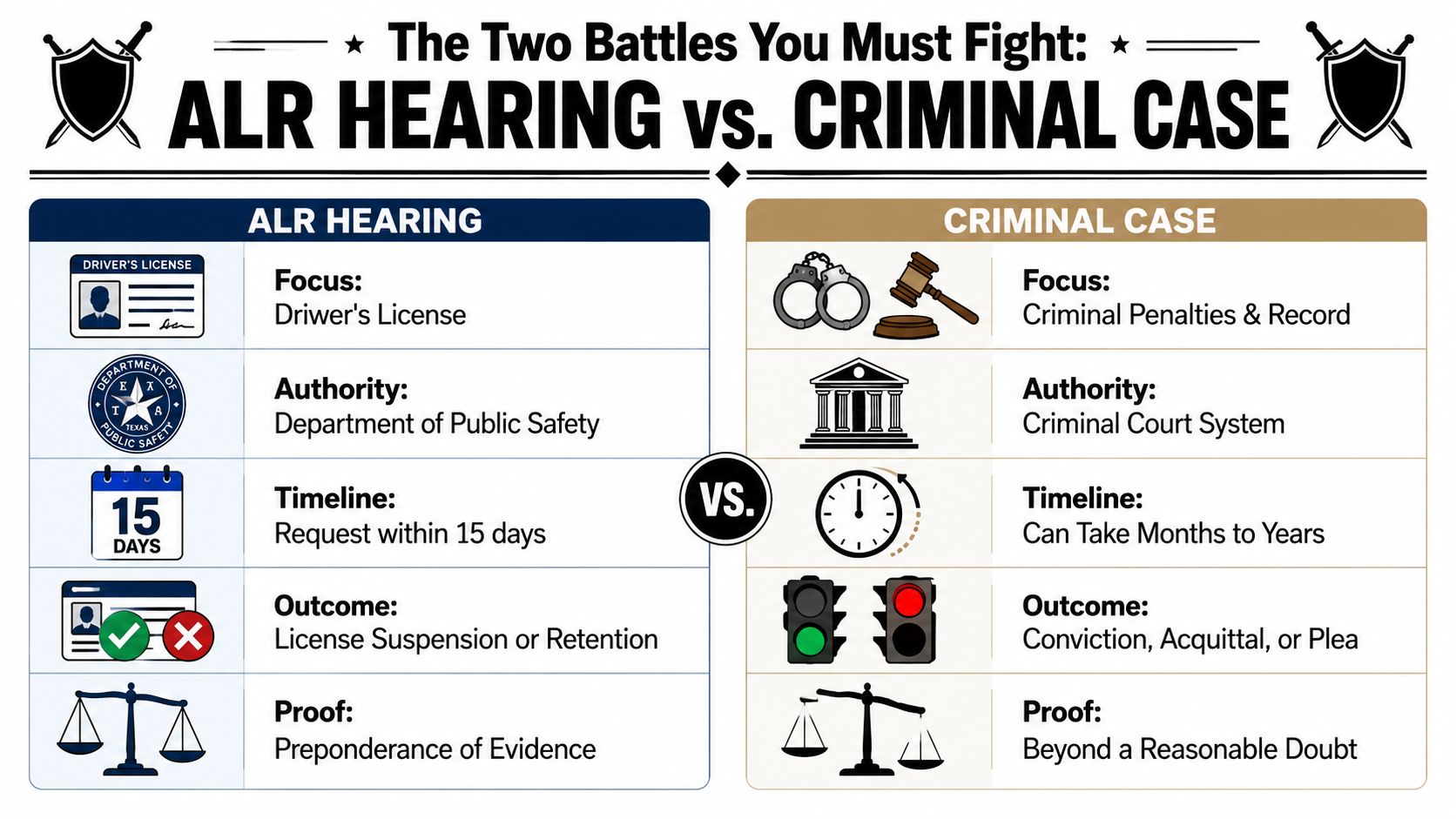
One is the Administrative License Review, often called the ALR hearing. The other is the criminal prosecution. They are related, but they are not the same case.
What the ALR hearing is really about
The ALR hearing is a civil proceeding focused on your driving privileges. It is not the part of the case where the court decides guilt or innocence on the DWI charge. It is about whether the state can suspend your license through the administrative process.
In Harris County, drivers arrested for DWI have 15 days from the date of arrest to request an ALR hearing. If the driver refused a breath or blood test, the window extends to 20 days from receiving the suspension notice. If you miss the deadline, suspension happens automatically, as explained in this Houston ALR hearing deadline guide.
The suspension process is separate from the criminal case. If a driver fails or refuses a chemical test after an arrest with a BAC of 0.08% or higher, the Texas Department of Public Safety starts the ALR suspension process, and it typically begins 40 days after the arrest, as described in this overview of the Texas ALR process under Transportation Code Chapter 524.
How the criminal case differs
The criminal case is where the prosecutor tries to prove a DWI offense under Texas law. That case can lead to a conviction, acquittal, dismissal, negotiated outcome, or trial. It can involve motions, court settings, evidence disputes, and testimony.
The criminal court looks at issues like intoxication, probable cause, procedure, and admissibility of evidence. The ALR hearing looks at license consequences. Winning one does not automatically win the other.
The most common misunderstanding in DWI cases is thinking court dates and license deadlines are the same thing. They aren't.
Side by side comparison
ALR hearing
- Main issue: Your driver's license
- Handled by: Texas Department of Public Safety
- Urgency: Immediate deadline
- Result: Suspension or retention of driving privileges
Criminal case
- Main issue: Criminal penalties and record
- Handled by: Criminal court
- Urgency: Ongoing court process
- Result: Conviction, dismissal, plea, or acquittal
If you're trying to stop a DWI license suspension, start with a focused review of the Houston ALR hearing lawyer guide. Missing that step can hand the state an easy win before your defense even gets moving.
How a Houston DWI Lawyer Builds Your Defense Strategy
A good defense doesn't start with a speech in court. It starts with pulling the case apart piece by piece.

When I evaluate a DWI case, I don't begin by asking whether the officer arrested you. I ask why. What justified the stop? What did the officer observe? What do the videos show? Was the investigation handled correctly? Did the paperwork match the facts?
The defense starts before trial
Some cases turn on the traffic stop itself. If the officer lacked a lawful basis to stop you, that issue can affect everything that followed. Other cases turn on what happened after the stop. Maybe the officer overstated your performance on field sobriety tests. Maybe the report leaves out conditions that matter. Maybe the chemical testing process raises reliability questions.
A Houston DWI lawyer demonstrates their worth. Your attorney should request records, review footage, compare reports, challenge weak assumptions, and identify key defense points early. A Texas DUI attorney who only talks about pleading out a case is not building a defense. They're managing a file.
Penalties shape strategy
The stakes also change depending on the charge level. In Texas, a first-time DWI is a Class B misdemeanor, but it becomes a Class A misdemeanor if your BAC is 0.15 or higher. A third DWI becomes a third-degree felony with penalties of up to 10 years in prison and a $10,000 fine, according to this summary of Texas DWI penalty levels.
Those exposure levels affect everything from negotiations to trial planning. A lawyer has to build the defense with the actual risk in mind, not with canned advice.
Here's a short video that helps frame how DWI defense issues are often approached in Texas:
Common pressure points in a DWI defense
- The stop itself: Was there a legitimate legal basis for pulling you over?
- Officer observations: Are the claimed signs of intoxication clear, consistent, and supported by video?
- Field sobriety testing: Were the tests explained and administered fairly?
- Chemical evidence: Was the breath or blood evidence handled in a way that can be challenged?
- Procedure and timing: Did police and the state follow the rules they're required to follow?
A DWI case is often won by disciplined review of details that looked minor on arrest night.
That's why you want someone who treats the case as a technical fight, not a formality.
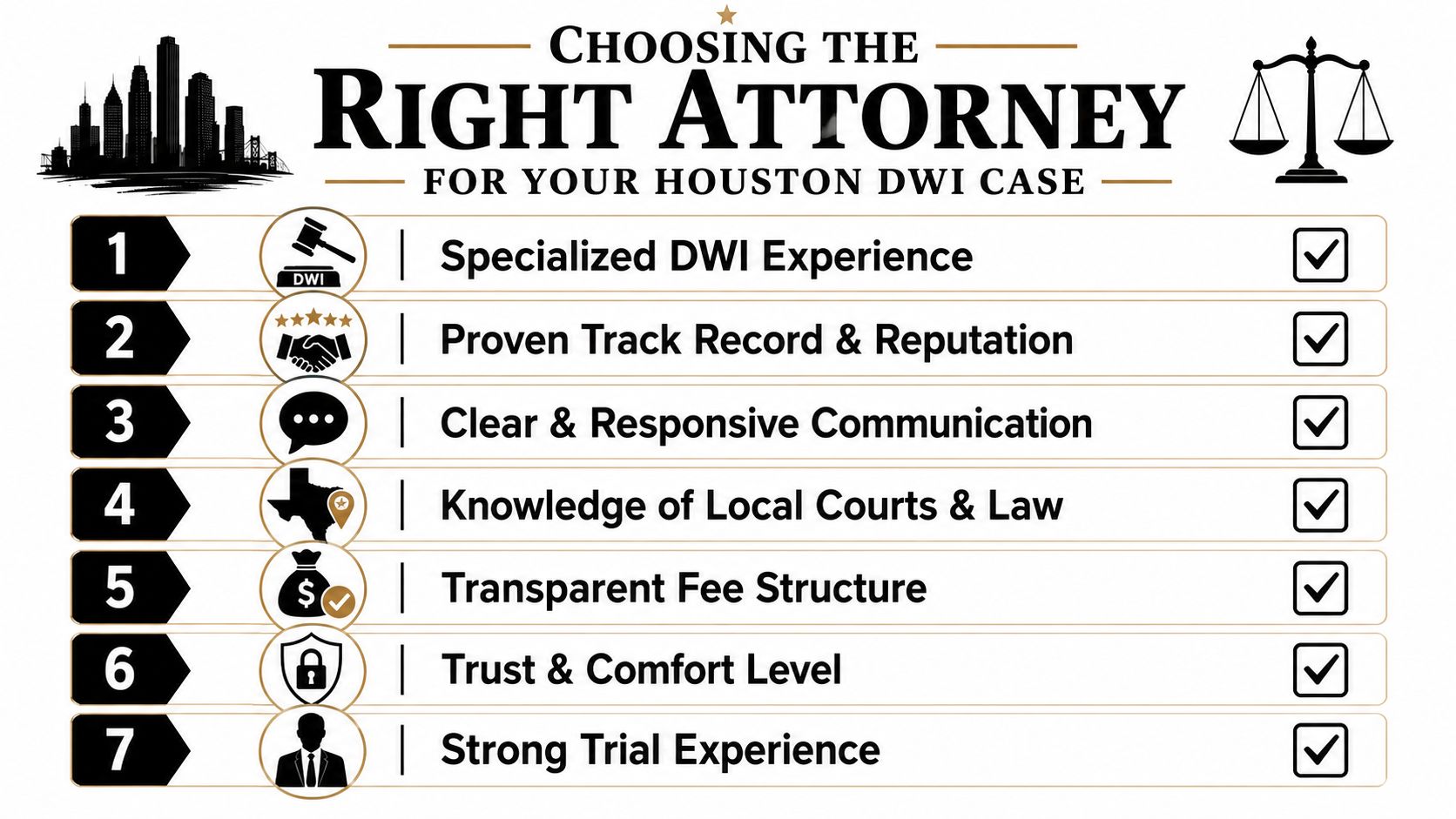
Choosing the Right Attorney for Your Houston DWI Case
Hiring a lawyer for a DWI isn't about finding the first office that answers the phone. It's about finding the right fit for a problem that can affect your license, your record, and your work.
What to look for first
Start with focus. You want an attorney who regularly handles DWI cases, not someone who takes one now and then between unrelated matters. DWI defense involves courtroom skill, but it also involves administrative hearings, testing issues, police procedure, and local practice.
Houston cases have their own rhythm. Local court settings, prosecutor habits, and Harris County procedure matter. The lawyer you hire should know how these cases move in real life, not just in theory.
Use the consultation like an interview
A free consultation isn't just a chance for the lawyer to hear your story. It's your chance to evaluate them. Ask direct questions. How do they approach ALR deadlines? Who reviews video and reports? Are they preparing for trial if negotiation fails? Can they explain the process in plain English?
Watch how they answer. A good attorney should make a stressful situation clearer, not murkier.
Here's a simple checklist you can use:
- DWI focus: Ask how much of the lawyer's work involves DWI defense.
- Local familiarity: Ask whether they regularly appear in Houston and Harris County courts.
- Communication style: If they can't explain your options clearly now, that won't improve later.
- Strategy, not slogans: You want a plan for your case, not generic promises.
- Trial readiness: Some cases resolve through negotiation. Some need to be fought hard.
Don't hire based on comfort alone
Being nice is not the same thing as being prepared. You want both. Trust matters, but so does discipline. Your lawyer should be able to talk through license issues, suppression issues, evidentiary issues, and practical next steps without dodging specifics.
If you're comparing attorneys, review a page focused on Houston DWI defense representation and use it as one of several tools to evaluate fit. The right Houston DWI lawyer should leave you feeling informed, not sold to.
If an attorney can't explain the roadmap of your case in a way you understand, keep looking.
When a DWI Case Is More Complicated
Some DWI cases carry added risk from the start. The law gets tougher, the consequences spread wider, and the defense has to become more precise.
Commercial drivers face a separate threat
If you hold a commercial driver's license, your case is not just about transportation. It's about your livelihood. Texas applies a stricter BAC standard to CDL holders, and the administrative side of the case can hit your commercial driving privileges even apart from the criminal charge.
One issue is routinely overlooked in general DWI content. The ALR hearing is a civil proceeding, and a refusal to test can result in a 1-year commercial license disqualification even if the criminal DWI charge is later dismissed, as explained in this discussion of CDL consequences in Houston DWI cases.
That means a commercial driver cannot afford to treat the license case like an afterthought.
Underage drivers and families need a different approach
For drivers under 21, these cases are often tied to family stress, school concerns, and future opportunities. Parents usually want fast answers. They should get them. The legal issues are only one part of the damage control. A careful defense also protects the young person's record and long-term options where possible.
The same is true for students, licensed professionals, and out-of-state drivers. The courtroom may be in Houston, but the consequences can follow you home, into your employment file, or into a licensing review.
Felony exposure changes everything
A felony DWI case requires a different level of attention. That may involve prior convictions, an accident with serious consequences, or facts that push the case into much more severe territory. The defense has to account for higher stakes, more aggressive prosecution, and deeper investigation into every part of the stop and arrest.
Here's how complexity often changes the case:
| Situation | Why it matters |
|---|---|
| CDL holder | Driving privileges affect income and employment directly |
| Underage driver | School, family, and future record concerns often become central |
| Repeat offense | The prosecution usually pushes harder and punishment risk increases |
| Out-of-state driver | Travel, court logistics, and home-state effects become practical issues |
Complex DWI cases don't call for generic advice. They call for a defense built around what you stand to lose.
If your case falls into one of these categories, don't rely on broad internet summaries. Get advice suited to the exact kind of exposure you're facing.
Take the First Step to Protect Your Future Today
It is 11:30 p.m. You are home, your car is gone, your paperwork is on the kitchen counter, and your mind is racing through worst-case scenarios. That is the moment to get organized, not defeated.
A DWI charge can threaten your license, your job, your record, and your peace at home. What you do next matters. Fast action gives your lawyer a better chance to secure records, review the stop, preserve video, challenge testing, and keep deadline mistakes from hurting your case before the main fight even starts.
Do not assume a quick plea will make this easier, especially if this is your first arrest. Early decisions can affect your driving privileges, court strategy, and long-term options. You need a plan from the start, built around the facts of your case and the risks you face.
The Law Office of Bryan Fagan, PLLC handles DWI defense matters from arrest through resolution, including chemical test challenges, ALR hearings, and court defense. If you need a Houston DWI lawyer, get a direct case review now. Clear advice in the first stage of the case often puts you in a stronger position later.
If you want more background on first-time charges, review First-Offense DWI in Texas: Penalties and Defenses.
You do not need to fix everything tonight. You do need to start tonight.
If you've been arrested and need clear answers now, contact Law Office of Bryan Fagan, PLLC to request a free consultation or case evaluation. Our team helps drivers in Houston and surrounding areas address license threats, court deadlines, and defense strategy from the start. The sooner you reach out, the more options you have to protect your rights and your future.