
A DWI arrest can be overwhelming—but you don’t have to face it alone. One of the biggest worries is often the financial impact. Most people assume the official court-ordered DWI fine in Texas is the only cost, but that's just the tip of the iceberg. A conviction triggers a chain reaction of administrative fees, surcharges, and long-term costs that can easily stack up to thousands of dollars.
The Total Financial Impact of a Texas DWI
A DWI charge in Texas is a major legal and financial event, far more complex than a simple traffic ticket. People often focus only on the statutory fine outlined in the Texas Penal Code, but that figure significantly underestimates the real damage to your finances. The first step toward building a strong defense is understanding every potential cost so you can protect both your freedom and your financial future.
Think of it this way: a single DWI hits your finances from multiple directions at once. The costs fall into three main buckets: court-imposed penalties, administrative fees required by the state, and indirect costs that can follow you for years.
These pieces combine to create a substantial financial burden. The infographic below breaks down the main categories of expenses you should be prepared for.
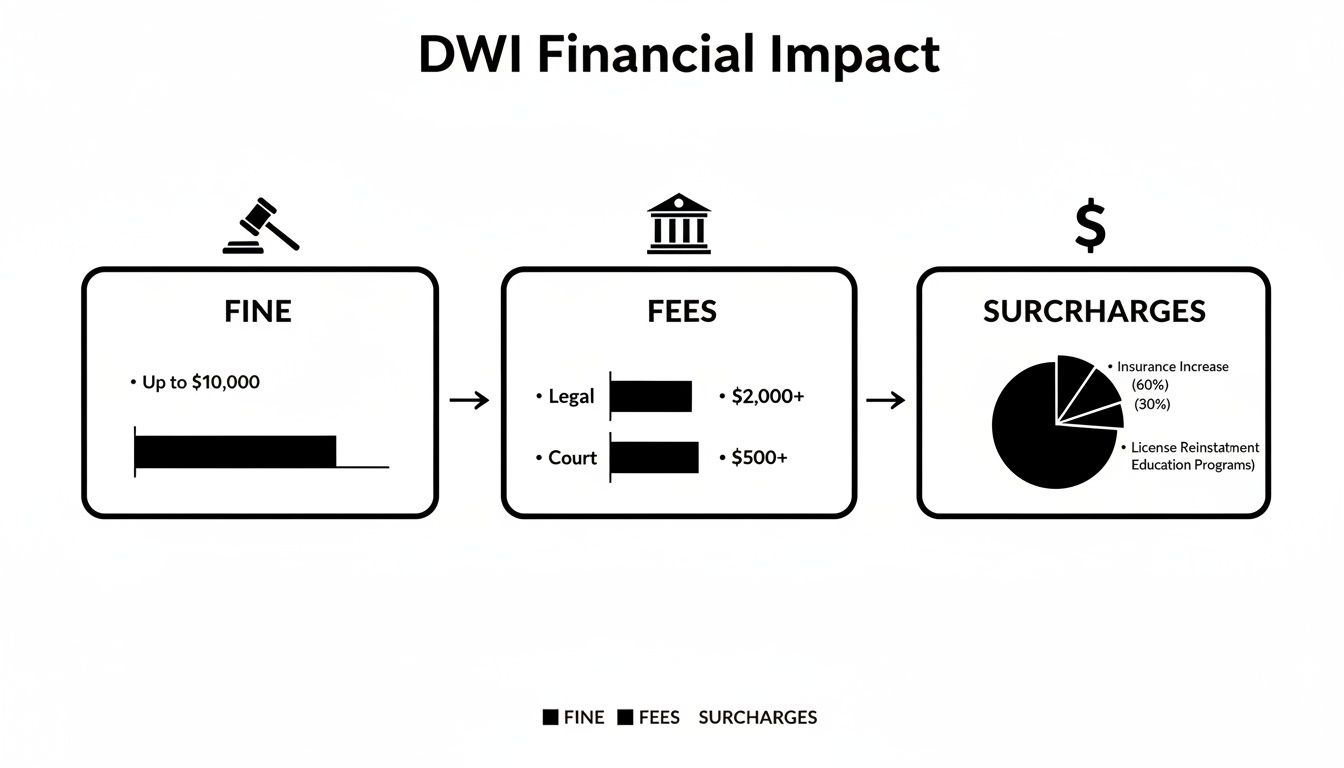
As you can see, the court fine is just one piece of the puzzle. The administrative fees and state surcharges are entirely separate obligations, and they add up quickly.
When you break it all down, the total cost becomes much clearer. The court fine is just the starting point.
A Quick Look at the Financial Components of a Texas DWI
This table illustrates how various costs contribute to the total financial impact of a DWI, going far beyond the initial fine.
| Cost Category | Typical Range or Amount | Description |
|---|---|---|
| Statutory Fine | Up to $2,000 (1st Offense) | The base penalty set by the court, which increases with prior convictions or aggravating factors. |
| Court Costs | $200 – $500+ | Fees charged by the court to cover administrative processing of your case. |
| DPS Surcharges | $1,000 – $2,000 per year for 3 years | Annual fees paid to the Texas Department of Public Safety to maintain your driver's license after a conviction. |
| SR-22 Insurance | Varies widely (can double or triple premiums) | A certificate your insurer must file proving you have liability coverage, leading to much higher insurance rates. |
| Ignition Interlock Device | $70 – $100+ per month | If ordered by the court, you must pay for the installation and monthly monitoring of this device. |
| License Reinstatement Fees | $125+ | A fee paid to DPS to get your license back after a suspension. |
| Probation Fees | $60 – $100 per month | Monthly fees paid to the county to cover the costs of supervision while on probation. |
These are just the most common expenses. Depending on your case, there could be others, like DWI education class fees or substance abuse evaluation costs.
Beyond the Courtroom Penalties
The financial strain doesn't stop once you leave the courtroom. In fact, a conviction triggers a new set of mandatory expenses that often catch people by surprise. These typically include:
- Annual DPS Surcharges: The Texas Department of Public Safety will bill you every year—usually for three years straight—just to keep your license valid after a DWI. These fees run from $1,000 to $2,000 per year.
- SR-22 Insurance: You'll be required to file an SR-22 certificate with the state. This is a form from your insurance company proving you have liability coverage, but it signals to them that you're a high-risk driver, almost always causing a massive spike in your premiums.
- Ignition Interlock Device (IID): If the court orders an IID, you are responsible for the installation and monthly monitoring fees for the device that requires you to provide a breath sample to start your car.
With a conviction, these costs are nearly unavoidable. That's why fighting the charge aggressively from day one is so critical. You can learn more about the numerous hidden costs of a DUI charge in our detailed guide. An experienced Houston DWI lawyer can help you challenge the state's case and work to minimize these punishing financial consequences.
Breaking Down the Official Court-Ordered DWI Fines
When you are arrested for a DWI in Texas, the first cost that likely comes to mind is the official court fine. This amount is set by the Texas Penal Code and serves as the starting point for all the financial challenges you may face. It’s important to understand these figures because they show how seriously the state treats a DWI conviction.
However, these fines are not arbitrary. They are directly tied to the specifics of your case—whether it’s your first DWI in Texas, if your Blood Alcohol Concentration (BAC) was high, or if other aggravating factors were involved. While the maximum fine is a significant part of the potential punishment, remember that it’s not set in stone. A strategic legal defense can often lead to reduced charges or even a dismissal, which could eliminate these fines entirely.
Fines for a First-Time DWI Offense
For most people, a first-time DWI is a Class B misdemeanor, assuming no aggravating factors. The law is clear on the financial penalty for a conviction at this level.
- Maximum Fine: Up to $2,000
This is the ceiling for the fine itself. It does not include court costs, probation fees, or any of the other administrative penalties. While $2,000 is a serious amount, it’s the lowest statutory fine for an adult DWI. An experienced Houston DWI lawyer works to keep you far from the maximum by challenging every piece of evidence and negotiating on your behalf.
Enhanced Penalties for a High BAC
The situation becomes more serious if the prosecutor can prove your Blood Alcohol Concentration (BAC) was 0.15 or higher. In Texas, this automatically enhances a first-time DWI from a Class B to a Class A misdemeanor. This single change has a significant impact on your finances, immediately doubling the maximum fine you could face.
A BAC of 0.15 or more elevates a first-time DWI to a Class A misdemeanor, which carries a maximum fine of up to $4,000. This shows how a single piece of evidence—that BAC reading—can dramatically raise the financial stakes.
This is precisely why challenging the results of a breath or blood test is a cornerstone of a solid DWI defense. If your attorney can get the test results suppressed, the charge may be reduced to a standard DWI, cutting the potential fine in half.
Escalating Fines for Repeat Offenses
Texas law imposes harsh penalties on repeat DWI offenders, and the fines reflect this. Each subsequent conviction brings a much higher maximum fine, not to mention longer potential jail sentences and a DWI license suspension.
- Second DWI Offense (Class A Misdemeanor): The maximum fine jumps to $4,000.
- Third DWI Offense (Third-Degree Felony): A third conviction sends the maximum fine soaring to $10,000.
These numbers make the state’s position clear: it does not tolerate repeat offenses. The financial penalties are designed to be punishing, which is why it is so critical to fight every single charge. The official fine is just one piece of the puzzle, but it’s a large one that grows quickly.
Felony DWI Fines for Aggravating Factors
Certain situations can elevate even a first-time DWI to a felony, which carries the highest possible fines. One of the most common ways this occurs is driving while intoxicated with a child passenger.
If you are arrested for DWI with a passenger under the age of 15, you face a state jail felony charge. The potential fine is the same as for a third DWI.
- DWI with a Child Passenger (State Jail Felony): Up to a $10,000 fine.
The same $10,000 maximum fine applies if a DWI leads to an accident causing serious injury (Intoxication Assault) or death (Intoxication Manslaughter). For a complete breakdown of how these penalties are structured, check out our guide on DWI fines in Texas.
When you are arrested for a DWI, your first thought is probably about the fine a judge might impose. It’s a natural focus, but fixating only on that can be a costly mistake. The sticker price of a DWI fine is just the beginning. The real financial hardship often comes from a flood of hidden costs that can follow you for years, long after you’ve left the courtroom.
These are not optional penalties. They are mandatory administrative fees and requirements imposed by the state. Unlike a court fine that can sometimes be negotiated, these costs are often fixed. With a conviction, they become unavoidable. The goal here is not to cause fear, but to provide you with the clear truth about what you are up against. Understanding the full picture is the only way to make informed decisions and protect your financial future.
DPS Administrative Fees and Surcharges
One of the most unwelcome surprises for many people is the Texas Driver Responsibility Program. After a DWI conviction, the Texas Department of Public Safety (DPS) will impose an annual surcharge for the privilege of keeping your driver's license.
These surcharges are not a one-time fee. It’s an annual bill you must pay for three straight years, and it typically adds up to between $3,000 and $6,000. That’s on top of any penalties the court ordered you to pay.
If you fail to pay, your license will be suspended automatically, placing you in an even more difficult legal and financial position. This program is designed to be punishing, which makes it absolutely critical to fight the DWI charge from the very beginning.
The High Cost of an Ignition Interlock Device
If the court allows you to continue driving—either on probation or with an occupational license—it will likely order an Ignition Interlock Device (IID) for your car. This is a small breathalyzer wired into your vehicle that prevents it from starting if it detects alcohol.
While an IID keeps you on the road, the cost is entirely your responsibility. You are responsible for:
- Installation Fees: A one-time charge for professional installation, usually $100 to $200.
- Monthly Leasing and Monitoring Fees: This is the recurring expense. Expect to pay between $70 and $100 every month.
- Calibration Fees: You will also have to pay for periodic checks to ensure the device is working correctly.
When added up, an IID can easily cost you more than $1,000 over the course of a year. For many, this is a significant financial strain that serves as a constant, expensive reminder of their conviction.
SR-22 Insurance Requirements
After a DWI conviction, your auto insurance company will classify you as a "high-risk driver." To legally remain on the road, the state will require you to obtain an SR-22 certificate. This isn't insurance itself; it's a document your insurer files with the DPS to prove you have at least the minimum required liability coverage.
The immediate result? Your insurance premiums will skyrocket. It is common for rates to double or even triple. This is not a short-term penalty, either. It can affect you for several years.
Let’s put that into real numbers: If you currently pay $1,500 a year for insurance, a DWI conviction could easily increase that to $3,000 or even $4,500 annually. Since you typically have to maintain the SR-22 for three years, you could pay an extra $4,500 to $9,000 just for car insurance.
When you start adding up the DPS surcharges, IID costs, and inflated insurance premiums, the "hidden" costs of a DWI can quickly make the original court fine seem small. This is exactly why a strategic defense focused on avoiding a conviction is not just about staying out of jail—it’s about protecting your financial stability for years to come.
How a DWI Conviction Impacts Your Career and Insurance

The financial consequences of a DWI conviction extend far beyond the initial fines and state fees. The effects ripple outward, impacting two of the most critical areas of your life: your auto insurance and your career.
In many cases, these long-term impacts can actually be more costly than the official DWI fine in Texas. They threaten your financial stability and professional future for years to come.
Your Insurance Rates Will Skyrocket
A DWI conviction sends a clear message to your insurance provider: you are now officially a high-risk driver. The result is almost always a dramatic and painful increase in your premiums.
This isn't just a minor adjustment. It's common for insurance rates to double or even triple after a DWI, and this financial penalty can last for three to five years.
This rate hike is directly tied to the SR-22 requirement. Think of an SR-22 not as insurance, but as a certificate your provider files with the state to prove you have liability coverage. This filing flags your account, triggering the higher rates that can easily cost you thousands of extra dollars over time.
The Threat to Your Professional Life
For many Texans, a DWI conviction is more than an inconvenience—it's a direct threat to their livelihood. The impact on your career can be swift and severe, especially if your job requires you to drive, maintain a professional license, or pass a background check.
Remember, a conviction is a public record, accessible to current and future employers.
Certain professions are particularly vulnerable. If your career falls into one of these categories, the need for a strategic defense becomes even more urgent.
- Commercial Drivers (CDL Holders): For truck drivers, delivery drivers, and anyone with a Commercial Driver's License, a DWI can be a career-ending event. Federal and state regulations are incredibly strict, and a conviction often leads to immediate CDL suspension or revocation.
- Licensed Professionals: Nurses, pilots, real estate agents, and other professionals who hold state-issued licenses can face disciplinary action from their licensing boards. A conviction could lead to suspension, probation, or even the loss of the professional license you worked so hard to earn.
- Employees Who Drive for Work: If you use a company car or even your personal vehicle for work, your employer's insurance may no longer cover you. This can result in termination or reassignment to a different, often lower-paying, role.
The reality is that employers have the right to terminate employment for a DWI conviction in most cases, particularly in an "at-will" employment state like Texas. The conviction raises serious concerns about reliability, judgment, and potential liability for the company.
Understanding these high-stakes consequences is crucial. A DWI charge puts more than just your driving privileges on the line; it jeopardizes the career you've built. For a deeper dive, read our guide on the impact of a DUI on your insurance rates.
A proactive legal strategy isn’t just about fighting a fine; it’s about protecting your entire future.
How Your BAC Level Influences Case Outcomes
The centerpiece of nearly every DWI case in Texas is the Blood Alcohol Concentration (BAC) reading. This single number, obtained from a breath or blood test, is what prosecutors often rely on to prove intoxication. Understanding what it means is the first step in building an effective defense.
Your BAC level isn’t just about whether you are over the legal limit—it directly influences the severity of the charges and penalties. In Texas, the legal limit is 0.08%. If your BAC is at or above that level, you are considered legally intoxicated, and the state has grounds to charge you with DWI.
However, a much higher BAC reading can lead to significantly more serious legal trouble.
When a High BAC Leads to Enhanced Charges
Texas law draws a hard line when a driver's BAC is exceptionally high. If your chemical test shows a BAC of 0.15% or higher, the charge is automatically enhanced, even for a first offense.
A standard first-time DWI is a Class B misdemeanor. But with a BAC of 0.15 or more, it is elevated to a Class A misdemeanor. That enhancement carries immediate and severe financial consequences:
- Standard DWI (Class B Misdemeanor): The maximum fine is $2,000.
- Enhanced DWI (Class A Misdemeanor): The maximum fine doubles to $4,000.
Just like that, a single data point—your BAC reading—can instantly double the maximum DWI fine in Texas you might have to pay. This is precisely why a core strategy for any experienced Houston DWI lawyer is to challenge the validity of the BAC test result from every possible angle.
The Statistical Link Between BAC and Conviction Rates
Data from Texas courtrooms reveals a clear and powerful story: there is a direct correlation between a defendant's BAC level and the outcome of their case. A lower BAC provides a skilled defense attorney more room to challenge the evidence and negotiate a better result.
This is not just a theory; the numbers support it. Take a look at how conviction rates tend to shift based on a defendant's BAC.
How Your BAC Level Affects DWI Case Outcomes in Texas
Statistics from Texas DWI cases show a strong correlation between a defendant’s Blood Alcohol Concentration (BAC) and how their case is likely to resolve. A higher BAC generally makes it more challenging to secure a favorable outcome, but it is never impossible.
| BAC Level | Conviction Rate | Charge Reduction Rate | Dismissal Rate |
|---|---|---|---|
| Below 0.08% | 40-55% | 25-35% | 15-25% |
| 0.08-0.149% | 55-65% | 20-30% | 10-15% |
| 0.15%+ | 65-80% | 10-20% | 5-10% |
As you can see, the odds change significantly as the BAC number increases. While these statistics provide a sobering look at reality, they also highlight that dismissals and reductions happen at every level. You can discover more insights about these Texas DWI statistics to see the full picture.
This data emphasizes a critical point: while a BAC reading may seem like conclusive evidence, it is not unbeatable. A skilled Texas DUI attorney can challenge the procedures used to collect the sample, the calibration of the testing machine, and other factors to fight for a dismissal or a reduction in charges—even with a high reading.
Ultimately, your BAC level sets the stage for the legal battle ahead. A higher number may make the prosecutor’s job easier and raise the stakes, but it never eliminates your right to a powerful defense.
Proven Strategies to Minimize Financial Damage
Seeing the potential costs of a DWI can feel overwhelming, but remember this crucial fact: an arrest is not a conviction. This is the moment to stop worrying and start taking decisive action. A proactive, aggressive defense is the single most powerful tool you have to protect your finances, your freedom, and your future.
The State of Texas has the burden of proving its case beyond a reasonable doubt, and that is a high standard. An experienced DWI attorney knows exactly where to find weak points in the prosecution's case. We don’t just accept their version of events; we systematically dismantle it. This is how we fight to minimize the financial damage.
The First Line of Defense: The ALR Hearing
Many people don’t realize the fight for their driver's license begins almost immediately after an arrest—long before the criminal case reaches a courtroom. You have only 15 days from the date of your arrest to request an Administrative License Revocation (ALR) hearing. If you miss this deadline, your license will likely be suspended. This hearing is your first and often best opportunity to challenge the evidence. Winning the ALR hearing can prevent an automatic DWI license suspension, saving you from reinstatement fees and the daily hassle of arranging transportation.
There is also a significant strategic advantage. The ALR hearing serves as a valuable pre-trial discovery tool. During this hearing, your attorney can:
- Subpoena the arresting officer and question them under oath.
- Challenge the legal justification for the traffic stop.
- Scrutinize how the field sobriety tests were administered.
This process often uncovers critical weaknesses in the state’s case that we can use as leverage in your criminal proceedings. Sometimes, the information revealed here is enough to get the charges reduced or even dismissed entirely.
Challenging the Breath and Blood Test Evidence
That BAC number might seem final, but it’s far from it. The machines used to measure breath and blood alcohol levels are sensitive instruments that require strict, documented calibration and maintenance. The officers operating them must follow a rigid set of protocols. Any mistake or deviation from procedure can render the results unreliable and inadmissible in court.
Our defense strategy involves a thorough investigation into every aspect of the chemical test. We examine the maintenance logs for the machine, verify the officer's certifications, and review the exact procedure they followed in your case. We look for errors that can get the BAC result thrown out.
When we successfully challenge the BAC evidence, it changes the entire dynamic of the case. Without a hard number, it becomes much more difficult for the prosecutor to prove intoxication, opening the door for us to negotiate for a lesser charge, such as reckless driving.
Pushing for Dismissals and Smart Plea Negotiations
An aggressive defense is about creating opportunities. By challenging the stop, the sobriety tests, and the chemical evidence, we build a strong negotiating position. Our goal is to make the prosecutor see that taking your case to a jury is a significant risk for them.
This pressure often leads to outcomes that avoid the crushing financial penalties of a DWI conviction. A non-conviction resolution is a very real possibility in Texas. For example, first-offense DWIs in Harris County have a 10-15% dismissal rate and a 30-40% reduction rate. Dallas County's numbers are even better, with 18-25% dismissals and 25-35% reductions. You can learn more about these local DWI statistics to see just how often a strong defense can succeed.
Even when a dismissal is not possible, we can often secure alternatives that keep a DWI conviction off your permanent record. These include:
- Deferred Adjudication: You complete a period of probation successfully, and the case is dismissed, resulting in no final conviction.
- Pre-Trial Diversion Programs: Often available for a first DWI in Texas, these programs allow you to complete certain requirements in exchange for having the charges dropped.
These strategies are designed to do far more than just save you money on fines. They protect your record and shield your financial future from the devastating long-term impact of a conviction.
Answering Your Top Questions About DWI Fines
When you're facing a DWI arrest, the financial stress can be just as overwhelming as the legal process. You are left with pressing questions and few clear answers. Here is a straightforward breakdown of the most common concerns we hear from our clients.
Can a Lawyer Really Reduce My DWI Fine?
Yes, absolutely. An experienced Texas DUI attorney doesn’t just accept the initial charges—they challenge them. The goal is to identify weaknesses in the prosecution's case.
By working to get charges reduced from a more serious Class A to a Class B misdemeanor, for example, we can cut the maximum potential fine in half. If we can secure a full dismissal of the charges, you pay no court fine at all. This is a key part of how to fight DWI Texas charges effectively.
What Happens If I Can't Afford to Pay My Fines?
This is a common and valid concern. If you are convicted and cannot pay the full fine upfront, the court may agree to a payment plan. While this sounds helpful, it comes with a condition.
If you miss a single payment or fail to follow the plan exactly, the court can issue a warrant for your arrest. The best way to avoid this situation is to fight the conviction from the very beginning.
The smartest way to manage the massive cost of a DWI is to avoid the conviction entirely. Investing in a strong legal defense now can save you thousands in fines, fees, and surcharges later on.
Will My Insurance Rates Ever Go Back to Normal?
If you are convicted, expect your insurance premiums to be significantly high for three to five years. It is a long and expensive waiting period.
Once that time has passed and you are no longer required to carry an SR-22 policy, you can begin shopping for better rates. However, the only certain way to prevent the rate hike in the first place is to beat the conviction.
Is Hiring a DWI Attorney Worth the Cost?
Consider the total financial damage. A single DWI conviction can easily cost you upwards of $10,000 when you add up all the fines, court fees, surcharges, and sky-high insurance premiums. Suddenly, the value of a solid defense becomes crystal clear.
A skilled Houston DWI lawyer works to shield you from these crushing long-term financial hits. More often than not, the money you save by avoiding a conviction far outweighs the cost of legal fees.
A DWI arrest can feel like an assault on your financial stability, but you do not have to accept the consequences without a fight. You have the power to defend your rights. At The Law Office of Bryan Fagan, PLLC, our team is ready to protect your rights and your future. Don't let uncertainty dictate your next step. Request a free, no-obligation case evaluation today by visiting https://texasduilawfirm.com.