
A DWI arrest in Texas can be overwhelming, triggering a flood of questions about your future, your freedom, and your finances. Suddenly, you're facing both criminal penalties, like jail time and steep fines, and administrative consequences, like an immediate driver's license suspension. While a first-time DWI is typically a Class B Misdemeanor, the impact is serious and the charges escalate quickly. But you don’t have to face it alone.
The key is to understand that an arrest is not a conviction. You are fighting a battle on two fronts: one in criminal court against the state and another with the Texas Department of Public Safety (DPS) to save your license. Knowing what to expect is the first step toward building a strategic defense and protecting your rights.
What Happens After a DWI Arrest in Texas?
Being arrested for a DWI in Texas can make you feel lost and uncertain, but a clear path forward is possible. The moment you are arrested, two distinct legal processes begin simultaneously. One is the criminal case, where a prosecutor will pursue charges that could lead to jail time and fines. The other is a civil administrative process that can suspend your license long before your criminal case is ever resolved.
Navigating both at once is critical to protecting your future. Remember the most important thing: an arrest is just an accusation. A strategic legal defense can challenge the evidence against you and safeguard your rights at every turn.
The Two Fronts of a Texas DWI Case
Immediately after an arrest, you must address two separate legal challenges:
- The Criminal Case: This is the process most people think of—a prosecutor files charges, and your case proceeds through the criminal justice system. The primary goal is to avoid a conviction, which carries penalties like jail, thousands of dollars in fines, and a permanent criminal record.
- The Administrative Case (ALR): This civil process focuses entirely on your driver's license. The Texas DPS will automatically initiate proceedings to suspend your license. You have only 15 days from the date of your arrest to request an Administrative License Revocation (ALR) hearing to challenge this suspension.
Fighting a DWI means you’re protecting your freedom in criminal court and your ability to drive in an administrative hearing. Both demand immediate, strategic action.
Defining the Key Terms in Your Case
To effectively defend your case, it’s important to understand the legal language. In Texas, DWI (Driving While Intoxicated) means you were operating a motor vehicle in a public place while legally intoxicated. The state can prove this in two ways:
- Impairment: You lost the normal use of your mental or physical faculties due to alcohol or drugs.
- Per Se Intoxication: You had a Blood Alcohol Concentration (BAC) of 0.08% or higher.
Blood Alcohol Concentration (BAC) is a scientific measurement of the amount of alcohol in your bloodstream. Even if you feel fine, a BAC at or above the 0.08% legal limit means you are considered intoxicated under Texas law.

One of the biggest worries we hear from clients is about how a DWI will impact their daily life, especially their job. Our firm put together a helpful guide on driving to work after a DWI in Texas that dives into more detail on how to keep your livelihood intact while your case is ongoing.
Texas DWI Penalties Explained
After a DWI arrest, your mind is probably racing with questions about what comes next. While it’s an intimidating situation, understanding the potential penalties is the first step toward regaining control. It’s critical to remember: the penalties outlined in Texas law are the state’s starting point, not a guaranteed outcome. With a skilled Houston DWI lawyer and the right legal strategy, these consequences can often be fought, reduced, or in some cases, dismissed entirely.
The criminal consequences of a DWI charge in Texas are severe and can follow you for years. You are legally considered intoxicated with a 0.08 blood alcohol concentration (BAC), but the law is even broader. You can be charged if alcohol or drugs have impaired your ability to drive—or even operate a boat or airplane. Enforcement is aggressive across the state. In fact, recent data shows that 74% of all traffic-related arrests in Texas were for drunk driving. You can explore more of this data on the official Texas traffic safety portal.
These penalties aren’t just abstract legal terms; they represent real disruptions to your freedom, finances, and future. Knowing exactly what’s at stake is the only way to build a defense that truly protects you.
Penalties for a First DWI in Texas
For most people, a first DWI offense is charged as a Class B Misdemeanor. While it is a misdemeanor, the consequences are significant. A conviction results in a permanent criminal record, which can affect everything from your career opportunities to your car insurance rates for years to come.
Here are the standard penalties for a first offense:
- Jail Time: A mandatory minimum of 72 hours in jail, with a maximum of up to 180 days.
- Fines: A criminal fine of up to $2,000.
- DWI License Suspension: A driver's license suspension ranging from 90 days to one year.
These penalties can increase if certain aggravating factors are present. For instance, if your BAC was 0.15 or higher, the charge is enhanced to a Class A Misdemeanor, doubling both the potential jail time and the maximum fine.
The Stakes Get Higher: Second DWI Consequences
If you are arrested for a second DWI, the state’s approach becomes much more severe. A second DWI is a Class A Misdemeanor and comes with significantly harsher penalties. The courts no longer view it as a one-time mistake but as a pattern of behavior, and the punishments are designed to reflect that.
For a second DWI conviction, the potential consequences include:
- Jail Time: The possible jail sentence increases to a minimum of 30 days and a maximum of one year.
- Fines: The maximum fine doubles to $4,000.
- License Suspension: You could lose your driver's license for 180 days up to two years.
A second DWI conviction raises the stakes considerably. It is critical to fight the charge with an aggressive legal strategy, because a felony conviction becomes a much greater risk.
Crossing the Line: Facing a Felony for a Third DWI
A third DWI arrest in Texas crosses a critical legal threshold—it is charged as a third-degree felony. This is a life-altering event. A felony conviction can strip you of fundamental civil rights, such as the right to vote or own a firearm, and create permanent barriers to professional licenses and employment.
The potential penalties for a third DWI conviction are severe:
- Prison Time: You face between two and 10 years in a Texas state prison.
- Fines: The maximum fine increases to $10,000.
- License Suspension: Your driving privileges can be revoked for up to two years.
To help you see the differences side-by-side, here is a clear breakdown of the standard criminal penalties.
Texas DWI Criminal Penalties at a Glance
This table provides a quick look at how the potential jail time and fines increase with each subsequent DWI offense in Texas.
| DWI Offense | Classification | Potential Jail Time | Maximum Fine |
|---|---|---|---|
| First DWI | Class B Misdemeanor | 72 hours – 180 days | $2,000 |
| Second DWI | Class A Misdemeanor | 30 days – 1 year | $4,000 |
| Third DWI | Third-Degree Felony | 2 years – 10 years | $10,000 |
Understanding these potential outcomes isn't meant to cause fear—it's meant to empower you with knowledge. An experienced Texas DUI attorney can analyze every detail of your case, from the traffic stop to the chemical tests, to build a defense aimed at preventing these worst-case scenarios from becoming your reality.
Navigating Administrative License Suspension
A DWI arrest in Texas initiates two separate legal battles. One takes place in criminal court, but the other begins almost immediately—a civil fight for your right to drive. This is the Administrative License Revocation (ALR) process, a swift action taken by the Texas Department of Public Safety (DPS) to suspend your license.
This administrative process often catches people by surprise. Many assume their license is safe until they are convicted in court, but that is not the case. Your driving privileges are at risk from the moment of your arrest, long before your criminal charge is resolved.
The Power of Implied Consent
How can the DPS suspend your license so quickly? It all comes down to a Texas law known as "implied consent." This legal concept states that by accepting and using a Texas driver's license, you have already given your consent to provide a breath or blood sample if a police officer has probable cause to suspect you of DWI.
This is not something you agree to during the traffic stop; it is a condition you accepted when you obtained your license.
Implied consent is the legal basis for the ALR process. If you refuse to take a chemical test (like a breathalyzer) after a lawful DWI arrest, the DPS will automatically start the process to suspend your license. The same thing happens if you agree to the test and your Blood Alcohol Concentration (BAC) is 0.08% or higher. This is an administrative penalty, not a criminal one, based on the circumstances of the arrest itself.
The Critical 15-Day Window
After your arrest, a clock starts ticking. You have exactly 15 days to formally request an ALR hearing to fight the automatic license suspension. This is one of the most important deadlines in your entire DWI case.
If you miss this 15-day deadline, your license will be automatically suspended on the 40th day after your arrest. There are no extensions. Taking immediate action is essential to protect your ability to drive.
Requesting an administrative license suspension hearing is not just about saving your license—it’s also a powerful strategic move. It gives your attorney an early chance to question the arresting officer under oath and gather evidence that could be crucial for weakening the criminal case against you. To get a full picture of how this works, check out our comprehensive Texas ALR hearing process guide.
The infographic below illustrates how quickly the stakes rise with each DWI offense, which is why it is so important to fight every part of the charge from day one.
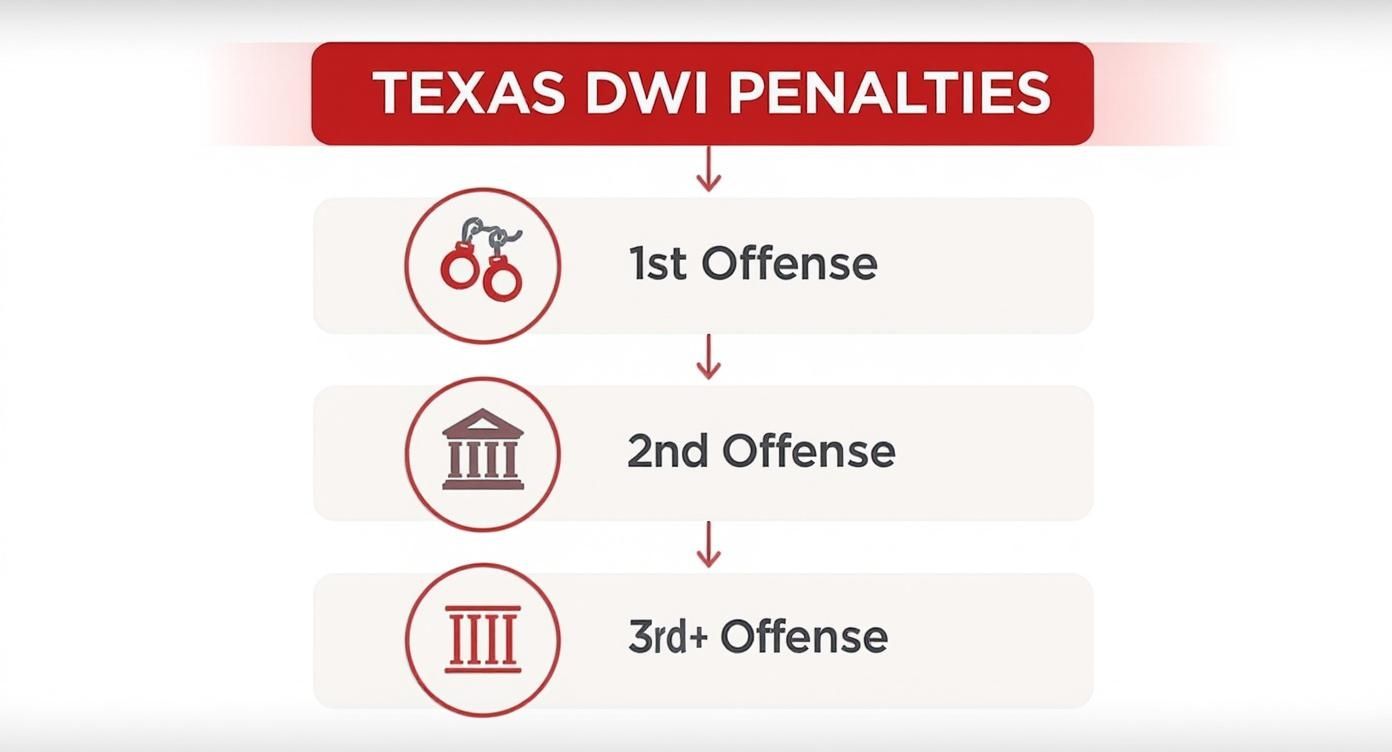
As you can see, penalties escalate dramatically from a misdemeanor for a first offense to a serious felony for a third. This makes a strong, early defense more important than ever.
What Happens at an ALR Hearing
An ALR hearing is not a criminal trial. It is a focused administrative proceeding where a judge determines if the DPS has the legal grounds to suspend your license.
The DPS must prove two key things:
- The officer had reasonable suspicion for the traffic stop and probable cause for the DWI arrest.
- You either refused a chemical test or failed it with a BAC of 0.08% or greater.
This hearing is an excellent opportunity for a skilled Houston DWI lawyer. It provides the first chance to cross-examine the officer, challenge their procedures, and question the reliability of the breath or blood test. Weaknesses in the state’s case are often exposed here, which can be used as leverage in your criminal defense. Winning the ALR hearing not only saves your license but can also significantly improve your chances of a better outcome in criminal court.
How Special Circumstances Can Turn a DWI into a Felony
While any DWI charge in Texas is serious, certain situations can instantly elevate a standard misdemeanor into a life-altering felony. These "enhancements" are factors that signal to the state that the incident posed a greater threat to public safety.
Understanding these scenarios is critical because they demand a more aggressive and sophisticated legal defense. When enhancements are involved, your case becomes a complex felony charge that puts your entire future on the line.
DWI with a Child Passenger
Driving while intoxicated with a child in the vehicle is one of the fastest ways to face a felony. Under Texas law, if you are arrested for DWI with a passenger under the age of 15, the charge is automatically enhanced to a state jail felony.
This is true even if it is your first DWI offense. The penalties are designed to send a clear message about protecting children.
- Jail Time: A conviction carries a sentence in a state jail facility for 180 days to two years.
- Fines: The criminal fine can be as high as $10,000.
- Family Impact: This charge often triggers an investigation by Child Protective Services (CPS), creating a second legal battle that can impact your family.
The mere presence of a child passenger is enough for the prosecution to pursue a felony conviction.
Intoxication Assault and Intoxication Manslaughter
When a DWI leads to an accident that causes injury or death, the legal consequences become far more severe. These cases are no longer just about impaired driving—they are about being accused of causing serious harm to another person.
- Intoxication Assault: If a DWI-related accident causes "serious bodily injury" to someone else, you will be charged with Intoxication Assault. This is a third-degree felony, carrying a potential prison sentence of two to 10 years and a fine of up to $10,000.
- Intoxication Manslaughter: If that same accident results in someone's death, the charge becomes Intoxication Manslaughter. As a second-degree felony, it is punishable by two to 20 years in prison and a fine of up to $10,000.
These are among the most aggressively prosecuted offenses in the Texas criminal justice system. The consequences are permanent, making a strategic defense an absolute necessity to protect your freedom.
Consequences for Underage Drivers (DUI)
Texas has a zero-tolerance policy for underage drinking and driving. For anyone under 21, the offense is called Driving Under the Influence (DUI). A minor can be charged with a DUI for having any detectable amount of alcohol in their system.
A first-offense DUI is typically a Class C Misdemeanor, punishable by a fine up to $500, community service, and mandatory alcohol awareness courses. While this may not seem severe, the long-term damage to a young person's driving record and future opportunities can be significant.
Special Rules for Commercial Drivers
For professional drivers, the rules are much stricter, and the consequences can be career-ending. The law holds Commercial Driver's License (CDL) holders to a higher standard. While the legal BAC limit for most drivers is 0.08%, it drops to just 0.04% for a CDL holder operating a commercial vehicle.
A DWI conviction is often a professional death sentence.
A first conviction triggers a one-year disqualification of their CDL. If they were transporting hazardous materials, that suspension increases to three years. A second DWI conviction results in a lifetime disqualification, effectively ending their career as a professional driver.
The Hidden Costs of a DWI Conviction

Most people focus on the immediate penalties of a DWI—the potential fines and jail time. However, those are just the beginning. The true consequences are the ones that follow you for years, creating a ripple effect that touches nearly every aspect of your life. These collateral damages don’t appear on the initial police report but can create significant long-term obstacles.
A conviction creates a permanent public record that follows you everywhere. This isn't just about a one-time punishment; it's about protecting your entire future. A smart defense is your best tool for minimizing these hidden costs and safeguarding your career, reputation, and financial stability.
Your Professional Life on the Line
For many Texans, a DWI conviction is a direct threat to their livelihood, especially for professionals who require a state-issued license. A conviction can trigger disciplinary action from licensing boards, putting entire careers at risk.
Certain professions are particularly vulnerable:
- Nurses and Healthcare Professionals: Licensing boards like the Texas Board of Nursing view DWI convictions as a serious indicator of unprofessional conduct that could endanger patients.
- Pilots and Commercial Drivers: The Federal Aviation Administration (FAA) and the Department of Transportation (DOT) have zero tolerance. Alcohol-related offenses can lead to immediate license suspension or revocation.
- Lawyers, Teachers, and Real Estate Agents: Any profession requiring a “character and fitness” evaluation can be jeopardized by a DWI, making it difficult to maintain or renew a license.
Beyond professional licenses, countless employers conduct background checks. A DWI on your record can make it extremely difficult to secure a new job or even keep your current one, particularly if driving is part of your responsibilities.
The Financial Strain Beyond Court Fines
While criminal fines are significant, they are only one part of the financial equation. The ongoing costs of a DWI conviction can easily add up to thousands of dollars over several years, creating a heavy burden long after your court case has concluded.
One of the most immediate and lasting financial hits comes from your car insurance. After a DWI conviction, insurance companies will classify you as a "high-risk" driver, and your premiums will skyrocket.
A DWI conviction can cause your auto insurance premiums to triple or even quadruple almost overnight. On top of that, you'll likely be required to get an SR-22 certificate—a special form proving you have liability insurance—which further inflates your costs for years to come.
The total financial impact goes far beyond just the courtroom. If you're looking for more detail on the specific financial penalties you might face, our guide to DWI fines in Texas provides a thorough breakdown of what to expect.
Immigration Status and Your Future in the U.S.
For non-citizens, the immigration consequences of a DWI conviction can be devastating. While a single misdemeanor DWI might not automatically lead to deportation, it creates a serious red flag for immigration authorities and can complicate your ability to:
- Renew a visa or green card.
- Apply for naturalization to become a U.S. citizen.
- Re-enter the country after traveling abroad.
The situation worsens if your DWI involves aggravating factors, such as having a child in the car or causing an accident. In these cases, it could be classified as a "crime of moral turpitude" or an "aggravated felony" under immigration law, which carry severe immigration consequences, including potential removal proceedings. Protecting your immigration status is a critical reason to fight DWI charges with an experienced attorney who understands what is at stake.
Building Your Defense with a Houston DWI Lawyer
An arrest is not a conviction. While it is a frightening and overwhelming experience, it is only the beginning of the legal process. It is important to understand the potential consequences of a DWI in Texas, but it is even more important to know that you have the right to fight back.
Hiring a skilled Houston DWI lawyer is about launching a strategic defense designed to deconstruct the prosecution's case. It’s about creating opportunities for a better outcome by challenging every piece of evidence the state plans to use against you. Your defense begins the moment you hire an attorney who knows how to fight DWI Texas charges.
How to Fight a Breath Test Result and Other Evidence
A successful DWI defense often comes down to challenging the evidence. From the initial traffic stop to the chemical tests, a skilled attorney will scrutinize every detail.
Challenging the Traffic Stop
The entire DWI case rests on the legality of the initial traffic stop. If the officer did not have a valid, legal reason—known as reasonable suspicion—to pull you over, then all evidence gathered afterward could be thrown out of court. An experienced lawyer will analyze the officer’s report and dashcam footage, asking critical questions. Was the stop based on a minor traffic violation that never occurred? Was it based on a vague, anonymous tip? If the foundation of the stop is weak, the entire case can fall apart.
Your Fourth Amendment rights protect you from unreasonable searches and seizures. An unlawful traffic stop is a violation of this right and is one of the most powerful tools your attorney can use to fight for a dismissal.
Scrutinizing Field Sobriety and Chemical Tests
The prosecution’s case almost always relies on the results of field sobriety tests (FSTs) and chemical tests like a breathalyzer or blood draw. However, these tests are far from perfect and often provide a strong basis for a defense strategy.
A knowledgeable Texas DUI attorney will challenge their validity from every angle:
- Field Sobriety Tests: Were the tests administered correctly according to the strict standards set by the National Highway Traffic Safety Administration (NHTSA)? Do you have any medical conditions that could have made you appear impaired? Were the tests performed on an uneven surface or in poor weather?
- Breath Test Results: Was the breathalyzer machine properly calibrated and maintained? Was the officer who administered the test certified to operate it? Did the officer observe you for the mandatory 15-minute period before the test to ensure nothing contaminated the sample?
- Blood Test Results: Was your blood drawn by a qualified professional in a sterile environment? Was the chain of custody for the sample properly maintained? Were there any issues at the lab that could have produced a false high result?
Every one of these questions represents a potential weakness in the prosecution's case. By identifying these issues, your lawyer can work to get evidence suppressed, which may lead to reduced charges or a full dismissal. You do not have to accept the initial charges—a proactive defense can change everything.
Common Questions About DWI Consequences
When you're facing a DWI charge, it’s natural to have a million questions. Getting clear, accurate answers is the first step toward regaining control. Here are some of the most common concerns we hear from clients.
Can a Texas DWI Charge Be Dismissed?
Yes, absolutely. Getting a DWI charge dismissed is often the primary goal of a strong defense strategy. It is a realistic outcome when your attorney can successfully challenge the evidence the state has against you. For example, if the police officer did not have a legitimate reason to pull you over, or if the breathalyzer was not calibrated correctly, that evidence may be inadmissible. When your lawyer identifies enough weaknesses in the prosecution's case, a dismissal becomes very possible.
How Long Does a DWI Stay on Your Record?
In Texas, a DWI conviction remains on your criminal record permanently—unless you take legal action to remove it. It does not simply disappear over time. There are two legal tools available to clean your record: an expunction, which completely destroys the record of the arrest as if it never happened, or an order of non-disclosure, which seals it from public view. Eligibility for these options is strict and often depends on your case being dismissed or successfully completing a deferred adjudication program.
A permanent criminal record can create unforeseen barriers in your life. Exploring options like expunctions is not just about clearing your past; it's about protecting your future opportunities.
What Is the Difference Between DWI and DUI?
Although people often use these terms interchangeably, they mean different things under Texas law. The distinction is based on age.
- DWI (Driving While Intoxicated) is the charge for adults 21 and older. It applies if you are caught driving with a blood alcohol concentration (BAC) of 0.08% or higher, or if your ability to drive is impaired by alcohol or drugs.
- DUI (Driving Under the Influence) is a charge exclusively for minors under 21. Due to the state's zero-tolerance policy, a minor can be charged with a DUI for having any detectable amount of alcohol in their system.
Understanding what you're up against is crucial for building a defense that protects your future. At The Law Office of Bryan Fagan, PLLC, our experienced Houston DWI lawyers are ready to defend your rights and fight for the best possible outcome in your case. You don’t have to navigate this challenging time alone—request a free, confidential case evaluation today.