
A DWI arrest can be overwhelming—but you don’t have to face it alone. Hearing the word "felony" attached to that charge adds a new level of stress and uncertainty. Suddenly, you’re worried about prison, your career, and what this means for your family.
It’s crucial to understand that an arrest is not a conviction. You have rights, and an experienced Houston DWI lawyer can make a significant difference in the outcome of your case. First, however, you need to understand what you’re up against.
This guide is designed to bring clarity to a confusing and stressful time. We’ll explain how a DWI escalates to a felony, what the potential consequences are, and most importantly, how a strategic legal defense can protect your future. There are proven ways to challenge these serious charges, and our team is here to help you navigate the path forward.
What Elevates a DWI to a Felony in Texas?
While a first-time DWI is typically a misdemeanor, Texas law has specific aggravating factors that can elevate the charge to a felony. When one of these factors is present, the state views the situation as a greater risk to the public, which dramatically increases the potential penalties you face.
The most common reasons a DWI charge is upgraded to a felony include:
- Third DWI Offense: This is the most frequent trigger. If you have two prior DWI convictions on your record, a third arrest is automatically charged as a third-degree felony. It doesn't matter how long ago the prior convictions were.
- DWI with a Child Passenger: Driving while intoxicated with a passenger under the age of 15 is a state jail felony, even for a first-time offense. The law is designed to protect children, and the penalties reflect that priority.
- Intoxication Assault: If you cause an accident while intoxicated that results in another person suffering a "serious bodily injury," you can be charged with this third-degree felony. Texas law defines this as an injury that creates a substantial risk of death or causes permanent disfigurement or loss of a bodily function.
- Intoxication Manslaughter: This is the most severe charge. If an accident caused by your intoxication results in another person's death, it is charged as a second-degree felony, with penalties that can include decades in prison.
Facing a felony charge means the stakes are incredibly high. A conviction can lead to lengthy prison sentences, substantial fines, and a permanent criminal record that follows you forever. This is not a situation to navigate alone; professional legal guidance is essential to protect your rights and future.
The Line Between Misdemeanor and Felony DWI
Being arrested for DWI is a disorienting experience. When you hear the word "felony," the stakes become much higher, putting your freedom, career, and future on the line. In Texas, the law draws a clear line between a misdemeanor and a felony DWI. Understanding how you crossed that line is the first step toward building an effective defense strategy.
Think of certain circumstances as triggers that automatically upgrade the charge. Knowing which trigger applies in your case is critical, as it informs your attorney exactly what the prosecution must prove to secure a conviction.
Repeat Offenses: The Most Common Trigger
By far, the most common reason a DWI becomes a felony is a history of prior convictions. The state views repeat offenses not as isolated mistakes but as a dangerous pattern of behavior. Importantly, Texas has no "look-back" period, meaning a DWI from 10, 20, or even 30 years ago still counts toward enhancing a new charge.
A third DWI is automatically a third-degree felony in Texas. The moment the prosecutor identifies two prior convictions on your record, your case is filed as a felony, carrying a potential sentence of 2 to 10 years in prison and fines up to $10,000.
This chart breaks down the key factors that escalate a DWI from a misdemeanor to a life-altering felony charge.
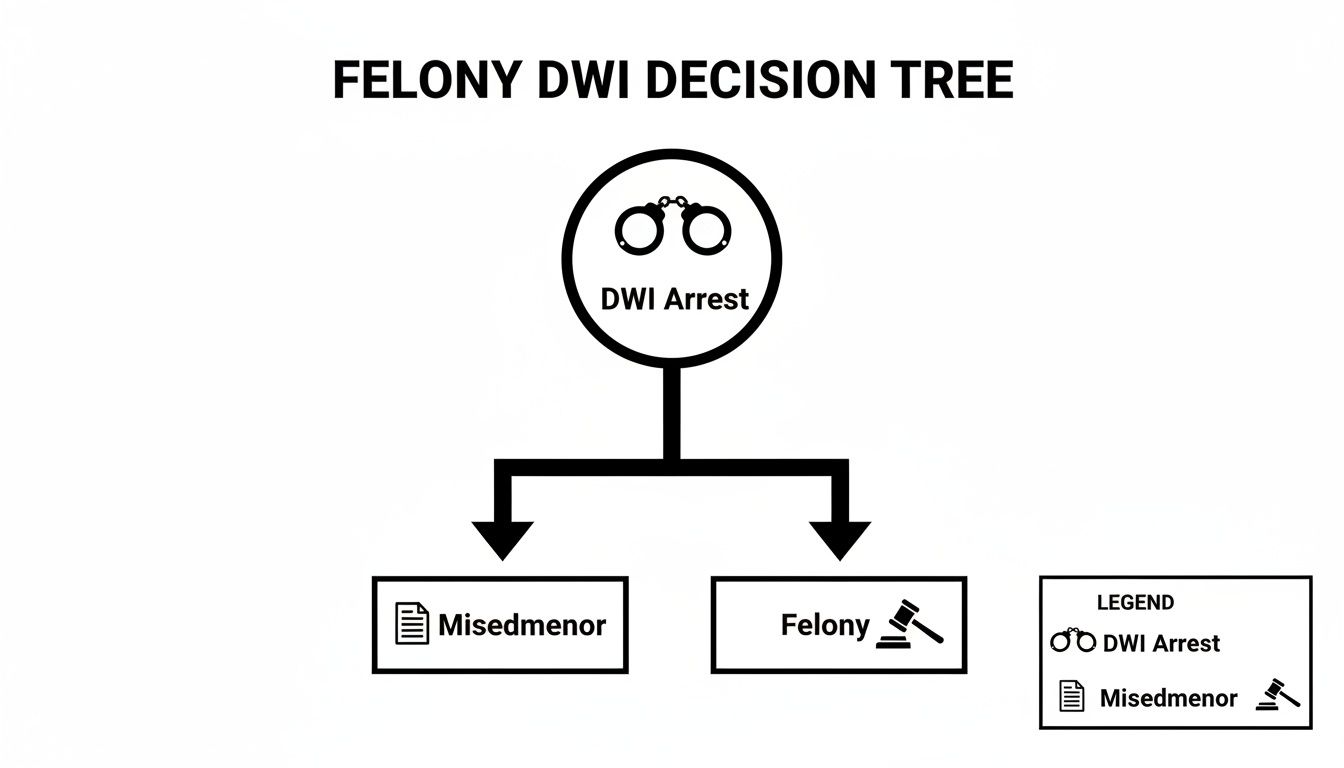
As you can see, factors like prior convictions or having a child in the car are major branching points that lead directly to a felony charge.
Endangering a Child Passenger
Another direct path to a felony is driving while intoxicated with a child in the vehicle. The law is designed to provide extra protection to minors who are dependent on the driver for their safety.
If you are arrested for DWI with a passenger under the age of 15, you will be charged with a state jail felony. This is true even if it is your very first DWI offense.
The presence of a child automatically escalates the charge, reflecting the state's commitment to punishing behavior that puts vulnerable passengers at risk. You can learn more about a DWI with a passenger under 15 in our detailed article.
Causing Serious Injury or Death
The final set of triggers involves accidents where someone gets hurt or killed. These charges are incredibly serious and focus on the devastating consequences of an impaired driving crash. They come with some of the harshest penalties under Texas law.
There are two main charges in this category:
- Intoxication Assault: If an accident you cause while intoxicated results in "serious bodily injury" to someone else, you will face this third-degree felony charge. The legal definition is broad—it includes any injury creating a substantial risk of death, causing permanent disfigurement, or the long-term loss of a bodily function.
- Intoxication Manslaughter: If an accident caused by your intoxication leads to another person's death, the charge becomes Intoxication Manslaughter, a second-degree felony.
These cases are legally complex and emotionally charged. The prosecution will build its entire case around the harm caused to the victim, making a strategic and experienced defense absolutely essential. A skilled DWI lawyer will meticulously examine every detail, from the initial traffic stop to the accident reconstruction report, to protect your rights.
What Are the Penalties for a Felony DWI?
When a DWI is elevated to a felony, the consequences extend far beyond those of a typical misdemeanor. A felony conviction brings penalties that can permanently change the course of your life. Understanding the full scope of what’s at stake is the first step toward building a defense designed to protect your future.

The penalties for a felony DWI in Texas are designed to be severe. It's important to know that many of these are not just possibilities—they can include mandatory minimums that judges must impose upon conviction.
Here’s a breakdown of the different felony DWI charges in Texas and the penalties associated with them.
Texas Felony DWI Charges and Potential Penalties
| Felony DWI Charge | Felony Classification | Potential Prison Sentence | Maximum Fine | Driver's License Suspension |
|---|---|---|---|---|
| DWI 3rd or More | 3rd Degree Felony | 2 to 10 Years | Up to $10,000 | 180 Days to 2 Years |
| DWI with Child Passenger | State Jail Felony | 180 Days to 2 Years | Up to $10,000 | 90 Days to 1 Year |
| Intoxication Assault | 3rd Degree Felony | 2 to 10 Years | Up to $10,000 | 90 Days to 1 Year |
| Intoxication Assault (SBI) | 2nd Degree Felony | 2 to 20 Years | Up to $10,000 | 180 Days to 2 Years |
| Intoxication Manslaughter | 2nd Degree Felony | 2 to 20 Years | Up to $10,000 | 180 Days to 2 Years |
As you can see, the stakes are incredibly high. A conviction doesn't just mean a fine; it means the potential loss of your freedom for years, if not decades.
Prison Time and Financial Costs
The most immediate penalties are the possibilities of significant prison time and substantial fines. A felony conviction means you’re facing time in a state prison, not just a county jail.
For a third DWI offense, a third-degree felony, the law specifies a prison sentence of 2 to 10 years. For more severe charges like Intoxication Assault causing serious bodily injury (a second-degree felony), that range increases to 2 to 20 years. On top of that, you can face a fine of up to $10,000.
A felony DWI conviction isn't just a mark on your record; it's a fundamental shift in your legal status. The state's goal is not just to penalize but to remove you from society for a significant period.
The financial impact doesn't stop with the fine. You will also be responsible for court costs, probation fees, and thousands of dollars in annual surcharges to the Texas Department of Public Safety (DPS) just to maintain your driving eligibility. These costs add up quickly, creating a long-term financial burden.
Loss of Driving Privileges
Beyond prison time and financial costs, your ability to drive will be severely restricted. A felony DWI conviction triggers an automatic driver’s license suspension that can last anywhere from 180 days up to two years. Getting your license back isn’t a simple matter of waiting it out.
To regain your driving privileges, you will almost certainly be ordered to install an Ignition Interlock Device (IID) in any vehicle you operate. This device is an in-car breathalyzer that prevents the engine from starting if it detects alcohol. You are responsible for all related costs, from installation to monthly monitoring fees.
Lasting Consequences on Your Civil Rights
Perhaps the most overlooked yet devastating penalties are those that remain long after you’ve served your sentence and paid all fines. A felony conviction strips you of fundamental civil rights.
In Texas, convicted felons lose:
- The Right to Vote: You cannot vote while incarcerated or while on parole or probation.
- The Right to Own a Firearm: Both state and federal law permanently ban convicted felons from possessing a firearm.
- Professional and Personal Roadblocks: A felony record can prevent you from obtaining certain professional licenses (such as for nursing, law, or real estate), make it nearly impossible to find housing, and even disqualify you from federal student loans.
These consequences are why fighting a felony DWI charge from day one is so critical. For a deeper look at what a third offense means, check out our guide on a 3rd DUI offense in Texas. An aggressive defense is the only way to protect yourself from a conviction that will follow you for the rest of your life.
Your Next Steps After a Felony DWI Arrest
The moments following a felony DWI arrest can be a blur of confusion and anxiety. While you’re trying to make sense of what happened, the legal system is already moving forward.
Feeling overwhelmed is completely normal, but you don’t have to face this alone. Acting quickly and strategically is key to protecting your rights and giving yourself the best possible chance at a favorable outcome. The legal process involves a series of critical deadlines and hurdles, and understanding this timeline is the first step toward regaining control.
The First 24-48 Hours: Bond and Arraignment
Almost immediately after your arrest, you’ll be brought before a magistrate for a bond hearing, often called an arraignment. During this brief but critical proceeding, the judge officially informs you of the felony charge and sets your bail or bond amount.
Bond is the amount of money you must pay to be released from jail while your case is pending. The judge considers factors like the severity of the charge, your criminal history, and your ties to the community. Securing your release is the top priority, as building a strong defense is much easier from home than from behind bars.
The 15-Day Deadline for Your Driver’s License
This is the most urgent, time-sensitive deadline you will face. From the date of your arrest, you have only 15 days to request an Administrative License Revocation (ALR) hearing with the Texas Department of Public Safety (DPS).
If you miss this deadline, your driver's license will be automatically suspended. The ALR hearing is a civil proceeding, separate from your criminal case, and it is your only opportunity to challenge the administrative suspension of your license.
This hearing is about more than just saving your license. It's a valuable opportunity for your attorney to question the arresting officer under oath long before the criminal trial. This testimony can uncover crucial weaknesses in the state’s case that can be used to your advantage later.
Winning the ALR hearing can prevent your license from being suspended and give your defense a significant head start. Missing this deadline means giving up a critical strategic advantage.
The Grand Jury Indictment
Because you’re facing a felony, your case must first be presented to a grand jury—a group of citizens who review the prosecutor's evidence to decide if there is enough probable cause to formally charge you.
If the grand jury finds sufficient evidence, they issue an indictment. This formal accusation officially moves your case into the felony court system. While your attorney does not present your side at this stage, they should be using this time to proactively investigate your arrest and gather evidence.
A skilled DWI attorney will:
- File Pre-Trial Motions: These are formal legal requests to the court. A motion to suppress evidence asks the judge to exclude evidence obtained illegally. For example, if the police lacked a valid reason to pull you over or if a blood draw was performed improperly, that evidence could be thrown out.
- Investigate the Case: Your legal team will obtain and scrutinize all of the prosecution's evidence—police reports, body cam and dash cam videos, and lab results from blood or breath tests—looking for inconsistencies or errors.
- Negotiate with the Prosecutor: A thorough investigation often reveals weak spots in the state's case. This opens the door to negotiations for a possible charge reduction or, in some cases, a complete dismissal.
The time between your arrest and a potential trial is a critical period for building a powerful, strategic defense. Every step, from the ALR hearing to pre-trial motions, is an opportunity to challenge the state's narrative and fight for your future.
Building a Strategic Defense Against Your Charge
Facing a felony DWI charge can make you feel like the odds are stacked against you, but an arrest is just the beginning of the story—it is not a conviction. The state’s version of events is often full of procedural holes, questionable evidence, and assumptions that may not hold up under scrutiny. A strong defense is built by carefully examining every piece of that story.

The goal of any defense strategy is to introduce reasonable doubt. A seasoned Houston DWI lawyer starts by investigating every detail, beginning from the moment the police lights appeared in your rearview mirror. We never take the state's evidence at face value, because the key to a successful outcome often lies in the details others overlook.
Questioning the Traffic Stop and Arrest
The entire DWI case depends on the legality of the initial traffic stop. If the stop was unlawful, then everything that followed—field sobriety tests, breath or blood samples, and your statements—could be thrown out of court. This is one of the most powerful tools available to fight a DWI in Texas.
An officer must have reasonable suspicion of a traffic violation to pull you over. We will scrutinize the police report and any available video footage to answer critical questions:
- Did you genuinely commit a traffic violation, like speeding or failing to signal?
- Was the officer’s reason for the stop vague or unsubstantiated?
- Did the officer have probable cause to escalate from a traffic stop to a DWI investigation and arrest?
If we can show that the stop was illegal, we will file a motion to suppress the evidence. Winning this motion can significantly weaken the prosecution’s case, often leading to a dismissal of the charges.
A defense attorney’s job is to hold law enforcement accountable to the letter of the law. Your constitutional rights don’t just vanish because an officer suspects you of DWI. Every single action they take must be legally justified.
Even if the stop was valid, the subsequent investigation must follow strict legal and scientific protocols, opening up additional avenues to challenge the evidence against you.
Challenging Field Sobriety and Chemical Tests
Standardized Field Sobriety Tests (SFSTs) are notoriously unreliable. These are difficult physical exercises that can be failed for many reasons other than intoxication, such as medical conditions, fatigue, poor weather, or nervousness.
More importantly, officers must administer these tests exactly according to the standards set by the National Highway Traffic Safety Administration (NHTSA). Any deviation can render the results invalid. We will pick apart the officer’s instructions and your performance to identify these critical mistakes.
The same intense scrutiny applies to breath and blood tests:
- Breath Tests: Was the machine properly calibrated and maintained? Was the officer certified to operate it? Did they conduct the mandatory 15-minute observation period before the test to ensure the sample wasn't contaminated?
- Blood Tests: Was the blood drawn by a qualified professional in a sterile environment? Was the chain of custody maintained to ensure the sample wasn’t contaminated or mishandled on its way to the lab?
Any procedural misstep can compromise the results. A skilled Texas DWI lawyer knows how to expose these flaws, creating serious doubt about the reliability of the state’s evidence. In the most serious cases, like intoxication manslaughter, a powerful defense is even more essential. You can learn more about what intoxication manslaughter is and the defense strategies that apply.
Attacking Prior Convictions
When you’re facing a felony DWI due to prior convictions, the prosecution has the burden of proving those old cases are valid for enhancement purposes. This isn't always straightforward. We can investigate whether you had proper legal representation in your previous cases or if procedural errors could disqualify a prior conviction from being used to elevate your current charge.
Successfully challenging a prior conviction can mean the difference between a felony and a misdemeanor. It is a complex but vital defense strategy. Your case is far more than a police report; it’s a collection of evidence that must be tested, challenged, and scrutinized. We are here to ensure your rights are protected at every turn.
Common Questions About Felony DWI in Texas
When you're facing a charge as serious as a felony DWI, your mind is likely racing with questions. Getting clear, straightforward answers is the first step toward regaining a sense of control.
Here are answers to some of the most urgent questions we hear from clients in your situation.
Can a Felony DWI Be Reduced to a Misdemeanor?
Yes, it is possible. Reducing a felony DWI to a misdemeanor is a realistic goal, but it requires a well-executed legal strategy. The outcome depends on the specific facts of your case, the strength of the prosecution's evidence, and whether law enforcement made any procedural errors.
For example, if we successfully challenge a prior conviction being used to enhance the charge, or if we get key evidence thrown out (like a faulty breath test), we create leverage. This leverage allows us to negotiate for a lesser charge. This result is achieved through a proactive, aggressive defense from the very beginning.
Will I Automatically Go to Prison If Convicted?
A felony DWI conviction carries the threat of prison time, but it is not a foregone conclusion. An experienced defense lawyer can advocate for alternatives, such as probation—which Texas law refers to as "community supervision."
The outcome depends on your criminal history, the specifics of your arrest, and the strength of the defense presented. Even though a third DWI carries a potential prison sentence of 2 to 10 years, a judge may still grant probation. This would include conditions such as mandatory treatment programs and community service. Our primary goal is always to build a compelling case to keep you out of prison.
How Long Does a Felony DWI Stay on My Record?
This is the harsh reality of a felony DWI in Texas: it's permanent. A conviction stays on your criminal record for life.
Unlike some lesser offenses, a felony conviction is almost never eligible for expunction or even record sealing (nondisclosure). This creates a domino effect of long-term consequences that can impact your ability to get a job, find housing, maintain professional licenses, and even own a firearm. Because the damage is permanent, it is absolutely critical to build the strongest possible defense to avoid a conviction in the first place.
A felony DWI charge puts your freedom, your family, and your entire future on the line. You don’t have to face it alone. At The Law Office of Bryan Fagan, PLLC, our experienced Houston DWI lawyers are ready to build the aggressive defense you need. Contact us today for a free, confidential case evaluation to understand your rights and start fighting back. Learn more at https://texasduilawfirm.com.