
A DWI arrest can be overwhelming—but you don’t have to face it alone. If you've been arrested for drunk driving in Texas, one of the first things you'll grapple with is the terminology. Is it a DUI or a DWI? While people often use the terms interchangeably, in the eyes of Texas law, they are not the same.
The difference boils down to one simple factor: age. DWI (Driving While Intoxicated) is the charge for adults aged 21 and over who are legally impaired. In contrast, DUI (Driving Under the Influence) is a specific offense for minors under 21 who have any detectable amount of alcohol in their system. Understanding this distinction is the first step toward building a solid defense for your case.
Clarifying Texas Drunk Driving Charges
An arrest is overwhelming, and the legal jargon only adds to the confusion. You've probably heard "DUI" and "DWI" thrown around your whole life, but Texas law is very specific about what each one means. They aren't just different names for the same crime; they have entirely different standards of proof and come with their own unique penalties.
In Texas, the primary charge for intoxicated driving is DWI. This is what you'll face if you're over 21 and operating a vehicle with a blood alcohol concentration (BAC) of 0.08% or higher, or if you've lost the normal use of your mental or physical faculties. While DUI is a common term nationwide, Texas reserves it for a very specific situation involving underage drinking and driving.
The Foundation of Each Charge
For an adult to be convicted of a DWI, the prosecutor has to prove intoxication in one of two ways:
- Your Blood Alcohol Concentration (BAC) was 0.08% or higher.
- You lost the normal use of your mental or physical faculties because of alcohol or drugs.
A DUI charge, on the other hand, operates under the state's "zero tolerance" policy for minors. For someone under 21, the prosecutor doesn't need to prove they were impaired at all. If there is any detectable amount of alcohol in their system, that's enough for a DUI charge. You can dig deeper into the history of these terms in our guide on when DUI became DWI.
An arrest is not a conviction. The state has the burden of proving its case beyond a reasonable doubt, and a knowledgeable Houston DWI lawyer can identify weaknesses in the prosecution’s evidence at every stage.
To make things even clearer, let's break down the key differences side-by-side.
Texas DWI vs DUI at a Glance
This table offers a quick snapshot of how Texas law distinguishes between these two very different charges.
| Aspect | DWI (Driving While Intoxicated) | DUI (Driving Under the Influence) |
|---|---|---|
| Applicable Age | 21 and over | Under 21 |
| Legal Standard | Intoxication (BAC ≥ 0.08% or impaired) | Any detectable amount of alcohol |
| Typical Offense | Class B Misdemeanor (for a first offense) | Class C Misdemeanor (for a first offense) |
| Key Proof Needed | Evidence of impairment or BAC level | Any evidence of alcohol consumption |
Understanding which charge you or a loved one is facing is crucial because the defense strategies, penalties, and long-term consequences are vastly different.
How Texas Law Defines Intoxication and Impairment
A DWI arrest can feel like the world is crashing down, but you don't have to face it alone. The first step in building a solid defense is understanding exactly what the state has to prove to convict you. In Texas, "intoxication" isn't just about a number on a breathalyzer. It's a broad legal definition that gives prosecutors two different paths to secure a conviction.
Under the Texas Penal Code, you are legally intoxicated if you lack the normal use of your mental or physical faculties because of alcohol, drugs, or any other substance. The second, more well-known definition is having a Blood Alcohol Concentration (BAC) of 0.08% or higher.
This dual definition is absolutely critical. It means the state doesn't always need a chemical test to charge you with a DWI. An officer's subjective opinion about how you looked, acted, or performed during a traffic stop can be enough to initiate an arrest and formal charges.
The Two Pillars of a DWI Charge
The prosecution's entire case will be built on one of two theories of intoxication. Your defense must be ready to challenge the evidence for either one.
- Loss of Normal Faculties: This is based on the arresting officer's observations. They will testify about things like slurred speech, stumbling, or red, glassy eyes. They will lean heavily on your performance during the Standardized Field Sobriety Tests (SFSTs) to argue that you were impaired.
- Per Se Intoxication (BAC ≥ 0.08%): This is the more scientific, numbers-based route. If the state has a breath or blood sample showing your BAC was at or over the legal limit, they'll argue you were intoxicated by definition—or "per se"—no matter how well you were driving.
Even if your BAC is below 0.08%, you can still be charged and convicted of DWI if a prosecutor believes they can convince a jury you had lost the normal use of your faculties. This is why a significant part of any strong defense involves challenging the officer's subjective opinions and observations.
A DWI charge is not a conviction. Every single piece of evidence the state uses—from the reason they pulled you over to the results of a chemical test—can be challenged by an experienced Houston DWI lawyer who knows how to spot procedural mistakes and scientific flaws.
DUI and the Zero Tolerance Standard for Minors
While adults are held to the 0.08% BAC and impairment standards, Texas law has a much tougher rule for minors. For any driver under the age of 21, the state enforces a strict "zero tolerance" policy.
This means a minor commits the offense of Driving Under the Influence (DUI) if they have any detectable amount of alcohol in their system. The standard isn't impairment; it's simply the presence of alcohol. A BAC of just 0.01% is enough for a minor to face a DUI charge, which is a Class C misdemeanor for a first offense.
This creates a clear line in the sand for how these cases are handled:
- For an adult DWI: The prosecutor has to prove intoxication beyond a reasonable doubt.
- For a minor DUI: The prosecutor just has to prove the presence of alcohol.
A DUI charge can cast a long shadow over a young person's future, impacting everything from college admissions to job prospects. It's essential to understand all your options, including deferred disposition, which can help keep a conviction off their permanent record. To get a better grasp of the numbers involved, you can learn more about the specifics of Texas BAC legal limits and how they apply to different drivers.
Texas DWI Penalties Explained
Getting a handle on the potential consequences is a key step in building your defense after a drunk driving arrest. In Texas, the penalties for a DWI and a DUI couldn't be more different—they reflect the significant legal gap between how the state treats adult offenders versus minors. A DWI conviction can land an adult in jail with steep fines and a permanent criminal record, while a DUI for a minor is often geared more toward education and administrative penalties.
However, both charges can have lasting consequences. Understanding these differences makes it crystal clear why you need a strategic legal plan from the moment you're charged.
Penalties for an Adult DWI
The penalties for a DWI in Texas are harsh, and they escalate quickly with each new conviction. A first-time DWI is typically a Class B Misdemeanor, but that can be enhanced if certain aggravating factors are present.
For a standard first DWI in Texas (with a BAC under 0.15%), you're looking at:
- Jail Time: A mandatory minimum of 72 hours, with a maximum of 180 days in county jail.
- Fines: A criminal fine of up to $2,000.
- License Suspension: A DWI license suspension that can last anywhere from 90 days to a full year.
- Annual Surcharges: A fee of $1,000 to $2,000 every year for three years just to keep your driver's license.
These consequences increase significantly for a second or third offense. A third DWI is a third-degree felony, which could mean two to ten years in prison and fines reaching $10,000.
What Factors Can Make DWI Penalties Worse?
Certain situations can turn a standard DWI into a much more serious charge with far worse penalties, even if it's your first time being arrested. These are known as aggravating factors.
One of the most common is a high blood alcohol concentration. If your BAC is 0.15% or higher, a first-offense DWI gets enhanced to a Class A Misdemeanor. This instantly doubles the potential jail time to one year and raises the maximum fine to $4,000.
Another serious factor is driving while intoxicated with a child passenger under the age of 15. This is an automatic upgrade to a state jail felony. It's punishable by up to two years in a state jail facility and a fine of up to $10,000, and it doesn't matter if it's your first offense.
An arrest is not the final word. A skilled Houston DWI lawyer can challenge everything from the legality of the traffic stop to the accuracy of the BAC test. A strong defense can lead to reduced charges or even a full dismissal.
Penalties for a Minor DUI
Texas has a "zero tolerance" policy for underage drinking and driving. A DUI charge applies to anyone under 21 with any detectable amount of alcohol in their system. The penalties aren't as severe as an adult DWI, but a conviction still creates a criminal record that can cause problems down the road.
Here’s what a first-offense DUI (a Class C Misdemeanor) typically involves:
- Fines: A fine up to $500.
- License Suspension: A driver's license suspension for at least 60 days.
- Community Service: 20 to 40 hours of community service, usually related to alcohol education.
- Alcohol Awareness Course: Mandatory completion of an state-approved alcohol awareness class.
If a minor has prior DUI convictions, the penalties get tougher. A third DUI can lead to a 180-day license suspension and a fine of up to $2,000. These consequences can seriously impact a young person's future, affecting everything from college applications to job opportunities.
This infographic breaks down the two ways Texas law defines intoxication for adults.
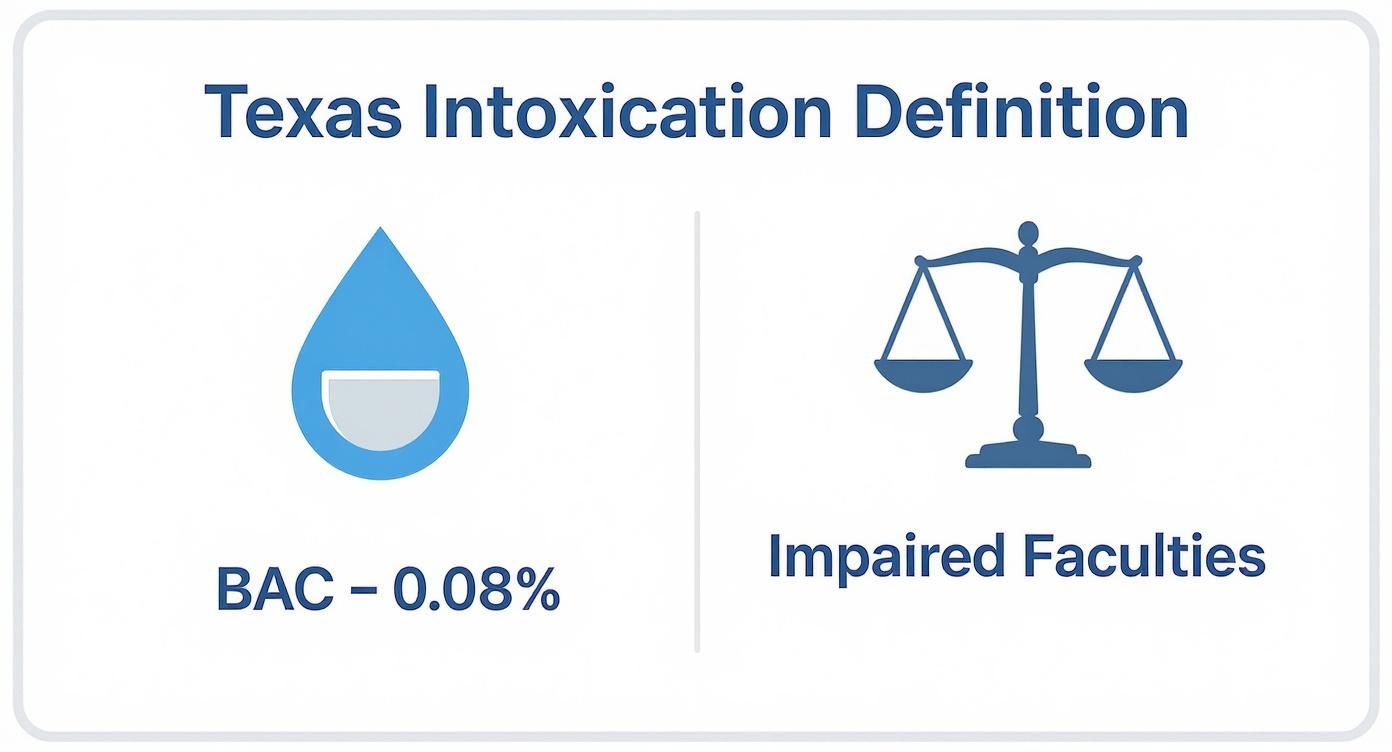
This dual definition is key—it means prosecutors can pursue a DWI charge based solely on an officer's subjective opinion that you were impaired, even without a BAC test over the legal limit.
To help you see the differences side-by-side, here is a direct comparison of the penalties for a first offense.
First-Offense DWI vs DUI Penalty Comparison
| Penalty Type | First-Time DWI (Adult, BAC < 0.15) | First-Time DUI (Minor) |
|---|---|---|
| Criminal Charge | Class B Misdemeanor | Class C Misdemeanor |
| Jail Time | 72 hours to 180 days | None |
| Maximum Fine | Up to $2,000 | Up to $500 |
| License Suspension | 90 days to 1 year | 60 days to 180 days |
| Community Service | 24 to 100 hours | 20 to 40 hours |
| Education Program | DWI Education Program | Alcohol Awareness Course |
| Annual Surcharges | $1,000 – $2,000 for 3 years | None |
This table makes it clear: while both charges are serious, the criminal and financial weight of an adult DWI is substantially heavier than a minor's first DUI.
The state's tough stance on intoxicated driving is a direct response to some sobering statistics. For years, Texas has battled high rates of drunk driving fatalities. Data from the Texas Department of Transportation shows that alcohol-related crashes claim over 1,200 lives annually. This stubbornly high figure means Texas has a fatality rate roughly 50% higher than the national average for both men and women. You can dig deeper into these Texas DWI trends and statistics.
Whether you're an adult facing a DWI or a minor dealing with a DUI, the stakes are incredibly high. The best move you can make is to consult an experienced Texas DUI attorney who can build a defense that protects your rights, your license, and your future.
Navigating the Legal Process After a DWI Arrest
Getting arrested for a DWI can leave you feeling disoriented and overwhelmed—but you don't have to face what comes next alone. The moments right after an arrest are critical. They set the stage for two separate legal battles: one to save your driver's license and another to fight the criminal charge itself.
Understanding this two-track process is the very first step toward regaining control. The legal journey isn't a single event; it's a series of crucial deadlines and court proceedings. From the moment you're arrested, a clock starts ticking on your right to drive, while the criminal justice system begins its own intimidating process. A clear roadmap helps you understand what's coming and prepare a smart, strategic response.
Step-by-Step Guidance on What Happens After a DWI Arrest
The most immediate concern after a DWI arrest is your driver's license. Under Texas’s implied consent law, the state considers that you have already agreed to provide a breath or blood sample just by driving on a public road. If you refuse a chemical test or if you provide a sample showing a BAC of 0.08% or higher, the Texas Department of Public Safety (DPS) begins the process to suspend your license.
This is called an Administrative License Revocation (ALR), and it's a civil proceeding completely separate from your criminal DWI case. You have only 15 days from the date of your arrest to request an ALR hearing and challenge this suspension.
Crucial Deadline: If you miss that 15-day window to request an ALR hearing, you automatically lose your license. The suspension typically starts 40 days after your arrest. Protecting your driving privileges starts with taking immediate action.
Requesting an ALR hearing isn't just about trying to save your license; it’s a vital strategic move. The hearing gives your attorney a valuable opportunity to question the arresting officer under oath. This allows them to gather evidence and testimony that can be used to build a much stronger defense for your criminal case. To learn more, you can find detailed information about the State Office of Administrative Hearings in Texas and how it all works.
The Criminal Case Unfolds
While you're fighting to keep your license, the criminal DWI case moves forward on its own timeline. The process can feel long, but it generally follows a predictable set of stages.
- Bond and Arraignment: This is your first official court appearance after being released from jail on bond. The charges against you will be formally read, and you will enter a plea—almost always "not guilty" at this stage. The judge will also review the conditions of your release.
- Pre-Trial Phase: This is the longest and most work-intensive part of your case. Your lawyer will file motions to obtain all the state’s evidence against you, a process known as discovery. This evidence includes police reports, body cam videos, and the results of any breath or blood tests.
- Pre-Trial Motions: After reviewing the evidence, your attorney can file motions to suppress evidence that was obtained illegally. For instance, if the police pulled you over without reasonable suspicion, any evidence gathered after that could be thrown out. This is a powerful tool to fight DWI Texas charges.
- Negotiation or Trial Process: Depending on the strength of the evidence, your case might be resolved through a plea agreement or proceed to trial. A plea deal could involve reducing the charge to a lesser offense, while a trial means presenting your case to a judge or jury who will decide your guilt or innocence.
Key Terms You Need to Know
Throughout this process, you will hear a lot of legal terms. Understanding what they mean is key to being an active participant in your own defense.
- Field Sobriety Test (FST): These are the roadside physical and mental exercises officers use to gauge impairment. They are highly subjective and often administered incorrectly, which makes them a frequent target for legal challenges.
- Implied Consent: The legal principle in Texas that states by driving a vehicle, you have implicitly agreed to submit to a chemical test (breath or blood) if lawfully arrested for DWI.
- Administrative License Suspension: This is the civil penalty from the DPS, separate from any criminal suspension ordered by a court. It is triggered by either refusing a chemical test or failing one (BAC of 0.08% or higher).
A DWI arrest kicks off a complex legal journey with high stakes. However, every step in this process also presents an opportunity for a skilled Houston DWI lawyer to challenge the state's case, protect your rights, and work toward the best possible outcome for your future.
How to Fight a Breath Test Result and Other Defense Strategies

An arrest for DWI or DUI is not a conviction. The state carries the heavy burden of proving its case beyond a reasonable doubt, and every piece of evidence they present can—and should—be scrutinized and challenged.
A skilled Houston DWI lawyer knows that a successful defense is built by meticulously examining every detail of your arrest, from the moment an officer’s lights flashed in your rearview mirror to how a chemical test sample was handled. This is where a strategic defense begins—by deconstructing the state's narrative.
Your rights are protected by strict legal procedures. When law enforcement fails to follow them, it creates powerful opportunities to weaken the prosecution's case. With the right legal advocate, you can build a formidable defense aimed at a positive outcome, whether that's a charge reduction, a dismissal, or a not-guilty verdict at trial.
Challenging the Initial Traffic Stop
The foundation of every DWI or DUI case is the traffic stop itself. Under the Fourth Amendment, a police officer cannot pull you over without reasonable suspicion that you have committed a traffic violation or are engaged in criminal activity. If the stop was unlawful from the start, all evidence collected afterward—including field sobriety tests and chemical test results—can be suppressed and thrown out of court.
An effective defense often begins by asking some tough questions:
- Did the officer have a legitimate reason to stop you, like speeding, swerving, or a broken taillight?
- Can the officer clearly articulate the specific facts that led them to believe you were breaking the law?
- Was the stop based on a vague hunch or an anonymous, uncorroborated tip?
If the stop was illegal, it doesn't matter what happened next. An experienced attorney can file a Motion to Suppress, which can lead to the entire case being dismissed before it ever reaches a jury.
A DWI arrest can be overwhelming—but you don’t have to face it alone. The cornerstone of a strong defense is challenging the legality of every action taken by law enforcement, ensuring your constitutional rights are protected at every turn.
Questioning Field Sobriety and Chemical Test Results
The state’s two main tools for proving intoxication are Standardized Field Sobriety Tests (SFSTs) and chemical tests (breath or blood). While they might seem objective, both are highly susceptible to error and can be effectively challenged in court.
SFSTs, like the walk-and-turn or one-leg stand, are notoriously unreliable. They're designed to be difficult even for sober individuals, and factors like medical conditions, fatigue, poor weather, or simple nervousness can cause a person to "fail." On top of that, officers frequently administer these tests incorrectly, failing to follow the strict protocols required by the National Highway Traffic Safety Administration (NHTSA).
Similarly, breath and blood tests are not infallible. A skilled Texas DUI attorney will dig into potential issues, such as:
- Improper Device Calibration: Breathalyzer machines must be regularly maintained and calibrated. If they aren't, they can produce wildly inaccurate readings.
- Breaks in the Chain of Custody: Blood samples must be properly handled, labeled, and stored from the moment they are drawn until they are tested. Any break in this chain can lead to contamination or compromise the sample's integrity.
- Medical Conditions: Certain health issues, like acid reflux or diabetes, can create substances in your breath that mimic alcohol, leading to a false positive on a breath test.
Challenging the scientific validity of these tests is a core component of many successful DWI defense strategies. While Texas has seen a rise in arrests for repeat offenders, a strong defense can prevent a charge from becoming a conviction. In fact, historical state data shows that from 1987 to 1990, DWI arrests for repeat offenders increased by about 15%, highlighting the long-standing importance of fighting every charge aggressively. You can learn more about Texas DWI offender trends to understand the landscape. Your case deserves a defense that holds the prosecution to its highest standard of proof.
When you're facing a DWI or DUI charge, it's easy to feel cornered. But you don't have to go through this alone. At The Law Office of Bryan Fagan, PLLC, we build a strategic legal defense tailored to the specifics of your case. Our deep experience handling complex DWI cases all over Texas means we know exactly how to protect your rights, from the moment of the traffic stop to your day in court.
Our approach is built around one goal: minimizing the impact this charge has on your life. We're not just lawyers; we're your advocates, committed to digging into every piece of evidence, challenging sloppy police work, and building a defense that gives you the best possible shot at a positive outcome. This isn't just a legal service—it's a partnership to get your future back on track.
Your Defense Starts with a Free Consultation
The first step is always to understand your options. That’s why we offer a free, confidential consultation to go over the details of your arrest. In this meeting, we'll listen to your side of the story, answer your questions, and start outlining a preliminary defense strategy.
This initial review is critical. It’s our chance to spot potential weaknesses in the prosecutor's case, like an illegal traffic stop or improperly performed field sobriety tests. From there, we can walk you through the next steps, including the time-sensitive process of requesting an ALR hearing to fight a DWI license suspension.
A DWI arrest is not a conviction. It's an accusation that the state has to prove beyond a reasonable doubt. Our job is to hold them to that standard and fight for you every single step of the way.
Whether you're dealing with a first DWI in Texas or a more complicated charge, our commitment to you is the same. An experienced Houston DWI lawyer from our firm will be in your corner, providing the assertive and knowledgeable defense you need. Contact us right away to start building that defense.
Got Questions About Your DWI or DUI? We Have Answers.
When you're facing a DWI or DUI charge, your mind is probably racing with questions. It's a confusing and stressful time, but getting clear, straightforward answers is the first step toward taking back control and figuring out your next move. Here are some of the most common concerns we hear from people just like you.
Can I Really Get a DWI for Driving on My Prescription Meds?
Yes, you absolutely can. Texas law doesn't just focus on alcohol. The legal definition of "intoxicated" includes being impaired by a controlled substance, a drug, or any combination of substances—even if they're legally prescribed.
If your medication, whether it's for pain, anxiety, or anything else, affects your mental or physical abilities to the point where you can't operate a vehicle safely, you can be charged with DWI.
Do I Have to Take a Breathalyzer Test if an Officer Asks?
This is a common question. Under Texas's implied consent law, the act of driving on a public road means you have technically already agreed to a chemical test if lawfully arrested for DWI.
However, you still have the right to refuse a breath or blood test. Be aware that a refusal isn't a get-out-of-jail-free card. It automatically triggers an administrative license suspension. The trade-off is that by refusing, you deny the prosecution one of the strongest pieces of evidence they can use against you in your criminal case.
What’s the Difference Between a DWI and an Obstruction of a Highway Charge?
While both charges can arise after a traffic stop involving alcohol, they are fundamentally different. A DWI requires the state to prove you were intoxicated. That is the core of their case.
An Obstruction of a Highway charge, which is sometimes used in plea bargains, is much simpler. It only focuses on the act of stopping your vehicle in a roadway, blocking traffic. The prosecutor does not have to prove you were intoxicated. This charge comes with less severe penalties and, importantly, helps you avoid the lasting stigma of a DWI conviction on your record.
An arrest can make you feel powerless, but you don’t have to go through this alone. The experienced attorneys at The Law Office of Bryan Fagan, PLLC are here to stand up for your rights and protect your future. Contact us today for a free, confidential case evaluation to understand exactly where you stand and what your options are.