 Skip to content
A DWI arrest can be overwhelming—but you don’t have to face it alone. People often use DUI and DWI interchangeably, but Texas law makes a clear, critical distinction between the two. At its core, the difference comes down to one simple factor: age.
DUI (Driving Under the Influence) is a charge reserved almost exclusively for minors under the age of 21. On the other hand, DWI (Driving While Intoxicated) is the charge that applies to adults who are found to be legally impaired behind the wheel. Understanding the specific charge you're up against is the first, most crucial step toward building a strong, strategic defense.
Understanding the Critical Difference Between DUI and DWI in Texas
The core difference between a Texas DUI and DWI boils down to the driver's age and the legal standard used to define intoxication. This isn't just a matter of semantics—it completely changes the nature of the charge, the evidence needed for a conviction, and the penalties you could face.
For anyone 21 or older, the only charge that matters is Driving While Intoxicated (DWI). The state defines "intoxicated" in two specific ways:
- Having a Blood Alcohol Concentration (BAC) of 0.08% or higher.
- Not having the normal use of your mental or physical faculties because of alcohol, drugs, or a combination of both.
For minors under 21, Texas takes a much stricter "zero tolerance" approach. An officer can charge a minor with Driving Under the Influence (DUI) if they have any detectable amount of alcohol in their system. This is a far lower bar than the 0.08% BAC standard for adults. This simple flowchart breaks down the primary distinction.
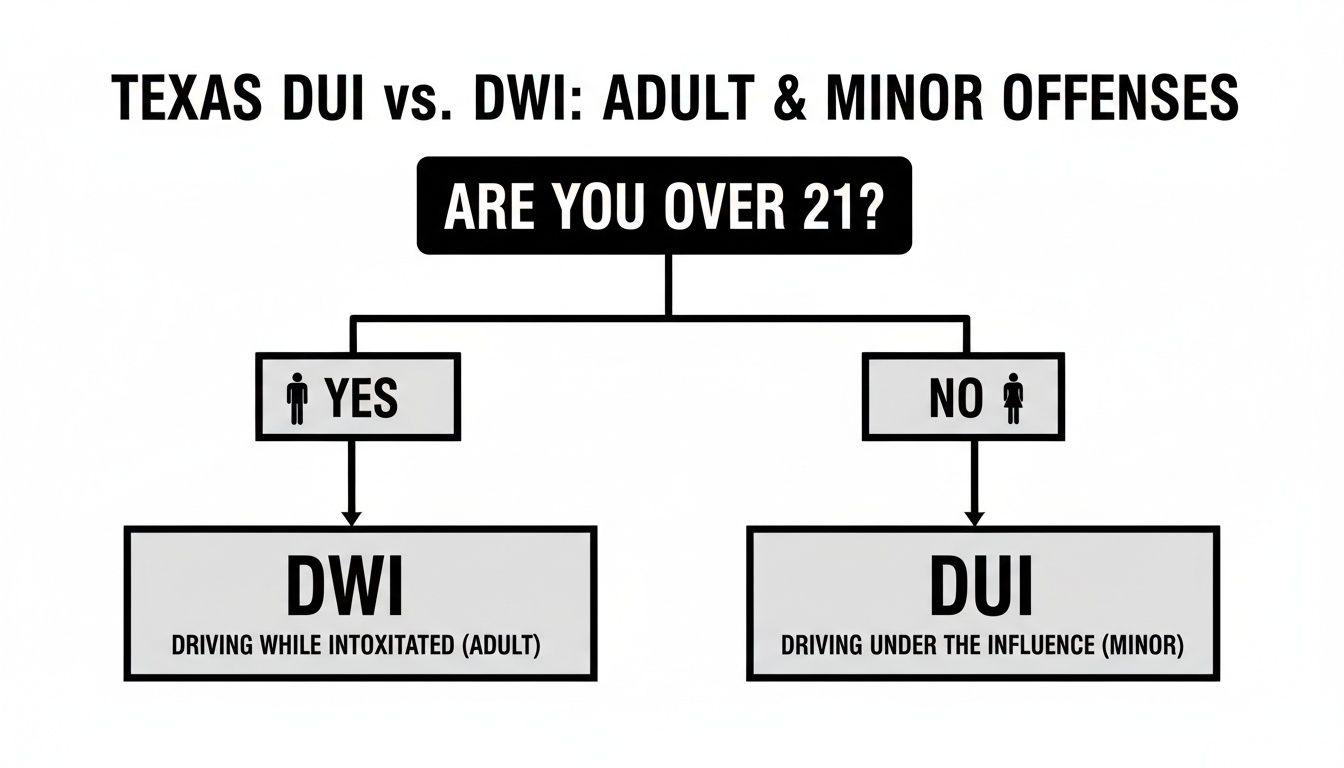
As you can see, your age is the key factor that determines whether you face a DUI or DWI charge. To get a better handle on the legal evolution of these terms, you can explore the history of how DUI became DWI in our detailed guide.
At a Glance: Comparing Texas DUI and DWI Charges
This table offers a clear, side-by-side summary of the fundamental distinctions between DUI and DWI charges under Texas law.
| Comparison Point | DUI (Driving Under the Influence) | DWI (Driving While Intoxicated) |
|---|---|---|
| Primary Defendant | Minors under the age of 21. | Adults aged 21 and over. |
| Legal Standard | Any detectable amount of alcohol. | BAC of 0.08% or loss of faculties. |
| Typical Offense Level | Class C Misdemeanor (first offense). | Class B Misdemeanor (first offense). |
| Key Consequence | Creates a criminal record impacting future opportunities. | Involves potential jail time and higher fines. |
While both charges are serious, the consequences for a DWI are typically much harsher, reflecting the higher standard of impairment required for a conviction.
Breaking Down the Legal Definitions of Intoxication
To build a strong defense, you first have to understand what the prosecutor is trying to prove. When people talk about the difference between DUI and DWI in Texas, it all comes down to the legal definition of "intoxication"—and it's not always about what a breathalyzer says.
For an adult facing a DWI charge, Texas law gives the state two different paths to prove you were intoxicated. Knowing both is critical because your defense strategy will depend on which one the prosecution leans on.
The Two Ways the State Can Prove DWI Intoxication
The prosecutor only has to convince a jury of one of the following definitions beyond a reasonable doubt:
- Per Se Intoxication: This is the black-and-white, numbers-based definition. You are considered legally intoxicated if you have a Blood Alcohol Concentration (BAC) of 0.08% or higher. This is the reason chemical tests like breathalyzers and blood draws are so central to the state's case. It's a simple, scientific threshold.
- Loss of Normal Faculties: This path is far more subjective and open to interpretation. You can be convicted of DWI even if your BAC is below 0.08%. The state just has to argue that you lost the “normal use of your mental or physical faculties” because of alcohol, drugs, or a mix of substances.
This second definition is where an officer’s observations during the traffic stop—like slurred speech, fumbling for your license, or your performance on field sobriety tests—become the primary evidence. A sharp Houston DWI lawyer knows how to challenge these subjective assessments, which are often unreliable and can be influenced by nerves, medical conditions, or fatigue.
You can get a deeper look at how this all works in our detailed guide on Texas BAC legal limits.
Key Insight: Remember, a DWI charge doesn't hinge on having a BAC of 0.08% or more. The state can move forward based entirely on an officer’s opinion that you seemed impaired. This makes challenging the field sobriety test evidence a critical part of the defense to fight a DWI in Texas.
The Standard for a Minor DUI Charge
For drivers under 21, the rules change dramatically. Texas has a strict "zero tolerance" policy for underage drinking and driving, which means the legal bar for a DUI charge is incredibly low and much easier for the state to clear.
A minor is guilty of DUI if they're caught operating a motor vehicle in a public place with any detectable amount of alcohol in their system. That's it. The prosecution doesn't have to show they were impaired or that they lost their faculties. The mere presence of alcohol is enough for a conviction.
- Example: A 19-year-old has one beer at a party and drives home hours later, feeling completely sober. If they are pulled over for a minor traffic violation and a breath test shows a BAC of just 0.02%, that is sufficient evidence for a DUI charge in Texas.
This stark contrast really highlights why the conversation about DUI versus DWI in Texas is so tied to the driver's age. The legal standard flips from proven impairment for adults to the mere presence of alcohol for minors. An experienced Texas DUI attorney can fight these charges to protect a young person's future from the heavy weight of a criminal record.
Navigating the Penalties and Long-Term Consequences
A conviction for either DWI or DUI in Texas brings consequences that reach far beyond the courtroom. Understanding what's at stake isn't about fear—it's about knowing what you are up against so you can build the strongest possible defense. These penalties are designed to be tough, but remember, an arrest isn't a conviction. A strategic Houston DWI lawyer can work to minimize or even avoid these outcomes entirely.
The real difference between DUI versus DWI Texas becomes crystal clear when you look at the penalties. Both are serious, but the consequences for an adult DWI are dramatically more severe than for an underage DUI, reflecting the different legal standards for each charge.
Texas DWI Penalties Explained
The stakes are high when an adult is charged with a DWI. A first DWI in Texas is usually a Class B Misdemeanor, carrying penalties that escalate sharply with each subsequent offense.
Here’s a breakdown of the standard criminal penalties for DWI convictions in Texas:
| Offense Level | Jail Time | Fines | License Suspension |
|---|---|---|---|
| First DWI | 3 to 180 days | Up to $3,000 | 90 days to 1 year |
| Second DWI | 30 days to 1 year | Up to $4,500 | 180 days to 2 years |
| Third DWI (Felony) | 2 to 10 years in prison | Up to $10,000 | 180 days to 2 years |
These are just the baseline criminal penalties. A judge can also order probation, add hundreds of hours of community service, and mandate DWI education classes.
Impaired driving remains a huge focus for law enforcement statewide. Back in 2016, the Texas Department of Transportation reported a staggering 987 fatalities from intoxicated drivers. Houston ranked second in the state with 1,492 DUI-related crashes. You can discover more insights about these statistics and see why the laws are so strict.
Penalties for an Underage DUI
Because Texas has a zero-tolerance policy for underage drinking and driving, the penalties for a DUI are mostly aimed at education and prevention. However, a conviction can create significant hurdles for a young person.
For a first-offense DUI (a Class C Misdemeanor), a minor under 21 is typically looking at:
- A fine of up to $500.
- A driver's license suspension of 60 to 180 days.
- 20 to 40 hours of mandatory community service.
- Required attendance at an alcohol awareness program.
While there's no jail time, the real sting comes from the permanent criminal record. This can appear during college admissions, scholarship applications, and future job searches. An experienced Texas DUI attorney can often negotiate outcomes that allow for an eventual expunction, which would clear the record and protect a young person's future.
The Long-Term Consequences That Follow You
Beyond immediate court-ordered penalties, a DWI conviction unleashes administrative and financial consequences that can last for years.
- SR-22 Insurance Requirement: After a DWI license suspension, you’ll be forced to file an SR-22 certificate, which brands you as a high-risk driver. Your insurance premiums will skyrocket for several years.
- Ignition Interlock Device (IID): Many people must install an IID—a small breathalyzer wired into their car’s ignition—to regain driving privileges. You are responsible for all installation and monthly maintenance fees.
- A Permanent Criminal Record: Unlike a minor's DUI, an adult DWI conviction is much harder to seal from public view. This permanent record can be a major barrier to getting a job, securing a professional license, or applying for housing.
Protecting Your Future: The most effective way to avoid these severe and lasting consequences is to fight the charge from day one. A skilled Texas DWI attorney can challenge the evidence, negotiate with prosecutors, and work toward a dismissal or reduction that protects your freedom, finances, and future.
Facing these potential penalties can feel overwhelming, but with the right guidance, you can make informed decisions to protect your rights.
Your First Steps After a DWI or DUI Arrest
Getting arrested for a DWI can leave you feeling overwhelmed and uncertain. But the hours and days right after an arrest are critical, and the decisions you make can dramatically shape the outcome of your case. Your best defense starts with a calm, strategic approach.

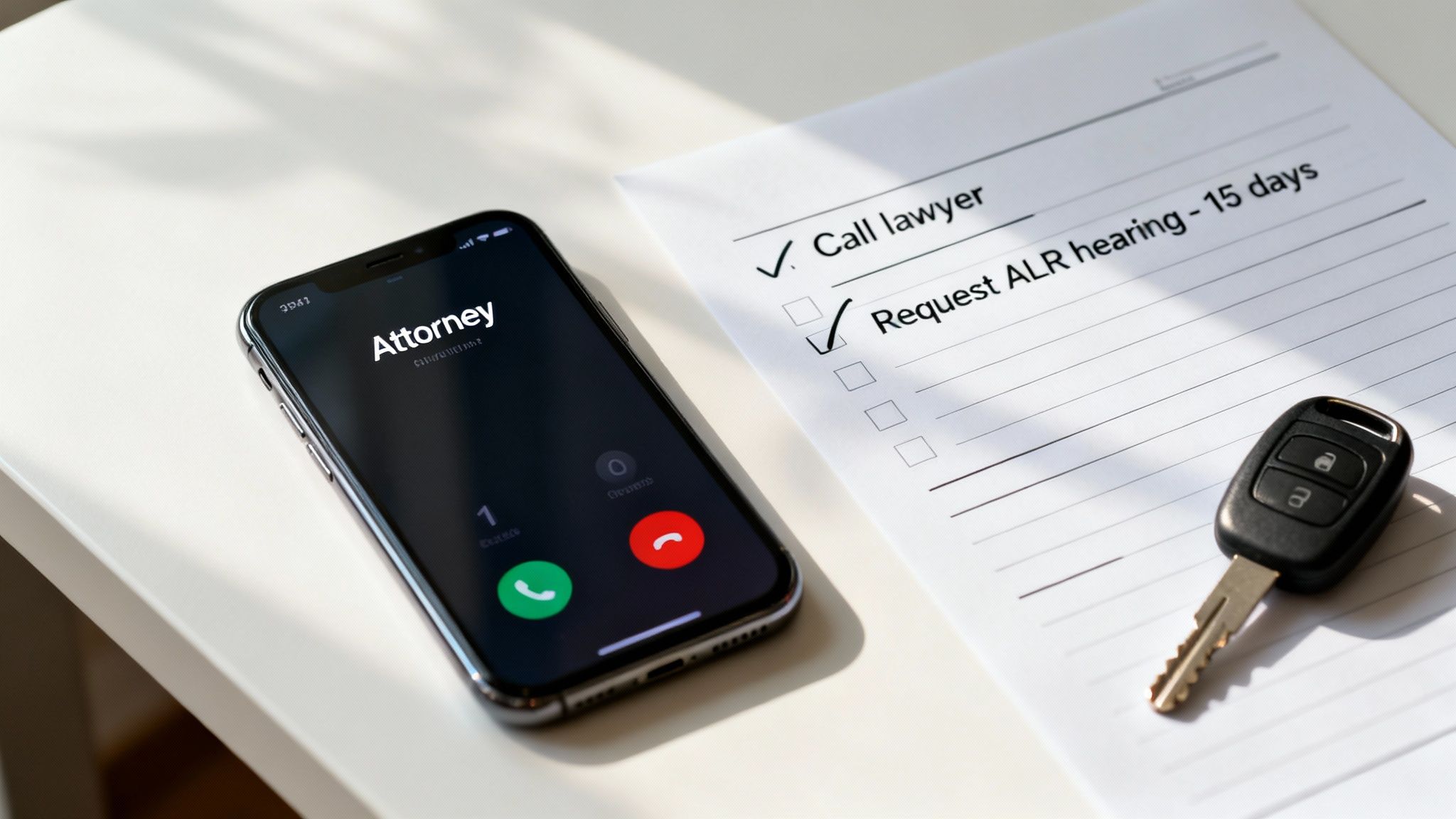
Here's a crucial point: your first priority after release is not the criminal charge itself. It’s a time-sensitive civil matter that can trigger an automatic suspension of your driver's license. This is due to Texas's implied consent law. By accepting a Texas driver's license, you legally agree to provide a breath or blood sample if lawfully arrested for DWI. Refusing that test—or failing it with a BAC of 0.08% or higher—triggers the Administrative License Revocation (ALR) process immediately.
The 15-Day ALR Hearing Deadline
Once arrested, the clock starts ticking. You have only 15 days from the date of your arrest to request an Administrative License Revocation (ALR) hearing. This is, without a doubt, the single most important deadline you'll face.
If you miss this 15-day window, your license will be suspended automatically. The length of this DWI license suspension depends on the situation:
- 90 days for a first-time offense where you failed a chemical test (BAC ≥ 0.08%).
- 180 days for a first-time offense if you refused to provide a sample.
Requesting an ALR hearing puts the automatic suspension on hold. More importantly, it gives your Houston DWI lawyer a powerful early opportunity to question the arresting officer under oath and gather evidence that could be invaluable for your criminal defense. This hearing is a critical first move to fight a DWI in Texas.
Securing Your Release and Preparing for Court
After the arrest, you’ll be booked into jail. To get out, you'll need to post bond, which is a financial promise that you will appear for all future court dates. Your first court appearance is the arraignment, where a judge will formally read the charges against you and you'll enter a plea. It is vital to have legal representation to protect your rights from day one. Your lawyer will almost always advise you to plead "not guilty," which gives them time to review the evidence and start crafting your defense.
Important Takeaway: The legal journey after a DWI arrest is a two-front battle. You have the criminal case in court and the separate civil ALR process to save your license. Both demand immediate, strategic action.
The initial steps you take lay the foundation for your entire defense. You can get more detailed guidance on this crucial period by reading our guide on the essential steps to take after a DUI arrest. By acting fast, you can shift from a defensive posture to an offensive one, protecting your rights, your license, and your future.
How the Stakes Get Higher for Minors and CDL Holders
A DWI or DUI charge is serious for anyone, but the law comes down even harder on certain drivers. For a young person or a commercial driver whose career is on the line, the consequences can be devastating. Understanding how these unique situations are handled is the first step in building a defense to protect what matters most.
The legal landscape for DUI and DWI in Texas isn't one-size-fits-all; an arrest isn't just a legal headache for a minor or CDL holder—it's a direct threat to their future.
The Zero-Tolerance Rule for Minors
Texas has an incredibly strict zero-tolerance policy for drivers under 21. While an adult needs a BAC of 0.08% for a DWI, a minor can be charged with Driving Under the Influence (DUI) for having any detectable amount of alcohol in their system. This means a single drink can lead to life-altering consequences.
A first-offense DUI is a Class C Misdemeanor, with penalties including:
- A driver’s license suspension for 60 to 180 days.
- Mandatory alcohol awareness courses.
- Up to 40 hours of community service.
The real damage, however, is the permanent criminal record, which can create roadblocks to college admissions, scholarships, and future job opportunities. The fight to have these charges dismissed or made eligible for expunction is critical to protecting a young person's future.
Career-Ending Consequences for CDL Holders
For a commercial driver, a DWI isn't just a legal problem—it's a potential career-killer. Commercial Driver's License (CDL) holders are held to a much higher standard, whether they are on the clock or not.
The BAC limit for a CDL holder driving a commercial vehicle is just 0.04%. However, they can still be convicted of a regular DWI at the 0.08% limit even when driving their personal car. A first DWI conviction triggers a mandatory one-year disqualification of their CDL. A second conviction means a lifetime disqualification.
Crucial Takeaway: A DWI charge can literally end a commercial driver's career. With such high standards and severe penalties, an aggressive defense isn't just an option—it's an absolute necessity.
The state's tough stance on impaired driving is backed by sobering statistics. In 2020, data showed that 963 people were killed in alcohol-related crashes in Texas. By 2022, alcohol-impaired fatalities made up a staggering 42% of all traffic deaths in the state. You can read the full TxDOT report on these findings.
DWI Enhancements That Raise the Stakes
Certain factors can elevate a DWI charge to a much more serious level. These "enhancements" can turn a misdemeanor into a felony overnight.
- DWI with a Child Passenger: A DWI with a passenger under the age of 15 automatically enhances the charge to a state jail felony, carrying a potential sentence of up to two years and fines up to $10,000.
- Intoxication Assault: If a DWI leads to an accident that causes serious bodily injury, the charge becomes Intoxication Assault, a third-degree felony.
- Intoxication Manslaughter: If an accident caused by an intoxicated driver results in someone's death, the charge becomes Intoxication Manslaughter, a second-degree felony punishable by up to 20 years in prison.
These enhancements show just how quickly a DWI situation can spiral. An experienced Houston DWI lawyer knows how to challenge the evidence and fight these elevated charges to protect your freedom.
How to Build a Winning Defense Strategy for Your Case
An arrest for a DWI can feel like your world is collapsing, but remember this: an arrest is not a conviction. The State of Texas carries the entire burden of proof, and the case they have against you is often weaker than it first appears. A skilled Texas DWI attorney builds a strategy that empowers you to fight for your future.
A strong defense involves systematically challenging every piece of the state's evidence, starting from the moment the police lights appeared in your rearview mirror.
How to Fight a Breath Test Result
Breath and blood test results that seem definitive can be unreliable. A sharp Houston DWI lawyer will immediately investigate:
- Was the machine calibrated? Breathalyzer machines require regular maintenance and calibration to function properly. Failure to follow state protocols can create a falsely high BAC reading.
- Was the officer certified? The officer who administered the test must have a current certification and follow every procedural step exactly.
- Was there a proper observation period? Before a breath test, the officer must observe you for 15 minutes to ensure you don't burp, vomit, or put anything in your mouth, as these actions can skew the results.
Challenging Field Sobriety Test Results
Field sobriety tests (FSTs) are notoriously subjective coordination and memory exercises, not scientific proof of intoxication. Your performance can be affected by many factors unrelated to alcohol:
- Anxiety, nervousness, or fatigue from the stress of being pulled over.
- Pre-existing medical issues that affect balance or coordination.
- Poor conditions like uneven pavement, bad lighting, or flashing police lights.
- Confusing or incorrect instructions from the arresting officer.
A knowledgeable attorney can highlight these issues to create reasonable doubt about the officer's conclusions.
Contesting the Initial Traffic Stop
Every DWI case starts with a traffic stop. An officer cannot pull you over on a hunch; they must have reasonable suspicion—a specific, articulable reason to believe you have broken a law. If the stop was illegal, any evidence they collect afterward—from FSTs to your breath sample—can be thrown out of court.
Key Insight for Your Defense: You don't have to prove you are innocent. Your lawyer's job is to create reasonable doubt by showing that the state's evidence is flawed, unreliable, or was obtained by violating your constitutional rights.
Successfully fighting a DWI in Texas means leaving no stone unturned. By methodically challenging the legality of the traffic stop, the administration of sobriety tests, and the validity of chemical evidence, you can construct a powerful defense.
Frequently Asked Questions About Texas DWI and DUI Laws
When you're facing a DWI or DUI charge in Texas, questions can feel overwhelming. Getting clear, straightforward answers is your first step toward taking back control.
What are Field Sobriety Tests?
Field sobriety tests (FSTs) are a set of three standardized physical and mental coordination exercises administered by police during a traffic stop to assess impairment. The three standardized tests are the Horizontal Gaze Nystagmus (eye test), the Walk-and-Turn, and the One-Leg Stand. These tests are voluntary, and you have the right to politely decline to perform them.
Can I Refuse a Breathalyzer Test in Texas?
Yes, you have the right to refuse a breathalyzer test. However, this decision has immediate consequences under Texas’s implied consent law. Refusing the test triggers an automatic driver’s license suspension through the Administrative License Revocation (ALR) process. While refusing keeps a key piece of evidence from the prosecution, you face an immediate license suspension that must be fought separately.
What is an Administrative License Suspension?
An Administrative License Revocation (ALR) is a civil penalty separate from your criminal DWI case. It is handled by the Texas Department of Public Safety (DPS) and is triggered when you refuse a chemical test or provide a sample with a BAC of 0.08% or higher. This suspension can happen even if your criminal charges are eventually dropped. You have only 15 days from your arrest to request an ALR hearing to challenge this automatic suspension.
A common question is the difference between a DUI versus DWI in Texas regarding record sealing. While both create a criminal record, the path to expunction or non-disclosure can differ, making experienced legal guidance essential.
Will a DWI Charge Stay on My Record Forever?
A DWI conviction in Texas generally stays on your criminal record permanently. However, you may be eligible to have your record sealed through an order of non-disclosure in certain limited circumstances, typically for a first-time offense where you have successfully completed all terms of your probation. An attorney can review the specifics of your case to see if this is an option to protect your future.
An arrest is a serious event, but it's not the end of the road. At The Law Office of Bryan Fagan, PLLC, we believe in building a strategic defense that protects your rights, your license, and your future. Don't wait to get the answers and the advocacy you deserve. Request your free, confidential case evaluation today by visiting us at The Texas DUI Law Firm.

