
A DWI arrest can be overwhelming—but you don’t have to face it alone. It's confusing, stressful, and easy to feel like you've already lost. But here's the most important thing to remember: an arrest is not a conviction.
The decisions you make in the hours and days that follow are absolutely critical. They can change the entire outcome of your case. It's time to stop feeling overwhelmed and start taking smart, strategic steps to protect your rights and your future.
What to Do After a DWI Arrest in Texas
A DWI arrest can make you feel powerless, but you can—and should—start taking control of the situation right away. Every action you take, from the moment the police lights flash in your rearview mirror to the day you're released, matters.
Understanding what's happening is the key to navigating it all and building a strong defense from day one. Let's shift from a place of anxiety to a position of action.

Protect Your Rights During and After the Arrest
From the second you're pulled over, it’s vital to stay calm and respectful. But that doesn't mean giving up your rights. You're required to provide your driver's license, registration, and proof of insurance. That's it.
You are not required to answer questions like "Where are you coming from?" or "Have you been drinking tonight?". It's your constitutional right to politely decline to answer questions that could incriminate you.
The same goes for the Standardized Field Sobriety Tests (SFSTs)—the walk-and-turn, one-leg stand, and eye test. These tests are notoriously subjective and often difficult for even a perfectly sober person to pass under pressure. You can refuse them.
The most powerful tools you have are your right to remain silent and your right to an attorney. Using them early is the first critical step in building your defense.
The Urgent 15-Day Deadline for Your License
Once you're released, a very important clock starts ticking. After a DWI arrest in Texas, you have only 15 days to request an Administrative License Revocation (ALR) hearing.
This isn't part of your criminal case; it's a separate civil process where the Texas Department of Public Safety (DPS) tries to suspend your driver's license. If you miss that 15-day window, your license is automatically suspended. No exceptions.
But this hearing is more than just a chance to save your license. It's a golden opportunity for your attorney to:
- Get an early look at the evidence the state has against you.
- Question the arresting officer under oath.
- Pinpoint weaknesses in the prosecution's case long before you ever step into a criminal courtroom.
This deadline is absolute and unforgiving, so you have to act fast. You can learn more about this crucial first battle by reading up on the Administrative License Revocation process in Texas and seeing how an experienced lawyer can fight for you.
Securing Your Release and Seeking Legal Counsel
After the arrest, you’ll be taken to a local jail for booking. This is the standard procedure: fingerprints, mugshot, and your information being entered into the system. To get out, you'll need to post bond, which is simply a financial guarantee that you'll show up for your future court dates.
As soon as you are released, your number one priority should be calling a skilled Houston DWI lawyer. The sooner an attorney gets involved, the better. They can work to preserve evidence, find and speak with witnesses, and start crafting a defense strategy built around the specific facts of your case.
Don't make the mistake of waiting for your first court date to get help. The right Texas DUI attorney can provide the clarity and strategic guidance you need to face this challenge with confidence.
Understanding Texas DWI and DUI Laws
In Texas, people often use the terms DWI and DUI interchangeably, but under the law, they are two different offenses with their own rules and consequences. Knowing which charge you're facing is the first step in building an effective defense.
Once you understand the law, the legal maze starts to feel less intimidating. Let's break down exactly what these terms mean and how the laws behind them operate.
DWI: Driving While Intoxicated
Driving While Intoxicated (DWI) is the charge most adults in Texas face. According to the Texas Penal Code § 49.04, you’ve committed a DWI if you are operating a motor vehicle in a public place while you are legally intoxicated.
So what does "intoxicated" actually mean in a courtroom? The state has two ways to prove it:
- Per Se Intoxication: This is based on your Blood Alcohol Concentration (BAC). If a chemical test shows your BAC is 0.08% or higher, you are considered legally intoxicated, regardless of how you felt or drove.
- Impairment: This definition is more subjective. You can be charged with a DWI even if your BAC is below0.08%. If the state can argue that you’ve lost the normal use of your mental or physical faculties due to alcohol or drugs, that’s enough to file a DWI charge.
A first-time DWI in Texas is a serious matter, typically charged as a Class B Misdemeanor with significant penalties.
DUI: Driving Under the Influence
In Texas, a Driving Under the Influence (DUI) charge is exclusively for minors—anyone under the age of 21. Texas has a zero-tolerance policy for underage drinking and driving.
This means a minor can be charged with a DUI for driving with any detectable amount of alcohol in their system. The prosecutor doesn't need to prove impairment or a specific BAC level. The mere presence of alcohol is enough for a DUI charge, which is a Class C Misdemeanor for a first offense. Our comprehensive Texas DUI laws guide digs deeper into the specifics of these laws.
The Implied Consent Law
Another critical piece of Texas law is "implied consent." By accepting a Texas driver's license, you have automatically agreed to provide a breath or blood sample if lawfully arrested for a DWI.
You still have the right to refuse a chemical test, but this refusal has immediate consequences. The main one is an Administrative License Suspension. For a first-time refusal, your license will be suspended for 180 days.
Refusing a chemical test triggers an automatic license suspension, a civil process separate from your criminal DWI case. That's why requesting an ALR hearing within 15 days is so critical—it's your only opportunity to fight that immediate suspension.
Texas law enforcement and prosecutors pursue these cases aggressively, and the statistics show why. A 2023 report revealed that Texas is the third worst state for drunk driving, with a shocking 42.37% of all traffic fatalities involving an intoxicated driver. This data explains the state's hardline stance and why having a knowledgeable Houston DWI lawyer in your corner is essential to navigate such a high-stakes situation.
Navigating the Criminal and Administrative Processes
Getting arrested for a DWI in Texas doesn't just start one legal battle—it starts two. You are suddenly facing both a criminal charge and a separate administrative action against your driver’s license.
The criminal case is handled in court and could lead to jail time, fines, and a criminal record. At the same time, the Texas Department of Public Safety (DPS) begins a fast-moving process to suspend your driver's license.
Understanding how both of these work is crucial. They have different rules, goals, and timelines, and the outcome of one can impact the other. An experienced Texas DUI attorney knows how to manage both fronts simultaneously, building a defense that protects not just your freedom, but your ability to drive.
The infographic below breaks down the critical differences between a DWI charge for an adult and a DUI charge for a minor.
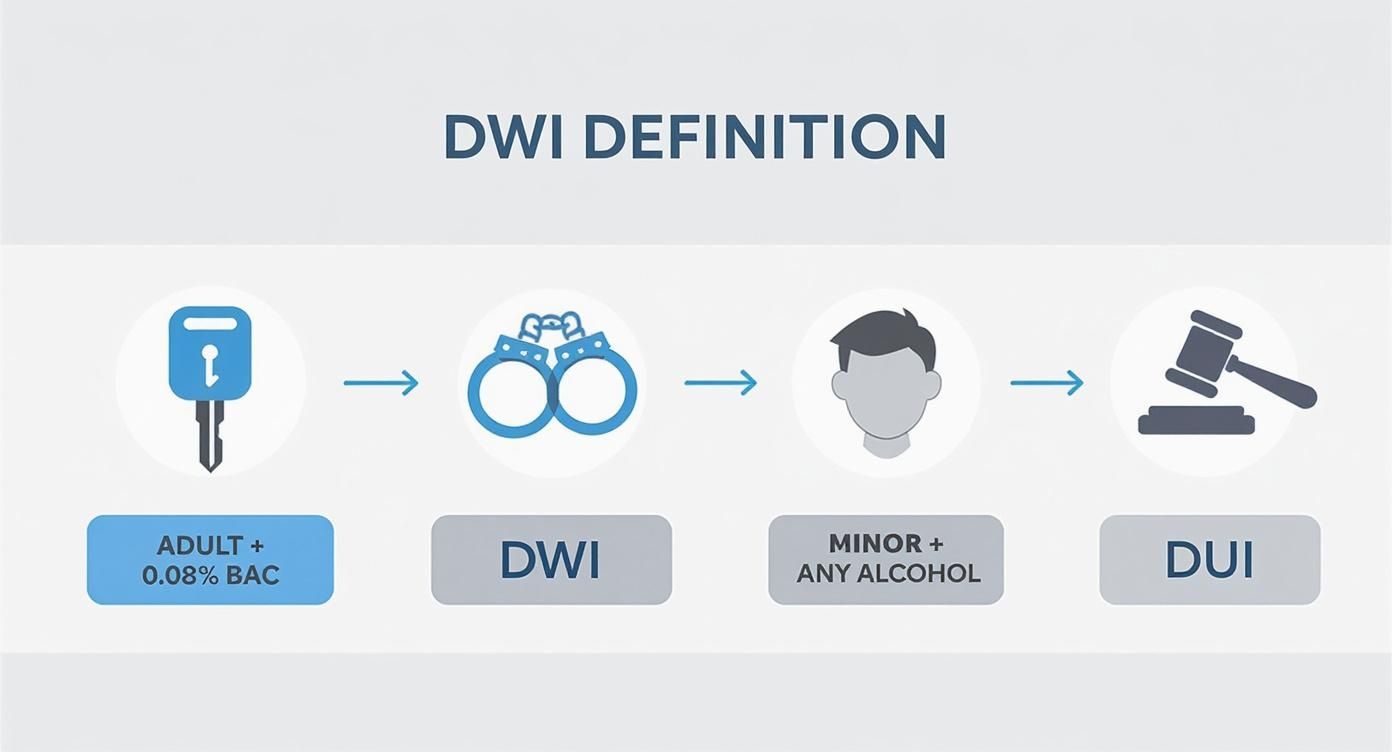
As you can see, the legal standard is worlds apart. Adults face a 0.08% BAC threshold, while for minors, it’s any detectable amount of alcohol.
The Administrative License Revocation (ALR) Hearing
Your first and most time-sensitive fight is the administrative one. After a DWI arrest, you have a strict 15-day deadline to request an Administrative License Revocation (ALR) hearing. If you miss this tiny window, your license gets suspended automatically.
This hearing is your one and only shot to stop that automatic DWI license suspension. But it’s so much more than that—it's a massive strategic advantage. The ALR hearing gives your lawyer the first chance to:
- Challenge whether the officer had a legal reason to pull you over.
- Question the arresting officer under oath, locking them into their story.
- Get a sneak peek at the evidence the state will try to use against you in the criminal case.
Winning the ALR hearing can save your license and provide priceless intelligence for your criminal defense. It's the first battleground where you can proactively fight your DWI in Texas.
An ALR hearing is far more than just a fight for your license. It's a critical early opportunity to gather information, lock the arresting officer into their story, and expose weaknesses in the prosecution's case before your criminal trial even begins.
The Criminal Court Process
While the ALR process is playing out, your criminal case moves along its own, usually slower, path. This journey is much longer and more complicated, involving several key stages where your rights need to be fiercely protected.
1. Arraignment
This is your first official court appearance. The judge reads the charges against you, and you enter a plea—almost always "not guilty" at this stage. This is also when the judge sets or reviews your bond conditions, which might include things like installing an ignition interlock device on your car.
2. Pre-Trial Phase
This is where the real legal work happens. Your attorney will request all of the state's evidence—police reports, breathalyzer logs, body cam videos, and more. Then, they will file motions to challenge that evidence. For example, a "motion to suppress" could argue that the breath test results shouldn't be allowed in court because the machine wasn't properly calibrated.
3. Plea Negotiations or Trial
Depending on the strength of the evidence, your case might be resolved with a plea agreement or go to trial. A favorable plea bargain could mean reducing the charge or avoiding jail time. But if the prosecutor isn't offering a fair deal, your case will be presented to a judge or jury, where the state must prove its case beyond a reasonable doubt.
Every single step in these parallel processes is a chance for a skilled Houston DWI lawyer to make a real difference. From that urgent 15-day ALR deadline to the complex pre-trial motions, having a strategic advocate in your corner is your absolute best defense.
Potential Penalties for a First-Time DWI
Knowing what’s at stake is the first step in building a powerful defense. If you're facing a first DWI in Texas, the charge is typically a Class B Misdemeanor. While that might not sound like the most serious crime, the consequences can disrupt your life, your finances, and your freedom.
Our goal is not to scare you, but to be clear about what you're up against. Understanding these potential penalties makes it obvious why a strategic legal defense isn't a luxury—it's a necessity. An experienced DWI lawyer can work to minimize these outcomes or, in the best-case scenario, have them thrown out completely.
Criminal Penalties Explained
For a standard first-time DWI, Texas law lays out a specific range of penalties. These are the direct consequences handed down by a criminal court if you are convicted.
The penalties that get the most attention are jail time and fines, which can put an immediate and heavy strain on your family and your job.
To give you a clear picture, here's a quick summary of the statutory penalties for a standard first-offense DWI.
Texas First DWI Penalties at a Glance (Class B Misdemeanor)
| Penalty Type | Minimum Penalty | Maximum Penalty |
|---|---|---|
| Jail Time | 72 Hours | 180 Days |
| Fines | Up to $0 | Up to $2,000 |
| License Suspension | 90 Days | 1 Year |
It’s crucial to see these numbers for what they are: the bookends. A skilled attorney’s job is to fight to keep you on the absolute lowest end of this spectrum—or better yet, get the charges dismissed so these numbers don't apply at all. You can learn more about what to expect in our comprehensive guide to a first DUI offense in Texas.
Beyond Fines and Jail Time
The court-ordered penalties don't stop with a fine and a possible jail sentence. A conviction for a DWI in Texas brings a whole host of other requirements that can impact your daily life for months, or even years, after your case is officially closed. These are often called "conditions of probation."
Think of these as the long-term consequences. They are designed to be both educational and preventative, but they are also incredibly time-consuming and expensive.
Common additional penalties often include:
- DWI Education Program: You will almost certainly be ordered to complete a 12-hour class focused on the risks of drinking and driving.
- Community Service: The court can order anywhere from 24 to 100 hours of community service.
- Ignition Interlock Device (IID): This is a device installed in your car that requires a clean breath sample before the engine will start. It can be ordered as a condition of your bond or as part of your probation.
- Probation: You may be placed on community supervision (probation) for up to two years. This means regular check-ins with a probation officer and a long list of strict rules you must follow to the letter.
A DWI conviction is more than a one-time event; it's a long-term burden. The penalties are designed to follow you, impacting your time, your finances, and your freedom of movement long after you leave the courtroom.
The state of Texas is particularly aggressive in prosecuting these cases, and for good reason. According to the National Highway Traffic Safety Administration (NHTSA), in 2022, Texas saw a staggering 42% of its traffic fatalities linked to alcohol-impaired driving—one of the highest rates in the nation. You can explore more of these national traffic safety statistics on the NHTSA's website. This sobering reality is why prosecutors push for serious penalties, and it’s why your defense must be equally serious and strategic.
How to Fight a Breath Test Result
A DWI arrest can feel like the end of the road. In reality, it’s often just the beginning of your defense. The prosecution's case might look solid on the surface, but it's built on a long chain of procedures that must be followed perfectly. Any mistake the police make or any violation of your rights can create an opening to challenge the entire case against you.
The key is to remember that an accusation is not a conviction. A skilled Texas DUI attorney will meticulously deconstruct every single moment—from the initial traffic stop to the final chemical test—to find the weak links that can lead to a positive outcome.
Challenging the Initial Traffic Stop
The foundation of any DWI case is the traffic stop itself. A police officer can't just pull you over on a hunch; they must have reasonable suspicion that you've committed a traffic violation. This is a crucial legal standard that protects every driver from random and unwarranted stops.
If the officer can't clearly state a legitimate reason for pulling you over—like speeding, swerving, or even just a broken taillight—any evidence collected afterward could be thrown out of court. An experienced Houston DWI lawyer will immediately scrutinize the police report and any available dashcam or bodycam footage to see if your constitutional rights were violated from the very start.
Scrutinizing Field Sobriety and Chemical Tests
The evidence used to prove you were intoxicated is rarely as foolproof as it seems. Both Field Sobriety Tests (FSTs) and chemical tests (like breath or blood) are notoriously prone to errors in how they're administered and interpreted. This is a major area where a strong defense can be built.
- Field Sobriety Tests: These tests are incredibly subjective. Things like nervousness, physical limitations, poor lighting, or even just an uneven patch of road can cause a completely sober person to "fail." Your attorney can argue that these tests are not a reliable measure of impairment at all.
- Breath Tests: Breathalyzer machines aren't magic. They require precise calibration and regular maintenance to work correctly. If the police department's records show the device wasn't properly cared for, or if the officer who gave you the test wasn't certified, the results can be challenged and potentially suppressed.
- Blood Tests: A blood test might seem scientific and undeniable, but it's vulnerable to human error every step of the way. Issues like improper storage of the blood sample, contamination in the lab, or a broken chain of custody (the documented trail of everyone who handled the sample) can make the results completely invalid.
The prosecution's case is a chain, and every single link—from the reason for the stop to the handling of a blood sample—must be legally sound. A single broken link can cause the entire case against you to fall apart.
Uncovering Alternative Explanations
Sometimes, what looks like intoxication has another explanation entirely. A knowledgeable attorney will explore every possibility to show the court that your behavior or test results weren't actually caused by alcohol.
Certain medical conditions, for instance, can mimic the signs of intoxication or even throw off a breathalyzer. Conditions like diabetes can cause a person's breath to smell like alcohol or make them perform poorly on coordination tests. On top of that, some diets, like a low-carb or keto diet, cause the body to produce acetones that breathalyzers can mistake for ethyl alcohol.
By presenting these alternative explanations, backed up by medical records or expert testimony, your attorney can introduce that all-important reasonable doubt.
Negotiating for a Favorable Outcome
Even when the evidence seems strong, a skilled negotiator can often secure a much better result than a conviction. Your attorney can use the weaknesses in the prosecution's case as leverage to negotiate for a charge reduction, like getting a DWI knocked down to a lesser offense like Obstruction of a Highway.
In other situations, it might be possible to negotiate for deferred adjudication. This is a special kind of probation that, if you complete it successfully, results in the case being dismissed and allows you to petition for non-disclosure later.
The goal is always to fight the DWI in Texas to protect your record and your future. A proactive, strategic defense is your best tool to make that happen.
Take the Next Step to Protect Your Future
Facing a DWI charge feels overwhelming. It’s easy to feel lost, but the single most important thing you can do right now is get an experienced legal guide in your corner. You don't have to navigate this alone.
At The Law Office of Bryan Fagan, PLLC, we’re committed to defending the rights of Texans just like you. Our approach isn't just about showing up to court—it's about strategically protecting your freedom and working to minimize the long-term fallout of a DUI in Texas.
We dig into every piece of evidence, from the initial traffic stop to the chemical test results, to find the weaknesses in the prosecution's case and build the strongest possible defense for you.
The stakes couldn't be higher. In 2016, Texas reported 987 deaths caused by intoxicated drivers, and cities like Houston saw nearly 1,500 DUI-related crashes. You can learn more about Texas DUI statistics to see why the state prosecutes these cases so aggressively.
Don't let uncertainty and fear dictate what happens next. We invite you to request a free, confidential consultation to talk through your situation. Let our dedicated team of Houston DWI lawyers provide the expert defense you need to move forward with confidence and fight for your future.
Common Questions About Texas DUI Cases
When you’re facing a DWI charge, your mind is probably racing with questions. The whole legal system can feel overwhelming and confusing, but getting clear, direct answers is the first step toward getting back some sense of control. Let's break down some of the most common questions we hear from people in your exact situation.
Can a DUI Charge Be Dismissed in Texas?
Yes, absolutely. An arrest is not a conviction, and it's entirely possible to get a DUI in Texas dismissed. The prosecutor's case has to be strong enough to stand up to intense legal scrutiny, and often, it isn't.
A dismissal can happen for all sorts of reasons. For example, if your Houston DWI lawyer can prove the initial traffic stop was illegal—meaning the officer had no valid reason to pull you over in the first place—any evidence they gathered after that can be thrown out. Challenges to the accuracy of a breathalyzer or the way field sobriety tests were administered can also poke holes in the case, often leading to a dismissal or a major reduction in the charges.
Will I Definitely Lose My License After a First DWI?
Losing your license is a serious risk, but it’s not an automatic guarantee. Before the state can suspend your license, they have to go through a completely separate legal process, and you have every right to fight it. This is where the Administrative License Revocation (ALR) hearing comes in.
But there’s a catch: you only have 15 days from the date of your arrest to request this hearing. It's a critical deadline. If you win the hearing, you can stop the administrative DWI license suspension in its tracks. This is often your first real chance to challenge the evidence against you.
Remember, the criminal case and the license suspension case are two separate battles. Winning the ALR hearing can save your driving privileges even while your criminal case is still ongoing.
Am I Required to Perform Field Sobriety Tests?
No, you are not legally required to take the Standardized Field Sobriety Tests (SFSTs) in Texas. Think about it—tests like the walk-and-turn or the one-leg stand are highly subjective and notoriously difficult to perform perfectly, even for someone who is completely sober.
You have the right to politely say no. Keep in mind, however, that refusing a chemical test (like a breath or blood test) is a different story. That refusal carries its own set of consequences under Texas's implied consent law, including an automatic license suspension that you'll have to fight at an ALR hearing.
Can I Get a DWI on Private Property?
This is a common misconception that gets a lot of people in trouble. The law says you can be charged with a DWI for operating a motor vehicle in a "public place." The key here is that courts have interpreted "public place" very broadly, and it often includes private property that the public can access.
This means you can absolutely be charged with a DWI in places like:
- A shopping center parking lot
- A friend's driveway
- An apartment complex parking area
If the public can get to it, it can be considered a public place for DWI purposes. Never assume you're safe from arrest just because you aren't on a public road. A skilled Texas DUI attorney can dig into the specifics of your case to see if this is an issue they can defend.
How Much Does a DWI Lawyer Cost?
The cost of hiring a good lawyer can vary quite a bit. It really depends on how complex your case is, the attorney's experience level, and whether your case ends up going to a full trial. While it's certainly an investment, the long-term financial hit from a conviction—fines, court costs, skyrocketing insurance premiums, and even losing your job—is almost always far, far greater.
Many highly-qualified DWI attorneys offer a free initial consultation. This is your chance to sit down, talk through the details of your arrest, understand your legal options, and get a clear picture of what it would cost to build a strong defense to fight your DWI in Texas.
A DWI charge can feel like an impossible weight, but you don't have to carry it alone. At the Law Office of Bryan Fagan, PLLC, our team is dedicated to providing the strategic, assertive defense you need to protect your rights and your future. We offer a free, no-obligation case evaluation to help you understand your options and take the first step forward with confidence. Contact us today to schedule your free consultation.