If you’re on probation for a DWI in Texas, you’re likely focused on one specific requirement: the drug test for probation. A DWI arrest can be overwhelming, and probation can feel like you’re constantly walking on eggshells. Understanding how the testing process works is the first step to successfully completing your term and moving forward with your life.
Facing this can be stressful, but you don’t have to face it alone. Let's break down exactly what to expect so you can complete your probation and finally move on.
Probation Drug Testing in Texas at a Glance
Here is a quick overview of what you can expect with probation drug testing. This table summarizes the key aspects we will explore in detail throughout this guide.
| Key Aspect | What It Means for You |
|---|---|
| Purpose | To verify sobriety and ensure you're following court orders. |
| Frequency | Can be random or scheduled, depending on your probation officer. |
| Types of Tests | Urine tests are most common, but hair, blood, or saliva may be used. |
| Consequences | A failed test can lead to a probation violation, jail time, or stricter conditions. |
| Your Rights | You have the right to challenge results and ensure proper procedures are followed. |
Knowing these basics is a great start. Now, let’s dig into the details of what this all means for your case.
Understanding Probation and Drug Testing in Texas
A DWI arrest can be overwhelming, but the probation that follows can feel like a whole new battle. One of the most common conditions you’ll face is mandatory drug and alcohol testing. While it’s easy to see these tests as punitive, from the court's perspective, they serve as a critical tool to monitor your compliance and support your rehabilitation.
When a judge sentences you to community supervision (probation), they are giving you a set of rules to follow to stay out of jail. For a DWI, that list is almost always topped by a strict rule: no alcohol or illegal drugs. A drug test for probation is the primary way your probation officer ensures you’re holding up your end of the deal.
This isn’t unique to Texas; it’s a core part of how the criminal justice system handles substance-related offenses nationwide. As courts aim to manage cases and ensure public safety, systematic testing has become a standard practice to verify sobriety.
Probation can feel like walking a tightrope, where one mistake could have serious consequences. But it doesn’t have to be a source of constant anxiety. By viewing these tests as checkpoints on your path forward, you can take control of the process. The key is knowing exactly what’s required of you—and what your rights are.
Here are the reasons Texas courts demand drug testing during probation:
- Verify Sobriety: This is the most straightforward reason. The court needs to know you’re not using alcohol or illegal substances as ordered.
- Enforce Court Orders: Testing isn’t optional; it’s how the judge’s sentence is enforced. Clean tests prove you’re taking the rules seriously.
- Support Rehabilitation: For individuals working to overcome substance use, regular testing can be a powerful motivator to stay clean and on track.
- Assess Risk: Probation officers use your test results to decide if you need more hands-on supervision or should be enrolled in additional treatment programs.
Understanding the legal "why" behind these tests is your first powerful move. The rules may seem rigid, but they are manageable once you know what to expect. Whether you're on standard community supervision or are exploring options like deferred adjudication, understanding the testing process will empower you to navigate it without stumbling. A Houston DWI lawyer can be your best ally on this journey, making sure your rights are protected every step of the way.
Common Probation Drug Testing Methods Explained
If you’re on probation in Texas, facing a drug test can be one of the most stressful parts of the process. The uncertainty of what kind of test it will be and how far back it can detect a substance can be unnerving. Much of that anxiety comes from not understanding the tools your probation officer has at their disposal.
Think of it this way: some tests are like a snapshot, capturing only what you did in the last day or two. Others are like a detailed diary, creating a historical record that can go back months. Knowing the difference is the first step to navigating the system with confidence. The most common methods you’ll encounter are urine, hair, blood, and saliva tests. Each one tells a different story.
The goal of this process, from the court's perspective, is to ensure you're staying sober and on the right track.
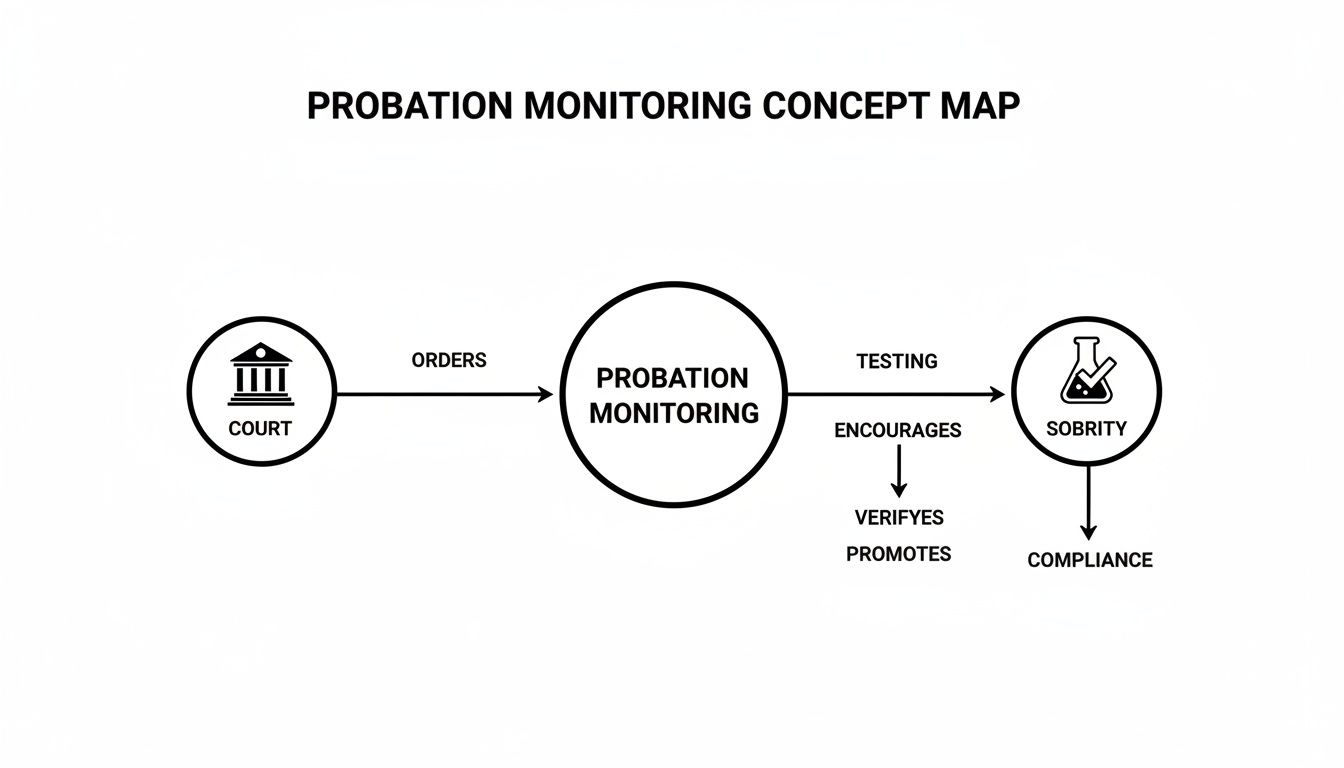
As you can see, testing is the bridge between the judge's orders and the goal of verified sobriety. It’s how the system holds you accountable.
Urine Tests (Urinalysis)
This is the most common type of test you're likely to encounter. A urine test, or urinalysis, is the workhorse of probation drug screening in Texas because it's cost-effective, easy to administer, and screens for a wide range of substances.
The process is typically two-fold. First, your sample goes through a quick initial screening. If it flags a positive result, it doesn’t stop there. The lab then runs a more precise confirmation test—typically a gas chromatography-mass spectrometry (GC-MS) test—to ensure the result is accurate and not a false positive.
- Detection Window: Usually 3 to 7 days for most substances. For heavy, chronic marijuana users, that window can stretch to 30 days or more.
- What It Detects: Alcohol, marijuana (THC), cocaine, opiates, amphetamines, benzodiazepines, and many others.
- Reliability: Very reliable, especially after a GC-MS test confirms an initial positive screen.
Hair Follicle Tests
Hair tests are less common for routine check-ins, mainly because they are more expensive. However, when a judge or probation officer wants a broader overview, this is the test they turn to. It provides a long-term lookback, making it a powerful tool for checking long-term compliance or establishing a baseline at the start of probation.
A hair test won’t show if you had a drink last night. It takes about 7-10 days for substances to grow out from the scalp into the hair shaft. Instead, it creates a 90-day historical record, which is why it’s used to spot patterns of use over time, not immediate impairment.
This method is incredibly accurate and almost impossible to cheat. A standard test takes a small sample of hair (about 1.5 inches) from your scalp, where drug metabolites have become embedded in the hair itself.
Saliva and Blood Tests
You are less likely to encounter saliva or blood tests for regular probation monitoring, but they have their own specific and important uses.
Saliva Tests:
These are all about a very recent "snapshot." Because they are simple to administer on the spot, they are perfect for checking for immediate use.
- Detection Window: Extremely short, usually just 24 to 48 hours for most drugs.
- Use Case: Often used by law enforcement during a traffic stop or by a probation officer who suspects very recent use.
Blood Tests:
Blood tests are the most invasive and expensive, but they are the gold standard for proving current impairment.
- Detection Window: The shortest of all, often just a few hours and rarely more than a day.
- Use Case: Almost exclusively used right after an incident, like a DWI arrest, to measure your exact Blood Alcohol Concentration (BAC) or confirm the presence of drugs in your system at that moment.
The technology behind drug screening has given probation departments a wide range of options to monitor compliance. For anyone on probation in Texas, this means you need to be prepared for any type of test. Facing one of these tests is intimidating, but a skilled Houston DWI lawyer can help you understand the science, protect your rights, and challenge any results that seem inaccurate.
Navigating the Drug Testing Process Step by Step
Showing up for a probation drug test can be incredibly nerve-wracking. Knowing what’s coming can make all the difference, transforming that feeling of intimidation into a sense of control. The procedure isn’t random; it follows a strict protocol designed to be fair and accurate.
Understanding exactly how it works, from the moment you get the call to the second your sample is sealed, is your best tool. It empowers you to know your rights and, more importantly, to spot when something isn't being done by the book.
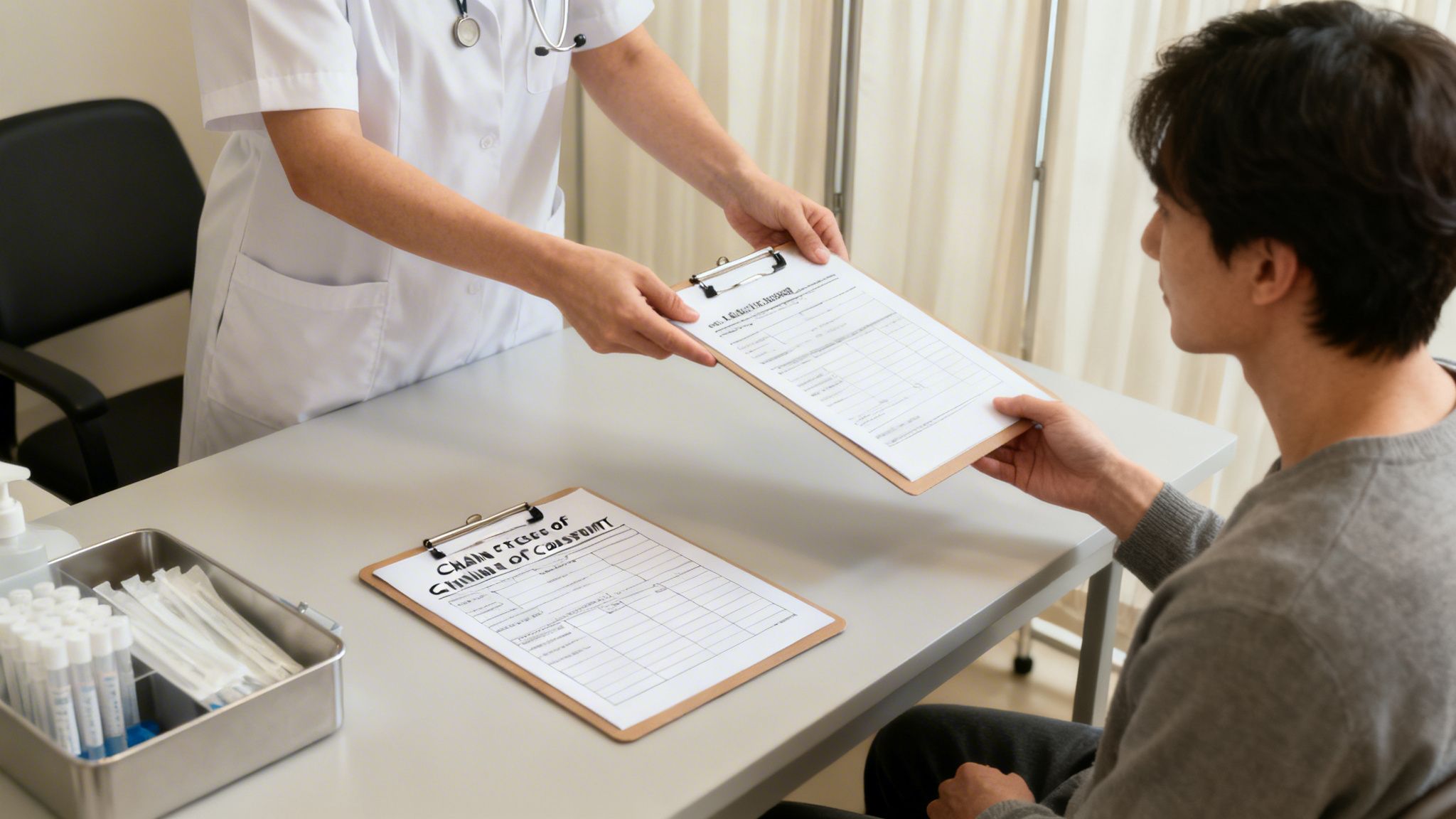
Every single step is documented. This isn’t just to protect the lab; it’s meant to protect you, too. Let’s walk through what you should expect on testing day.
The Notification and Arrival
Your probation officer can order a test in one of two ways: either on a fixed schedule or completely at random. For random tests, you’ll likely have to call a hotline or check a website every day to see if your color or number is called.
Once you’re notified, the clock starts ticking. You will have a very strict window to get to the designated testing facility. When you arrive, you’ll check in and need to show a valid photo ID.
Be on time and have your ID ready. Failing to show up for a required drug test for probation is almost always treated as a positive test, which will land you in hot water with a probation violation.
The Collection Procedure
The actual collection is a highly regulated process. While there are several types of tests, a urine test is by far the most common, and its procedure is built to prevent any form of cheating while respecting your privacy as much as possible.
Here’s what that typically looks like:
- Preparation: You will be instructed to wash your hands. You won’t be allowed to bring anything with you into the collection area—no coats, bags, or purses.
- Observation: A collection technician of the same gender will physically watch you provide the sample. Yes, it’s awkward, but this direct observation is a standard measure to make sure the sample is yours and hasn't been substituted or tampered with.
- Temperature Check: Immediately after you hand over the cup, the technician will check the sample’s temperature. This is another anti-tampering step to confirm it’s a fresh sample within the normal body temperature range.
While direct observation is standard, you still have a right to a reasonably private setting. The process should be professional and respectful. If you feel harassed or that procedures are not being followed correctly, it is crucial to document it and inform your attorney immediately.
Understanding the Chain of Custody
After you’ve provided the sample, the single most critical part of the process begins: securing the chain of custody.
Think of it as a documented paper trail that follows your sample from the moment it leaves your body until the lab reports the final result. Every single person who touches that sample has to sign off on it, creating an unbroken log.
This process is your primary shield against a sample getting mixed up, contaminated, or tampered with. A proper chain of custody form has to include:
- Your name and identifying information
- The exact date and time of collection
- The signature of the technician who collected the sample
- The signature of every person who transports or analyzes the sample
Any break, missing signature, or inconsistency in this chain can be a powerful defense. An experienced attorney knows exactly how to dissect this documentation, looking for the kinds of errors that could get a test result thrown out. If you're facing a potential probation violation, defending your rights starts with making sure every step of this process was handled perfectly.
What Happens After a Failed Probation Drug Test
Let's address your biggest concern: what happens if you fail a drug test for probation? The moment you get that call, it’s natural to feel a wave of panic. But right now, you need to think strategically, not emotionally. Take a deep breath. A positive test is serious, but it is not an automatic trip to jail. It’s the start of a legal process—and you have rights.
The first move isn't yours; it's your probation officer's. They will likely file a formal document with the court called a Motion to Revoke Probation (MTRP). This motion is the State’s official request to the judge, asking to end your probation and enforce the original sentence, which almost always involves jail time. The MTRP claims you broke the rules of your supervision.
Once that motion is filed, the court will likely issue a warrant for your arrest, and a hearing will be scheduled. This hearing is your opportunity to present a defense. It isn't a new trial where the state must prove its case "beyond a reasonable doubt." Instead, the prosecutor's job is much easier. They only have to prove by a "preponderance of the evidence" that you likely violated your probation.
Understanding the Probation Violation Hearing
This hearing is where everything is on the line. The judge will hear evidence from the prosecutor and your defense attorney. The prosecutor's main piece of evidence will be the failed drug test, presented as proof that you violated the rules.
Your lawyer’s job is to challenge that evidence and build a strong case for why you deserve to remain on probation. This is not a battle you want to fight alone. The rules of evidence are complex, and a skilled attorney knows how to use them to protect you.
The court's strict stance on compliance is influenced by public safety concerns. Judges in Texas and elsewhere rely heavily on drug testing to monitor individuals in the justice system, and a violation is seen as a serious breach of the court's trust.
Potential Outcomes After a Failed Test
At the hearing, the judge has several options. The final decision depends on the specific facts of your case, your track record on probation, and how effectively your attorney argues on your behalf.
The judge’s options include:
- Dismissing the Motion: Your attorney might successfully show the test was unreliable or that the violation isn't serious enough to justify revocation. If the judge is convinced, the MTRP is dismissed, and you continue on probation.
- Continuing Probation: The judge could decide to give you another chance, continuing your probation exactly as it was before.
- Modifying Probation: This is a very common outcome. The judge might keep you on probation but add new, tougher conditions. This could mean more frequent drug tests, mandatory rehab or counseling, or stricter check-ins.
- Revoking Probation: This is the worst-case scenario. If the judge revokes your probation, they can order you to serve the original jail or prison sentence that was suspended.
An experienced attorney can challenge a failed test in several ways. The table below shows common defense strategies that can protect your freedom and future.
Potential Defenses for a Failed Probation Drug Test
| Defense Strategy | How It Works | Example |
|---|---|---|
| Challenge the Chain of Custody | The prosecutor must prove the sample was properly collected, sealed, and transported. Any break in this chain can get the result thrown out. | Your lawyer shows the lab's paperwork has missing signatures, making it impossible to prove the sample is yours. |
| Contest the Test's Accuracy | No drug test is 100% perfect. False positives can be caused by prescription medications, certain foods, or even technical errors at the lab. | You provide medical records showing you were taking a prescription drug known to cause a false positive for an illicit substance. |
| Argue Unintentional Ingestion | This defense claims you consumed a substance without knowing it. While difficult to prove, it can be effective in some unique circumstances. | You prove you were at a party where you unknowingly drank from a spiked punch bowl. |
| Demonstrate Rehabilitation | You can present evidence that you're taking your sobriety seriously through proactive steps, showing the judge you're a good risk. | You provide certificates from a voluntary substance abuse program you enrolled in before the hearing. |
A failed drug test for probation is a major legal hurdle, but it's one you can overcome with a smart defense.
For a deeper look at what to expect in the courtroom, you should read our detailed guide on DWI probation violation hearings in Texas. Your future is too important to leave anything to chance.
How a Texas DWI Lawyer Can Build Your Defense
Facing a failed drug test for probation can make you feel like your freedom is slipping away. The prosecutor will hold up that positive result as undeniable proof, pushing the judge to revoke your probation and send you to jail. But an experienced DWI defense attorney knows a lab report isn't the end of the story—it's just the beginning of our investigation.
Our job is to be your advocate, and that means we don't take the state's evidence at face value. A positive test is just one piece of evidence, and like any evidence, it can be flawed, misinterpreted, or mishandled. We approach this by strategically deconstructing the state's case, piece by piece, to protect your freedom.

Investigating the Chain of Custody
Often, the most powerful defense lies in what's called the "chain of custody." This is the documented paper trail that tracks your sample from the collection cup to the final lab report. For that result to be valid, the chain must be unbroken, proving the sample tested was yours and wasn't contaminated or switched.
We meticulously comb through this paperwork, looking for any error, no matter how small.
- Missing Signatures: Did every single person who handled the sample sign and date the log? A missing signature creates a gap in the timeline and makes the evidence unreliable.
- Improper Sealing: Was your sample sealed correctly with a tamper-evident seal right in front of you? If not, its integrity is questionable from the very start.
- Unexplained Delays: Long, unaccounted-for gaps between collection and testing raise serious questions about how and where that sample was stored.
A single break in the chain of custody can be enough to get a test result thrown out entirely.
Challenging the Scientific Accuracy of the Test
No test is perfect. Both the initial screenings and the more specific confirmation tests can produce errors, and a skilled attorney knows how to challenge the science behind the result.
Your defense isn't just about what happened; it's about what the science can actually prove. We work to show the court that a number on a lab report doesn't automatically equal guilt.
We immediately investigate potential causes of a false positive, which are far more common than most people think. Many everyday substances can interfere with drug screenings and give an inaccurate result.
These can include:
- Prescription Medications: Drugs for pain, anxiety, ADHD, and even some over-the-counter cold medicines are notorious for triggering false positives.
- Over-the-Counter Products: Common things like ibuprofen, naproxen, and even certain dietary supplements have been known to cross-react with initial drug screens.
- Certain Foods: Believe it or not, something as innocent as eating a poppy seed bagel can lead to a false positive for opiates on a screening test.
We will gather your medical records, prescription history, and any other evidence to build a strong case that the test result was simply a mistake.
Exploring Alternative Explanations
Even if the test is scientifically accurate, there might be a perfectly innocent explanation for why that substance was in your system. Our job is to present a compelling narrative to the judge that explains why revoking your probation isn't the right call.
This could include:
- Unintentional Ingestion: Did you unknowingly consume something? For example, being at a concert or party where marijuana was heavily smoked could, in rare cases, lead to a positive test from secondhand smoke.
- Legally Prescribed Medication: If you have a valid, current prescription for a substance that was detected, we can present this as a complete defense. While it’s always best to inform your probation officer about all medications beforehand, a strong defense can still be built after the fact.
By developing a complete picture of who you are and what really happened, we can argue for a more favorable outcome. Many people facing a drug test for probation violation are good people who either made a mistake or became victims of a flawed system. Learn more about how we build a strong case by reviewing our comprehensive Texas DUI defense strategies.
A Houston DWI lawyer is your shield, ensuring your side of the story is heard loud and clear. We fight to minimize the consequences and protect your future.
You Do Not Have to Face a Probation Violation Alone
That phone call from your probation officer, the sinking feeling after a "hot" test—it’s a moment of pure panic. When you're accused of failing a drug test for probation, it can feel like the walls are closing in and that one mistake has just undone all your progress. But this is not a fight you have to go through by yourself.
The prosecutor will likely treat this as an open-and-shut case. They’ll hold up the test result like it’s the final word, a black-and-white fact that can’t be questioned. We know better. There’s always another side to the story, and our job is to make sure yours gets heard loud and clear.
A failed drug test isn’t the end of your story. It’s a critical moment where having the right legal partner can make the difference between going back to jail and getting a second chance. Your rights don’t disappear just because of an accusation.
Take the First Step Toward Your Defense
This is the time to act, not wait. We invite you to schedule a completely free, confidential consultation with our team. This isn’t a sales pitch; it’s a no-risk, no-obligation chance for your case to be evaluated by a skilled Houston DWI lawyer who understands exactly what’s at stake.
Here’s what you’ll get from our meeting:
- A safe, private space to talk through exactly what happened, without judgment.
- A straightforward explanation of your legal options and the potential defenses we see.
- A clear idea of how we can start building a defensive strategy to protect you right now.
Don’t let the court system decide your fate without putting up a real fight. Contact The Law Office of Bryan Fagan, PLLC today. Let us put our experience to work for you and build the powerful, strategic defense you deserve.
Common Questions We Hear About Probation Drug Tests
If you're on probation, the thought of a drug test can create a lot of anxiety. What happens if I fail? Can I refuse? How often will they even test me? These are the questions we get every day from clients across Texas.
Let's cut through the confusion and give you some straight answers. While this guide is a great starting point, remember that nothing replaces talking to a Texas DUI attorney about the specific details of your case.
Can I Refuse to Take a Drug Test on Probation?
You can, but it's a terrible idea. Refusing a drug test is almost always treated as an automatic failure. In the eyes of the court, a refusal is the same as a positive result.
This will almost certainly lead to the prosecutor filing a Motion to Revoke Probation, and you could be arrested and held in jail while you wait for a hearing. It’s far better to take the test and, if you think it might be positive, call a lawyer right away. We can start building a defense before the results even come back.
How Often Will I Have to Get Tested?
There’s no single answer to this. The frequency of your drug tests depends on the terms of your probation and how your probation officer decides to manage your case. It could be a scheduled test once a month, or it could be completely random, requiring you to call a hotline every day to see if your number was called.
Several factors influence how often you'll be tested:
- The nature of your original DWI offense.
- Any history of substance abuse on your record.
- How well you've been complying with probation so far.
If you’ve had a previous violation, you can expect the court to order more frequent testing as part of your modified probation conditions.
What if a Prescription Medication Causes a Positive Test?
This is a very real and common concern. The good news is that a positive test caused by a legitimate, legally prescribed medication is a defensible issue—but you have to handle it correctly.
The best approach is to be proactive. Tell your probation officer about all medications you're taking, both prescription and over-the-counter, before you ever have to take a test. If you test positive for something for which you have a valid prescription, your attorney can use your medical records to prove its legitimacy. Don’t wait for a problem to arise; being upfront is the smartest strategy to fight a DWI Texas probation violation.
How Long Does Alcohol Stay in Your System for a Probation Test?
This is perhaps the most critical question for anyone on probation for a DWI. While a standard urine test can detect alcohol for about 12 to 48 hours, you cannot rely on that timeframe. Many Texas courts now use more sophisticated tests with a longer look-back period.
The EtG (ethyl glucuronide) test is incredibly common in probation cases. This test can find traces of alcohol in your urine for up to 80 hours—that's more than three days after your last drink. Never assume a 24-hour window is safe.
Given the severe consequences of a DWI license suspension and a probation revocation, the only truly safe approach is to completely abstain from alcohol for the entire duration of your probation.
Can I Really Go to Jail for a First Failed Drug Test?
Yes, you can absolutely go to jail for just one failed drug test. A positive result gives the prosecutor all the justification they need to file a Motion to Revoke Probation and ask the judge to send you to jail to serve out your original sentence.
However, it is not an automatic outcome. An experienced Houston DWI lawyer can fight for alternatives, such as modifying your probation with stricter terms like mandatory counseling, more frequent testing, or a SCRAM monitor. Ultimately, the decision is up to the judge, which makes having a strong legal defense non-negotiable.
The fear and anxiety of facing a probation violation can be overwhelming, but you don’t have to go through it alone. Your future is on the line. At The Law Office of Bryan Fagan, PLLC, we dedicate our practice to defending Texans just like you.
We invite you to take the first step by scheduling a free, confidential consultation with our team. It's a no-risk opportunity to discuss your specific situation, understand your legal options, and learn how we can start protecting you today. Contact us now at https://texasduilawfirm.com and let us build the defense you deserve.