
A DWI arrest can be overwhelming—but you don’t have to face it alone. Under Texas drinking law, Driving While Intoxicated (DWI) means you were operating a vehicle in public without the normal use of your mental or physical faculties—or you had a Blood Alcohol Concentration (BAC) of 0.08% or higher.
It's a serious accusation, but an arrest is not a conviction. This guide is your first step toward understanding the road ahead, protecting your rights, and building a strategic defense.
A DWI Arrest Is Overwhelming—But You Are Not Alone
The flashing lights in your rearview mirror, the officer's questions, the cold reality of handcuffs—it’s enough to leave anyone feeling shaken and isolated. In that moment, your job, your driver's license, and your reputation feel like they're hanging by a thread.
This is a critical moment. Feeling overwhelmed is normal, but this is the time to take control, not give up. This guide is your roadmap. We’re going to demystify the legal process, from the traffic stop to the courtroom. Think of it as a playbook designed by experienced Texas DWI attorneys to give you the knowledge and confidence to make smart decisions.
Your Rights Are Your First Line of Defense
From the second you see those flashing lights, your rights are your shield. Many people inadvertently harm their own case simply because they don't know the protections they have. Understanding these rights is the first step in building a solid defense.
Know these three things:
- The Right to Remain Silent: You are not required to answer questions about where you were going, where you came from, or if you've had anything to drink. You can politely state, "Officer, I choose to remain silent."
- The Right to Refuse Field Sobriety Tests: The walk-and-turn, one-leg stand, and eye-tracking tests are voluntary. They are notoriously subjective and difficult to pass even when sober. Politely declining them denies the prosecution key subjective evidence.
- The Right to an Attorney: You have the right to speak with a lawyer before answering questions or making decisions. This is your most important right—use it as soon as you can.
An arrest is just the start of the legal fight, not the end of it. A strategic defense, led by an experienced Houston DWI lawyer, can expose weaknesses in the evidence, protect your rights, and work to minimize every possible consequence.
With a firm like The Law Office of Bryan Fagan, PLLC in your corner, you can face what’s coming with confidence. An arrest doesn't have to define your future. Let’s start by breaking down exactly what a DWI means under Texas law.
What Legally Constitutes a DWI in Texas
To build a strong defense against a DWI, you must first understand how the state defines "intoxicated." In Texas, the prosecution must prove you were intoxicated while operating a motor vehicle in a public place. While it sounds simple, the law gives them three different ways to try and make their case.
An experienced DWI lawyer’s job is to build a roadblock on every path the prosecution might take.
The Three Definitions of Intoxication
Under the Texas Penal Code, “intoxicated” isn’t just about your BAC. The prosecution only needs to prove one of the following three definitions beyond a reasonable doubt:
- Not having the normal use of mental faculties. This is about cognitive impairment. Has alcohol or another substance clouded your thinking or judgment? An officer might point to alleged confusion, slurred speech, or difficulty following instructions as proof.
- Not having the normal use of physical faculties. This focuses on your body's coordination. An officer may testify about unsteadiness, swaying, or fumbling for your license and insurance. This is their primary justification for requesting field sobriety tests.
- Having a Blood Alcohol Concentration (BAC) of 0.08% or higher. This is the per se rule. If a chemical test shows your BAC is at or above 0.08%, the law presumes you are intoxicated, regardless of whether you felt impaired.
That third path is precisely why breath and blood tests are so crucial in DWI investigations. But these scientific tests are far from perfect, and a skilled attorney knows how to challenge their accuracy. You can learn more by checking out our guide on the legal alcohol limit in Texas.
Understanding Different BAC Limits
While 0.08% is the standard for most drivers, it’s not a one-size-fits-all number. Texas law imposes much stricter limits on certain drivers.
- Commercial Drivers (CDL Holders): If you hold a Commercial Driver's License, the legal limit is cut in half to 0.04%. A DWI conviction doesn't just put your personal license at risk—it can end your career.
- Minors (Under 21): Texas has a zero-tolerance policy for underage drinking and driving. For anyone under 21, it is illegal to operate a vehicle with any detectable amount of alcohol in their system. This is typically charged as a DUI (Driving Under the Influence), a Class C Misdemeanor for a first offense.
An arrest is not a conviction. Your attorney’s role is to scrutinize the state’s evidence and ensure they cannot prove intoxication under any of the legal definitions.
The sheer volume of arrests can be daunting. A recent Texas DPS report shows thousands of DWI arrests each month. But these numbers don't tell the whole story. Many of these arrests will never become convictions when a proper defense is mounted.
Texas DWI Penalties Explained
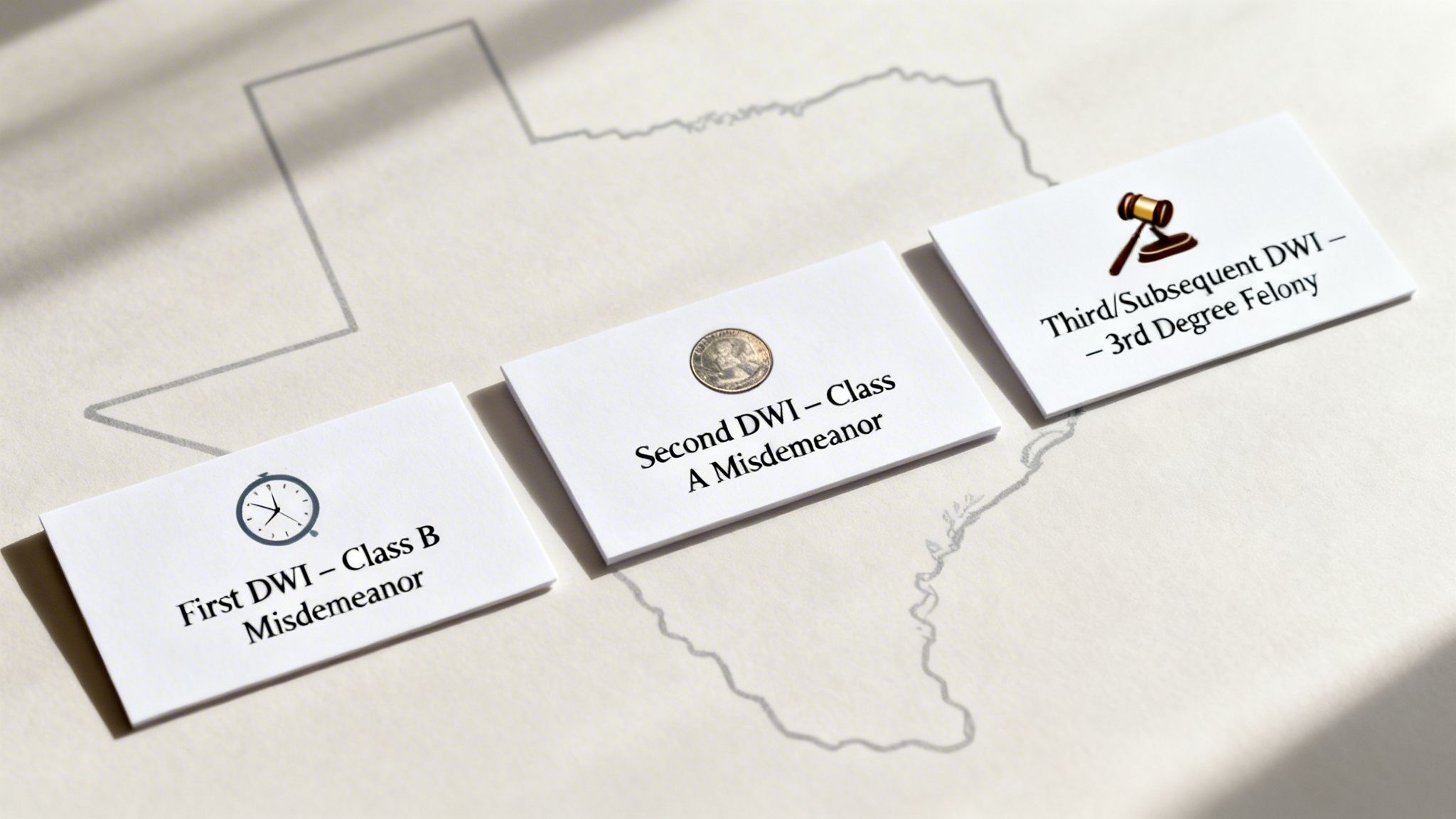
After a DWI arrest, your mind is likely racing with questions about what comes next. Understanding the potential penalties under Texas drinking law isn't about creating fear—it's about preparing you for the fight ahead.
The consequences for a DWI conviction in Texas escalate with each offense. What starts as a misdemeanor can quickly become a life-altering felony. Knowing exactly what’s on the line is the first step in building a powerful defense strategy.
First DWI in Texas
For most people, a first DWI in Texas is a Class B Misdemeanor, assuming no aggravating factors. While it's the lowest-level DWI charge, the penalties are designed to be disruptive and can follow you for years.
A conviction for a first-time DWI can include:
- Jail Time: A minimum of 72 hours in county jail, with a maximum sentence of up to 180 days.
- Fines: A fine of up to $2,000.
- DWI License Suspension: Your driver's license could be suspended for 90 days to one full year.
These are just the court-ordered penalties. You could also face probation, mandatory DWI education classes, and community service. A conviction also creates a permanent criminal record, which can create challenges when you apply for jobs, loans, or housing.
Second DWI Offense
If you are arrested for a second DWI, the stakes get much higher. The charge is elevated to a Class A Misdemeanor, and the penalties increase significantly.
For a second DWI conviction, you could be looking at:
- Jail Time: A sentence ranging from 30 days to one full year.
- Fines: The maximum fine doubles to $4,000.
- DWI License Suspension: A lengthy suspension, from 180 days up to two years.
Beyond these penalties, the court will likely require you to install an ignition interlock device (IID) in your car. This device acts as a personal breathalyzer, requiring a sober breath sample before your car will start.
Third or Subsequent DWI: A Felony Offense
This is where everything changes. A third DWI arrest in Texas is automatically charged as a Third-Degree Felony, regardless of how much time has passed since your previous convictions.
A felony conviction changes your life. It carries the weight of serious prison time, the loss of fundamental civil rights like voting and owning a firearm, and a stigma that can last forever.
The penalties for a third DWI are severe:
- Prison Time: A sentence of 2 to 10 years in a Texas state prison.
- Fines: A fine of up to $10,000.
- DWI License Suspension: A driver's license suspension lasting from 180 days to two years.
Facing a felony charge is a serious turning point. This is when you need an experienced Texas DUI attorney to help you fight DWI Texas charges and protect your future.
Texas DWI Penalties At a Glance
This table summarizes the potential penalties for DWI offenses in Texas, helping you understand the stakes for a first, second, or third offense.
| Offense Level | Jail Time | Maximum Fine | License Suspension |
|---|---|---|---|
| First DWI (Class B Misdemeanor) | 72 hours – 180 days | Up to $2,000 | 90 days – 1 year |
| Second DWI (Class A Misdemeanor) | 30 days – 1 year | Up to $4,000 | 180 days – 2 years |
| Third DWI (Third-Degree Felony) | 2 – 10 years in prison | Up to $10,000 | 180 days – 2 years |
It's also crucial to know that certain circumstances can automatically elevate the charges. For example, if you are arrested for DWI with a child passenger under the age of 15, the offense becomes a State Jail Felony, even if it's your first offense. This carries a penalty of 180 days to two years in a state jail and a fine of up to $10,000.
An arrest is not a conviction, and these penalties are not guaranteed. A strategic defense can challenge the evidence and protect your rights, but you have to act fast.
Navigating the DWI Stop and Protecting Your Rights
The moment you see red and blue lights in your rearview mirror, your heart sinks. The minutes that follow are tense, confusing, and absolutely critical. What you say—and what you don’t say—during a traffic stop can be the difference between driving home and being arrested.
From the second an officer approaches your car, they are building a case against you. They’re observing your every move, listening for slurred words, and looking for any sign of impairment. Every interaction is part of their investigation, and understanding your rights is your first line of defense.
What Are Field Sobriety Tests?
After their initial observations, the officer will likely ask you to step out of your vehicle to perform Standardized Field Sobriety Tests (FSTs). These exercises are designed to test your balance, coordination, and ability to follow instructions.
The three tests approved by the National Highway Traffic Safety Administration (NHTSA) are:
- Horizontal Gaze Nystagmus (HGN): The officer asks you to follow a stimulus (like a pen) with your eyes, looking for involuntary jerking they are trained to believe indicates intoxication.
- Walk-and-Turn: You are instructed to take nine heel-to-toe steps, turn, and take nine steps back. The officer looks for missteps, loss of balance, or starting too soon.
- One-Leg Stand: You are told to stand on one foot, raise the other about six inches, and count aloud for 30 seconds. They watch for swaying, hopping, or putting your foot down.
Remember this: these tests are notoriously subjective. Nerves, a medical condition, poor lighting, or even the shoes you’re wearing can cause a perfectly sober person to "fail."
You have the absolute right to politely refuse to perform Field Sobriety Tests. They are 100% voluntary. An officer cannot force you to take them. Your refusal denies the prosecutor a key piece of subjective evidence.
The Roadside Breath Test Is Also Voluntary
The officer might also ask you to blow into a small, handheld Portable Breath Test (PBT). This device gives a rough estimate of your Blood Alcohol Concentration (BAC).
Like FSTs, providing a roadside breath sample is voluntary. These devices are often poorly calibrated, and their results are generally not admissible as primary evidence in court. Their main purpose is to give the officer probable cause for an arrest. You can—and should—politely decline this test.
Protecting Your Rights During the Stop
Staying calm and strategic during a traffic stop is your best move. Focus on these key rights:
- Provide Your Documents: You are required to provide your driver’s license, proof of insurance, and vehicle registration.
- Stay Silent: You do not have to answer incriminating questions like, "How much have you had to drink?" You can politely state, "Officer, I'm exercising my right to remain silent."
- Do Not Consent to a Search: An officer needs a warrant or probable cause to search your car. If they ask for permission, you can say, "Officer, I do not consent to any searches."
The consequences of a DWI conviction are life-altering, a fact driven home by Texas statistics. In a single recent year, drunk driving led to 987 fatalities on Texas roads, according to DWI statistics in Texas. These numbers show why the state takes these offenses so seriously, but they also represent thousands of cases built on evidence that might not hold up in court. An unlawful stop or a poorly administered test can be the key to getting your case dismissed.
The ALR Hearing: The First Step to Save Your Driver's License
When you're arrested for a DWI, you face two separate legal battles simultaneously. One is the criminal case in court. The other is a swift civil process that targets your driver’s license immediately: the Administrative License Revocation (ALR).
This process is separate from the criminal court and is triggered automatically if you refuse a chemical test or provide a sample over the legal limit. This happens because of Texas’s “implied consent” law, which states that by having a driver's license, you have already agreed to provide a breath or blood sample if lawfully arrested for DWI. But an automatic suspension is not a done deal. You have one chance to stop it, but the clock is ticking.
The Critical 15-Day Deadline
From the date of your arrest, you have just 15 days to request an ALR hearing with the Texas Department of Public Safety (DPS). If you miss this deadline, your license will be automatically suspended on the 40th day after your arrest. There are no extensions.
This is why contacting a DWI lawyer immediately is so important. A skilled attorney can file the hearing request for you, stopping the automatic suspension and preserving your right to drive while your case proceeds.
Why the ALR Hearing Is a Strategic Advantage
The immediate goal of the ALR hearing is to save your license, but it's also a strategic goldmine. This hearing is often the first—and best—chance for your attorney to dismantle the state's case against you.
Think of it as a legal preview. It’s a dry run where your lawyer gets to:
- Subpoena and Cross-Examine the Arresting Officer: We can question the officer under oath about the traffic stop, their observations, and the arrest itself.
- Scrutinize Police Reports: We hunt for inconsistencies, procedural mistakes, or proof that they lacked a valid reason to stop you.
- Challenge the Evidence: We question whether the officer had probable cause for the arrest and expose flaws in how the chemical test was handled.
The testimony we uncover at the ALR hearing can be weaponized in your criminal case. If an officer's story changes later, we can use their sworn ALR testimony to destroy their credibility, which can lead to a reduced charge or even a full dismissal.
The DWI process has a predictable flow, from the traffic stop to the final chemical test. This flowchart breaks down the typical stages of a DWI stop in Texas.
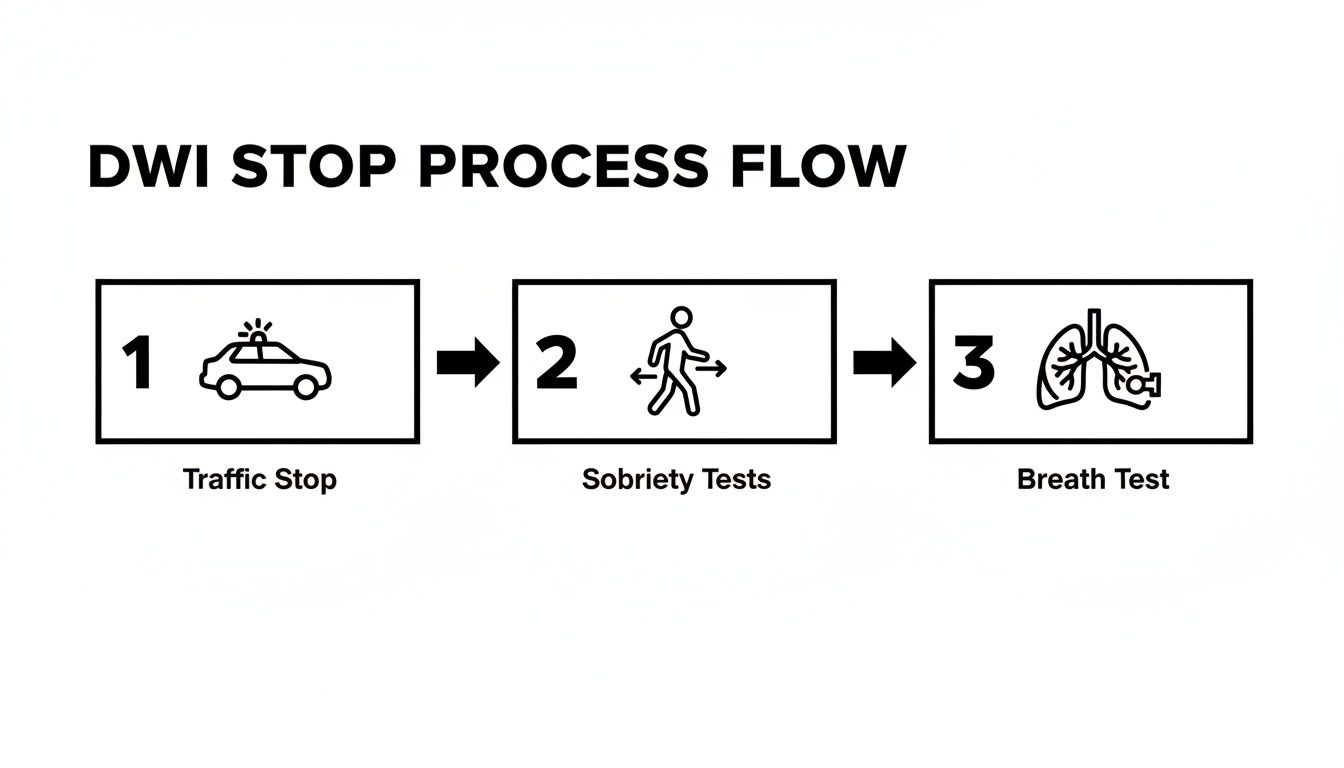
As you can see, there are multiple points where a sharp attorney can attack the state's case—from the legality of the stop to the administration of the tests. Getting through this administrative minefield requires expertise and immediate action. Learn more about fighting a license suspension in our guide on the Texas ALR hearing process. Don't let that 15-day window close.
How a Houston DWI Lawyer Builds Your Defense

A DWI arrest is a disorienting experience, but remember: an arrest is not a conviction. The state must prove every element of its case beyond a reasonable doubt, and a skilled lawyer's job is to make that as difficult as possible. We don’t just react to their evidence; we attack it from day one.
A powerful defense is built piece by piece, starting with a relentless review of every report, video file, and piece of evidence from your arrest. What seems like a minor procedural error can become the foundation of a successful defense. Our mission is to protect your rights, dismantle the evidence, and fight for the best possible outcome.
Challenging the Legality of the Traffic Stop
The entire DWI case hinges on the traffic stop. An officer cannot pull you over on a hunch. They must have reasonable suspicion—a legally recognized belief that you have violated a traffic law or are engaged in criminal activity.
This is often the first weak point in the prosecution's case. We dissect the officer’s reason for the stop by asking critical questions:
- Did you actually commit the traffic violation the officer claims? We analyze dashcam and bodycam footage to see if you really crossed a lane line or failed to signal.
- Was the officer’s stated reason legally valid? Vague justifications like "driving too slowly" often don't hold up in court.
- Are there contradictions between the officer's report and the video evidence?
If we can prove the stop was unlawful, all evidence collected afterward—sobriety tests, breath or blood results, everything—can be thrown out. This is how cases get dismissed.
How to Fight a Breath Test Result
Breath and blood tests are complex scientific procedures prone to human and machine error. A number from a machine is never the final word.
An experienced DWI attorney knows how to challenge chemical test results by investigating the breathalyzer’s maintenance records, the officer’s training credentials, and the chain of custody for blood samples to find flaws that can make the results inadmissible in court.
Even if you refused a test, it’s not an automatic loss. We can still challenge the legality of the stop and whether the officer had probable cause to arrest you in the first place. You can learn more about how we work to protect your driving privileges in our guide to DWI license defense in Texas.
A proactive, detail-oriented defense is your strongest shield against the severe penalties of Texas drinking law. When you fight DWI Texas charges with a strategic legal partner, you give yourself the best possible chance to protect your freedom and your future.
Common Questions About Texas Drinking and Driving Laws
After a DWI arrest, your mind is probably racing with a thousand questions. The legal system can feel overwhelming, but getting straight answers is the first step toward regaining control. This section tackles some of the most common concerns we hear from people facing charges under Texas drinking laws.
Remember, every case is unique, and the best advice will always come from a strategic attorney who can analyze the specifics of your arrest.
Do I have to take a breathalyzer test in Texas?
This question has two parts. The first is the portable, roadside breath test (PBT). You can, and often should, politely refuse this test. These devices are unreliable and are mainly used to establish probable cause for an arrest.
The second part concerns the formal chemical test (breath or blood) at the police station. Under Texas's “implied consent” law, you have already agreed to provide this sample by having a Texas driver's license. If you refuse, you will face an automatic DWI license suspension. However, refusing also denies the prosecution a key piece of scientific evidence. A Houston DWI lawyer can fight that suspension for you at an ALR hearing.
Can I get a DWI removed from my record?
Yes, in certain situations, it is possible to clear a DWI from your record. There are two primary legal tools for this:
- Expunction: This is a "total erase" option. If your case is dismissed or you are found not guilty, you may be eligible to have all records of the arrest completely destroyed. It’s as if it never happened.
- Order of Non-Disclosure: This seals the record from public view. If you successfully complete a special type of probation called deferred adjudication, you may be able to petition the court to seal it. This prevents most private parties, like employers or landlords, from seeing it.
An experienced Texas DWI attorney can evaluate your case to determine if you qualify for an expunction or non-disclosure and guide you through the process.
What is the difference between a DWI and a DUI in Texas?
In Texas, these acronyms refer to different offenses based on the driver's age.
DWI (Driving While Intoxicated) is the charge for an adult 21 or older who operates a vehicle while legally impaired or with a BAC of 0.08% or higher.
DUI (Driving Under the Influence) is the charge for a minor (under 21) who drives with any detectable amount of alcohol in their system. A first-offense DUI is a Class C Misdemeanor, while a first-offense DWI is a more severe Class B Misdemeanor.
An arrest for any of these offenses is a serious matter, but it's one you don't have to face alone. At The Law Office of Bryan Fagan, PLLC, our team is dedicated to defending Texans against DWI charges and protecting their futures. We are here to provide the reassurance and strategic guidance you need. Don't wait to take the next step. Request a free, confidential consultation with our experienced attorneys today by visiting https://texasduilawfirm.com.