
A DWI arrest in Texas can be overwhelming, throwing your world off balance with worries about your job, your license, and your future. But an arrest is not a conviction, and you don’t have to face it alone. For many first-time offenders, a strategic legal option called deferred adjudication offers a path to get the charge dismissed and eventually sealed from public view, protecting your record and your peace of mind.
Your Path Forward After a Texas DWI Arrest
Facing a DWI charge brings a wave of immediate uncertainty. Questions about jail time, steep fines, and the prospect of a permanent criminal record can feel overwhelming. Our role as your Houston DWI lawyer is to replace that confusion with clarity, empowering you to make informed decisions about your defense. The Texas justice system can be complex, but with the right guidance, you can navigate it successfully.

With an experienced Texas DUI attorney on your side, every possible defense avenue will be explored. Deferred adjudication is one of the most powerful tools available, but it's not a given. It's essential to understand what it is, who qualifies, and what it requires of you. This guide will walk you through each step of the process.
Understanding Key DWI Terms
Before diving into deferred adjudication, let's define a few key terms you will encounter. A DWI case involves two separate battles: the criminal court process and an administrative fight over your driver's license.
Key elements include:
- Blood Alcohol Concentration (BAC): This is the measure of alcohol in your system. In Texas, the legal limit for most drivers is 0.08%.
- Field Sobriety Tests: These are the physical and mental exercises an officer may ask you to perform during a traffic stop to assess impairment. Their validity can often be challenged.
- Implied Consent: Texas law states that by driving on public roads, you have implicitly consented to provide a breath or blood sample if lawfully arrested for DWI. Refusing a test carries its own consequences, including license suspension.
- Administrative License Revocation (ALR): This is a civil process, separate from your criminal case, where the Texas Department of Public Safety (DPS) attempts to suspend your license. You have only 15 days from your arrest to request an ALR hearing to fight this suspension.
Deferred adjudication addresses the criminal charge, not the automatic license suspension. To protect your driving privileges, we must take separate, time-sensitive legal action through an ALR hearing.
This distinction is critical. While your attorney works to achieve a favorable outcome like deferred adjudication in criminal court, they must also act quickly to challenge the DWI license suspension. It’s a defense fought on two fronts, and both are essential to protecting your freedom and ability to drive.
What Is Deferred Adjudication in a Texas DWI Case?
While the term “deferred adjudication” might sound complicated, the concept is straightforward—it’s one of the most valuable second chances in the Texas legal system.
Think of it as a conditional agreement with the court. Instead of finding you guilty of DWI, the judge agrees to put that decision on hold, or "defer" it.
This isn’t an instant dismissal. You will be placed on community supervision (a form of probation) for a set period with specific rules to follow. If you successfully complete all the requirements, the court dismisses the DWI charge against you.
The bottom line is simple but powerful: you avoid a final DWI conviction on your permanent criminal record. This outcome can be a game-changer for your future job prospects, housing applications, and professional licenses.
The Conditions of Deferred Adjudication Probation
Deferred adjudication is like a contract. The court upholds its end by not convicting you, and you must uphold yours by meeting all conditions. The specific terms vary by case and county but typically include:
- Regular Reporting: You will check in with a community supervision officer on a set schedule.
- Fines and Court Costs: You must pay all court-mandated fines and administrative fees.
- DWI Education Programs: You are required to complete a state-approved DWI education class.
- Community Service: You will likely be assigned a certain number of community service hours.
- Ignition Interlock Device (IID): It is common for a judge to require an IID on your vehicle. This device prevents your car from starting if it detects alcohol on your breath.
Successfully meeting these conditions is the only way to secure a dismissal. A single misstep can void the agreement, which is why understanding every requirement from day one is so important.
Deferred Adjudication Is Not a Conviction
One of the biggest points of confusion is whether deferred adjudication is the same as being found guilty. The answer is a clear no. A conviction is a final, formal judgment of guilt. With deferred adjudication, that judgment is intentionally withheld.
To receive deferred adjudication, you typically enter a plea of "guilty" or "no contest." However, the judge does not make a finding of guilt based on that plea. This legal distinction keeps the door open for a dismissal after you complete probation, protecting your record from the permanent stain of a DWI conviction.
This is a critical point. While the arrest itself will still appear on a background check initially, the final result is a dismissal, not a conviction. Understanding that deferred adjudication is not a conviction in Texas helps you see its strategic value. The goal is to prevent one mistake from defining your future.
What Happens If You Violate Probation?
While deferred adjudication offers a golden opportunity, it also carries a significant risk. If you fail to meet any of the court's conditions—such as failing a drug test or picking up a new charge—the prosecutor can file a "motion to adjudicate."
This brings you back before the judge. Since you already entered a guilty or no-contest plea, you have waived your right to a trial on the original charge. The judge can find you guilty immediately and proceed to sentencing. The penalties could include jail time, steep fines, and a permanent DWI conviction that can never be sealed.
Are You Eligible for Deferred Adjudication for a DWI in Texas?
For anyone facing a first-time DWI in Texas, deferred adjudication is often the best-case scenario. However, it's not available in every case. Texas law sets clear, non-negotiable eligibility rules.
Just meeting the legal requirements only gets your foot in the door. The final decision rests with the prosecutor and the judge, which is why having a skilled DWI lawyer to negotiate on your behalf is crucial to fight for this outcome.
The State's Strict Eligibility Requirements
Texas law is very specific about who can qualify for deferred adjudication for a DWI. You must meet every single one of these criteria:
- This must be your first DWI. Any previous DWI conviction or deferred adjudication, even from decades ago, will disqualify you.
- Your Blood Alcohol Concentration (BAC) must be below 0.15%. If a breath or blood test showed a BAC of 0.15% or higher, deferred adjudication is legally prohibited.
- The incident did not result in an accident involving another person. This includes a passenger in your own vehicle.
- You do not hold a Commercial Driver's License (CDL). This rule applies even if you were driving a personal vehicle at the time of the arrest.
If you cannot meet all of these criteria, a prosecutor is legally barred from offering deferred adjudication. There is no gray area.
Texas DWI Deferred Adjudication Eligibility Checklist
Use this table to quickly assess if you may meet the baseline criteria for deferred adjudication for a first-time DWI in Texas.
| Eligibility Requirement | Can I Qualify? | Important Notes |
|---|---|---|
| First DWI Offense? | Yes / No | Any prior DWI, even from another state, is a disqualifier. |
| BAC Below 0.15%? | Yes / No | If you refused a test, this doesn't apply, but refusal creates other issues. |
| No Accident with Others? | Yes / No | This includes passengers in your vehicle, not just other drivers. |
| No CDL Held? | Yes / No | This applies whether you were on or off the clock. |
If you answered "Yes" to all these questions, you have cleared the first major hurdle. But the fight to secure the offer is just beginning.
The flowchart below shows how deferred adjudication creates a path to dismissal within the court system.
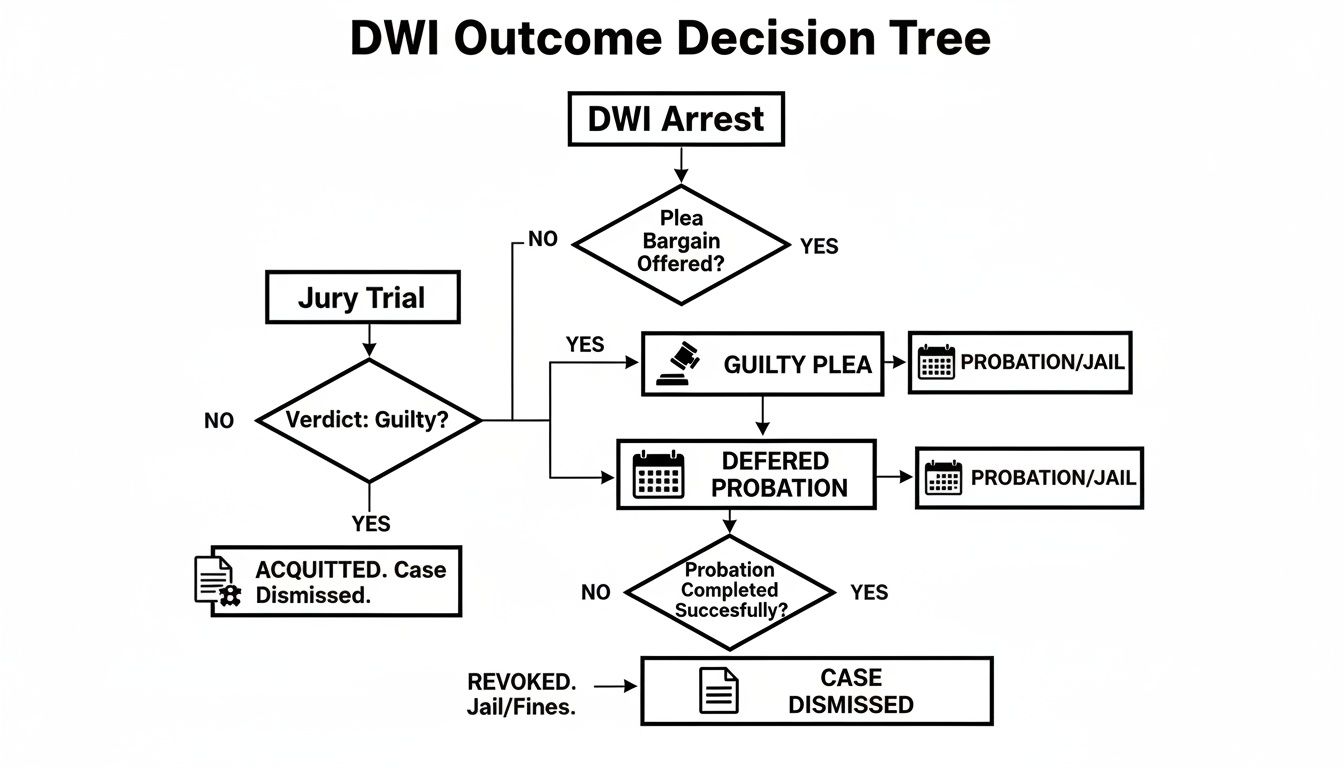
As you can see, it’s a direct route to keeping a conviction off your permanent record.
Why Eligibility Isn't a Guarantee
Even if you check all the boxes, an offer of deferred adjudication is never guaranteed. The prosecutor has complete discretion. They will analyze the specifics of your arrest—your behavior on dashcam footage, your performance on field sobriety tests, and the overall strength of their evidence.
A prosecutor's goal is to secure convictions. If they believe they have a strong case, they have little incentive to offer a deal that ends in a dismissal. This is where a skilled defense attorney can change the dynamic.
An experienced lawyer knows how to identify weaknesses in the state's case. By challenging the legality of the traffic stop, the administration of sobriety tests, or the accuracy of the BAC result, your attorney creates leverage. This pressure is often what convinces a prosecutor to offer deferred adjudication to avoid the risk of losing at trial. Since this option became available for DWIs, it has been a valuable tool for many first-time offenders. You can learn more about how this works by exploring the full research on Texas probation.
Weighing the Pros and Cons of Deferred Adjudication
If you are offered deferred adjudication for a Texas DWI, you are at a critical crossroads. This offer provides a clear path to avoiding a conviction, but it’s a decision that requires careful consideration.
Accepting it means you fully understand what you stand to gain and what you're putting on the line. It's a strategic choice where you must weigh the demands of probation against the long-term benefit of a clean record.
The Powerful Advantages of Deferred Adjudication
The most compelling reason to accept deferred adjudication is what happens upon successful completion: the DWI charge is dismissed. This outcome creates positive ripples throughout your life.
Here are the main benefits:
- You Avoid a Permanent DWI Conviction: This is the most significant advantage. A conviction can create barriers to jobs, professional licenses, and even housing. A dismissal means you can honestly state that you were not convicted of DWI.
- You Keep Your Record Cleaner: While the arrest record remains temporarily, the case resolution is a dismissal, which is far better than a permanent mark of guilt.
- It Opens the Door to Sealing Your Record: After successfully completing probation and a mandatory waiting period, you can petition for an Order of Non-Disclosure. This order seals the record from public view, meaning most private employers conducting a background check will never see it.
For many, these benefits are life-changing, allowing them to move forward without one mistake defining their future.
Understanding the Serious Drawbacks and Risks
While the benefits are significant, the downsides of deferred adjudication are equally serious. When you accept this offer, you agree to a period of intense supervision where any mistake can have severe consequences.
The major disadvantages include:
- Strict and Costly Probation Terms: Community supervision is demanding. You will likely have to install an Ignition Interlock Device (IID), report to a probation officer, submit to random drug and alcohol tests, and complete DWI classes. The costs for the IID, court fees, and classes can add up quickly.
- You Give Up Your Right to a Trial: To accept deferred adjudication, you must enter a plea of "guilty" or "no contest." This means you waive your right to fight the charges in court, challenge the evidence, and have a jury decide your case.
- Failure Leads to Automatic Conviction: This is the biggest risk. If you violate any term of your probation, the prosecutor can file a motion to have your guilt adjudicated. Because you’ve already entered a plea, the judge can find you guilty on the spot and proceed to sentencing, which could include jail time and maximum fines.
Accepting deferred adjudication is a calculated risk. You trade the uncertainty of a trial for the certainty of a dismissal—but only if you can follow every rule the court sets, without fail.
The decision comes down to a strategic conversation with your lawyer. If the evidence against you is strong, the guaranteed dismissal from deferred adjudication might be the smartest move. But if there are weaknesses in the prosecutor’s case, fighting for a complete dismissal or a "not guilty" verdict at trial could be the better path.
How to Seal Your Record After Deferred Adjudication
Successfully completing deferred adjudication probation is a major accomplishment, but it’s not the final step. The DWI arrest and court case still exist on your criminal record. To achieve a truly clean slate, you must take action to seal the record from public view.

This next step involves petitioning the court for an Order of Non-Disclosure. Securing this order is key to protecting your future career, housing, and educational opportunities from the shadow of a DWI charge.
Understanding an Order of Non-Disclosure
An Order of Non-Disclosure is a court order that prohibits government agencies from releasing your criminal history information to the general public. In simple terms, it seals your record. Once a judge signs the order, private entities like employers, landlords, and banks will not see the DWI arrest when they run a background check.
However, this is not the same as having your record destroyed. Law enforcement and certain state licensing agencies can still access the sealed information if they have a specific, legal reason to do so.
Think of a non-disclosure order as putting your records in a locked filing cabinet. The general public cannot access it, but certain government officials have a key for legally authorized purposes. This provides powerful privacy protection for everyday life.
This is different from an expunction, which completely destroys the record as if the arrest never happened. To learn more, review our guide on expunging a DWI in Texas. Expunction is typically only available for cases that were dismissed outright or ended in a "not guilty" verdict. For deferred adjudication, a non-disclosure is the best path forward.
The Mandatory Waiting Period
You cannot file a petition for non-disclosure immediately after your probation ends. Texas law requires a mandatory waiting period. The length of this period depends on whether an ignition interlock device (IID) was a condition of your probation.
- If an IID was required: You must wait two years from the date your deferred adjudication is successfully discharged and the case is dismissed.
- If no IID was required: You may be eligible to file immediately upon dismissal.
This waiting period is non-negotiable. Filing before the required time has passed will result in an automatic denial.
The Step-by-Step Process for Filing the Petition
Getting your record sealed is a formal legal process that requires precision. Any errors can delay or jeopardize your chances. This is why having an experienced Houston DWI lawyer handle the filing is so important.
The process generally includes:
- Drafting the Petition: Your attorney prepares a formal "Petition for Order of Non-Disclosure," detailing your case, confirming your eligibility, and arguing why granting the order is in the interest of justice.
- Filing with the Court: The petition is filed with the clerk of the same court that handled your original DWI case.
- Notifying the State: The prosecutor's office must be formally notified, giving them an opportunity to object.
- The Hearing: A judge will schedule a hearing to consider your request. Your attorney will present your case and argue for the order.
- The Judge's Order: If the judge agrees, they will sign the Order of Non-Disclosure. This official document is then sent to relevant state agencies with instructions to seal your records from public view.
Could Fighting for a Full Dismissal Be a Better Option?
An offer of deferred adjudication is a good outcome that keeps a DWI conviction off your public record. However, it still involves a long and demanding probation period. For some, the better strategy is to fight the charge head-on and aim for a complete dismissal or a "not guilty" verdict at trial.
An arrest is only an accusation. The state’s evidence is often weaker than it first appears. A skilled DWI defense attorney knows exactly where to find the weaknesses in the prosecution's case. Every detail, from the reason for the traffic stop to the chemical test results, can be challenged. When you accept a plea deal, you waive your right to fight. The alternative is to put the pressure on the state to prove its case beyond a reasonable doubt.
Common DWI Defense Strategies
A strong defense involves a thorough examination of all evidence. Successfully challenging even one part of the state's case can lead to its collapse. An experienced Houston DWI lawyer will investigate several key areas to fight DWI Texas charges.
Effective defense strategies include:
- Challenging the Traffic Stop: Did the officer have a legal reason—known as reasonable suspicion—to pull you over? If the stop was unlawful, any evidence gathered from it could be suppressed.
- Questioning Field Sobriety Test Administration: These tests follow strict, standardized procedures. If the officer failed to administer them correctly, the results are unreliable and can be attacked in court.
- Attacking Breath or Blood Test Results: Breathalyzer machines can malfunction or be improperly calibrated. Blood samples can be contaminated or mishandled. Exposing these errors can undermine the state's strongest evidence.
The goal is to create leverage. By demonstrating flaws in the prosecutor's case, your attorney can push for a complete dismissal—an outcome that is superior to any plea agreement.
The Statistical Reality of Fighting a DWI
Challenging a DWI charge is far from a long shot. Statistics from Texas show that a strong defense often leads to positive outcomes for a first DWI in Texas.
In fact, a significant percentage of first-time DWI cases are either dismissed or result in convictions for lesser charges. These numbers prove that many DWI cases are winnable with the right legal strategy.
An experienced DWI attorney doesn’t just accept the police report at face value. We dig into the details, question the procedures, and challenge the evidence to build a powerful defense designed to secure the best possible result for you—whether that’s deferred adjudication or a complete dismissal.
Ultimately, the decision to accept a plea or fight your charge depends on the specific facts of your case. A detailed evaluation is the only way to determine which path offers you the best chance of success. To learn more, you might be interested in our guide on the chances of dismissal for a DWI in Texas.
Your Questions About DWI Deferred Adjudication Answered
When you're facing a complex issue like deferred adjudication, questions are natural. Here are clear, straightforward answers to the most common questions we hear from clients dealing with a first-time DWI in Texas.
Will Deferred Adjudication Show Up on a Background Check?
Yes, initially. While you are on probation, both the arrest and the deferred adjudication status will likely appear on a background check. However, this is temporary.
Once you successfully complete your probation and the case is dismissed, you can petition the court for an Order of Non-Disclosure. This powerful legal tool seals the record from the public, meaning most private employers, landlords, and other entities will not see it.
Can I Get Off DWI Probation Early?
It’s possible, but not guaranteed. If you were granted deferred adjudication, Texas law allows a judge to grant an early release from probation. This is entirely discretionary and depends on whether the judge believes it is in your best interest and the interest of society.
However, if you received straight probation after a conviction, the answer is no. Texas law prohibits early termination of probation for any offense involving intoxication.
How Is Deferred Adjudication Different from Pretrial Diversion?
The main differences are the timing and the ultimate outcome for your record.
-
Pretrial Diversion is an agreement made with the prosecutor before you enter a plea in court. Upon completion, the charge is dismissed, and you can typically get the entire record expunged—meaning it is completely destroyed.
-
Deferred Adjudication occurs after you plead guilty or "no contest." While it also ends in a dismissal, the record cannot be expunged. Your only option is to have it sealed from public view with an Order of Non-Disclosure.
What Happens If I Violate My Deferred Adjudication?
Violating any condition of your probation is a serious matter. If this happens, the prosecutor can file a "motion to adjudicate."
Because you already entered a guilty plea, you have waived most of your rights to fight the original charge. The judge can find you guilty and impose a sentence, which could include the maximum penalties for a DWI, including jail time and a permanent conviction.
A DWI arrest can be overwhelming, but you don’t have to face it alone. Understanding your rights and legal options is the first step toward building a strong defense that protects your future. At The Law Office of Bryan Fagan, PLLC, our experienced Houston DWI lawyers are here to provide the clear answers and strategic guidance you need. We are committed to defending Texans against DWI/DUI charges and minimizing the consequences.