 Skip to content
A DWI arrest can be overwhelming — but you don’t have to face it alone. The clock starts ticking the moment you’re arrested, and the consequences can feel fast and overwhelming, often leading to an automatic driver's license suspension and the start of a criminal case.
It’s a stressful situation, but the most important thing to remember is that an arrest is not a conviction. This is the beginning of a legal process, and with a strategic defense, you can fight to protect your rights and your future.
Your Guide to Navigating a Texas DWI Charge
Right now, you’re fighting on two separate fronts. One is the criminal case, where the state must prove you were intoxicated behind the wheel. But there’s another, equally urgent battle: an administrative process that puts your driver's license on the line immediately.
Understanding how to handle both is the key to achieving the best possible outcome in your case.
Understanding the Two Legal Battles
Imagine being pulled into two different legal proceedings at once. Each has its own rules and its own potential outcome.
-
The Criminal Case: This is the fight against the State of Texas. You'll appear before a judge and face a prosecutor. A conviction here can lead to penalties like steep fines, probation, and jail time. The prosecutor has the heavy burden of proving your guilt "beyond a reasonable doubt."
-
The Administrative License Revocation (ALR) Hearing: This is a separate, civil process with the Texas Department of Public Safety (DPS) focused entirely on your driver's license. What happens in your criminal case doesn't automatically decide the outcome here, and vice versa. They are completely independent.
The most critical deadline you face is for the ALR hearing. You have only 15 days from the date of your arrest to request this hearing to challenge the automatic suspension of your driver’s license. If you miss this window, you lose your right to fight, and your license will be suspended.
Key Terms You Need to Know
When you're dealing with a DWI, you'll hear a lot of legal jargon. Understanding these terms will empower you to take an active role in your own defense.
Blood Alcohol Concentration (BAC) is the percentage of alcohol in your bloodstream. In Texas, the legal limit for most drivers is 0.08%. For commercial drivers, it's a much stricter 0.04%, and for anyone under 21, any detectable amount of alcohol is illegal.
Another crucial term is Implied Consent. Under Texas law, by driving on a public road, you have automatically agreed to provide a breath or blood sample if you're lawfully arrested for a DWI. You can still refuse the test, but this refusal triggers its own penalty: an automatic license suspension that's often longer than the one for failing the test.
Here’s a clear breakdown of the two processes that start the moment you're arrested.
Immediate DWI Consequences in Texas at a Glance
| Legal Process | What Is at Stake? | Critical Deadline | How a Lawyer Helps |
|---|---|---|---|
| Criminal Case | Your freedom, finances, and criminal record (fines, jail, probation) | Varies (arraignment, hearings, trial) | Challenges evidence, negotiates with prosecutors, and defends you in court. |
| ALR Hearing | Your ability to drive | 15 days from arrest to request a hearing | Files the hearing request on time, represents you before the judge, and fights to save your license. |
Facing these two battles alone is a significant risk. A skilled Houston DWI lawyer can dissect every detail of your case—from the traffic stop to the chemical test results—to build a powerful defense designed to protect your rights.
Whether it’s challenging the shaky results of a field sobriety test or fighting to keep you on the road at an ALR hearing, a proactive strategy makes all the difference.
Penalties for a First DWI Offense in Texas
If you’re facing your first DWI charge, it’s easy to feel like the future is uncertain. An arrest is overwhelming, but understanding the specific penalties you might face helps cut through the confusion and puts you in a better position to build a strong defense. You are not alone in this, and the right legal strategy can make a huge difference in the outcome of your case.
For a first-time offense with no aggravating factors, a DWI is typically charged as a Class B Misdemeanor in Texas. The state outlines a clear range of penalties for this charge, which serves as the starting point for prosecutors in court.
Standard Criminal Penalties
The official penalties for a Class B Misdemeanor DWI are serious. These are the consequences a judge can impose if you are convicted.
- Jail Time: A conviction comes with a mandatory minimum of 72 hours in jail, but the sentence could extend up to 180 days.
- Fines: You could face a fine of up to $2,000, not including court costs and other administrative fees that can add hundreds more.
- Driver's License Suspension: Your license can be suspended for anywhere from 90 days to one full year. This is a court-ordered suspension, separate from any administrative action.
- Community Service: A judge can also order you to complete between 24 and 100 hours of community service.
These are the direct consequences of a conviction. For a first offense, however, an experienced DWI lawyer can often negotiate for better outcomes, such as probation instead of a lengthy jail sentence.
When a First DWI Gets More Serious
Certain factors can instantly upgrade a first-time DWI from a Class B to a Class A Misdemeanor, which carries much tougher penalties. The most common reason for this is a high Blood Alcohol Concentration (BAC).
If your BAC is 0.15 or higher, the charge is automatically enhanced. For a Class A Misdemeanor, the potential fine doubles to $4,000, and the maximum jail time increases to one year.
Having an open container of alcohol in your vehicle at the time of your arrest is another serious factor. This alone increases the mandatory minimum jail sentence to six days. Understanding these distinctions is crucial because they change the legal strategy required to defend your case effectively. For a closer look at how these factors can shape an outcome, you can learn more about the full range of DWI penalties in Texas and how to fight them.
The Hidden Financial Consequences
The impact of a first DWI doesn’t stop at the courthouse. The financial fallout often extends far beyond the initial fines, and these "hidden" costs are what can affect people the most in the long run.
While the court-ordered fine might be up to $4,000, that’s just the tip of the iceberg. When you add up the costs for legal representation, court fees, mandatory alcohol education classes, and a staggering hike in your car insurance premiums, the total financial impact can easily exceed $17,000.
This figure doesn’t even account for potential lost income if your job is at risk or if a professional license is threatened. These collateral consequences are precisely why it's so important to fight the charge from the very beginning. A skilled defense attorney isn't just working to minimize official penalties; they're fighting to protect you from these devastating long-term financial burdens.
Escalating Consequences of Repeat and Felony DWI Charges
If you’re facing a second, third, or subsequent DWI charge in Texas, the rules have changed. The legal system treats repeat offenses with much greater severity, and what was once a misdemeanor can quickly become a life-altering felony. Understanding these escalating consequences is the first and most critical step in building a defense to protect your freedom.
While a first offense is serious, the state dramatically raises the stakes for any subsequent arrest. At this point, the goal of the justice system becomes more punitive than corrective.
The flowchart below breaks down the two main types of DWI penalties in Texas: the official consequences handed down by a judge and the often-overlooked hidden costs that can impact you long after the case is closed.
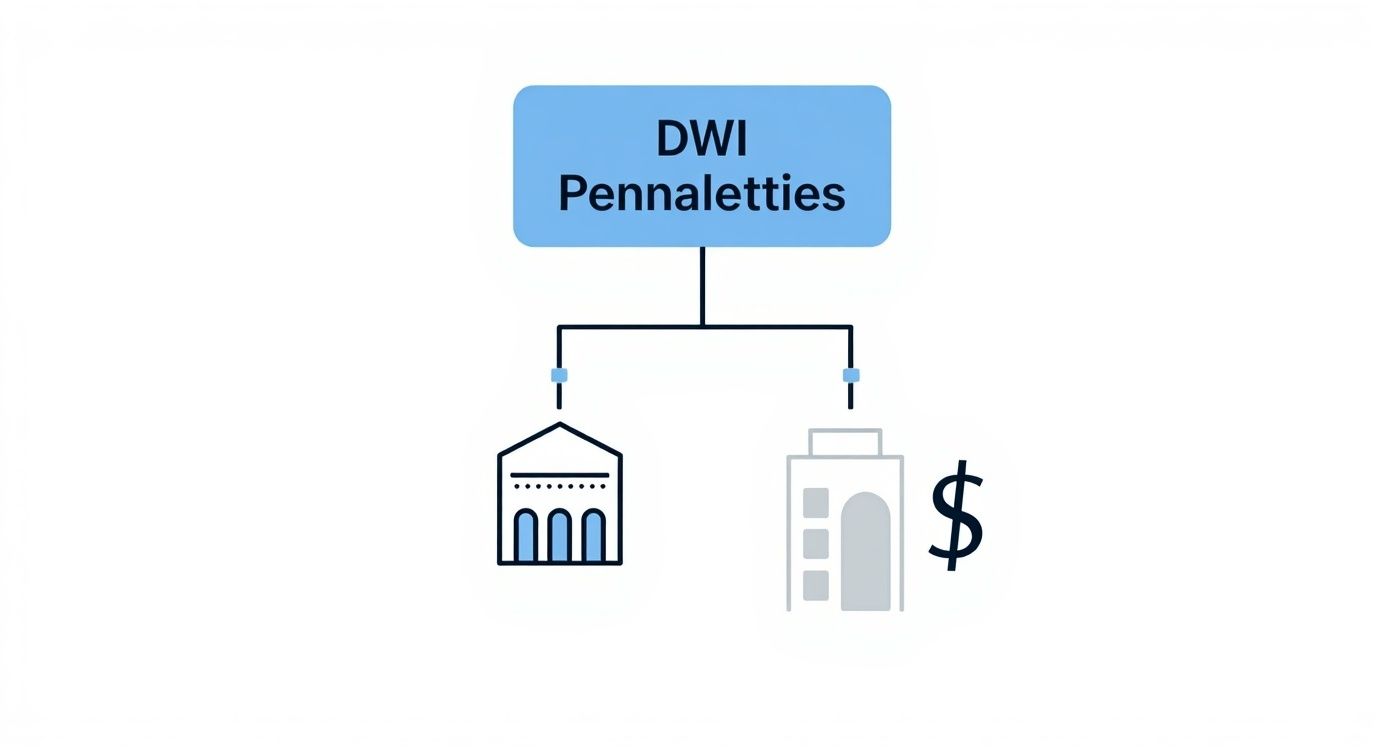
As you can see, the fallout from a DWI conviction stretches far beyond the courtroom, putting a serious strain on your finances for years to come.
Penalties for a Second DWI
An arrest for a second DWI elevates the charge to a Class A Misdemeanor. This isn't just a minor change—it brings a significant increase in potential penalties and a more aggressive stance from prosecutors.
The consequences for a second DWI conviction in Texas can include:
- Fines: The maximum fine doubles from a first offense, increasing to $4,000.
- Jail Time: You could be sentenced to anywhere from 30 days to one full year in county jail. Probation may be an option, but it often includes a mandatory minimum jail sentence as a condition.
- License Suspension: Your driver’s license can be suspended for a period ranging from 180 days to two years.
In addition, a judge will almost certainly order the installation of an Ignition Interlock Device (IID) on any vehicle you operate. This device requires a clean breath sample before the car will start, and you are responsible for all installation and monthly monitoring fees.
The Leap to a Felony DWI
A third DWI charge marks a critical turning point. In Texas, a third offense is automatically charged as a Third-Degree Felony. A felony conviction carries consequences that will follow you for the rest of your life, making a strategic legal defense more essential than ever.
A Third-Degree Felony DWI conviction can result in 2 to 10 years in a state prison—not county jail—and a fine of up to $10,000. These are not worst-case scenarios; they are the harsh realities that prosecutors will aggressively pursue.
Beyond a third offense, some situations can result in a felony DWI charge from the start, even on a first arrest. The state considers these circumstances especially dangerous, and they are prosecuted accordingly.
Other Felony DWI Scenarios
Certain aggravating factors can elevate any DWI charge to a felony, regardless of your prior record. These charges are reserved for situations where other people were put in immediate, severe danger.
- DWI with a Child Passenger: If you are arrested for DWI with a child under the age of 15 in the vehicle, it is a State Jail Felony. This carries a penalty of 180 days to two years in a state jail and a fine up to $10,000.
- Intoxication Assault: If a DWI-related accident causes serious bodily injury to someone else, you will be charged with Intoxication Assault, a Third-Degree Felony.
- Intoxication Manslaughter: If a DWI-related crash results in the death of another person, the charge becomes Intoxication Manslaughter. This is a Second-Degree Felony, punishable by 2 to 20 years in prison.
A felony conviction means losing fundamental rights, like the right to vote or own a firearm. It creates a permanent barrier to many professional careers, housing opportunities, and educational goals. The consequences are incredibly severe, but remember: an arrest is not a conviction. A skilled Houston DWI lawyer can challenge the evidence, fight procedural errors, and work to protect you from these devastating outcomes.
The Hidden Consequences Beyond Fines and Jail Time
When you’re facing a DWI in Texas, it’s easy to focus on the most obvious penalties: fines, community service, and potential jail time. But the truth is, those court-ordered punishments are just the beginning.
A DWI conviction leaves a mark that goes far deeper, creating a ripple effect that can touch almost every corner of your personal and professional life. These are the "collateral consequences"—the hidden costs that aren't handed down by a judge but can impact you for years. Understanding what's truly at stake is the first step toward realizing why a strong defense is so critical from day one.
Your Career and Professional Life at Risk
One of the most immediate and significant impacts of a DWI conviction is often on your career. In today's job market, background checks are standard practice. A DWI on your record can be a major red flag, potentially costing you a job offer or even leading to termination from your current position.
For anyone who drives for a living or holds a state-issued professional license, the damage can be catastrophic.
- Commercial Drivers: If you hold a Commercial Driver's License (CDL), a DWI conviction will trigger a lengthy, mandatory disqualification, making it impossible for you to work.
- Licensed Professionals: Are you a nurse, pilot, real estate agent, or another licensed professional? A DWI can trigger a review by your licensing board, which could lead to suspension or even revocation of the license you worked so hard to earn.
- Military Personnel: For service members, a DWI can result in non-judicial punishment, administrative separation, or a court-martial, potentially ending a military career.
Even if your job doesn't involve driving, many companies view a DWI as a sign of poor judgment, making it more difficult to get hired or promoted.
The Personal and Financial Toll
Beyond your career, the personal and financial fallout from a DWI conviction can be staggering. The financial strain extends far beyond the initial court fine, creating a long-term drain on your finances that you might not see coming.
One of the biggest financial hits is to your auto insurance. Insurers view anyone with a DWI conviction as a high-risk driver, and your premiums will skyrocket. You'll likely be required to file an SR-22 certificate, which is a special form proving you carry high-risk insurance. It's expensive and non-negotiable. To get a clearer picture of this, you can learn more about the specific Texas DUI insurance requirements and how they can impact your budget.
The social stigma is another heavy burden. A criminal record can strain relationships with friends and family and may make finding housing more difficult, as many landlords run background checks on prospective tenants.
Navigating Travel and Immigration Hurdles
The consequences of a DWI don't stop at the Texas border. A conviction can follow you across the country and around the world, creating serious problems for travel and immigration.
For non-U.S. citizens, a DWI can be devastating. While a single misdemeanor DWI might not automatically lead to deportation, it can be classified as a "crime of moral turpitude" under certain circumstances. This can make it incredibly difficult to renew a visa, apply for a green card, or become a naturalized citizen.
Even simple travel can become complicated. Some countries, most notably Canada, view a DWI as a serious criminal offense and may deny you entry, which can derail work trips and family vacations. These hidden consequences are exactly why it is so important to fight the charge. A skilled Texas DUI attorney doesn't just represent you in court; they fight to protect your entire future.
How a Strategic Defense Can Mitigate DWI Consequences
Getting arrested for DWI can feel like the walls are closing in. You might think the outcome is already decided, but that couldn't be further from the truth. The moments after an arrest aren’t the end of your story; they are the beginning of your defense. A smart legal strategy is about challenging the state's case at every turn, protecting your rights, and working to minimize—or even eliminate—the harsh consequences of a DWI in Texas.

Remember, the state carries the heavy burden of proving its case "beyond a reasonable doubt." A thorough defense attorney knows how to identify weaknesses in that case by examining every piece of evidence. An experienced Texas DWI lawyer knows exactly where to look first.
Challenging the Evidence Against You
From the moment an officer turns on their lights, every action they take must follow strict legal procedures. If they deviate from these rules, it can become a powerful tool for your defense. A strong legal strategy starts with a meticulous review of the entire process, from the stop to the arrest.
Here are some of the most common weak points we look for in a DWI case:
- The Initial Traffic Stop: Did the officer have a legitimate reason—what the law calls reasonable suspicion—to pull you over? An illegal stop can get all the evidence collected afterward thrown out of court.
- Field Sobriety Tests (FSTs): These tests are notoriously subjective. A skilled attorney can challenge whether the tests were administered correctly or if other factors—like medical conditions, fatigue, or poor road conditions—impacted your performance.
- Breath and Blood Test Results: Chemical tests may seem like concrete proof, but they are often flawed. We investigate the details: Was the breathalyzer properly calibrated? Was the blood sample handled correctly to prevent contamination?
A DWI charge is not a conviction. The prosecution's case is often built on procedures and technology that can be questioned. A single procedural error or a piece of faulty equipment can be the key to getting charges reduced or dismissed.
Turning Weaknesses into Winning Strategies
Every DWI case is unique. A one-size-fits-all defense won’t work. A dedicated Houston DWI lawyer will build a defense tailored to the specific facts of your situation. For example, if the officer failed to read your Miranda rights correctly, any statements you made could be ruled inadmissible in court.
Or perhaps there was a significant delay between your arrest and when your blood was drawn. In that scenario, we can argue that the BAC result isn't an accurate reflection of your intoxication level at the time you were driving. These details matter. The state's case is often not as solid as it first appears, and our job is to find and exploit those cracks.
The reality is that impaired driving has tragic outcomes. The Texas Impaired Driving Task Force reported 1,699 alcohol-impaired driving fatalities in Texas in 2023, a stark reminder of why these laws are enforced so aggressively. You can discover more insights in the full state report on impaired driving. This is why prosecutors fight hard—and why you need an equally determined legal team on your side.
Facing the consequences of a DWI in Texas is daunting, but you have the power to fight back. By proactively challenging the evidence and building a strategic defense, you can dramatically improve the outcome of your case.
Protecting Your Driving Privileges from Suspension
After a DWI arrest, the threat to your driver's license is immediate. Many people mistakenly believe their license is safe until they are convicted in criminal court, but that's a dangerous misunderstanding. The moment you are arrested, a separate civil process called the Administrative License Revocation (ALR) begins, and the clock starts ticking.

The ALR process runs on a completely different track from your criminal DWI case. This means you could win your criminal trial and still have your license suspended, or vice versa. It all comes down to a swift and strategic response on this separate front.
You have only 15 days from the date of your arrest to request an ALR hearing. Missing this deadline results in an automatic license suspension. Acting fast is the single most important thing you can do to protect your driving privileges.
Understanding Implied Consent and the ALR Hearing
The entire ALR system is based on a legal principle called "implied consent." In Texas, the simple act of driving on a public road means you have legally agreed to provide a breath or blood sample if you are lawfully arrested for a DWI.
While you have the right to refuse a chemical test, that refusal triggers the automatic license suspension. The ALR hearing is your one and only chance to fight back against that suspension. You can get a much deeper look into how this works by reading our guide on the Administrative License Revocation process in Texas.
At this hearing, the Texas Department of Public Safety (DPS) must prove the officer had a valid reason to stop you and probable cause to believe you were intoxicated. As your attorney, our job is to challenge their evidence and show why your license should not be taken away.
What the State Must Prove to Suspend Your License
To win the ALR hearing and suspend your license, the State's lawyer must prove several key points. An experienced defense attorney knows exactly where to apply pressure and challenge their case.
The State must show that:
- Reasonable Suspicion Existed: The officer had a legitimate, lawful reason to pull you over.
- Probable Cause Was Established: The officer had enough evidence to form a reasonable belief that you were intoxicated and to make an arrest.
- You Were Properly Notified: You were either asked to provide a chemical sample and refused, or you gave a sample that showed a BAC of 0.08% or higher.
We examine every report and piece of evidence—from the officer's initial observations to the arrest procedures—to find weaknesses. A single procedural mistake or lack of solid proof can be enough for us to win the hearing and stop the suspension.
Even if the suspension is upheld, all is not lost. We can help you apply for an occupational driver's license (ODL), which allows you to drive to essential locations like work, school, and medical appointments. Protecting your ability to drive is one of our top priorities, and navigating the ALR process is the first, most critical battle in fighting the consequences of a DWI in Texas.
Common Questions After a Texas DWI Arrest
When you're facing a DWI charge, your mind is likely filled with urgent questions. Getting clear, straightforward answers is the first step toward regaining control and figuring out what to do next. Here, we address some of the most common concerns people have after being arrested for DWI in Texas.
Will I Definitely Go to Jail for a First DWI in Texas?
Not necessarily. While jail time is a possible penalty for a first DWI in Texas, it is not guaranteed. For first-time offenders with no aggravating factors, an experienced Houston DWI lawyer can often negotiate for alternatives to jail.
These alternatives might include probation, community service, or mandatory DWI education classes. The key is to build a strong defense from day one to work toward the best possible outcome—which, in many cases, means avoiding jail time altogether.
How Long Does a DWI Stay on Your Record in Texas?
A DWI conviction stays on your criminal record permanently in Texas. The only way to remove it is to have it sealed through an order of nondisclosure, but eligibility for this is very strict. Expunction, which is the complete destruction of arrest and case records, is even rarer and generally only an option if your case is dismissed or you are found not guilty at trial.
For some first-time offenders, sealing the record might be possible after a waiting period, but it's not a guarantee. The only way to know for sure if you have a path to sealing your record is to discuss the specific details of your case with an attorney.
The permanence of a DWI conviction is one of its most punishing consequences. It can create long-term hurdles for employment, housing, and professional licenses, which is why fighting the charge from the beginning is so critical.
Can I Refuse a Breathalyzer Test in Texas?
Yes, you have the right to refuse a breath or blood test. However, this decision has an immediate consequence. Under Texas's implied consent law, refusing the test triggers an automatic administrative penalty—the Texas Department of Public Safety (DPS) will immediately begin the process to suspend your driver's license.
So, while refusing the test prevents the state from getting a key piece of evidence (your BAC), it creates a new, urgent problem. You must act fast to challenge the DWI license suspension. You only have 15 days from the date of your arrest to request an Administrative License Revocation (ALR) hearing to fight to keep your driving privileges.
At The Law Office of Bryan Fagan, PLLC, we understand how stressful and confusing a DWI arrest can be. We are here to provide the strategic, professional defense you need to protect your rights, your license, and your future. For a free, confidential case evaluation to discuss the consequences of a DWI in Texas and how to fight your charges, contact us today. Visit our website at https://texasduilawfirm.com to learn how we can help you.

